As a brief summary: the majority of the people in Venezuela do not trust the electoral system, even large chunks of the chavista side who are aware of the problem but shrug a shoulder as they benefit form it. But there is more to it than the legal aspect of how to run elections: there are also not so easily measurable aspects that aggravate the general situation. Resuming all would be too long, and for that, in particular the legal stuff, the reader can be referred to the pages of SUMATE. Here, I just intend to highlight which are the main problems in my humble opinion.
The Real Problems
There are two real problems in Venezuela that make it almost impossible to run a decent political campaign where the country can be offered real choices. The first one is the governmental abuse of the state resources and the second one is the Maisanta list that makes it very difficult to counter the Chavez campaign.
The governmental advantage
It resides in two very simple things: the use and abuse of state resources, and the control of the media. I could of course start decrying all sorts of political and populist measures that office holders are tempted to execute to garner the support of the people, but that is par for the course even though Chavez greatly exaggerates. Thus belittling all the populist and vote buying measures that chavismo is taking would be vulgar and even sound outlandish, even if indeed Chavez activities on this respect overcome any of those seen in the past. Until close to election day we can expect all sorts of new social programs (Misiones), all sorts of long delayed infrastructure construction started years ago, as far as Caldera last term, that surprisingly come to completion in the few weeks before the election. Some of what Chavez was supposed to do during his 8 years in office will come to a close in a span of barely more than a quarter. None of them by the way initiated by himself, all a follow up as creativity in building is not a hallmark of the Bolivarian Revolution. But here I am more interested in the insidious ways in which the state participates directly to sustain the Chavez electoral campaigns, the things that are not as obvious for the foreign observer, things that are not legal, or barely legal but always crassly unethical.
The state as the financier of the Chavez campaign
This is very easy to understand. When, say, a president of the US does make an electoral trip for his reelection, he is obliged to foot the bill for Air Force 1. That is, even though probably all the expenses of that trip are not covered by the Political Friends and Action Committees, at least the gas bill for the flight is paid back. After all there is a national security concern for the guy that is occupying the White House that must be paid by the state, but at least there is an effort to cover as much as possible the costs related to campaign issues.
This does not happen in Venezuela. Chavez flies right and left and the state picks all the tabs. As it also picks all the tabs in political rallies where dozens to hundred of buses are rented by state agencies to ferry the pro Chavez “crowds”, now professional, to the different rally stages. And let’s not speak of all the party goodies (cash, red shirts, food, booze, fireworks, etc…) which are distributed at these meetings and whose tab payment the Venezuelan electoral board, CNE, has consistently failed to investigate properly.
Never in the history of Venezuela has the state been paying so much to promote the figure of the president. Never have so many public buildings harbored so many pro government slogans. Never have the ministries hallways been plastered with so much office holder propaganda. Never has public transport ferried so many administration supporters where needed. Never.
The control of the media
There was a time where a case could be made that the Venezuelan media held an unfair advantage against Chavez. This did not stop him from getting all what he wanted, but it sure made a good story for the pages of sycophantic rags such as Le Monde Diplomatique. This situation has not only totally changed but it has reverted into an advantage for Chavez that the private media never held, even in 1999-2000, the highlight of the confrontation.
Today the balance sheet is as follows:
TV. Only RCTV and Globovision present opinion shows that criticize strongly the government. Venevision and Televen have been neutralized and have no opinion program worth mentioning. Meanwhile the government who originally held only VTV has now added to it, even through cable all across the land, ViveTV, ANTV, and Telesur. The first three are nothing more than a semi permanent talk show supporting Chavez and trashing the opposition in a way that this one cannot do on Globovision and RCTV. ViveTV is leavened with some “documentaries” which are meant to reflect the joy of the people now liberated from the shackles of neo liberalism and the empire. On TV now (and I am not counting the regional TV stations) the government disposes of a total majority, and a militant one at that. It remains to be seen if opposition candidates, as per law, will be allowed to run adds there or even participate on given talk shows on an equal footing with Chavez. To add insult to injury, VTV, Vive TV, ANTV, Telesur and the other are financed at 99 % Venezuelan tax payer expense, something that would not be tolerated for a second for, say, the BBC or PBS or DW or TVE. Of course, whether “the people” watch state TV is another matter and that seems to be a problem for Chavez as poor neighborhoods seem to be spotting more and more satellite dishes.
Radio. The situation is even more dramatic. By law no radio system can have a nation wide coverage. The only one is RNV which is also an all support Chavez system. In some rural areas RNV is the only one of 2-3 radio stations that can be heard. To this the government has added some private regional networks. There is no opposition radio system that covers the whole country, perhaps not even half of the country. Taxes and pressures have taken care of this. Only Union Radio does cover the main markets but it is not allowed to expand and cover smaller markets such as San Felipe where you can get Union Radio only if you subscribe to expensive Direct TV. There is also a fast growing network of "community" radio stations which are supposed to be independent but that are in fact financed by the government to some degree. These, by their very local nature, seem to have some effect.
Press. Here the opposition holds better. Chavismo has been unable to produce a newspaper that people are actually wanting to pay to read. All have failed. Chavismo can only count on sympathetic newspapers such as Ultimas Noticias or Panorama. VEA, Temas and other rags are heavily subsidized (99% state advertisement) and exist on stands because some chavistas need to buy them to know the official line and thus know exactly what to say at work. Just as people who read Granma, or used to read Pravda did: you do not buy them for information.
Controlled news. The problem of chavismo is that a majority of the population finds official media or even sympathetic media boring. Thus opposition outlets still have a much bigger audience than chavista propaganda tools. To counter that since 2004 the government disposes of the infamous Ley Resorte. With such a law the government has effectively limited the amount of criticism that can be hurled at it between 7 AM and 11 PM. Self censorship is now the rule, even in Globovision. Oh, it not too bad, major news still can pass but they must be presented in such a way that their impact is somewhat neutralized. This self censorship is also seen every day in newspapers where certain topics are just ignored as they could provoke annoying actions such as spurious law suits or visits from controlling agencies (CONATEL) and heavy fines (SENIAT).
Forced broadcasts. But the ultimate weapon to reach those who refuse to watch state TV is the forced broadcast. There are two types of broadcasts. The worst offender is the “cadena”, a forced simultaneous broadcast on all radio and TV. Any activity the government might think important is enough excuse to chain the country, leaving it with only two options: turn off TV or subscribe to cable. It is most of the time a lengthy Chavez speech at prime time, and at election time it becomes an shameless political add that lasts anywhere from 15 minutes to 3 hours. The other tool to serve chavismo is very insidious. As for the “ley Resorte” the government is allowed, free of charge, to pass on TV a certain number of minutes of “institutional” adds daily. As election approaches these adds are turning more and more like mere propaganda. A recent one shows Chavez inaugurating a new thermal plant in what can only be judged as a flagrant violation of the spirit of the law. But the CNE and CONATEL remain silent. In other words, Chavez will not need to pay for political advertisement and any protest lodged by opposition candidates will be received and promised to be investigated AFTER the election, Chavez getting at best an “exhortation” (I kid you not) to tone it down some.
Conclusion 1
The Chavez unfair advantage is huge and it is almost impossible to deal with for the opposition who can only count on the conscience of the country, and its memory of such past abuses to minimize some of the huge and unfair Chavez advantage. Never in our democratic history has a sitting administration held such a lopsided advantage in money or communication.
For the keen observer it will suffice to turn to the US control during reelection campaigns to see the difference. What we can see in Venezuela today makes these US controls a paragon of republican virtues in spite of all of their limitations. Or simply look at the Colombian example where Uribe was allowed to run for reelection only once he had accepted a very stringent law that controls some of the advantages that an incumbent presidents benefits. Apparently it is working as we are not hearing much from the Uribe opposition who is concerned about campaigning as hard as possible, which should be the case always.
(RETURN to entry post)
Monday, May 08, 2006


Friday, May 05, 2006
Bolivia as the new “bad boy” of the Americas?
Nothing further from the truth, what Bolivia is doing is the bidding of Chavez and Castro. But to understand this fully one needs to scratch a little bit deeper.
The first thing that should strike the observer is that the US really does not hurt, directly, from the Morales decreed nationalization of the gas industry. In fact, the two countries that are most affected are Brazil, Argentina and Spain, now under the rule of socialist administrations. How come?
Yes, you could argue that by rattling the oil markets Bolivia’s Morales forces a price increase that does affect the US, the empire, the enemy of all LatAm patriots. But it is enough for the Energy department to announce an unexpected surplus in the stocks of gasoline to push down and all but annul that price hike. Bolivia’s gas is not that important, certainly not in the league of Venezuelan oil. It has been a long time since US oil interests in Bolivia have been nationalized. Today main victim is state owned Petrobras and Lula is not amused as Brazil has perhaps 1.5 billion USD at stake in Bolivia, and I understand about half of the natural gas that serves the Sao Paulo region.
So, why did Morales decide to strike at Brazil, the leader of Mercosur, the group that Bolivia and Venezuela would like to enter as soon as possible? Did he think for a moment that Lula would have forgiven a temper tantrum of a fellow socialist president? There are two sets of reasons, internal and external ones.
In Bolivia it is far from certain that the coming constitutional assembly will be 95% pro Morales the way the Venezuelan one was in 1999, courtesy of a deficient electoral system. In fact, Morales is not even assured to get a majority in the next elections where regional aspirations will play a major role with a Bolivian opposition much better organized and spirited than the Venezuelan one was. In such context, there is no surprise that he is resorting to crass nationalism to rabble rouse the people around the “patriotic” president Morales.
The external reasons are more complex, and, in part, derive from the inherent weakness of Morales. And they revolve around the Chavez project. Just as Chavez was feeling a winner, with Bolivia aligned behind him, Peru about to fall and anytime soon Ecuador added to his trophy collection, clouds came up fast. At home, his administration is routinely ridiculed for its inefficiency when Chavez does not need that distraction in his ambitious foreign plans. Outside, Colombia and Peru sign up for a FTA with the hated US of A (1). Chile under Bachelet seems to sail as usual, minding its own interests and adding yet more FTA to its commercial arsenal. Then Ollanta Humala stumbles and only gets what the pollsters were predicting, a rather meager 30% for someone that chavistas were predicting winning on the first round balloting. The prospect of a Peru not falling in line has been enough to launch a series of events, probably planned for a while but which suddenly became urgent. This is why Chavez decided to leave the Andean Community, tried to force the hand of the Mercosur towards a more political block, and then sped up Morales in joining the Cuba Venezuela “trade” initiative. Probably in Havana a few days ago Castro and his gang decided that Bolivia needed to speed up its nationalization. It had become important to project an image of aggressiveness, of confidence, of victory of Chavez plans before people realize that maybe things were not going Chavez’s way. Even during a suddenly darker period, it is important to give the impression that Chavez is leading the continent.
But this is not going to be easy. In spite of a mediocre success in avoiding the OAS to involve itself in the Peru Venezuela squabble, and even in spite of today meeting a Port Iguaçu where one would be led to believe that Brazil and Argentina made their peace with Morales thanks to Chavez intervention, one cannot hide the fact that the ones benefiting from recent events are the anti Chavez forces that are starting to react across the continent. Oh! The reaction is not going to be strong yet. After all, nobody contests Bolivia its right to control its natural resources better (as long as adequate compensation comes, which remains to be seen and which might turn the Iguaçu smiles into bitter smirks). After all Chavez check book has still a few checks that all want to get and cash before something happens to him.
But look at what happened today: Uruguay socialist president Tabare Vasquez has been received by George Bush, the hated “imperator”. No, Vasquez is not reneging his socialist origins, Vasquez is thinking about the well being of his citizens, something that Chavez would be well advised to do. See, it turns out that in spite of several years in the Mercosur, the US is STILL the main customer for Uruguayan goods. Actually what Chile and the US buy to tiny Uruguay is roughly as much as what Argentina and Brazil buy. Uruguayans can do simple arithmetic and the Mercosur looks more and more like a pain in the neck, even more when piquetero acting environmentalist in Argentina pretend impose on the development policies of Uruguay by blocking the bridges that link Uruguay to Argentina in protest for a paper mill construction (2). Vasquez tried to play Chavez against Lula and Kirchner and these two scolded Chavez and ignored Vasquez legitimate pretensions (both Argentina and Brazil think that Uruguay should be one of their provinces). So this one went to see George Bush, to “strengthen economic ties” and to vent, where it matters, the problems of Mercosur. Just the way Maria Corina Machado did, incidentally. Will Venezuelan courts sue Tabare? Will Machado and Vasquez share a cell for visiting the Shrub? Meanwhile in all capitals of LatAm, some amused, some worried, look at the latest move of Tabare who might outfox all of them as Uruguay has always done: when you are small, you survive on wits.
So, on one side we see Chavez trying to coax a coalition in his favor which is not birthing easily. He evens goes to talk to Sin Tierra groups of Brazil which is certainly something that Lula will not be delighted with. He intervenes grossly wherever he can. Yet, the more he intervenes the less long term changes are seen in his favor. Uribe will be reelected. Garcia now seems a shoo in in Peru, and will now be able to confirm the Peru FTA without losing political capital. Even better, that FTA might be a way to avoid Garcia to repeat the mistakes of his first term. Ecuador will probably follow its two immediate neighbors. Chile will be received by Washington in all regal splendor. Lula might finally sit down for real FTA business once he is reelected and will leave all the rest of LatAm hang high and dry (something that Vasquez is anticipating for sure, hence his preliminary strike). This will leave for Chavez Argentina and Bolivia and we all know that the first non Argentinean that will influence Argentina is not born yet…
Chavez would have achieved EXACTLY the same had he kept in Venezuela the hundreds of millions of dollars he has given away. Talk about lousy cost benefit calculations.
--- --- --- --- --- --- --- --- --- ---
1) Free Trade Agreements might be the secret weapon of the US against Chavez. This one does sell all the oil he wants to the US and folks are resenting that Chavez criticizes free trade agreements when US exports to Venezuela are booming and oil exports to the US are financing Chavez eccentricities and these governments own enemies at home. This inner contradiction is the best argument the US has gotten in quite a while to counter Chavez. The US Congress should swallow hard and approve these FTA as soon as possible. Their success in improving the economies of the signatories is the best antidote to the populist madness of Chavez. Hey, Dems and Gops, time to do something positive for LatAm before you get in much worse trouble as millions will soon seek the Northern roads.
2) Piqueteros are professional rioters issued from chronic Argentinean unemployment. Storm troopers of sorts created by peronista sectors and that now cannot be controlled.
The first thing that should strike the observer is that the US really does not hurt, directly, from the Morales decreed nationalization of the gas industry. In fact, the two countries that are most affected are Brazil, Argentina and Spain, now under the rule of socialist administrations. How come?
Yes, you could argue that by rattling the oil markets Bolivia’s Morales forces a price increase that does affect the US, the empire, the enemy of all LatAm patriots. But it is enough for the Energy department to announce an unexpected surplus in the stocks of gasoline to push down and all but annul that price hike. Bolivia’s gas is not that important, certainly not in the league of Venezuelan oil. It has been a long time since US oil interests in Bolivia have been nationalized. Today main victim is state owned Petrobras and Lula is not amused as Brazil has perhaps 1.5 billion USD at stake in Bolivia, and I understand about half of the natural gas that serves the Sao Paulo region.
So, why did Morales decide to strike at Brazil, the leader of Mercosur, the group that Bolivia and Venezuela would like to enter as soon as possible? Did he think for a moment that Lula would have forgiven a temper tantrum of a fellow socialist president? There are two sets of reasons, internal and external ones.
In Bolivia it is far from certain that the coming constitutional assembly will be 95% pro Morales the way the Venezuelan one was in 1999, courtesy of a deficient electoral system. In fact, Morales is not even assured to get a majority in the next elections where regional aspirations will play a major role with a Bolivian opposition much better organized and spirited than the Venezuelan one was. In such context, there is no surprise that he is resorting to crass nationalism to rabble rouse the people around the “patriotic” president Morales.
The external reasons are more complex, and, in part, derive from the inherent weakness of Morales. And they revolve around the Chavez project. Just as Chavez was feeling a winner, with Bolivia aligned behind him, Peru about to fall and anytime soon Ecuador added to his trophy collection, clouds came up fast. At home, his administration is routinely ridiculed for its inefficiency when Chavez does not need that distraction in his ambitious foreign plans. Outside, Colombia and Peru sign up for a FTA with the hated US of A (1). Chile under Bachelet seems to sail as usual, minding its own interests and adding yet more FTA to its commercial arsenal. Then Ollanta Humala stumbles and only gets what the pollsters were predicting, a rather meager 30% for someone that chavistas were predicting winning on the first round balloting. The prospect of a Peru not falling in line has been enough to launch a series of events, probably planned for a while but which suddenly became urgent. This is why Chavez decided to leave the Andean Community, tried to force the hand of the Mercosur towards a more political block, and then sped up Morales in joining the Cuba Venezuela “trade” initiative. Probably in Havana a few days ago Castro and his gang decided that Bolivia needed to speed up its nationalization. It had become important to project an image of aggressiveness, of confidence, of victory of Chavez plans before people realize that maybe things were not going Chavez’s way. Even during a suddenly darker period, it is important to give the impression that Chavez is leading the continent.
But this is not going to be easy. In spite of a mediocre success in avoiding the OAS to involve itself in the Peru Venezuela squabble, and even in spite of today meeting a Port Iguaçu where one would be led to believe that Brazil and Argentina made their peace with Morales thanks to Chavez intervention, one cannot hide the fact that the ones benefiting from recent events are the anti Chavez forces that are starting to react across the continent. Oh! The reaction is not going to be strong yet. After all, nobody contests Bolivia its right to control its natural resources better (as long as adequate compensation comes, which remains to be seen and which might turn the Iguaçu smiles into bitter smirks). After all Chavez check book has still a few checks that all want to get and cash before something happens to him.
But look at what happened today: Uruguay socialist president Tabare Vasquez has been received by George Bush, the hated “imperator”. No, Vasquez is not reneging his socialist origins, Vasquez is thinking about the well being of his citizens, something that Chavez would be well advised to do. See, it turns out that in spite of several years in the Mercosur, the US is STILL the main customer for Uruguayan goods. Actually what Chile and the US buy to tiny Uruguay is roughly as much as what Argentina and Brazil buy. Uruguayans can do simple arithmetic and the Mercosur looks more and more like a pain in the neck, even more when piquetero acting environmentalist in Argentina pretend impose on the development policies of Uruguay by blocking the bridges that link Uruguay to Argentina in protest for a paper mill construction (2). Vasquez tried to play Chavez against Lula and Kirchner and these two scolded Chavez and ignored Vasquez legitimate pretensions (both Argentina and Brazil think that Uruguay should be one of their provinces). So this one went to see George Bush, to “strengthen economic ties” and to vent, where it matters, the problems of Mercosur. Just the way Maria Corina Machado did, incidentally. Will Venezuelan courts sue Tabare? Will Machado and Vasquez share a cell for visiting the Shrub? Meanwhile in all capitals of LatAm, some amused, some worried, look at the latest move of Tabare who might outfox all of them as Uruguay has always done: when you are small, you survive on wits.
So, on one side we see Chavez trying to coax a coalition in his favor which is not birthing easily. He evens goes to talk to Sin Tierra groups of Brazil which is certainly something that Lula will not be delighted with. He intervenes grossly wherever he can. Yet, the more he intervenes the less long term changes are seen in his favor. Uribe will be reelected. Garcia now seems a shoo in in Peru, and will now be able to confirm the Peru FTA without losing political capital. Even better, that FTA might be a way to avoid Garcia to repeat the mistakes of his first term. Ecuador will probably follow its two immediate neighbors. Chile will be received by Washington in all regal splendor. Lula might finally sit down for real FTA business once he is reelected and will leave all the rest of LatAm hang high and dry (something that Vasquez is anticipating for sure, hence his preliminary strike). This will leave for Chavez Argentina and Bolivia and we all know that the first non Argentinean that will influence Argentina is not born yet…
Chavez would have achieved EXACTLY the same had he kept in Venezuela the hundreds of millions of dollars he has given away. Talk about lousy cost benefit calculations.
--- --- --- --- --- --- --- --- --- ---
1) Free Trade Agreements might be the secret weapon of the US against Chavez. This one does sell all the oil he wants to the US and folks are resenting that Chavez criticizes free trade agreements when US exports to Venezuela are booming and oil exports to the US are financing Chavez eccentricities and these governments own enemies at home. This inner contradiction is the best argument the US has gotten in quite a while to counter Chavez. The US Congress should swallow hard and approve these FTA as soon as possible. Their success in improving the economies of the signatories is the best antidote to the populist madness of Chavez. Hey, Dems and Gops, time to do something positive for LatAm before you get in much worse trouble as millions will soon seek the Northern roads.
2) Piqueteros are professional rioters issued from chronic Argentinean unemployment. Storm troopers of sorts created by peronista sectors and that now cannot be controlled.
The Boston Globe listens to Venezuelans
A few days ago the Boston Globe published a rather awful editorial on Venezuela, on how cool it was to get subsidized oil in Massachusetts. Well, apparently there was some flack and they published as a letter to the editor the letter written by yours truly.
They did edit it some, for example removing my outrage as a Liberal, but that is OK. At least the gist is there, and the Boston Globe deserves kudos for publishing rebuttals to their editorials, something that the NYT, mesmerized by pro Chavez Forero, is unable to do. Then again the NYT is loosing glamour whereas other papers are gaining luster. But this blogger will not insist on how he used to be a faithfull subscriber of the NYT just to ignore it on every matter except when a faithful rader points out some gross article on Venezuela. There was a time when the first thing I did landing in the US was to buy the latest NYT issue. I have not bought the NYT in three years now, and rediscovered the joys of the local press. Today's action by the Globe confirms that indeed the local press is more alive than the NYT, and certainly more intellectually honest. Oh well.....
It also proves that if you keep writing often, and good, non hysterical letters, you will get published. But not in the NYT of course.
They did edit it some, for example removing my outrage as a Liberal, but that is OK. At least the gist is there, and the Boston Globe deserves kudos for publishing rebuttals to their editorials, something that the NYT, mesmerized by pro Chavez Forero, is unable to do. Then again the NYT is loosing glamour whereas other papers are gaining luster. But this blogger will not insist on how he used to be a faithfull subscriber of the NYT just to ignore it on every matter except when a faithful rader points out some gross article on Venezuela. There was a time when the first thing I did landing in the US was to buy the latest NYT issue. I have not bought the NYT in three years now, and rediscovered the joys of the local press. Today's action by the Globe confirms that indeed the local press is more alive than the NYT, and certainly more intellectually honest. Oh well.....
It also proves that if you keep writing often, and good, non hysterical letters, you will get published. But not in the NYT of course.
Thursday, May 04, 2006
Misery on the highway
Last night I was writing on my dismay at seeing such unsuspected misery in nighttime downtown Caracas. Today I got more, and I had a camera.
I had to go on business trip from Caracas to Valencia. On the way back, this afternoon, the traffic jam of La Cabrera viaduct held me back. This the other major viaduct about to collapse but which is benefiting from the collapse of the other one in January: now they are trying to work out on it more diligently. Still, it is one lane at a time and I am not telling you the extent of the traffic jams.
This line, about 4 miles long, did start before the garbage dump close to Mariara. It was relatively easy for me to catch a couple of scenes at the dump before the car started moving again. The first one shows clearly at least two groups of people scavenging while a tractor lefts a cloud of particularly filthy, toxic, dust that these poor people breeze. The second picture was a close up of a pair scavenging close to the highway, about 20 yards further down on the road.


Nice juxtaposition of two extremes of chavista inefficiency: the collapsing infrastructure and the infrahuman world under creation.
Now, I am perfectly aware that in all parts of the world, probably even in Norway, there are people scavenging city dumps for sustenance, be it discarded items that might have some value to given individuals, or even food. But in this picture, just as the tractor has bulldozed the recent trash arrivals, there are dozens of indigent scavenging. I see them EACH time I drive between San Felipe and Caracas but I deluded myself in not seeing as many as there seem to be since I was driving by fast (and usually the grass is taller and hides some of it).
Again, what is becoming a litany: after 7 years of Bolivarian revolution, what is done for these people? Where is their Barrio Adentro? Their Mision Vuelvan Caras? Their Mision Robinson, even? How come none of the Chavez social programs, those wonderful social programs that he and his sycophantic court brag about seem to be reaching these people?
I had to go on business trip from Caracas to Valencia. On the way back, this afternoon, the traffic jam of La Cabrera viaduct held me back. This the other major viaduct about to collapse but which is benefiting from the collapse of the other one in January: now they are trying to work out on it more diligently. Still, it is one lane at a time and I am not telling you the extent of the traffic jams.
This line, about 4 miles long, did start before the garbage dump close to Mariara. It was relatively easy for me to catch a couple of scenes at the dump before the car started moving again. The first one shows clearly at least two groups of people scavenging while a tractor lefts a cloud of particularly filthy, toxic, dust that these poor people breeze. The second picture was a close up of a pair scavenging close to the highway, about 20 yards further down on the road.
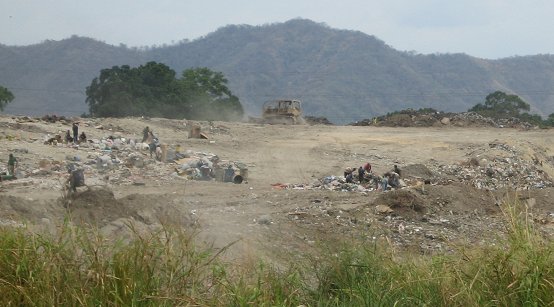

Nice juxtaposition of two extremes of chavista inefficiency: the collapsing infrastructure and the infrahuman world under creation.
Now, I am perfectly aware that in all parts of the world, probably even in Norway, there are people scavenging city dumps for sustenance, be it discarded items that might have some value to given individuals, or even food. But in this picture, just as the tractor has bulldozed the recent trash arrivals, there are dozens of indigent scavenging. I see them EACH time I drive between San Felipe and Caracas but I deluded myself in not seeing as many as there seem to be since I was driving by fast (and usually the grass is taller and hides some of it).
Again, what is becoming a litany: after 7 years of Bolivarian revolution, what is done for these people? Where is their Barrio Adentro? Their Mision Vuelvan Caras? Their Mision Robinson, even? How come none of the Chavez social programs, those wonderful social programs that he and his sycophantic court brag about seem to be reaching these people?
Wednesday, May 03, 2006
Caracas to Calcutta
To go from Caracas to Calcutta it takes you only a few minutes: reach Avenida Universidad and drive it along sometime after 9 PM. It is a vision worthy of one of Dante's infernos.
I have one friend who lives downtown Caracas, and thus does not bother owning a car. One of the few brave souls who dare to live in a place they could have escaped long ago. But he was born close to Quinta Crespo and it took him until this year to finally decide to move out, in a few months from now. Thus when we get together for dinner I am kind enough to give him a ride home, making sure that I am out of the area by 10 PM.
Tonight was the first major rain storm of the season. Rainy season starts any time between mid April to late May, but no matter when it starts, Caracas town hall is always caught without having cleaned up the drains, inspected the sewers. Tonight traffic was pandemonium. After dinner at La Castellana we could not get into the highway and we had to resort to the Libertador avenue. We discovered soon enough that it was also blocked and we decided to border it from above. We saw the huge pond that formed in the middle, that was crossed slowly one car by one.
Neither could we get back on the highway Plaza Venezuela and thus for the first time in years I took the Avenida Universidad from Bellas Artes to Capitolio AT NIGHT. I mean, I do go through it on occasion in day time, sorting all the informal street vendors, and garbage, and collapsing traffic to go on some official business downtown but it has been decades that no one in his right mind goes out at night on Avenida Universidad.
It is not such a bad avenue: after all that is where the infamous General Prosecutor Isaias has his offices in front of Parque Carabobo, a place where many an opposition march went to boo him. It ends at the historical Capitol building, which recently has been spruced up, now that chavismo controls it 100% of its seats. They do like their comfort and nice working places, you know...
But Avenida Universidad at night is something else. When the informal vendors leave around 6-7 PM, they leave, along the public buildings and numerous lunch places and small stores, dozens of piles of full trash bags. Some easily as high as 5-6 feet. By 9 PM most of the piles of garbage have been broken into and spread over the side walks by the army of indigent people that comes out from nowhere it seems (the pictures of the under-bridges that I have shown recently are not enough to account for the numbers that I saw tonight).
It was truly horrible. One scene summarizes all: at one corner, waiting for the light I could even see an African American man, perhaps in his early 40ies, without shoes, without a shirt, eating something he picked up from the floor, 200 yards from the Nation's Capitol, at 9:30 PM. But my friend told me that there were not that many already has most of the trash had been "inspected". Still, they were by the dozen.
This is worse than ever, and after 7 years of glorious bolivarian revolution which is now ready to battle the US instead of misery at home. Why don't TV crews come and film such a scene?
After I dropped my friend I was able to take the highway to come back home, on my usual way. The road was clear but at 10 PM the line on the blocked side still went from La Araña until Altamira, that is, it crossed 2/3 of Caracas. At 10 PM.
At least from the trans Caracas highway chavistas and opposition are spared observation of the worst failure of the regime: indigent and street kids scavenging for food.
And no, my disgestion is doing fine. After 7 years there is no reason for me to feel responsible for such misery. Chavismo is starting to have a lot to answer for. It is Chavez who proclaimed that street kids would be off the streets soon, or his name would have to change. It was in 1999. Chavez name has still to changed and the street kids of 1999 are now the adults of Avenida Universidad nightly raids. I pay more taxes than ever and I have never felt so insecure and saw so much misery. Where is my tax money going? Where are the shelters for these poor unfortunate souls? Are they built instead in Uruguay? Boston? F*** this!
I have one friend who lives downtown Caracas, and thus does not bother owning a car. One of the few brave souls who dare to live in a place they could have escaped long ago. But he was born close to Quinta Crespo and it took him until this year to finally decide to move out, in a few months from now. Thus when we get together for dinner I am kind enough to give him a ride home, making sure that I am out of the area by 10 PM.
Tonight was the first major rain storm of the season. Rainy season starts any time between mid April to late May, but no matter when it starts, Caracas town hall is always caught without having cleaned up the drains, inspected the sewers. Tonight traffic was pandemonium. After dinner at La Castellana we could not get into the highway and we had to resort to the Libertador avenue. We discovered soon enough that it was also blocked and we decided to border it from above. We saw the huge pond that formed in the middle, that was crossed slowly one car by one.
Neither could we get back on the highway Plaza Venezuela and thus for the first time in years I took the Avenida Universidad from Bellas Artes to Capitolio AT NIGHT. I mean, I do go through it on occasion in day time, sorting all the informal street vendors, and garbage, and collapsing traffic to go on some official business downtown but it has been decades that no one in his right mind goes out at night on Avenida Universidad.
It is not such a bad avenue: after all that is where the infamous General Prosecutor Isaias has his offices in front of Parque Carabobo, a place where many an opposition march went to boo him. It ends at the historical Capitol building, which recently has been spruced up, now that chavismo controls it 100% of its seats. They do like their comfort and nice working places, you know...
But Avenida Universidad at night is something else. When the informal vendors leave around 6-7 PM, they leave, along the public buildings and numerous lunch places and small stores, dozens of piles of full trash bags. Some easily as high as 5-6 feet. By 9 PM most of the piles of garbage have been broken into and spread over the side walks by the army of indigent people that comes out from nowhere it seems (the pictures of the under-bridges that I have shown recently are not enough to account for the numbers that I saw tonight).
It was truly horrible. One scene summarizes all: at one corner, waiting for the light I could even see an African American man, perhaps in his early 40ies, without shoes, without a shirt, eating something he picked up from the floor, 200 yards from the Nation's Capitol, at 9:30 PM. But my friend told me that there were not that many already has most of the trash had been "inspected". Still, they were by the dozen.
This is worse than ever, and after 7 years of glorious bolivarian revolution which is now ready to battle the US instead of misery at home. Why don't TV crews come and film such a scene?
After I dropped my friend I was able to take the highway to come back home, on my usual way. The road was clear but at 10 PM the line on the blocked side still went from La Araña until Altamira, that is, it crossed 2/3 of Caracas. At 10 PM.
At least from the trans Caracas highway chavistas and opposition are spared observation of the worst failure of the regime: indigent and street kids scavenging for food.
And no, my disgestion is doing fine. After 7 years there is no reason for me to feel responsible for such misery. Chavismo is starting to have a lot to answer for. It is Chavez who proclaimed that street kids would be off the streets soon, or his name would have to change. It was in 1999. Chavez name has still to changed and the street kids of 1999 are now the adults of Avenida Universidad nightly raids. I pay more taxes than ever and I have never felt so insecure and saw so much misery. Where is my tax money going? Where are the shelters for these poor unfortunate souls? Are they built instead in Uruguay? Boston? F*** this!
Monday, May 01, 2006
Venezuela Foreign policy: the Peru case
The first thing that the casual observer must be made aware of is that there is no such thing as a Venezuelan foreign policy. There is only a Chavez foreign policy that is bankrolled through the unfair oil revenues that Venezuela is benefiting of (1).
This being said, we now must turn to define what Chavez foreign policy is. Unfortunately this is not made it any easier after dissociating Venezuela’s fate from Chavez interests. The problem is that been the opportunist that he is, Chavez accessory goals can change as needed as long as they serve the only constant goals in Chavez mind: his glory, his leadership of Latin America, his inheritance of Castro’s mantle. Curiously, not necessarily in this order. This is what gives Chavez “diplomacy” this rather erratic behavior, though constant aggressive tone.
Finally, we must keep in mind that foreign policy can quite often be a reflection of the troubles at home. There is a political dictum of sorts in the US: the second term tend to be more about foreign policy than the first term. Presidents find some problems at home intractable and even if they were not tempted by foreign policy in their first term, they turn to it in their second in the hope to achieve abroad what they cannot achieve at home, for the history books of course. If we observe that Chavez is in his in his 8th year of rule (sworn in February 2, 1999) and that in seven years has failed in making significant dents in Venezuelan social problems such as the creation of real jobs, bringing the per capita income above the 1998 figure, failing to establish (or even reform) a comprehensive social security / health / unemployment / worker safety plan, we can see why he is seeking overseas “successes” to distract the hoi polloi at home. Because no matter what some folks say, the shine is fading as un-kept promises keep piling up.
Thus, after surviving the Recall Election of 2004, in a contested way, Chavez sought fast glory abroad to silence all. Helped with a fat wallet that now he disposed at will, as if it were his very personal charity fund, he has set to wreak havoc through LatAm in the name of resistance against the Empire (read: George Bush rather than the US per se). This had not stopped him to remain a reliable supplier of oil to the US through all of these two years of confrontation, an inner contradiction that is duly observed by the people whose business he meddles in. But Chavez is not going to be bothered by such contradictions as the anti US language ensures him, unquestioned, the support of the knee jerk left, which is all that he needs to inherit the mantle of an obviously ailing Castro.
The Peru intervention, as an example
It is vox populi that Chavez has been helping any leftist or pseudo leftist in LatAm since he has reached office. A short list: the ambiguity over the Colombian FARC; financing all sorts of suspicious operations in Argentina; open charity in Uruguay though this one has a per capita income MORE than double Venezuela’s; blackmailing Caribbean countries for cheap oil; allowing the trade deficit grow in favor of Brazil in gigantic proportions; openly supporting Morales of Bolivia; and more recently, direct conflicts such as insulting Mexico president, killing the Andean Community (CAN), manipulating the Mercosur, sending free oil only to pro Sandinista mayors in Nicaragua, and supporting Ollanta Humala in Peru. Quite a busy agenda that is far from including all the mischief Chavez incurs.
The Peruvian intervention is quite a representative case, even more interesting as it illustrates quite well how unhinged Chavez is becoming as no one at home seems to be able, or even willing, to tell him that certain things are just not said. It all started with the candidature of Ollanta Humala. This right wing military turned leftist for political expediency (and Venezuelan campaign money) has managed to win the first round balloting of last April. Though with only a 30% while some polls seemed to hope for a higher result (2). This must have upset Chavez as for once serious Peruvian polls did get the result except that they missed on Lourdes Flores: it was ex-president Alan Garcia that got the nod with almost 25%.
To this we must add that the relationship between Toledo and Chavez was never very good. Chavez could never find a good way to attack Toledo since his economic policies were more successful that Chavez’s policies (3), since Toledo was a real Peruvian Native (un Cholo), since Toledo was a real democrat. The arrival of Ollanta, who strangely looks mestizo unlike Toledo in spite of his similar native heritage, and the signing by Peru of a TLC with the US gave finally Chavez a way to attack this pesky successful center right guy form Peru. Now Toledo is a Vanilla Oreo, yellow outside, white (serving the Empire) inside.
But Chavez is an elephant in a china shop. And the lame 30% of Humala must have agitated him at the idea that Garcia could win, just as Uribe is apparently assured of a vote result better than whatever Chavez might get in December. That could sway Ecuador to stick with its two neighbors in its own elections, splitting once and for all LatAm in two, with much less complacency toward Chavez in general once the new governments have experienced close up and personal the animosity of Chavez.
So in short order we have had the following highly distasteful and inappropriate events. Ollanta was accompanied on Peruvian election day by none other than Jorge Rodriguez, of infamous Venezuelan CNE reputation. This single event is enough to etch in stone the Venezuelan intervention in Peruvian electoral matters, in addition to gauge once again the immoral position of the CNE ailed shrink.
Then, as Alan Garcia seemed to climb on top to ensure his pass to the second round, Chavez agitated that Garcia was, in his mind, a more dangerous adversary than Flores, decided to strike somewhere and found nothing better than to leave the Andean Community. When all deplored the hasty departure, wanting to call for some summit to straighten the mess up, Chavez in his munificence declared that if Colombia and Peru annulled their signature of the Free Trade agreement with the US, he would accept meeting them. Such unacceptable blackmail, from some one who had done its best to sabotage the CAN at any opportunity, did get the reply it deserved. Uribe for one dared Chavez to negotiate a real free trade agreement for a “Bolivarian” CAN. No reply from Caracas of course, probably quite humiliated at been reminded that Bolivar does not belong to Venezuela alone, and even less to Chavez.
But it got worse: even Humala did not applaud at Chavez leaving the CAN. Only Morales, who is looking more and more as Chavez agent than the president of his country as he is fast alienating more people in Bolivia, sort of chimed in, going as far as signing a free trade treaty with Cuba and Venezuela (4). A more unhinged Chavez decided to accuse Garcia of becoming the “empire” candidate now that Flores was out. Escalade was fast: Chavez threatened to break ties with Peru if Garcia won the run off election. And soon Chavez added personal insult by calling Toledo and Garcia “caimanes de un mismo pozo” (crocodiles from the same pit). Of course in his fury Chavez has forgotten that Garcia was certainly not the candidate of Toledo, a bitter enemy in fact. But when you yield to low passion and no one at home dares to tell you to shut up, that is what happens.
Sure enough Toledo had no option but to recall his ambassador to Venezuela, adding the following (5):
What is left to say? If Garcia wins the Peruvian election he will have cold relations with Venezuela as long as Chavez is president, something that will certainly not help the CAN. Chavez having dragged Morales in his personal vendetta will also deteriorate durably the Bolivia-Peru relations. The Mercosur partners will have now a full appreciation to the cantankerous guy who wants to become a full member of the Mercosur, going already on record as demanding a revision of the Mercosur on his own terms. The predicted result: increasing isolation of Venezuela.
Whenever a powerful leader has confused his interests with those of his country, the country suffered. A lot sometimes.
--- --- --- --- --- --- --- --- --- --- --- --- ---
1) I mean unfair not in the sense of high prices, I am all for them if anything to teach the modern world that oil is a non renewable resource, that in addition pollutes a lot, so the less we consume the better off we are. By unfair I mean that the Venezuelan windfall has fallen into the hands of such an incompetent but mean and driven individual who is squandering all that income for his glory.
2) This is the opposite to Bolivia where Morales surprisingly won strongly on the first round, with a much higher vote than the polls expected. Apparently some in the left took that as an omen for all future LatAm elections.
3) Toledo is leaving after an unprecedented 5 year economic expansion, which astoundingly sped up to 6.6% in 2005! With a low 1 digit inflation as a cherry on the cake. No matter Chavez is envious and resentful!
4) That trade treaty seems a joke, a purely political move as it was “negotiated” in record time, probably due to the simple fact that besides some Bolivian soy and Venezuelan oil there is really nothing to trade between these countries. This did not stop Morales to ask for a renaming of the CAN as "Anti-Imperialist Community". There are some things that just cannot be made up!
5) There is an interesting interview in La Republica, a Lima newspaper, that I recommend. Fabian Novak, a Peruvian expert on the matter, states quite well what is the perception of Chavez that more and more people are starting to have. Nothing new really, but nicely stated in that interview. You can also read in El Commercio of Lima a detailed expose of motives by the Peruvian government. At home, nobody cares, most think it is yet again some "malacrianza" of Chavez (ill breeding) or simply oppose Chavez as Petkoff did eloquently: "This country cannot be ruled by a man that on occasion gives the impression of a degree of arrogance almost demential."
This being said, we now must turn to define what Chavez foreign policy is. Unfortunately this is not made it any easier after dissociating Venezuela’s fate from Chavez interests. The problem is that been the opportunist that he is, Chavez accessory goals can change as needed as long as they serve the only constant goals in Chavez mind: his glory, his leadership of Latin America, his inheritance of Castro’s mantle. Curiously, not necessarily in this order. This is what gives Chavez “diplomacy” this rather erratic behavior, though constant aggressive tone.
Finally, we must keep in mind that foreign policy can quite often be a reflection of the troubles at home. There is a political dictum of sorts in the US: the second term tend to be more about foreign policy than the first term. Presidents find some problems at home intractable and even if they were not tempted by foreign policy in their first term, they turn to it in their second in the hope to achieve abroad what they cannot achieve at home, for the history books of course. If we observe that Chavez is in his in his 8th year of rule (sworn in February 2, 1999) and that in seven years has failed in making significant dents in Venezuelan social problems such as the creation of real jobs, bringing the per capita income above the 1998 figure, failing to establish (or even reform) a comprehensive social security / health / unemployment / worker safety plan, we can see why he is seeking overseas “successes” to distract the hoi polloi at home. Because no matter what some folks say, the shine is fading as un-kept promises keep piling up.
Thus, after surviving the Recall Election of 2004, in a contested way, Chavez sought fast glory abroad to silence all. Helped with a fat wallet that now he disposed at will, as if it were his very personal charity fund, he has set to wreak havoc through LatAm in the name of resistance against the Empire (read: George Bush rather than the US per se). This had not stopped him to remain a reliable supplier of oil to the US through all of these two years of confrontation, an inner contradiction that is duly observed by the people whose business he meddles in. But Chavez is not going to be bothered by such contradictions as the anti US language ensures him, unquestioned, the support of the knee jerk left, which is all that he needs to inherit the mantle of an obviously ailing Castro.
The Peru intervention, as an example
It is vox populi that Chavez has been helping any leftist or pseudo leftist in LatAm since he has reached office. A short list: the ambiguity over the Colombian FARC; financing all sorts of suspicious operations in Argentina; open charity in Uruguay though this one has a per capita income MORE than double Venezuela’s; blackmailing Caribbean countries for cheap oil; allowing the trade deficit grow in favor of Brazil in gigantic proportions; openly supporting Morales of Bolivia; and more recently, direct conflicts such as insulting Mexico president, killing the Andean Community (CAN), manipulating the Mercosur, sending free oil only to pro Sandinista mayors in Nicaragua, and supporting Ollanta Humala in Peru. Quite a busy agenda that is far from including all the mischief Chavez incurs.
The Peruvian intervention is quite a representative case, even more interesting as it illustrates quite well how unhinged Chavez is becoming as no one at home seems to be able, or even willing, to tell him that certain things are just not said. It all started with the candidature of Ollanta Humala. This right wing military turned leftist for political expediency (and Venezuelan campaign money) has managed to win the first round balloting of last April. Though with only a 30% while some polls seemed to hope for a higher result (2). This must have upset Chavez as for once serious Peruvian polls did get the result except that they missed on Lourdes Flores: it was ex-president Alan Garcia that got the nod with almost 25%.
To this we must add that the relationship between Toledo and Chavez was never very good. Chavez could never find a good way to attack Toledo since his economic policies were more successful that Chavez’s policies (3), since Toledo was a real Peruvian Native (un Cholo), since Toledo was a real democrat. The arrival of Ollanta, who strangely looks mestizo unlike Toledo in spite of his similar native heritage, and the signing by Peru of a TLC with the US gave finally Chavez a way to attack this pesky successful center right guy form Peru. Now Toledo is a Vanilla Oreo, yellow outside, white (serving the Empire) inside.
But Chavez is an elephant in a china shop. And the lame 30% of Humala must have agitated him at the idea that Garcia could win, just as Uribe is apparently assured of a vote result better than whatever Chavez might get in December. That could sway Ecuador to stick with its two neighbors in its own elections, splitting once and for all LatAm in two, with much less complacency toward Chavez in general once the new governments have experienced close up and personal the animosity of Chavez.
So in short order we have had the following highly distasteful and inappropriate events. Ollanta was accompanied on Peruvian election day by none other than Jorge Rodriguez, of infamous Venezuelan CNE reputation. This single event is enough to etch in stone the Venezuelan intervention in Peruvian electoral matters, in addition to gauge once again the immoral position of the CNE ailed shrink.
Then, as Alan Garcia seemed to climb on top to ensure his pass to the second round, Chavez agitated that Garcia was, in his mind, a more dangerous adversary than Flores, decided to strike somewhere and found nothing better than to leave the Andean Community. When all deplored the hasty departure, wanting to call for some summit to straighten the mess up, Chavez in his munificence declared that if Colombia and Peru annulled their signature of the Free Trade agreement with the US, he would accept meeting them. Such unacceptable blackmail, from some one who had done its best to sabotage the CAN at any opportunity, did get the reply it deserved. Uribe for one dared Chavez to negotiate a real free trade agreement for a “Bolivarian” CAN. No reply from Caracas of course, probably quite humiliated at been reminded that Bolivar does not belong to Venezuela alone, and even less to Chavez.
But it got worse: even Humala did not applaud at Chavez leaving the CAN. Only Morales, who is looking more and more as Chavez agent than the president of his country as he is fast alienating more people in Bolivia, sort of chimed in, going as far as signing a free trade treaty with Cuba and Venezuela (4). A more unhinged Chavez decided to accuse Garcia of becoming the “empire” candidate now that Flores was out. Escalade was fast: Chavez threatened to break ties with Peru if Garcia won the run off election. And soon Chavez added personal insult by calling Toledo and Garcia “caimanes de un mismo pozo” (crocodiles from the same pit). Of course in his fury Chavez has forgotten that Garcia was certainly not the candidate of Toledo, a bitter enemy in fact. But when you yield to low passion and no one at home dares to tell you to shut up, that is what happens.
Sure enough Toledo had no option but to recall his ambassador to Venezuela, adding the following (5):
"Señor Chávez, aprenda Ud. a gobernar en democracia y trabajar con nosotros para integrar a América Latina, no para desestabilizarla con una chequera" (Mr. Chavez, learn to rule in democracy and to work with us to integrate Latin America, not to destabilize it with a check book).Today we got an even stronger reply of Garcia to Chavez, where he even said "I am not afraid of Chavez. I am not a Venezuelan conscript". Precious! When you think at what has happened to some of Venezuelan conscripts during Chavez tenure.... (in Spanish with more details here)
What is left to say? If Garcia wins the Peruvian election he will have cold relations with Venezuela as long as Chavez is president, something that will certainly not help the CAN. Chavez having dragged Morales in his personal vendetta will also deteriorate durably the Bolivia-Peru relations. The Mercosur partners will have now a full appreciation to the cantankerous guy who wants to become a full member of the Mercosur, going already on record as demanding a revision of the Mercosur on his own terms. The predicted result: increasing isolation of Venezuela.
Whenever a powerful leader has confused his interests with those of his country, the country suffered. A lot sometimes.
--- --- --- --- --- --- --- --- --- --- --- --- ---
1) I mean unfair not in the sense of high prices, I am all for them if anything to teach the modern world that oil is a non renewable resource, that in addition pollutes a lot, so the less we consume the better off we are. By unfair I mean that the Venezuelan windfall has fallen into the hands of such an incompetent but mean and driven individual who is squandering all that income for his glory.
2) This is the opposite to Bolivia where Morales surprisingly won strongly on the first round, with a much higher vote than the polls expected. Apparently some in the left took that as an omen for all future LatAm elections.
3) Toledo is leaving after an unprecedented 5 year economic expansion, which astoundingly sped up to 6.6% in 2005! With a low 1 digit inflation as a cherry on the cake. No matter Chavez is envious and resentful!
4) That trade treaty seems a joke, a purely political move as it was “negotiated” in record time, probably due to the simple fact that besides some Bolivian soy and Venezuelan oil there is really nothing to trade between these countries. This did not stop Morales to ask for a renaming of the CAN as "Anti-Imperialist Community". There are some things that just cannot be made up!
5) There is an interesting interview in La Republica, a Lima newspaper, that I recommend. Fabian Novak, a Peruvian expert on the matter, states quite well what is the perception of Chavez that more and more people are starting to have. Nothing new really, but nicely stated in that interview. You can also read in El Commercio of Lima a detailed expose of motives by the Peruvian government. At home, nobody cares, most think it is yet again some "malacrianza" of Chavez (ill breeding) or simply oppose Chavez as Petkoff did eloquently: "This country cannot be ruled by a man that on occasion gives the impression of a degree of arrogance almost demential."
The suicide of Peru
In Brazil the Word for turkey is “peru”. Perhaps the Portuguese settlers called turkey the “chicken from Peru” as it probably came to Brazil via the Incas and Peru. Maybe the name stuck. Maybe I am completely wrong (any Brazilian reader?).
Inasmuch as the turkey is a rather noble animal in spite of the modern epithet associated to its name (Benjamin Franklin, nothing less, advocated for the Wild Turkey as the US national bird instead of the Bald Eagle) I was led to think about these cruel analogies reading about the political misfortunes of Peru these days. But before giving my opinion on the subject I think it would be good to review recent Peruvian history (a self-indulgence that kind readers forgive me).
It all started with the struggle between APRA and the privileged elites to make Peru a more modern country. The mistakes made from all sides lead to semi permanent strife until the leftist military dictatorship of Velasco Alvarado (who has been fondly remembered by Chavez). This one embarked on a policy of economic nationalism and populist measures that eventually failed when the loot was all distributed and new wealth failed to appear. Eventually, after 12 years of dictatorship the military returned power in 1980 to a reelected Belaunde Terry, from the center right.
But the bill of the authoritarian left adventure had to be paid and Belaunde was unable to do so: soon the economic collapse gave force to extreme left through the Tupac Amaru and bloody guerilla “Shining Path” of Maoist inspiration. The historical APRA finally made it to elected office with the youngest and most charismatic president in Peruvian history, Alan Garcia, who finished off his country during his messy and controversy plagued term. The totally discredited center left yielded two right wing candidates for the second round balloting of 1990: illustrious writer Vargas Llosa and unknown Fujimori of Japanese parents running on a bizarre coalition of evangelical and right wing populist promises that found echo in the Peruvian poor.
Fujimori won but the mess of Garcia administration was too much: in order to bring back some order Fujimori allied himself with the military and made a coup eliminating civilian rule except for his own power. If his tenure was widely controversial, it remains that Fujimori achieved what was thought impossible: bring stability to Peru after more than half century of chronic instability. He managed that by fighting a tough and successful war against the “Shining Path” and putting order in public finances. Though along the way human rights suffered greatly as Montesinos pockets were largely garnished, allowing him to create new ways for political corruption.
If Fujimori eventually failed, as do all autocrats eventually do when they outreach themselves, Fujimori will be remembered for creating the legal dictatorship model. That is, he wrote his own constitution and won his own elections, leaving enough room to the “opposition” to acquire a minimum of democratic respectability outside. That he tamed the most feared Shining Path certainly did allow many a country to turn a blind eye towards Peru. It is easy to draw the parallelism with Chavez: his own constitution which allows him to control all branches of government, while the price of oil forces many a country to turn a blind eye toward Venezuela’s government abuses.
But if Chavez achievement are far from been demonstrated, and less seen, one can say that at least Fujimori had economic achievements obtained without Oil money, through management and hard work. Alejandro Toledo has benefited of this economic recovery by getting a country in working order, if morally bankrupt, when he was elected as the first 100% Native American to reach the presidency in Peru. In fact Toledo will leave office in a couple of months as perhaps the most successful president in Peru’s history, the first one to leave a country in a better shape than when he got it, surviving in a democratic way a ferocious opposition that would have liked nothing better but to toss him on the garbage dump of Peruvian history. In 2005 Peru had the “best” (as in most solid and meaningful) economic growth in LatAm at almost 6% (Venezuela is higher but courtesy of high oil prices and a devastating 2002-2003 recession, barely making it to 1998 levels this year[1]). Toledo will also leave a country where now a native can reach the higher office, where institutions have regained some function and independence, where Peru is now a respected partner in foreign trade and politics.
And to whom will Toledo bequeath his great work?
This is where the problem starts: the victors of the presidential first rounds are two retrograde politicians that represent between them ALL the evils of Peru history. And thus the title of this post.
Alan Garcia
This ex president who had to escape Peru under indictment for corruption after finishing his miserable first term managed to make a surprise comeback in 2000 when he was surprisingly barely defeated by Toledo, hero of the resistance to Fujimori dictatorship. In all fairness, at least from this angle, Garcia did made strong opposition to Toledo but refrained himself from trying to push him out of office in the old APRA ways of before. It remains that his failed presidency casts real doubts as to how much he claims to have changed and even as to his learning a couple of things on good management.
Alan Garcia represents all the failed populists regimes in LatAm, with all their vices and lack of virtues except to bring an illusory social peace that always crumbles at some point. That he managed to get a quarter of the Peruvian vote in the first round makes one wonder if 15 years is an eternity sufficient to erase bad memories, of if democracy is all that is cracked up to be. I was watching on TV the other night a Peruvian commentator visiting Venezuela and he was saying that Garcia won in some of the districts that most benefited of Toledo administration, where full employment was all but fully reached! Talk about an incentive to excel in future Peruvian administrations…
At least, we can be assured of Garcia democratic leanings and his return to presidential palace of Lima is for a limited term. Which is far from being the case with the victor of the first round.
Ollanta Humala
What positive thing can be said about the man who grabbed 30% of the vote in the first round, and who might reach 50% + 1 vote at the second if he makes an agreement with the Fujimori camp by promising to free that one? The rumor is that Humala might be working on such a deal as Fujimoristas did get a good turnout in the parliamentary election when Fujimori’s daughter was one of the most voted representatives. By promising to lift judicial pursuit on Fujimori, Humala coudl not only get that 50% but even a working majority in the National Assembly!
Humala is a military (though I understand that he is better educated than Chavez, and perhaps less uncouth). But his family, and we all live with a family that we cannot discard that easily (look at the Chavez clan looting Barinas state), is a perturbing amalgam of racist, right wing, Stalinist, homophobic characters that Humala has not always disowned during the campaign.
What does the Humala score tells us? Let’s look first at that 30% he got. It is eerily the hard core 30% chavista that this blogger has always granted to Chavez even in the heydays of the Recall Referendum opposition hopes. Is it the third that all LatAm countries seem to have inherited from our convulsed past of caudillos and civil wars, a group of “resentidos sociales” that prefer to live in regimes of ideological order rather than the uncertainties that democracy always bring, amen of the necessity of facing personal responsibility. I will leave this for social studies and anthropologic debate, but if Humala wins, democracy will be toast again in Peru. Of this we can be certain.
And what about Chavez?
Linked to all of this we can detect the stench of Chavez intervention. But this is long enough to require a part 2 for this installment. Stay tuned.
--- --- --- --- --- --- --- --- --- ---
1) According to the CIA fact book the per capita income of Peru is now at 6 100 USD while Venezuela with record oil prices is barely at 6 500 USD !!!!!!!
Inasmuch as the turkey is a rather noble animal in spite of the modern epithet associated to its name (Benjamin Franklin, nothing less, advocated for the Wild Turkey as the US national bird instead of the Bald Eagle) I was led to think about these cruel analogies reading about the political misfortunes of Peru these days. But before giving my opinion on the subject I think it would be good to review recent Peruvian history (a self-indulgence that kind readers forgive me).
It all started with the struggle between APRA and the privileged elites to make Peru a more modern country. The mistakes made from all sides lead to semi permanent strife until the leftist military dictatorship of Velasco Alvarado (who has been fondly remembered by Chavez). This one embarked on a policy of economic nationalism and populist measures that eventually failed when the loot was all distributed and new wealth failed to appear. Eventually, after 12 years of dictatorship the military returned power in 1980 to a reelected Belaunde Terry, from the center right.
But the bill of the authoritarian left adventure had to be paid and Belaunde was unable to do so: soon the economic collapse gave force to extreme left through the Tupac Amaru and bloody guerilla “Shining Path” of Maoist inspiration. The historical APRA finally made it to elected office with the youngest and most charismatic president in Peruvian history, Alan Garcia, who finished off his country during his messy and controversy plagued term. The totally discredited center left yielded two right wing candidates for the second round balloting of 1990: illustrious writer Vargas Llosa and unknown Fujimori of Japanese parents running on a bizarre coalition of evangelical and right wing populist promises that found echo in the Peruvian poor.
Fujimori won but the mess of Garcia administration was too much: in order to bring back some order Fujimori allied himself with the military and made a coup eliminating civilian rule except for his own power. If his tenure was widely controversial, it remains that Fujimori achieved what was thought impossible: bring stability to Peru after more than half century of chronic instability. He managed that by fighting a tough and successful war against the “Shining Path” and putting order in public finances. Though along the way human rights suffered greatly as Montesinos pockets were largely garnished, allowing him to create new ways for political corruption.
If Fujimori eventually failed, as do all autocrats eventually do when they outreach themselves, Fujimori will be remembered for creating the legal dictatorship model. That is, he wrote his own constitution and won his own elections, leaving enough room to the “opposition” to acquire a minimum of democratic respectability outside. That he tamed the most feared Shining Path certainly did allow many a country to turn a blind eye towards Peru. It is easy to draw the parallelism with Chavez: his own constitution which allows him to control all branches of government, while the price of oil forces many a country to turn a blind eye toward Venezuela’s government abuses.
But if Chavez achievement are far from been demonstrated, and less seen, one can say that at least Fujimori had economic achievements obtained without Oil money, through management and hard work. Alejandro Toledo has benefited of this economic recovery by getting a country in working order, if morally bankrupt, when he was elected as the first 100% Native American to reach the presidency in Peru. In fact Toledo will leave office in a couple of months as perhaps the most successful president in Peru’s history, the first one to leave a country in a better shape than when he got it, surviving in a democratic way a ferocious opposition that would have liked nothing better but to toss him on the garbage dump of Peruvian history. In 2005 Peru had the “best” (as in most solid and meaningful) economic growth in LatAm at almost 6% (Venezuela is higher but courtesy of high oil prices and a devastating 2002-2003 recession, barely making it to 1998 levels this year[1]). Toledo will also leave a country where now a native can reach the higher office, where institutions have regained some function and independence, where Peru is now a respected partner in foreign trade and politics.
And to whom will Toledo bequeath his great work?
This is where the problem starts: the victors of the presidential first rounds are two retrograde politicians that represent between them ALL the evils of Peru history. And thus the title of this post.
Alan Garcia
This ex president who had to escape Peru under indictment for corruption after finishing his miserable first term managed to make a surprise comeback in 2000 when he was surprisingly barely defeated by Toledo, hero of the resistance to Fujimori dictatorship. In all fairness, at least from this angle, Garcia did made strong opposition to Toledo but refrained himself from trying to push him out of office in the old APRA ways of before. It remains that his failed presidency casts real doubts as to how much he claims to have changed and even as to his learning a couple of things on good management.
Alan Garcia represents all the failed populists regimes in LatAm, with all their vices and lack of virtues except to bring an illusory social peace that always crumbles at some point. That he managed to get a quarter of the Peruvian vote in the first round makes one wonder if 15 years is an eternity sufficient to erase bad memories, of if democracy is all that is cracked up to be. I was watching on TV the other night a Peruvian commentator visiting Venezuela and he was saying that Garcia won in some of the districts that most benefited of Toledo administration, where full employment was all but fully reached! Talk about an incentive to excel in future Peruvian administrations…
At least, we can be assured of Garcia democratic leanings and his return to presidential palace of Lima is for a limited term. Which is far from being the case with the victor of the first round.
Ollanta Humala
What positive thing can be said about the man who grabbed 30% of the vote in the first round, and who might reach 50% + 1 vote at the second if he makes an agreement with the Fujimori camp by promising to free that one? The rumor is that Humala might be working on such a deal as Fujimoristas did get a good turnout in the parliamentary election when Fujimori’s daughter was one of the most voted representatives. By promising to lift judicial pursuit on Fujimori, Humala coudl not only get that 50% but even a working majority in the National Assembly!
Humala is a military (though I understand that he is better educated than Chavez, and perhaps less uncouth). But his family, and we all live with a family that we cannot discard that easily (look at the Chavez clan looting Barinas state), is a perturbing amalgam of racist, right wing, Stalinist, homophobic characters that Humala has not always disowned during the campaign.
What does the Humala score tells us? Let’s look first at that 30% he got. It is eerily the hard core 30% chavista that this blogger has always granted to Chavez even in the heydays of the Recall Referendum opposition hopes. Is it the third that all LatAm countries seem to have inherited from our convulsed past of caudillos and civil wars, a group of “resentidos sociales” that prefer to live in regimes of ideological order rather than the uncertainties that democracy always bring, amen of the necessity of facing personal responsibility. I will leave this for social studies and anthropologic debate, but if Humala wins, democracy will be toast again in Peru. Of this we can be certain.
And what about Chavez?
Linked to all of this we can detect the stench of Chavez intervention. But this is long enough to require a part 2 for this installment. Stay tuned.
--- --- --- --- --- --- --- --- --- ---
1) According to the CIA fact book the per capita income of Peru is now at 6 100 USD while Venezuela with record oil prices is barely at 6 500 USD !!!!!!!
Subscribe to:
Posts (Atom)