Thursday, May 11, 2006

From smiles to smirks, Lula upset at Chavez

Last Friday I was writing on the Iguaçu summit between Lula, Kirchner, Chavez and Morales where meddlesome Chavez was pretending to arrange the situation between Bolivia and its two gas clients, Brazil and Argentina. That Chavez was the one pushing Bolivia to speed up the nationalization (albeit in the hope to get a fairer price for its gas) did not escape the attention of observers.

I did write then:
"as long as adequate compensation comes, which remains to be seen and which might turn the Iguaçu smiles into bitter smirks"
Well, yesterday and today my words were validated much sooner than I could have expected (pat, pat). Celso Amorin, the representative of the no-nonsense Brazilian foreign office has warned Venezuela, or rather Chavez, on its irksome meddling in Latin America. I quote Celso Amorin
"But yes, President Chavez was advised of our discomfort and the personal discomfort of President Lula for some of his (Chavez') actions,"
Now, in diplomatese, this is as direct as it gets to "bug off!"

The Venezuelan foreign ministry replied in a less than convincing note where not only it contradicts was Celso Amorin says:
"But, in addition, it is false that there might have been any complaint about our presence in Bolivia"
But goes on adding some silly and cliché banality that might play in Caracas but probably not in the streets of Brazilia:
"...in spite of the pressure and provocations of the right, as strong as it might be..."
Saying that Petrobras, a state company, and Lula, the former trade union boss now president of Brazil are subject to right wing pressure from a few articles is actually pretty insulting for Lula and Petrobras. Yet an additional testimony on how ineffective and ill prepared is the new "revolutionary" staff of the Venezuelan foreign ministry.

I do not know whether Amorin was smirking during the Brazilian congress comission intervention, but he probably does now.

Poor Chavez, he is not going to be helped much from his own ministry. Then again, he sees it only as a cheer leading squad, little bit better than to make sure that adoring crowds are wherever he sets foot overseas.

Wednesday, May 10, 2006

The problems in the Venezuelan electoral system (part 4)

The abstention problem

There is a new problem in the Venezuelan electoral situation: abstention has been increasing since Chavez came to office. The numbers are telling: in 1998 abstention was around 40%, now it is about 80%.

There are two roots to that problem: the lack of an opposition motivating force (why go and vote for these folks that are not representing me the way I want to be represented?), and the lack of trust in the electoral system (why go and vote since the result is foreordained thing?)

This problem has become significant enough that not only it alters the Chavez campaign pushing him to even more cheap populism to try to lure voters, when not using direct threats, but it paralyzes the opposition effort, compromising thus the democratic future of Venezuela.

The nature of the “abstentionist” in mid 2006

Let’s look first at the Venezuelan non-voter as they are today.

The chronic abstention. Phrases such as “I do not care”, “I cannot be bothered”, “It does not make a difference”, “you mean there is an election today?” summarize pretty much, in any country of the world, the chronic non-voter. I would give a 10% number for Venezuela since until the 80ies participation rate was around 90%.

The “cynical” or disgruntled abstention. If 20% voted in 2006, most of them for Chavez, and 10% will never vote no matter what, that leaves the astounding number of 70% that are new in the non-voting game. If Chavez claims to have up to 60% in the polls that means that he fails to garner at election time 2 out of 3 of his supporters! Not that this is a consolation for the 40% of the opposition as most do not want to vote. We thus have two sub-groups in this category.

The chavista abstention. This can be divided in three sectors: 1) the ones that thinks that the system is rigged in favor of Chavez and prefer to stay home and drink beer 2) the ones that think that it does not matter as Chavez will win anyway (the difference with the first group is that they think elections are still fair, whereas the first group thinks they are not fair but are fine with it, a difference that is fair to point out as it affects how an electoral campaign is done) and 3) the ones that pretend to be chavista but are not really that committed and prefer not to vote (if we look at the problems in polling, discussed earlier, this group might be larger than suspected and is a good hunting field for the opposition). There is really no way no measure the numbers in each subgroup, and the grand total. Something that is very perturbing to the chavista camapaign.

The opposition abstention. Things are clearer here are the motivations are precise and might or might not apply all to any opposition elector. Let’s list the motivations to stay home, in no particular order: 1) “the opposition leadership betrayed us on August 2004 and there is no way I will vote for these creeps; send me new faces” 2) “The system is rigged. As long as Chavez does not change the CNE and puts an impartial one I am not going to vote” 3) “Chavez is a dictator; there is no point to discuss election with him; he needs to be taken out by force”. Needless to say that no matter how unpalatable these statements are they all have a grain of truth in it. And needless to add that in front of such an emotional argumentation, the task of the wanna-be opposition candidate is quickly made near impossible to achieve.

How does “abstention” affect particularly the Venezuelan elections

Within Chavismo

This is easy to see. Chavez has declared that he will win in December with 10 million votes. If no one goes to vote he will certainly win but not by much more than what his parliament got last December, say somewhere between 3 and 4 million. This would be a victory with a taste of defeat, much worse than what experienced, for example, Tony Blair last year. There is actually a fair chance that even with suspiciously ballooning electoral rolls, Chavez might not even get the 2004 total.

Thus Chavez has embarked in a strategy that includes the following (and lots more): populist agenda of open vote buying; threats to the recipients of social programs and public employees in case they do not vote (and do not vote properly, see the Maisanta program); rabble rousing the people with pseudo patriotic initiatives such as turning the election as an anti Bush contest or attacking weaker foreign leaders; threaten the opposition with much worse if they do not accept a pre established defeat at the polls (which of course affects negatively the opposition effort). In other words, discuss all but issues, no debate, you are for Chavez and the fatherland or you are a traitor.

Within the opposition

There the damage is more complex and sometimes more subtle. The biggest blow however comes from the radical abstention party which is intent on sabotaging any effort to reach some decent agreement with the CNE or even within the opposition. These radical group wants all or nothing, and of course do not offer a significant and possible strategy as to how achieve their goals. It does not seem to bother them that the brilliant success of the abstention strategy of 2005 has been totally wasted since they were not able to build on it. In fact the real problem of the abstention movement is that its self proclaimed leaders think that 80% of the country is behind them when in fact they get very few followers, except for AD which now is playing the abstention card but has no more than a 10-15% in the polls (and it is to be doubted that all of AD potential voters support an active abstention movement).

The fact of the matter is that abstention at large is a general disgust of the people with the political situation of the country. This comes from chavismo cheating openly in 2003, and since, and the opposition being unable to take a powerful stand when it should have. It is this internal opposition contradiction, its inability to take responsibility for its mistakes that keeps fueling the abstention feeling. Chavez is just the spark that keeps it lighted up.

How to deal with the abstention group within the opposition


This is actually quite simple: make it very clear that if a certain number of things are not gained from chavismo by a certain deadline, then the given candidate swears to withdraw from the race. The point here is to stop debating Chavez on his chosen ground (he much prefers you to argue about CNE irregularities than his lackluster administration), and to stop crucifying people that have to offer something to the country just because they do not share your one track mind against Chavez. To the “asbtentionist”: it is not enough to just hate Chavez even if he richly deserves it, you must offer a plan for the post Chavez if you want to make the abstention threat a believable one.

Conclusion 4

The abstention feel in the opposition electorate is playing havoc with any effort in building a credible challenge against Chavez, not to mention wrecking any chance of a united front. At the same time it favors Chavez as it ensures an easy victory, legal though not legitimate. But within chavismo the only thing that matters is legality above legitimacy or ethics. The paradox here is that abstention is also affecting chavismo by his self imposed unrealistic goal of obtaining 10 million votes in 2006. This pushes Chavez to more promises, more vote buying, that will wreck once and for all the Venezuelan democracy. It is the opinion of this blogger that an ill managed abstention campaign will do much more harm than good to our future as a people.

(RETURN to entry post)

Tuesday, May 09, 2006

The problems in the Venezuelan electoral system (part 3)

The not so real problem

The CNE question

THE Venezuelan electoral board, the now infamous CNE, remains THE issue. Serious polls show that the CNE is one of the least trusted institutions of the country. At least through the opposition electorate there is no trust that one’s vote is actually counted. The act of voting has become meaningless for a majority of the country. Natural abstention had climbed from the 40% when Chavez arrived: now it floats close to 80%. Running a campaign is very difficult when people think that the umpire is sold out to the Miraflores side. Volunteers and donations are hard to come in such cases as people, understandably, do not want to waste their time or money.

Last week were sworn in the 5 new board members, 4 for Chavez and one supposedly not from Chavez. Well, all five of them come from a very leftist background, as inquired by Tal Cual, and the supposed 5th member who tokenly represents the opposition might not be such. I would dare to say that the balance of power in that new CNE is not 4 to 1 but rather 4 to 0 (1).

Does it matter?

First, who thought that Chavez would accept a CNE that would be fair and balanced? Whoever deluded him or herself into thinking that a 3 to 2 CNE would be named is now cruelly disappointed. I am not. I am actually surprised that they did not go ahead and set up a straight 5 to 0. But I suppose that outside projection still matters some to chavismo. Further, the preliminary declarations of three of the new arrivals have confirmed to the country that they want to pursue the Rodriguez policies: finger printing machines, no manual ballot counting, limited auditing, etc… Trust in the system is not coming back anytime soon.

This being said it does not matter as chavismo has amply demonstrated that it does not play by the democratic rule of respect to minority rights, minorities (?) which are at best tolerated until the time comes to dispose of them one way or another (as it has been seen for the “minorities” within chavismo, disposed off on the first opportunity). Thus a 3 to 2 CNE would have behaved exactly as a 4 to 1 or 5 to 0: nothing would happen at the CNE of real importance that it is not approved by Chavez. Wasting time discussing as to whether Jorge Rodriguez is controlling the CNE through Tibisay Lucena is a waste of time, totally irrelevant. Tibisay Lucena is controlled by Chavez, as well as at least 3 other members. That the line of command might go through Rodriguez is ancillary evidence. The CNE is a partial umpire that roots for the Miraflores team and there is nothing that can be done nicely to convince them to rise above their moral mediocrity.

Legalities are just a political problem

The way the CNE acts is through a variety of legal artifices that border legality and sometimes breach it. SUMATE and others such as the European Union have observed plenty of such instances. If SUMATE has a whole catalogue of them, the EU guys, for example, were astounded at how voting hours were manipulated and how strangely voting increased in some places during that extension. Had it not been for that irregularity, the official abstention result for 2005 might have been up to 5 points higher!

The CNE is backed by a whole bunch of seedy lawyers which make the 1999 Florida ones look like babies in diapers. Any rule that might be bent to accommodate irate opposition candidates is quickly circumvented by a new rule. Or, even better, a given concession comes in too late to have any effect on the ongoing campaign and electoral process.

But all of these are simply a decoy behind which chavismo hides to justify its abuses, including those detailed earlier in these texts such as illegal state financing. The real problem here is a political problem and its solution must be a political solution that can go above the law if needed. After all the law is Chavez and he can change it as he wills.

How to deal with the CNE

I am allowing myself to digress some here from the intent of this series of post: my intention is simply to illustrate the ways into Chavez and his followers have gutted elections of their meaning (Castro himself said that elections were a waste of time and Chavez did side with that thought during his early political years when he preached abstention). But by describing ways in which the CNE can be confronted I hope to illustrate the turpitude that resides in the CNE main seat.

The solution against the fraudulent CNE machinery is elsewhere: confronting the CNE with reasonable demands, properly documented in front of international observers, setting a deadline for those demands to be fulfilled, explain to all why, and then forget abut the CNE. Let SUMATE deal with the CNE and go out motivate voters, rouse the country. When the dead line comes, then we will see.

What is important is that the opposition does not get mired in a sterile debate about naming a suitable CNE: it is not going to happen the good way. For memory, the Chavez named CNE of 1999 failed miserably in organizing the 2000 May election. These had to be suddenly postponed to August and in the debacle a new CNE was named on the spot. This could happen any time before December 2006 if the political situation does require it. To get rid of Chavez, who cares if elections are postponed by a couple of months!

I am allowing myself to offer a concrete plan. I am sure, I truly hope, that political “experts” in the opposition can come up with something much better.

Step 1. Have all presidential candidates gather and name a commission which includes, or, even better, is led, by SUMATE. Name it officially as your link to the CNE. Confront the CNE with its unwillingness to deal with SUMATE and measure their mettle. Force a political crisis if necessary right now if the CNE refuses to receive your representatives and SUMATE. Since SUMATE is included among others, the CNE should yield. You provide a face saving device by mixing up your representation with SUMATE and SUMATE walks in.

Step 2. Set clear and precise conditions to participate and set a deadline(s). An early deadline should at least be set as to what pertains the campaign process. The CNE will try to dodge the issue and then concede it when it will be meaningless, in front of observers so as to look good. Opposition candidates need to have at least 2 months of real campaign. September 1 should be a goal for certain changes such as a better control of public finances, access to state media and access to the electoral rolls to check for fraud there or target electors the way chavismo is doing (the chavista camp has all the info the CNE is refusing to yield to the opposition, make no mistake: chavismo claims they just “got it” by chance through the signature processes or “leaks”).

Step 3. While opposition candidate(s) campaigns discuss the actual voting process in the background (do not let it become the campaign theme). Be it the finger printing machines, or the voting audit range, make sure to reach an agreement at least 3 full weeks before election. To withdraw from the election is it essential that it is made early enough to make sure two things: 1) that Chavez is uncomfortably alone long enough on the trail to start looking ridiculous and 2) to have time to organize a quick abstention campaign. But this deadline should be short enough to make sure that Chavez does not have time to add a surprise move such as putting on the ballot a referendum.

In other words it is essential that the opposition candidates maintain the CNE on the defensive. And there are ways to do that, one of them is limited and strong negotiation that the CNE cannot afford to break at this point.

Conclusion 3

The CNE is the boogey man displayed by chavismo to hide the real problems of Venezuelan elections: the unfair state advantage in financing all sorts of vote buying social programs (“Mision Spigot” as Francisco Toro calls them); the unfair state advantage in financing the Chavez campaign itself; the legal and emotional set up to hinder the opposition campaign against Chavez. In front of that strategy the CNE is a mere agent.

Besides, directing complaints against the CNE is a waste of time for an additional reason: there is no certainty at all that Chavez wants an election come December. All the recent activities and provocations, from Peru to Tibisay Lucena at the CNE head, indicate that Chavez might be looking for a conflict that will serve as an excuse to take away cumbersome electoral processes which absence in Cuba has never stopped Fidel from being received as a dignitary by more than a sucker. This blogger is not adverse at thinking that Chavez wants to force the opposition out of the electoral arena, and if a conflict with the opposition or the Empire is needed, so be it. But there is no way that Chavez will ever again run in a free and fair election.

--- --- --- --- --- ---

1) Carlos Blanco in el Universal of Sunday does get that 4 to 0 count. I did write it in an early draft before I read it there. I report this in case someone read the Blanco column, not to state who got the idea first, but rather to amuse myself with the cliché “Great minds think alike”.

(RETURN to entry post)

Follow up on La Trocha Mocha

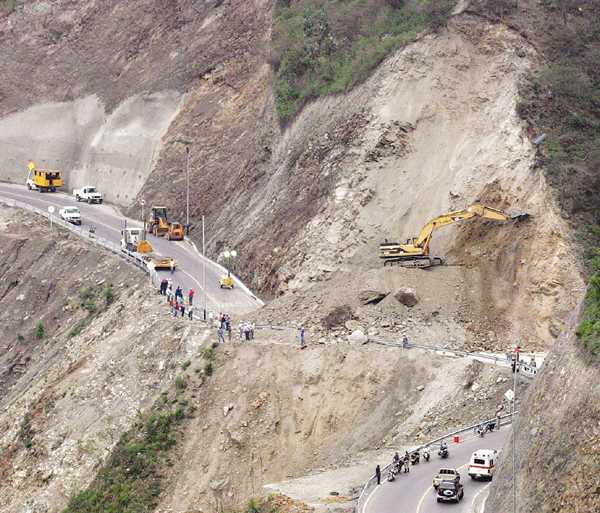
Last night I reported my amazement at the fast collapse of the "trocha mocha". Today Tal Cual carries its own feelings on the front page and I cannot help but translate them, and post the front page picture, where you can observe the too sharp cliffs that were begging to fall.


the man wants a gasoduct all the way to Patagonia

the man finances a bridge in Uruguay

the man helps the poor in the United States

the man builds housing in Jamaica

the man saves the Spanish shipping industry

the man buys bad Argentinean debt and allows Argentina to become solvent with the IMF

the man offers 30 million US dollars to Bolivia for social purposes

the man says that we are ready to withstand the imperial invasion

the man is the support of socialism Cuban style

Venezuela has its "trochabismo" [sic]
¡No pasarán!

explicative notes:

Trochabismo: pun, conveying the sense that the Chavez way lead us to the abysm through this very symbolic emergenreplace to repalce the main Venezuelan highway.

¡No pasarán! : very famous leftist slogan, used in all of Latin America to signifiy that oppression shall not pass. How appropriate, ain't it so?

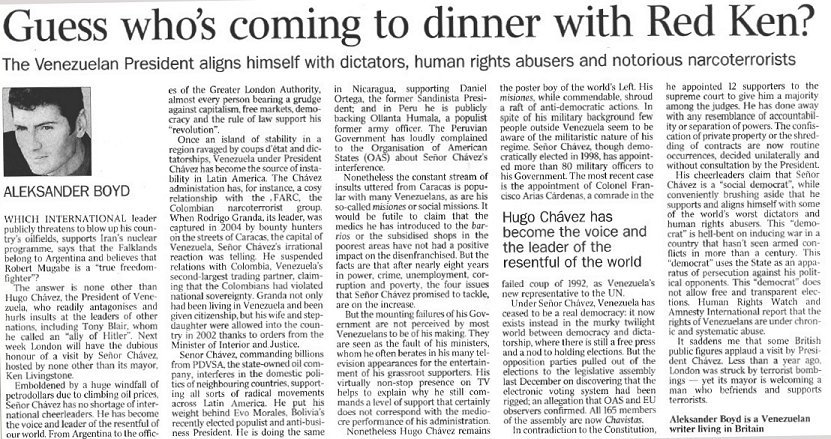
Alek Boyd in the London Times

If the New York Times sucks, other papers are more aware of the Venezuelan reality, including the Times of London where our very own Alek has managed to be received in an extensive article. Alek, in a rather sober style where he proves that he can also be quite effective, tells it like it is to London Mayor, nicknamed Red Ken ("tout un poème"). Ken Livingstone, the lunch host, is the kind of leftie that should recoil in horror at what Chavez is doing, things that one day will give the left a bad name. But it is politics in the UK and as long as Ken thinks he scores a point against Tony Blair cavorting with the pal of Ahmadinejad or Mugabe is fair game. Gives a new meaning to "cut your nose to spite your face". It is amazing to see that Livingstone is honoring Chavez who has said so much against the UK, not only Blair. But I suppose that in the UK it is the same thing as in the US, the hatred of Bush or Blair distorts the judgment of people who should know better, distorts enough that they might welcome enemies of their nation. A short list of the causes of Chavez that are anti UK, not anti Blair: the Falklands, Mugabe, Ahmadinejab, British investments in Venezuela, bad mouthing the UK in general, indirect support of terrorist (if not directly by Chavez himself, he knows better, by his people that he fails to reprehend).

Thus we can fairly assume that Livingstone is supporting those causes too. He reminds me of the 1980ies slogan "better red than dead". Had we listened to these people, Europe would still be covered with missiles except that now they would be around London pointing to the US and directed by some soviet Komissar. Unless a miracle happens at the luncheon and he uses it to reprimand Chavez, Livingstone is playing with fire. I am not holding my breath.

PS: added later. There is even a pic to show the article as it appeared on the paper.

La "Trocha Mocha"

We interrupt more important discussion on Venezuelan electoral problems to report on yet a new example of chavismo incompetence, lack of prevision and basic instinct of "taparear" all (Warning! From the title the reader might guess that there will be several expressions from Venezuelan Spanish that cannot be translated; readers are welcome to supply my lacking).

In January the main Viaduct to Caracas was closed. The viaduct fell once and for all on March 19. The government promised early January to build an alternate, and provisional way (La Trocha) for the Carnival vacation. It was built, albeit inaugurated one day late. This road, highly imperfect, was promoted as an adequate solution to hold the country until a new viaduct is built sometimes in 2007.

The experience of La Trocha has been rather dismal. Personally the only time I took it I could appreciate how insufficient it is to handle Caracas traffic, how many hours we should still spend in line in a round trip adventure (you must reach the Trocha by 6:15 AM if you want to avoid major blockade, advised me the experts; return trips are always aleatory and depend on the mood of the National Guards on charge that PM).

But the problem is that the Trocha was presented as some feat of engineering that it was not. Chavista pages praised the efficiency of the government even as experts denied access to the government had no recourse but to go to private networks to offer their warnings, if anything to clean their conscience.

Well, today all those predictions came to an end as a couple of days of rain were enough to send the mountain down and force closure of the day. Lamely the minister in charge (who should have resigned as early as January 6) sort of claimed that the Trocha was closed preventively so as to bring down some annoying and threatening rocks. Indeed…

I have been watching mesmerized Globovision filming the rocks semi constantly falling from as high as 300 feet from above the road, which is covered with debris and rocks for at least a quarter of a mile. Egg on the face, not only of the minister but on the chavista chorus which welcomed the Trocha as hot stuff. For once Chavez had more sense than his followers and did not bother to inaugurate the "Trocha". The minister promised to try to reopen it tomorrow morning. Nobody is buying.

Of course in Alo Ciudadano there could not be missing a woman caller complaining of the incessant criticism against Chavez now "that ministers show up". Besides that in the past ministers did show up in disaster areas, the interviewed party of the moment reminded her that Chavez has been in office for 8 years and it would be time to stop blaming all the errors of the current administration on the past governments.

Oh, well... Now we can all go back to take the Old Road, as I reported on it last January, with pictures. That is, if you are careful to leave home at least 3 hours before your flight or job schedule.

Monday, May 08, 2006

The problems in the Venezuelan electoral system (part 2)

The Tascon list and its effect on running a campaign

The Tascon list now the Maisanta program

During the Recall Election process of 2003-2004 the Chavez administration, under the direction of Assemblyman Luis Tascon, came up with a system to intimidate public sector workers into voting for Chavez at Referendum time. This device consisted in gathering, courtesy of the CNE that should have never provided this information, the names and ID numbers of all of those who signed to request a recall election on Chavez tenure. This has been well documented and can be seen in the documentary La Lista which shows clearly that Chavez had full knowledge of the existence of that list and what it was used for (Spanish version here).

Sure enough, this new McCarthy like list became the source for all sorts of abuses, coercions, firing, threats and what not. It has been duly recognized outside Venezuela by such folks as the European Union electoral observation mission, and diverse important civil right organizations. In fact, one could argue that the situation was so unbelievable in the XXI century for a self declared democracy that it took some time for people to become aware of the Venezuelan situation. This exposure has been further delayed since the pro Chavez Venezuelan judicial system refused to cooperate in countering such a basic civil right abuse such as the violated secret of vote. The inability to seek redress led many of the victims to shut up and try to rebuild their lives in other ways.

Unfortunately in spite of Chavez declarations as to stop the use of the Tascon list, which turned out to be yet new lies, the list has not only not been discontinued but has evolved into the Maisanta program which includes now all sorts of additional information from ALL Venezuelan voters, be they pro or anti Chavez citizens. Now, when you enter your ID number in the program (it has become a computer program that deals with the database) you can read your name, your address, your voting districts, whether you signed against Chavez, whether you signed against opposition assemblymen, whether you participate in some of the social programs called “Misiones” which supposedly indicate a pro Chavez posture, whether you voted in August 2005 or staid home (abstention is considered as a mark of weak support for Chavez if not outright opposition and your stay and benefits in a Mision might be challenged if you did not vote in 2005, including your public servant job if you hold one). I was told that the December 2005 electoral result is now incorporated which means that the 15% hard core that voted for Chavez is now fully identified and that they are now the superior caste of Venezuelan society.

With the Maisanta program the government disposes of a tool which creates a political discrimination, very short from an outright apartheid, which can be used to deny any service from the government that this one wishes to deny to punish you from not supporting Chavez.

Blocking citizen participation

It is easy to deduct the implications of such a vicious breach of privacy implied in the existence of a discrimination tool such as the Maisanta program. The first victim, at least in my opinion, are pollsters. Since August 2004 polls have stopped making sense in Venezuela as people simply declare open support to Chavez, just in case. Imagine a pollster going to the shanty towns of Caracas to establish a voting pattern in the 40% of the population that most depends on chavista hand outs. Picture yourself that chavismo through its misiones has established quite a network that is meant to monitor people, not unlike the Committee to defend the Cuban Revolution. Now, can you imagine that an anti Chavez inhabitant of this area will dare to state his opposition to Chavez? If you are still not convinced, look at the latest Keller Poll discussed next.

Keller is considered, at least by this blogger, as the most serious pollster in Venezuela these days. In his latest survey he rates things from Chavez endearing qualities to what people are thinking he is solving. Observe the decreasing numbers favoring Chavez and how strange gaps appear:

I like Chavez: 63%
I will vote for Chavez: 57%
Chavez is solving the poverty problem: 30% (Not!: 40%)
Chavez is solving the cost of living problem: 28% (Not!: 42%)
Chavez is solving the corruption problem: 22% (Not!: 39%)
Chavez is solving the crime problem: 12% (Not!: 67%)

How is it possible that 57% are planning to vote for Chavez and yet there are at most 30% satisfied customers?

But then Keller makes an “average” and we see that if 57% are planning to vote for Chavez, only 24% think he is solving the nation’s problems and 47% think he is making things worse! That is 4% more than those who say they will not vote for Chavez? Masochism? Or plain fear? This seems to give a new meaning to political dysfunction as there is no rational explanation in such results except that there is a problem in the measuring tool.

I think that this particular poll illustrates the real problem: as long as there is no alternative in the horizon people prefer to stick with Chavez or pretend to stick with him.

But there is another perverse effect. Once upon a time in Venezuela it was OK for yourself to declare who you were going to vote for. Supporting a political party was not a problem at least inside the private sector and the lower positions of the bureaucracy. Now, if you are a public servant you cannot state your divergences with the chavista pseudo ideology. Yes, some ministries are still reasonably spared the political persecution, but even at the SENIAT or at the Educational ministries that were relatively spared of the Tascon witch hunt, people that I know there told me that now participation in chavista marches is compulsory as attendance is required. Can you imagine a public servant singing up as a voluntary in the campaign of an opposition candidate?

The consequence of that is an added burden on opposition candidates that have more trouble in following polls to organize their campaign and trouble in staffing their campaign as people do not want to go on record as supporting the opposition in case Chavez is more than likely reelected.

Blocking financing of the opposition parties

And what about financing the opposition campaigns? There are two basic problems, besides the huge financial advantage of Chavez with the national treasure as his petty cash.

The 1999 constitution removed financing by the state of political parties (article 67). This was of course deliberately done by chavismo who by December 31 1999 had secured full basic control of the country. As of early 2000 the judicial system and account controlling systems where solidly controlled by Chavez and no further inquiry into the use of public funds for his campaigns would be performed. The opposition parties had to find ways to raise money. When you see at what is happening to SUMATE for a meager 55,000 NED donation, you can easily imagine that donors would become weary, outside of Venezuela or inside Venezuela for that matter. Because, let’s not fool ourselves, the only way to get funds is through foreign donors as only they can counter the huge state expenditures in favor of Chavez. Not to mention that chavismo is receiving lots of foreign “electoral” help from Cuba or from registering foreign nationals in the electoral registry… Who in Venezuela will call against foreign help to Chavez when this one can screen through banks to check out who is receiving what from where?

As for local financing, at home the situation is rather dramatic. The government now has reasonable access to private individuals transactions, gained under the pretext of tax evasion and detection of drug traffic money laundering. Thus it is safe to assume that most of the big donors, say, above 1,000 USD equivalent, will be easily traced. Such amounts are usually given to PAC bank accounts and thus traceable. Can you imagine what will happen to these people, under the Maisanta apartheid, once Chavez wins again in December?

The only way that the opposition candidates can get the kind of funding that a presidential campaign requires is through “secret” accounts overseas where Venezuelan nationals in a position to give a few thousand dollars can deposit through intermediaries without their names going on record. In other words chavismo is forcing people to go “underground” exposing them to legal problems once he is reelected if he can track down opponents. And small donors, well, they will have to do everything in cash, anonymously.


Conclusion 2


The effect of the discriminatory Tascon/Maisanta list is to pervert any rational organization of electoral campaign. To already politically debilitated opposition parties, the possibility of Chavez to exact revenge on his major opponents once the elections are over is a deterrent enough to limit organization of a serious campaign and its adequate funding. Not only the secret of vote is seriously compromised in Venezuela, but the freedom of political association is, by indirect but real and very effective ways. It is crucial that international observers are continuously made aware of this so as to judge adequately the fairness of any election that might be held this coming December.


(RETURN to entry post)

Followers