Monday, February 06, 2006

And the 2006 electoral campaign has started!

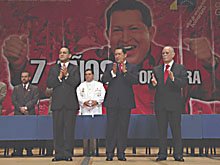
Last Thursday Chavez made a big “celebratory” event to commemorate his seven years in office. I suppose that those that cashed in where happy. The attendance lot seemed quite prosperous, far from that starved look of revolutionaries they harbored 7 years ago. They have learned how to wear the classic suit.

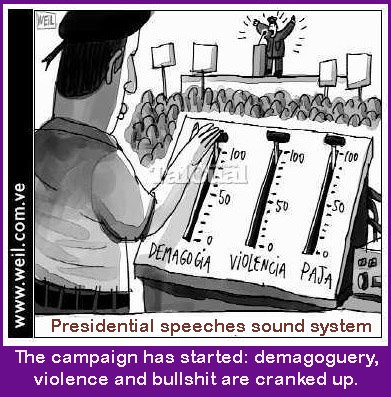
The speech through the unavoidable cadena lasted for hours. Apparently all the high feats needed to be recounted. And all the decibels, vulgarity, threats and bad jokes that accompany Chavez speech where there as this brilliant cartoon of Weil illustrates.


And while he was at it, Chavez launched his reelection campaign, several month before the official date. I would like to point out that next door Uribe has not really launched his own campaign. Actually, they have saddled him with all sorts of restrictions, something that Chavez in spite of the electoral law seems immune of. We know as of February 2 that any electoral restriction that will try to create a fair field for a presidential campaign will be broken through and through by Chavez. Why? Because the head of the Venezuelan Electoral Board, CNE, Jorge Rodriguez was in the attendance for all the speech and applauded as much as he could the pseudo achievements of Chavez.

You mean to say that the umpire of the electoral process was cheering the Chavez program and his new electoral bid? The umpire was witnessing all of these electoral violations and did not stand up and leave? An umpire? What umpire?

Today’s editorial of Teodoro Petkoff does not mince words. Spanish version here. I will only translate choice parts.

This was an act of clear electoral goals, where all speakers from Rangel [the V.P.] to anyone below did nothing else but to suck up to Chavez and where the key word of the festival (“Seven Years… For the time being”) obviously alluded to the reelection intention. Again: What was the president of the CNE doing in an event that was starting the Chavez campaign?

The president of the CNE _ just as from any public service _ not only must be honest but he must seem honest. It is clear that the participation of Jorge Rodriguez in this event and the posterior silence of the CNE in front of all the electoral violations of the Electoral Law that has perpetrated the Great Continuator [Teodoro knows how to coin expressions], does not go along in inspiring confidence to the electors as to the impartiality and honesty of the organization in charge of our elections. To the contrary, a CNE so visible partial is not even good for the government.

It is not that we are worried by the early start of Chavez campaign. It is evident that he is violating the law because he feels the ground shifting under himself and that the popular support is fraying. To ask from Chavez, this perpetual transgressor, to respect the law would be an exercise in naïveté. But the one we should demand to respect itself and the laws and the electoral calendar is the institution in charge of the elections.

This road can only increase the mistrust of the population. They are wrong those in the government who believe that only the opposition will abstain in front of an electoral process so perverse. The pedestrian chavismo will not want to win cheating. This chavismo also wishes for a clean game.

What to do with Venezuela: part 5

Part 5: How could the opposition capitalize on its recent success?

What could the opposition do considering the present circumstances? The good news is that there are options. The bad news is that political will and steady pulse are required.

One must be aware at all times that Chavez disposes of the colossal financial, legal and illegal support of the state for all of his misdeeds, electoral or not. It will be a rough campaign. However I do believe that the Venezuelan people have largely made up their mind, in particular the opposition: there is little that Chavez can do at this point to dent the 40% that has always been voting against him until August 2004. That capital is there and haunts Chavez at night. It haunts him even more since people have learned very well not express their real thoughts and hopes to pollsters, thus confusing all. The only consistency detectable in polls is a tendency for Chavez numbers to drop, without even having a clear discourse facing him. It must certainly be enervating.

I do believe that the opposition can mount a reasonable challenge with only a fraction of the money that Chavez will spend and still achieve a significant gain. Even a result of 4 million for Chavez to 3 million for the opposition would be a great success. And even if the opposition decides at the last minute not to run again, anything below 5 million votes for Chavez will be a disaster as Chavez inconceivably keeps invoking the 10 million mark!

I also think that if the opposition gets its act together by August 1, it can actually beat Chavez in December. How?

There are two issues that have been dodging the opposition and making Chavez task easier at berating the opposition: the lack of a program and the lack of a candidate. There is a way to deal with that. And a way that actually would weaken any partisan CNE that chavismo might throw in the ring to thwart opposition chances.

Creating a program of government

Criticizing the opposition for its lack of program is unfair. However it is fair to say that whatever program or message the opposition has had, this one was drowned in the background noise of multiple promises to please all and enthusiasm none. The first goal is thus to settle for a simple common opposition program that can be understood by all, with clear and limited objectives: namely the restoration of institutionalism and investor confidence to generate job and personal security as jobs take away the idle from the streets. It might not even hurt to be simplistic instead of the complex book offered a bare few weeks before the Recall Election.

Offering a transition government program

This election is different. The institutions of the country have been destroyed by the personal hunger for power of Chavez. When you see the Supreme Court judges chanting pro Chavez slogans you do realize that conciliation and promises of better roads pavement are not going to carry the day. What Venezuela needs is to rebuild institutions first before a real electoral campaign on matters of social and economical projects can be undertaken. After the collapse of the La Güaira bridge and 6 years of Vargas neglect people might start understanding that their job and hunger problems are not going to get solved by Chavez hot air. Some serious administrative job must be undertaken. Globovision is getting tiresome in showing chavistas complaining against chavista incompetent “public” servants. That is enough evidernce.

I think that it would be good to offer the country a three year plan, a transition period where the only promise is to make the state institutions work again as independent entities devoted only to the locals. A program where the new president will engage in divesting his power and returning it to the people and people only. After three years, new elections will be held to vote in a new more complete project.

This does carry some additional advantages:
  1. It allows forcing that the common presidential candidate to be there only for a three year period. When the main measures will have been taken, he or she will step down and allow for the election of a new president with a real long term program.
  2. A transition president, that promises not to run for reelection, might actually give that person the energy to tackle some necessary measures that a long term president with eyes on poll might not want to touch with 10 feet pole. This would be the secret of a transition government.
  3. It will allow for a reassuring of the chavistas that genuinely believe in Chavez that they will not be “eradicated” and that in three years they will be already able to come back, albeit with someone else than Chavez. With such a transition program only so much witch hunting can be done in three years.
  4. In brief, it could allow for the postponement of a major confrontation until people cool off their temper. Three years might be enough to bring back enough civility to run a real campaign.
What would that program be?

In no particular order:

1) Rebuilding the institutions of the country. This will probably require a constitution modification. This should be significant but limited. It should include a reduction of the presidential and legislative terms to 5 or 4 years (I’ll go for 4); putting back the army under civilian control; it should eliminate reelection no matter what; it should render justice independent once and for all; it should strengthen decentralization. Half a dozen amendments voted in a referendum would be enough. And certainly cheaper and faster than a constitutional assembly. Besides Chavez has been violating so many of the constitutional articles that the only ones that matter are those mentioned. The new government can keep violating the other constitutional articles as Chavez has been doing. Civic education is a long process and it must start by the core principles.

2) It should have the courage to say that some Misiones are good and list the ones that are bad and why. It should promise to deliver control of the good Misiones to the local governments, to place them under control of the consumer. That is one way to demonstrate that power will go to the people: states are perfectly able to run Barrio Adentro which is just a reprise of old primary schemes practiced in the 60ies. Mercal could be announced as designed only to help the poor, the real poor so as to benefit them even more by extending subsidies. There are antecedents for Mercal, from PROAL to the “bolsas de comida”. Mision Sucre should be crossed out as a waste but Rivas should be maintained and coupled with a technical program for people to get a real, if short, education for the only real jobs available out there: technical and maintenance jobs. We have enough university degrees holding "buhonero" stands. People know and can understand that. REAL JOBS, with complete social benefits, should be the core offering.

3) It should proclaim a “Venezuela first” policy, renouncing FTAA and Mercosur as well. Venezuela does not need either one for the time being. If we stop giving money away we might just have enough for us. And of course a clear pledge to not only stop giving money away but to try to get back as much as what was given away. Using international tribunals if necessary. It would not hurt to pledge that any recovered money will be distributed directly to the states. That way we could easily counter any nationalistic card that Chavez might want to play, constantly reminding folks on how he uses “their” money as if it were “his” money.

4) It should bluntly plead for a removal of the members of the “Poder Moral” accusing them of the biggest enablers of corruption. The institution should be preserved but it should call for a referendum on their tenure if they refuse to step down. Placing people of integrity there is the only way to start controlling the sick corruption that is destroying our society. In other words, Isaias, Clodosvaldo and German should be made electoral issues. They would be a great target to make sure that the election is not against Chavez only but against a perverse system that is there only to favor Chavez and his minions. Besides, the three of them are so politically engaged that nobody would be shocked by such an action.

5) PDVSA should be professionalized again. There should be a pledge of evaluation by an independent committee of the people who replaced the strikers: the ones who performed their job well should remain. Not all the ones that were fired should get a free return. It is unfortunately the price to pay for national reconciliation by demonstrating that there will be no witch hunting. And it is the only way to try to take PDVSA out of politics again. Perhaps the coexistence of the two camps within PDVSA might be better for the country on the long run. Besides many of the experimented ex PDVSA employees have already found jobs or could be hired by the private sector as Venezuela production should be raised by an extra million barrels a day, something that the present PDVSA seems unable to do, stuck below the pre 2002 level.

That would be enough and can be achieved in three years with a few more sweeteners for the bitter pill that awaits all of us Venezuelans after the mess of these last 7 years. Real efforts to achieve such goals would be enough to bring back investors confidence. With the oil money that will keep coming no matter what, Venezuela economy will experience a real productive growth instead of a distributive scheme of growth that is doomed even if oil prices were to remain high in a foreseeable future.

How to generate such a program?

There is nothing really original in the program offered above. It is just what a logical mind would think to return the country from the nincompoop socialism of the XXI century into a workable Social Democracy. The originality would be in how this program will be agreed upon. There should be an election of a commission that would decide the details of the program. A little bit like the now infamous Coordinadora Democratica, but with a real representation. That commission will be elected through the services of SUMATE and would welcome only groups that accept to abide by the final outcome of the commission no matter what that result is. Since the aim would be for a transition period government, that might not be too difficult to achieve.

An electoral system for the opposition

It would be important to elect an opposition commission that is not too large for several reasons:
  1. To make sure that it cannot act as a parallel parliament and thus pass in the eye of public opinion as a willful disturbance factor. Half of the country at least agrees that the monochromatic parliament we have now is useless, a rubber stamp body with Mickey Mouse ears. But half of the country is not willing to go into an extra parliamentary adventure.
  2. There should be good and pragmatic minds elected to it. The less of them the easier to reach an agreement and a short program of government.
  3. Political parties might be less tempted to send in their prima donne and instead opt for their real technicians to take seats.
  4. It would allow for any presidential candidate to get to know every one of the commissioners, making sure that no platform plank would bar outright a candidate to run in the primaries
But the best way to induce participation in that election is to make sure that no party or group can control such an assembly. I propose that the group is limited to, say, 25 folks and that no single group can get more than 1/3 of the seats available. That way, for example, if PJ were to get 60% of the votes it would still get only 8 seats. In such a scheme parties would be less afraid to count themselves as they will perceive that a bad result will not silence them and will give them a chance to adapt and regain ground for better results in the future. Civil society small groups would have a real chance to get at least one seat. And we will know which of these groups do really carry weight, promoting a necessary weeding without crushing them. They are the seed of future political parties.

In addition I would propose that only the ones who signed against Chavez for the Recall election vote. Or open the vote to all but announce that the secrecy of the names of those who vote cannot be guaranteed. That would scare away any hard core chavista sabotage by infiltrating perturbing factors. The so called “chavismo light” or the mythical Ni-Ni could thus be brought in to influence in a positive way and help restart a real dialogue in society. After all, only groups that pledge respect for the outcome of the commission and that have had a long tradition of opposing Chavez could run, protecting us from too much chavismo infiltration. Even if chavismo were to put an all out effort by openly supporting a given option it could still not get more than 1/3 of the seats. But I think that chavismo will not go and vote in an intra opposition election. In fact they will try to minimize the vote count as much as possible. Open voting is thus a risk probably worth taking.

Finally to make the system more responsible I would vote for open lists. That is, if you chose to vote for, say, the MAS list, you put a cross in front of the name in the list you like the most. That way the people can have an influence on who will be the leaders of the future, without imposition from party machinery. We could start getting rid of political dead wood and promote the rejuvenation of political parties even if they refuse to get internal elections. It would also help the civil society to go along as they could create unified lists to improve their chances to get certain names in.

Another implicit advantage would be the humiliation of the CNE demonstrating that a representative assembly can be elected fast, with pen and paper, without a complex and fraudulent apparatus.

Election could be held as early as mid March. Debate and final vote could be done as early as mid May. Then we could worry about the opposition presidential candidate.

RETURN
Support Denmark

I usually try to avoid non Venezuelan topics, but this was just too much. We cannot tolerate fundamentalists burning embassies and happily pronouncing fatwas. Sometimes we must take stands. I did find this banner which I thought was appropriate to post in support.

I also wish to state that I am perfectly aware that the jerks behind these gross acts of intolerance do not represent, by far, by very far, the majority of educated Muslims in the world who probably feel taken hostage by such barbarian acts. In fact, I sympathize very much with them as Chavez is taking me hostage in his equally fundamentalist anti US crusade which includes larval anti Semitism, nuclear nexus with Iran and other unsavory things sure to surface some day.


Note added later.

It has been pointed that the newspaper that published the "offensive" cartoons of Muhammad was a right wing tabloid in Denmark. Besides rising the question of what right wing might mean in one of the most socially advanced societies of the world, it is irrelevant. Freedom of expression is freedom of expression. People making such exceptions are probably ready to accept Chavez future limitations of freedom of expression (already taking place through the "gag law" and the interdiction to publish important and relevant material on the Anderson case).

This type of evasive argument seems to take place in France where indeed the large Muslim community is feared. Center Right newspaper, Le Figaro which has now a significant English section, echoes some of that debate.

There is first a rather wimpy editorial offering an explanaition as to why the Figaro will not publish the caricatures. That they are a lousy and dubious humor is true. That none should published, even one in support or to demonstrate how lousy they were is indefensible.

In another article at least the Figaro reports the widespread condemnation of fanatic threats across all the political spectrum of French Politics. Looks like French politicians have more backbone than Le Figaro or France Soir. A welcome change.

What to do with Venezuela: part 4

Part 4: Chavez electoral strategy

Before analyzing the opposition options it is useful to try to guess what will be Chavez strategy for December 2006.

Chavez realizes full well that releasing control of the CNE is too risky for him as his avowed aim is ten million votes. That aim is much more pretentious, and preposterous in a true democracy, than winning an outright majority. He will need all the help he can get. As he is already violating the constitution and the electoral law for his December bid, the urge of a complaint CNE is a sine qua non. Hoping thus that an eventual new CNE might be a little bit better than the Jorge Rodriguez combo is a complete delusion that all players should overcome fast.

After December 4, Chavez realizes that if he does not allow for an impartial CNE, abstention is his real enemy. In fact, it is such a powerful enemy that he might not even be able to get his Recall Election number (that would already require doubling the 12/05 result, no mean feat by itself). And we can suspect that Chavez is smart enough to realize that he will not be able to create a Frankenstein opposition candidate that will manage on his own to get at least 1 million votes: Chavez would need to send chavistas to vote for that guy (or rig the voting machines).

Apparently the strategy of Chavez will be in adding to the obvious (look at the list of presents from last February 2, already increased after Sunday 5 Alo Presidente, [5]) the US Venezuela 'conflict'. Argelia Rios publishes a good summary on that strategy in the Sunday edition of El Universal. Suffice to say that Chavez will try to link abstention as an US plot to sabotage his regime and use such an excuse to obtain legitimacy from his neighbors and associates, voiding the abstention effect as a necessary evil to secure National Independence.

Of course intelligent people will not buy such a crass plot, but these are not the intended targets of chavismo. His targets are those who get lavish cash flows from the Venezuelan state, so as to give them an excuse to remain silent and keep receiving fat checks to buy back their bad debt. After all, who thinks that Kirchner is worried about Venezuelan democracy? People like him just need an excuse as they have decided to apply some of the chavista strategies of power control at home.

It also prepares the country for an eventual repressive system if Chavez does not even get his Recall Election numbers. The new arms purchase that Chavez announced Saturday 4 are not to defend Venezuela against the US, they are to arm his militia to repress the opposition, a step he will have to take sooner than later. Or does anyone think that organizing “neighborhood squads” to seek voters and arm a 1 million militia with Kalashnikovs is to protect the republic against US missiles?

No, Chavez cannot get 10 million votes on his record alone. In fact, as the effects of mismanagement become more and more apparent through the electoral year, he might even grow weaker as months and scandals drag along. Thus the need to look for a strong issue to distract from his own failures and we all know since Samuel Johnson that cheap “patriotism is the last refuge of the scoundrel”.

The opposition has its work cut out.

--- --- --- --- --- --- --- --- --- --- ---

5) As a side note. On his Alo Presidente of February 5 Chavez announced that Cuba will “help” Venezuela in buying the 400 + million dollars it needs to “renovate” some hospitals. Now, I am sure that Cuba has experience buying stuff on the cheap going around embargoes, but the point here is that 3 days after commemorating 7 years in office, SEVEN YEARS, the bolibanana revolution apparently HAS NO TEAM able to do governmental purchases on the cheap. It is inconceivable that a president would acknowledge such incompetence from his staff. It is even more inconceivable that he puts up with such incompetence. And it is truly awesome to hear such a lapsus, such a confession of administrative failure.

RETURN

Sunday, February 05, 2006

What to do with Venezuela: part 3

Part 3: An opposition balance sheet

The problems

The opposition problems are thus manifold. How to resolve the contradiction and rivalry between AD and PJ? For better or for worse they are the only parties with a semblance of electoral machinery left. How to include the different democratic left members? They might not be many votes but they do offer the moral caution for a serious bid against Chavez. How to convince the “civil society” to participate, to take up the political challenge? They are a nebulous conglomerate of independent groups with a significant following but a confused political vision except a knee jerk attitude to favor abstention. How to generate a governmental program that can be not only convincing but understood by at least 51% of the electorate? It would be a mean feat to be able to stitch together a quilt that pleases all the components of the opposition. And, last but not least, how to find a leader to take a stand against the vulgarity and abuse of Chavez?

The strengths

Fortunately, and suddenly, the opposition has considerable strengths.

December 4th 2005 showed that Chavez could be beaten. Indeed many of the “abstentionists” are disaffected chavista voters that will likely either remain in abstention or return to Chavez before voting for an opposition candidate. People do not shift that easily, but at least it was clear that Chavez strength is not as impressive as once thought. Polls are highly contradictory, but the vote, or rather non-vote of 12/2005 was clear cut.

Evo Morales Bolivian victory brought some holiday cheer to chavismo. But the collapse of the most important bridge in Venezuela promptly wiped any smile on chavismo faces. Cruelly exposed was chavismo incompetence, once and for all. And it might drag on and on as more evidence of incompetence and lack of long term planning keeps adding up. People can see that after 7 years in office there are no excuses for not having been prepared for a long foretold disaster. Period.

And chavismo seems embarked in a long line of mistakes due to Chavez hubris and the sycophancy of his followers. Look at the mess of the Social Forum and the irrepressible growth of the personality cult. Look at the continued assault to private property which all polls identify as a losing issue for chavismo. Look at the astounding partiality of the High Court of Justice chanting “Uh, Ah, Chavez no se va”. Look at Isaias Rodriguez restricting freedom of speech and declaring, as if he were on drugs, that “justice cannot be blind” (4). If such partisan words and postures might stir the fundamentalists in chavismo, it can only stir the indifferent into taking a position once and for all: they have no excuse to pretend that Chavez is “just another government”. The opposition should be the logical beneficiary of a “time to chose”.

To that changed dynamic, the opposition also keeps its winning card with SUMATE. It can use this card to settle all of its difference. It has the most competent group in Venezuelan political establishment to help put its act together if it only were to show some backbone to do so. Chavismo would be so lucky to have something half as good as SUMATE to sort its problem instead of having to constantly recur to Chavez.


--- --- --- --- --- --- --- --- --- ---

4) The now obvious to all lack of independence of the judicial system in Venezuela is affecting all aspects of life, from the organization of legitimate political activity to the freedom of expression and even private investment. Any action undertaken in Venezuela has to consider that confronting any abuse from the executive is almost a certain loss in court. Not to mention that the new chavista court has decided to review the rare cases where the post 2000 court had already ruled against the executive. One does not need to wonder what an independent observer can think when s/he sees the Justices of the high court chant a political slogan. This is the gravest of Venezuelan problems and the one that the opposition can do little about for the time being.

RETURN

What to do with Venezuela: part 2

Part 2: The opposition turmoil

The opposition got a much needed shot in the arm on December 4. But we are now on February 4 and so far it does not look that it is taking much advantage of the situation. Indeed, one could argue that the opposition does not need to do much. After all, from the pathetic virulence of Chavez to the literally collapsing country one would be allowed to think that it is enough to sit down and watch chavismo consume itself in petty rivalries and chronic ineptitude.

But that is not what the opposition is doing. It is as mired in its own ineptitudes and seems to have no idea as to what to do next. There is some talk for some primaries. There is some talk of building pressure in the streets again; after all the January 22 march was more successful than expected and there is a real discontent brewing up as people start to realize that many of chavismo promises were just that, empty promises, just as the first consequences of years of mismanagement start to show up.

But that is pretty much all. Why is it so difficult for the opposition to get its act together? It comes from the very nature of December 4 victory.

The “abstention movement”, to give is a name, started rather spontaneously after the Recall Election because the opposition parties lost the political battle for that election. They were unable to defend what had been sold to us as an easy victory. Along the way lost the trust of their voters. The lack of response then has come back over and over again to bite the opposition leadership in the rear. When the voting machines, a few days before the December 4 election, were shown to break the secret of vote, in front of the international observers, some got the idea that the abstention would now be colossal. Unfortunately the one that got it first was AD, which for all its decrepitude has not lost all of the savvy it used to have. Boldly AD stepped out of the electoral ring and all serious contenders had to follow under threat of passing for chavismo accomplices. Indeed, those who remained in the ring are today not even a blimp in the opposition radar (3).

It is too bad that AD took that first step. The media “resurrection” of its boss, Ramos Allup, probably got AD thinking that again it was the leader of the opposition. It tried to forget that the abstention movement could not be controlled by its bureau. It is finding soon that it is not so. But two precious months have been wasted for AD to perhaps start seeing the limits of its “victory”.

The only other serious opposition movement, Primero Justicia or PJ, fell into a vortex of its own. Wanting to run in December 4 it failed to grasp the revulsion of the people at playing once again the sick game of the CNE. To avoid an immediate split in its ranks, it had to announce a withdrawing, even if its presidential candidate decided to go and vote null anyway. Since them PJ is facing an internal battle. We could draw the basic problem as AD having lost all of its credit but still retaining the pulse of the country whereas PJ credibility is rendered useless by its lack of connection with large sectors of the country. Both of them will have to find a way to work things out, or it will be done above their heads.

--- --- --- --- --- --- --- --- --- --- --- ---

3) The democratic left had been diligently trying to create a unified front, gathering together chavismo dissatisfied, the MAS and others. Pompeyo Marquez was probably the main motor behind this maneuver, which intention was probably to facilitate an eventual Petkoff candidacy. When the MAS and LCR decided to run anyway they might have well sunk the chances of Petkoff though a strategic retreat on this one, a couple of days before the election, still keep him as an option, but now as an independent.

Interestingly Copei, Proyecto Venezuela and Convergencia (who by the way had announced that it would not run months ago) do not seem to have benefited at all from their stepping out of the electoral ring. Seems like PJ and AD are the only two players left!

RETURN

Saturday, February 04, 2006

Satruday morning activities

I was supposed to share some activities with a friend today. He works in the public administration. Well, he cancelled. He has to go to the "celebratory" march to commemorate the failed coup of Chavez on February 4th 1992. His boss was quite clear: all employees were to meet at a given site to march together in support of Chavez. Non attendance was not an option unless your grandmother died or you were in a hospital.

And so goes democracy in a pseudo electoral year. the democracy that some fools saw in a bloody February 4th over a decade ago.

Good, I will have more time today to work on my multi part report, and more motivation if possible.

Followers