Showing posts with label predictions 2010. Show all posts

Saturday, September 25, 2010

Fine tuning VN&V 2010 predictions

OK, this is the last one.  I am not changing my predictions for next Sunday, I am just fine tuning them, and bringing down my optimistic scenario to a more realistic position.  Also, I am trying to give the final distribution, political party wise. (UPDATED)

The realistic scenario

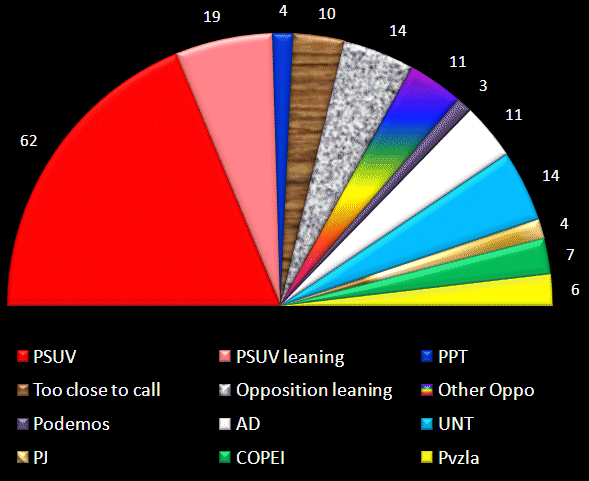
Having completed my "variometer" I went back to my original predictions, introduced political party affiliation of candidates (for whatever worth they are inside the MUD) and built up this new half moon chart of what the next National Assembly could look like.  That is, I am ruthlessly following my numbers even if some of them should in my opinion be different.  Remember also that polls are not good and are confirming my negative calculations.

Realistic result, based on VN&V predictions, for September 2010
From this chart we can observe the following things (if it were to happen, of course!):

Sunday, September 19, 2010

The Venezuela News and Views final 2010 vote prediction (well, maybe)

Well, it is time to make a final prediction, and I am afraid that most readers of this blog will not like it.  And I may add that never was I so keen to be proven wrong.
Seats to be taken by the two sides in the legislative elections of 2010, according to the 2008 votes, the 2010 estimated potential and the rosy scenario with at least a 6% swing from chavismo to the opposition
In the figure above in red we have the number of seats the PSUV and allies will take and in blue what the Opposition will take.

How did I reach this?

Thursday, September 16, 2010

The next National Assembly?

After the series of posts on electoral analysis this is my prediction for the composition of the next National Assembly, as a summary of all of these posts.  NOTE: they were written in an early August perspective and today I would already change a few things but that will have to wait a few days for a new post on the matter.

The final assembly, maybe?  Situation August 2010.

The graph above was obtained with the following parameters:

Wednesday, September 15, 2010

The 2010 election predictions: Aragua and Carabobo

When I started this project I did not know if I was going to have enough time to finish it.  Thus originally I had planned to leave for the end Bolivar and the Llanos, the regions that I know less about, hoping that in case I lacked time the rest of the discussion would be enough to give a good idea of the September 26 election result.  But as I plodded my way through I realized that the election will be decided in the two states of Aragua and Carabobo, the industrial heartland of the country, and thus found the motivation to write it all and leave that discussion for the end.

With 18 seats these two states represent 11% of the representatives to be elected in the new assembly.  If everywhere else in the country results can be guessed more or less accurately, in these two states it is where we are more likely to find interesting and significant shifts.  That is, Zulia is for the opposition: that the PSUV gains 1 or 3 seats really does not affect much the overall picture.  Same story in the Llanos where the PSUV is going to win and where the opposition gains will not be enough to imperil a putative chavista majority.  But in Carabobo, through gerrymandering, the opposition is not certain at all to fulfill its potential and in Aragua, the chavista bastion will still be carried by the PSUV but will be quite damaged.  For the opposition to win the National Assembly it is a must that it resists the gerrymandering of Carabobo AND that it breaches the PSUV monopoly in Aragua, and for chavismo it is essential that the Aragua hegemony is preserved and that the opposition does not reach half of the Carabobo seats otherwise its majority will be too thin for comfort.

Sunday, September 12, 2010

The 2010 election predictions: Oriente

Oriente, the North Eastern part of Venezuela, used to be Accion Democratica land.  As such it had no problem to become chavista land within a few years.  In 2008 chavismo took everything but the small island of Margarita, a sweep that left me quite surprised.  After all, we are not talking here of a region with particular affinities for a Llanero president: people of Oriente are a little bit different than the rest of the country, speak faster, swallow the ending of many of their words and look at Caracas like some alien city.  Since the Monagas brothers, if memory serves me well, the 4 states of Oriente have only given Venezuela one president, Lusinchi, in 1983-1988.  Their last attempt was the disastrous candidacy of Alfaro Ucero from Monagas that did so much to bring Chavez to power.  That does not mean Oriente has not participated in Venezuela history: it has its shares of heroes, ministers, writers and artists.  But perhaps there is some lingering effect that the Spanish province of Nueva Andalucia was attached quite late in the XVII century to Caracas and Orientales like to stay among themselves.

Monday, September 06, 2010

The 2010 election predictions: The Orinoco States

There are three states in Venezuela that really cannot be fit together except that their daily life is based around the mood of the Orinoco river of impressive water flow.  Being able to sail it is pretty much what decides the everyday life of its people.  Until the 60ies there was no bridge to cross it.  President Raul Leoni opened the first one at Ciudad Bolivar.  Since then a second bridge for Puerto Ordaz finally opened after much delay by Chavez (though apparently it is still not quite complete).  Chavez in great fanfare started work on a third bridge at Caicara and that was that, amen of the justification for a bridge where local traffic can be managed quite well with ferry.  But that is OK for Chavez because every so often he goes back there to pretend work is speedily advancing.  The natives are not holding their breath until completion.

Monday, August 30, 2010

The 2010 election predictions: Llanos

This is deep Venezuela, the large central plains, a chavista area and in some states perhaps even a bastion.  The reason is quite simple and goes beyond the Llanero origin of Chavez: the wave of land grabs, the expropriation of a considerable amount of large farms have created a generalized impoverishment of the area and thus an increased dependency of the people from state alms.  More than anywhere else we can see the contrast between the few urban areas of the Llanos which still can on occasion show an opposition presence, and the rural districts which have become a terre de mission for opposition candidates (missionary lands, french political vocabulary).

Cojedes

Saturday, August 28, 2010

The 2010 election predictions: The Andes

The Andes region, Trujillo, Merida and Tachira states, used to be seen as a common entity, from their high mountain physiognomy to their political similarities.  Not any more.  Tachira is now decidedly in the opposition camp while Trujillo has truly become an unconquerable chavista fortress.  Merida remains mercurial but then again it is the largest of the three, the one with the most flat land, the hot and humid region of El Vigia, the one with the highest peak of the country. Let's start with the simplest one: Trujillo.

Trujillo

For some reason this northerner of the Andean states has become a bastion of chavismo. In 2008 Hugo Cabezas was dropped out of nowhere by Chavez and still managed to win with 170,000 votes, the double than its next rival from the coalition opposition. And if opposition was in the hope of better days, it should keep in mind that the candidate of the Communist Party and PPT coalition (Trujillo was the rare division within chavismo) got 38,000, half of what the opposition won.

Wednesday, August 25, 2010

The 2010 election predictions: Zulia

For the past two days I have been stuck at home with all sorts of contract workers that could only come this week.  So in between bouts of supervision, checking work e-mails and some phone calls I have time to speed up my electoral analysis.  Thus we move on to Zulia, our very own "big enchilada".

Zulia is actually a good bellwether state even if the result there is predictable: the opposition, or rather the UNT, will win.  The only question is whether they will manage a grand slam or just a comfortable majority of the seats allotted.  And that is why it is a bellwether state because the more the opposition manages to progress in a state that already belongs to them, the more it speaks of chavismo degradation in ways that we cannot see in, say, Cojedes where a 10% drop in chavismo does not necessarily mean much.

The 2010 election predictions: Lara, Falcon, Yaracuy

For the next installment I will go local.  My geographical division is a rather artificial, a regional division kept for simplicity, the three states put together, sometimes even with Portuguesa which makes me cringe.  Falcon is really three areas, Lara two and even small Yaracuy can be split into three.  But none of them really fits with the neighboring region which are more specific culturally, and larger.  And thus their grouping together by default.

We are here in more or less chavista territory although there is significant trouble in Lara.  Thus we will start by Yaracuy, my home state, which can be dealt with rather fast.  Then we will move to Falcon which can be dealt almost as fast and then to Lara which is another story together.  At the end I will have enough predictions added up to be able to put up the first half moon putative composition of the next National Assembly.

Yaracuy

Monday, August 23, 2010

The 2010 election predictions: Caracas Metro area

To test my fabulous prediction system, without safety net, let's start by the Caracas Metropolitan area which includes the states of Miranda and Vargas and the Caracas Libertador separate municipal district.

Vargas

This state is the easiest one to analyze in that area.  A small state it sends four representatives, two through list vote and two single district.  If you remember the inequities of the Venezuelan system, there are single districts which can have up to three representatives elected through 3 votes (1).  That is, if you organize your electors well enough and the opposing side runs divided you can get 100% of the seats with as little as 40% of the vote.  This system was used in the US South pre voting rights era to concentrate black vote and favor white vote.  In chavista Venezuela it is used to make sure that chavismo does not need 50% of the vote to obtain up to 60% of the seats.  In short, it is possible for chavismo to get ALL seats in Vargas as long as the PSUV gets twice the votes of the opposition.  Fortunately this will not happen and the opposition will get one List seat.

Saturday, August 21, 2010

The 2010 election predictions: general terms

I have been dragging forever but at barely one month from voting day it is time to dust my files, gather the new information and settle to work out my predictions for next month National Assembly elections.  Thus this first post limited to general consideration of the situation and the parameters I will use to predict the results.  I do not know whether I will be able to be done by September 26 (the more so that Chavez is edgy and makes me write a lot on some other stuff ) but I will try to cover as much as possible.  For more detail on what comes below you can refer to many earlier posts under the tag "2010 elections" which specifically cover some of the issues mentioned.

General electoral conditions

Followers