Today is the dead line to register the nomination for the National Assembly elections of December 2005. Chavismo has filed up its candidates and the opposition is trying very hard to complete the job today. All would seem somehow normal, but this being the bolibanana republic, you would be far from the truth assuming such a thing.
Chavismo candidates
As expected it is a large list of mediocrities whose main criteria for selection is that they are not thought to defect in the next five years. The defections that happened in 2001 to 2003 cutting a comfortable majority of 2/3 to a bare one which had to use illegal ways to impose many crucial laws is not something that El Supremo is willing to put with once again. Thus apparently he made sure that his orders were followed and made sure that there would not even be internal primaries, going against the laws of "popular participation". But I suppose that El Supremo is the embodiment of the "popular" so he gets to decide.
Thus El Supremo decided that 27 present seat holders would not run again. That is right, they served Chavez with servility for 5 years except for an occasional ember of self criteria. That was enough to have them crossed from the list. The new revolutionary parliament is expected to vote promptly as ordered from Miraflores palace. The socialism ideal of the XXI century looks everyday more and more than the XX century tired version.
Any surprise there? Actually yes. As far as I can tell the amount of military candidates does not seem as large as once it was thought. Then again I have not found a complete CV on the candidates. Since they are named for loyalty, I suppose that there is no need to publish their CV.
The bigger surprise came from Lina Ron not been nominated. Nor some left wing allies such as the Tupamaros. As of today it is still not clear whether they will form a dissident alliance among themselves and run as they did in August when chavismo ejected them. A rather messy primary process which did not always gave the results expected by the chavismo nomenklatura resulted in them kicked out of the lists. But one thing is certain, their exclusion cannot help chavismo, not to mention that it illustrates the lip service that chavismo pays to democracy.
Opposition candidates
Well, it is quite messy. But the opposition is certainly more democratic that chavismo who accepts the word of the leader without major contestation. Then again chavistas know that after 7 years they are more dependent on Chavez coattails than ever!!!! So the opposition has miserably been threading along this past month. But some positive results can be hoped for, even if they are rather meager.
As of yesterday it seemed that many of the "old" leaders would not run for parliament. Probably sensing that the people were not going to vote for them, folks like Ramos Allup have decided to run for the Andean Parliament, a basically ceremonial post and an end of career, not too dishonorable considering all the leadership mistakes that he should be punished for. Other have simply announced that they will not run again.
I am not too sure yet of what the new faces will be. There has been a lot of talk as to nominating political prisoners, dissident generals and even Carlos Ortega now in jail. The ex-CTV leader and the "paro/strike" of 2002/2003 main spokesperson might actually become much more of a hindrance for the opposition. For the lower classes unfortunately the memory goes much more to the cooking gas lines and food shortages that took place during these days than to the chavismo abuses of the time. A referendum on February 2003 would have seen Chavez out, but two years of misiones and they forgot all about it, just remembering the bad of these days. After all, when you are hungry, destitute and hopeless for an improvement of your personal situation, democracy is a very vague concept whereas a small mision check is, well, a bird in hand. This blogger is certainly not going to blame them: Ortega might have been right in accepting the long strike, but he did not managed it well and he should pay the political price even if he is already in jail. After all he was caught in a casino, not on a barricade! I have a hard time feeling sorry for him: he is not a hero and his candidature can only favor chavismo. Politics is a hard game and if you want one of the top prizes, you must pay your dues.
Still, the opposition found some local problems, ranging from local ambitions and the inability of AD to let go of its pretensions, to simply the forfeit announced by some local leaders. AD, dreaming of days past that shall never come back for them, still tried to force the issue in states where it did very poorly in the last two elections, such as Lara and Anzoategui. At the local level three states are left leaderless by the opposition: in Carabobo Proyecto Venezuela is not running; in Yaracuy Convergencia has also announced that it would not run since the electoral situation does not allow for a fair election; in Cojedes apparently they cannot find anyone willing to run against the Yanez Rangel mafia, admittedly a dangerous group that has had no problem in invading farms, burning down independent press etc…
We will see which is the final list that supposedly should be announced today before we can make a final opinion on how renewed the opposition might be, how much of an electoral alliance is there and what are its reasonable chances to get at least 1/3 of the assembly.
The reality
But no matter what, there is an issue that has not been solved: the CNE partiality. No matter how great the opposition list is, it might have to decide at the last minute to withdraw all its candidates if the CNE does not clean up its act some. If the electoral coalition does not show some spine on this matter, the disgruntled electorate might annihilate that nascent leadership by staying home as it did in October 2004 and August 2005. The next two months would be big test for these people to show that they can do something against the authoritarianism of Chavez. If they do not motivate the opposition electorate, a real 40% and perhaps much more, they will not even get 10% of the seats, those that Chavez will order the CNE to give them so as to wear his democracy fig leaf.
Important note that on purpose I do not include in the text
The list top be presented today is not a united opposition. It is simply an electoral front where all tendencies are represented in order to avoid a massive and unfair chavismo victory in December. One cannot expect a comprehensive program from such a front, nor is chavismo offering a program itself except for more power to Chavez and more unaffordable social programs. Here, the only issue at stake is whether Venezuela will accept to submit itself once and for all to the dictatorial tendency of Chavez or if a group of people will decide to fight back and stop the decline of democracy. The December election and its campaign must be seen under this magnifying glass.
Sunday, September 18, 2005


Saturday, September 17, 2005
A new link on news in English
The Daily Journal, a tabloid format daily with a long Venezuelan tradition as the English language newspaper of Venezuela has finally set up shop in the net. This way it joins El Universal English language section to provide a source of news for the English only reader. This is indeed welcome news: the Daily Journal has a more detached look on the Venezuelan news than Venezuelan newspapers as it tries to serve the large foreign population that lives in Caracas, be they from the US or anywhere in Europe. The stress in the news might be more to the US audience interest but the feel is certainyl not of a US paper (though it does provide some of the main comics :) After all, not only the Daily Journal serves the US expat community, but it also serves the very large Venezuelan group that studied or lived many years in the US (such as yours truly).
This blogger is quite happy to have now two reliable sources of news in English as it will help him greatly when he writes up his posts.
Visit The Daily Journal
This blogger is quite happy to have now two reliable sources of news in English as it will help him greatly when he writes up his posts.
Visit The Daily Journal
Friday, September 16, 2005
Civil rights in Venezuela as a morality play
Yesterday we had Chavez making his little show as the wanna-be savior of the world (for which he got a stern rebuke on Tal Cual, once again reminding the reader that Vargas is far from being saved, and he would do better by starting at home). But Chavez after a couple of days of Comedy Cappers did go to New York where he made a speech that was closer to anti Bush and anti whatever itches his crotch than a real and for the occasion speech (video). It seems that he was rather decomposed again, suggesting reasons why he had to take a large significant staff along, while the US was refusing visas as these request came in just too late apparently. On TV last night someone was explaining that the foreign ministry of Chavez was simply incompetent as the UN 60th anniversary bash had been announced over a year ago and all the invitations, accreditations, et al. were supposed to have been sent, replied to, processed, months ago. But spreading the revolution around the world seems to have "distracted" the foreign minister and his staff: the request just came in too late while the rest of the world had already reserved its spot. Normally he should be fired for making his boss look bad, but this being the Bolibananarian Republic of Venezuela....
The reader might wonder why I am discussing this in such details after the title given to the post. Well, simply to contrast the self assumed role of Chavez as the liberator of the poor, the provider of all of the people rights, with what is really going on at home. Three internet articles, from the grass roots, and which can easily be documented extensively reading Venezuelan papers, even, should I say, pro Chavez papers if one knows how to read between lines, represent quite well the present mood of the country, the low expectation we have for our future.
One article reminds us, with luxury of details, of the Tascon list and how this one has found its way into a nifty bureaucrat computer program that allows easy discrimination of the Venezuelan people according to their political tendencies. In other words the Venezuelan government is now a private corporation which is destined to the sole service of its preferred customers, those who vote for Chavez. Thos who do not vote for Chavez must still pay taxes but do not even get pot-hole free streets. The good news here is that the CD ROM that carries the program has made its way to the Caracas embassies where now the fascistic inclinations of the Chavez regime are not only known, but well documented. Will they take action? We'll see.
Another article leads us to the mundane, to the degradation of our culture. Alexandra does detail the attempts at censorship towards the Venezuelan movie "Secuestro Express" which has become the first Venezuelan movie to reach some notoriety and public success in years. That movie simply shows the human degradation of Venezuela, the increasing violence to which our society is subjected to. And I am talking of social violence, not even governmental one. Apparently the Chavez administration, who one would have thought would have supported such a movie as to an example of why they wanted power in order to solve these problems, is pretty much incensed about the movie. See, it takes a scene, from the public domain as Alexandra points out so rightly, a scene from April 11 2002, a scene taboo for chavismo who only tolerates discussion on these days under its own version, never adequately backed up by the elements that they present themselves. The movie and the director have been taken to court simply because now one must follow the official story, and to scare away any other person who would use April 11 2002 for anything else but the glory of the UN ranter.
The third article, well, it is from this blogger on how private property is under attack in Venezuela. Certainly I would not comment on my own text, but I wanted to bring together these three articles as they illustrate how our values as a society have been decomposed under Chavez, how his regime is corroding our social system in order to establish his one and only power. Fascism? Castrism? The reader may chose, but all share the same basic principle: moral corruption of the people, division, privilege to a few only, degradation. All which are tools of absolute power, which we all know corrupts absolutely.
The reader might wonder why I am discussing this in such details after the title given to the post. Well, simply to contrast the self assumed role of Chavez as the liberator of the poor, the provider of all of the people rights, with what is really going on at home. Three internet articles, from the grass roots, and which can easily be documented extensively reading Venezuelan papers, even, should I say, pro Chavez papers if one knows how to read between lines, represent quite well the present mood of the country, the low expectation we have for our future.
One article reminds us, with luxury of details, of the Tascon list and how this one has found its way into a nifty bureaucrat computer program that allows easy discrimination of the Venezuelan people according to their political tendencies. In other words the Venezuelan government is now a private corporation which is destined to the sole service of its preferred customers, those who vote for Chavez. Thos who do not vote for Chavez must still pay taxes but do not even get pot-hole free streets. The good news here is that the CD ROM that carries the program has made its way to the Caracas embassies where now the fascistic inclinations of the Chavez regime are not only known, but well documented. Will they take action? We'll see.
Another article leads us to the mundane, to the degradation of our culture. Alexandra does detail the attempts at censorship towards the Venezuelan movie "Secuestro Express" which has become the first Venezuelan movie to reach some notoriety and public success in years. That movie simply shows the human degradation of Venezuela, the increasing violence to which our society is subjected to. And I am talking of social violence, not even governmental one. Apparently the Chavez administration, who one would have thought would have supported such a movie as to an example of why they wanted power in order to solve these problems, is pretty much incensed about the movie. See, it takes a scene, from the public domain as Alexandra points out so rightly, a scene from April 11 2002, a scene taboo for chavismo who only tolerates discussion on these days under its own version, never adequately backed up by the elements that they present themselves. The movie and the director have been taken to court simply because now one must follow the official story, and to scare away any other person who would use April 11 2002 for anything else but the glory of the UN ranter.
The third article, well, it is from this blogger on how private property is under attack in Venezuela. Certainly I would not comment on my own text, but I wanted to bring together these three articles as they illustrate how our values as a society have been decomposed under Chavez, how his regime is corroding our social system in order to establish his one and only power. Fascism? Castrism? The reader may chose, but all share the same basic principle: moral corruption of the people, division, privilege to a few only, degradation. All which are tools of absolute power, which we all know corrupts absolutely.
Thursday, September 15, 2005
Venezuela round up
I have been a little bit overwhelmed with work and the amount of telling news that have been happening these past few days. No major news in a way, nothing that has not happened since Chavez in office even though the brazenness and intensity seems to indicate something else.
Tonight I found enough articles in English in El Universal to make a quick all English language round up on all of the subjects that if I were a paid for blogging or as a journalist I should be covering non stop. Alas, as I must work for a living, a quick round up will have to suffice. It is too bad that I am not like Sumate who got 107 002 USD from the NED. It is brave from them to accept that in the present situation. But it also demonstrates that they are sure of their legal right no matter what the official line will be. Meanwhile, I was wondering if I could get some grant too, as I really need a vacation.
If I need a vacation it looks like Chavez is not getting his off-Broadway own show in his planned New York vacation. Apparently the US embassy was deluged with the visa request of all of these anti American bolibananarian revolutionaries who seem to only dream of going to the Big Apple. Since they all request diplomatic passports and visas (looks fancy, allows you to skip immigration lines that this blogger must do) I can imagine the mess that the usual revolutionary improvisation must have caused. The Caracas Embassy has just claimed "delays" and I am willing to believe them. Diplomacy being what it is we only hear Chavez complaining that the visas are denied, that they are not letting in his medical staff (he travels with more than one doctor?) and his bodyguards (who needs body guards in New York these days, when the UN block is probably the safest block in the Americas during the UN summit?) Or was it that there was not parking space left at the Airport for his magnificent Airbus?
But there might be other reasons. Chavez might actually be quite happy to have an excuse to skip New York. Apparently it would have been difficult to make the show he wanted to make at the UN. But also he had to make a show at home. Besides the land seizures, there was also the need to settle securely the issue of who will run for the legislative elections of December. Happily all was settled without primaries of any sort, Chavez deciding it all. His satisfied (?) supporters through a rather bitchy Diosdado Cabello on TV are not afraid to declare that they will take all of the 167 seats as the opposition seems unable to reach an agreement. But you see, there is democracy inside the opposition where nominations are at least openly discussed whereas in chavismo all offered their neck to the beloved leader (including 27 seating members of parliament who were denied the right to run for reelection by Chavez). Even Lina Ron was left outside: if there is one chavista that can be elected on her own, without the help of Chavez, it is Ms. Ron. Or is that what she was denied a nomination? Nah! I am such a ill intended blogger!
And in that show Chavez also announced that the new Assembly will have to modify the constitution. So again we will elect an assembly for constitutional amendments that will not be discussed during the campaign. But the readers of this blog are lucky, as this blogger is pretty sure which are the coming amendments: reelection ad infinitum of Chavez, suppression of article 350 for the right of civil disobedience, modification if not suppression of private property to welcome the XX1 century socialism, and a few other gems, including Recall Elections stricter standards.
While we are talking of private property, it looks that Chavez will not be able to wait for an amendment. Even FEDECAMARAS who was playing footsy with the administration since the Recall Election is rearing its head again. Also desperate to cut down the ratings of Globovision (who lately receives an inordinate amount of chavista callers complaining, of all things, of other chavistas not doing their jobs) Conatel wants to take back some of the airwaves allocated to private media. Censorship advances. In spite of the "gag" law, economic pressure, reaching a pact with Cisneros to silence Venevision, buying off Televen, projecting forced governmental propaganda for free, forcing cable to give up 8 lines for free, people are still not watching the TV networks with the ratings that are revolutionary desirable. In other words, under the lame excuse to reorganize the airwaves to give more room to Telesur and other monstrosities, the government will try to remove some of the networks from some provincial slots, and more if possible. The excuse of Conatel: airwaves belong to the public (that is, Chavez?)
So here we are, on the well traveled road to autocracy, just waiting for the next shoe to drop.
Tonight I found enough articles in English in El Universal to make a quick all English language round up on all of the subjects that if I were a paid for blogging or as a journalist I should be covering non stop. Alas, as I must work for a living, a quick round up will have to suffice. It is too bad that I am not like Sumate who got 107 002 USD from the NED. It is brave from them to accept that in the present situation. But it also demonstrates that they are sure of their legal right no matter what the official line will be. Meanwhile, I was wondering if I could get some grant too, as I really need a vacation.
If I need a vacation it looks like Chavez is not getting his off-Broadway own show in his planned New York vacation. Apparently the US embassy was deluged with the visa request of all of these anti American bolibananarian revolutionaries who seem to only dream of going to the Big Apple. Since they all request diplomatic passports and visas (looks fancy, allows you to skip immigration lines that this blogger must do) I can imagine the mess that the usual revolutionary improvisation must have caused. The Caracas Embassy has just claimed "delays" and I am willing to believe them. Diplomacy being what it is we only hear Chavez complaining that the visas are denied, that they are not letting in his medical staff (he travels with more than one doctor?) and his bodyguards (who needs body guards in New York these days, when the UN block is probably the safest block in the Americas during the UN summit?) Or was it that there was not parking space left at the Airport for his magnificent Airbus?
But there might be other reasons. Chavez might actually be quite happy to have an excuse to skip New York. Apparently it would have been difficult to make the show he wanted to make at the UN. But also he had to make a show at home. Besides the land seizures, there was also the need to settle securely the issue of who will run for the legislative elections of December. Happily all was settled without primaries of any sort, Chavez deciding it all. His satisfied (?) supporters through a rather bitchy Diosdado Cabello on TV are not afraid to declare that they will take all of the 167 seats as the opposition seems unable to reach an agreement. But you see, there is democracy inside the opposition where nominations are at least openly discussed whereas in chavismo all offered their neck to the beloved leader (including 27 seating members of parliament who were denied the right to run for reelection by Chavez). Even Lina Ron was left outside: if there is one chavista that can be elected on her own, without the help of Chavez, it is Ms. Ron. Or is that what she was denied a nomination? Nah! I am such a ill intended blogger!
And in that show Chavez also announced that the new Assembly will have to modify the constitution. So again we will elect an assembly for constitutional amendments that will not be discussed during the campaign. But the readers of this blog are lucky, as this blogger is pretty sure which are the coming amendments: reelection ad infinitum of Chavez, suppression of article 350 for the right of civil disobedience, modification if not suppression of private property to welcome the XX1 century socialism, and a few other gems, including Recall Elections stricter standards.
While we are talking of private property, it looks that Chavez will not be able to wait for an amendment. Even FEDECAMARAS who was playing footsy with the administration since the Recall Election is rearing its head again. Also desperate to cut down the ratings of Globovision (who lately receives an inordinate amount of chavista callers complaining, of all things, of other chavistas not doing their jobs) Conatel wants to take back some of the airwaves allocated to private media. Censorship advances. In spite of the "gag" law, economic pressure, reaching a pact with Cisneros to silence Venevision, buying off Televen, projecting forced governmental propaganda for free, forcing cable to give up 8 lines for free, people are still not watching the TV networks with the ratings that are revolutionary desirable. In other words, under the lame excuse to reorganize the airwaves to give more room to Telesur and other monstrosities, the government will try to remove some of the networks from some provincial slots, and more if possible. The excuse of Conatel: airwaves belong to the public (that is, Chavez?)
So here we are, on the well traveled road to autocracy, just waiting for the next shoe to drop.
Wednesday, September 14, 2005
Chavez seizing his "homeland"?
Last week the Venezuelan army in a feat of high military prowess and courage invaded the property called La Marqueseña (and 4 others not as not worthy though one belongs to the Vestey group, thus adding a second important loss to that group). The invasion revealed that inside there were a few workers busily producing abundant agricultural products and apparently not particularly upset by the way the (ex-) owners were treating them. It was soon obvious for the public opinion that the assault had nothing to do with the new agrarian law which allows the state to force unproductive lands to be surrendered to peasant that want to work them. As far as I can tell I have not seen throngs of people trying to get the lands of La Marqueseña, and certainly not to the extent of the crowds that were wanting a take on, say, the Charcote farm, the first Vestey loss.
Thus from the very beginning that La Marqueseña, bought by the Azpurua family in 1949 (as seen on TV by one of the present owners showing all the titles that she held from her father) seemed like a very suspicious move, only understandable if one is willing to believe that the Chavez administration has decided to exacerbate political tension in an electoral move for December 2005.
Today a very interesting notice has come to the forefront and it is better for me to just translate the ironic editorial of Tal Cual from Simon Boccanegra.
--- --- --- --- --- --- --- --- --- ---
La Marqueseña
Regarding the intervention in hato La Marqueseña something started buzzing in my head. Somewhere, it seemed to me, I had read something on that farm and Chavez. Eventually the light bulb lighted up in my head. I went back to the famous book of Agustín Blanco Muñoz, "Habla el Comandante", (The Comandante speaks) (1). There I found the thing. Says the president (page 49): "Because it turns out that the lands of La Marqueseña belonged, at the beginning of the century, to my great grandfather, Pedro Pérez Delgado (I must note, before I continue to quote, that it is the official name of the ineffable Maisanta), who being a Gomez general rebelled and died in jail. That farm belonged to the Pérez Delgado (2).
Alter the year 1914, when my great grandfather left us, for the guerrilla against Gomez, those lands fell into the hands of the government. […] Today I believe they belong to the Azpúrua. These went from hand to hand. But my grandfather, the son of Maisanta, died fighting for those lands.
When he died, quite old, he got tired of going with lawyers and papers to try to rescue those lands. Those documents must be with the family". Well, I would not want to believe that La Marqueseña would fall into the hands of these peasants without land that the brothers Chávez Frías are (3).
--- --- --- --- --- --- --- --- --- --- --- ---
To make the reader understand this better a few comments:
(1)This book is dated from around the time was released from jail. Some sort of comprehensive interview which is used by chavistas on occasion although the author/interviewer is now solidly in the anti Chavez camp. This blogger has never read that book nor is he planning to.
(2)According to the Polar Dictionary of Venezuelan history, 4 books that I read constantly, indeed Maisanta was the named character. Originary of the Lara lands he somehow ended managing some lands in the Sabaneta area after the civil wars that brought to power Cipriano Castro and Gomez. Hence why the Chavez clan is from Sabaneta de Barinas (the state). But that Maisanta who seemed to have worked for the politician who offered the most, rebelled against Gomez once too many and ended up in jail where he died. Some historians consider Maisanta to be simply a famous highway robber who settled in Barinas state and tried to get some legitimacy for his booty by playing politics. Something which was, by the way, very frequent in Venezuela until Gomez finally brought some order through the country through the longest and bloodiest dictatorship of our history, so far…
(3)Of course Boccanegra cannot stop himself from pointing out that since Barinas state fell into the hands of his father as a governor, and under real management of one of his brothers, the Chavez family has become the happy owner of a considerable amount of lands. One would only need to look at the electoral add of Chavez one year ago, aired for his birthday, shot from a "family" farm with horse paddocks that looked more like manicured English Polo fields than a working farm of the Llanos.
--- --- --- --- --- --- --- --- --- --- ---
So? One might say?
It is rather interesting to see so many coincidences, is it not? Can Chavez have become so brazen in trying to recover lands that fell into the hands of the Azpurua family at least 20 years after Gomez took them away from his ancestor? Is he becoming a highway robber like said ancestor?
No matter what, it looks like this new land seizure episode is tainted with all sorts of irregularities, not to say violations of the law approved by chavismo itself.
Interestingly also, this week Chavez is hoping to visit New York and be celebrated by the intelligentsia of the Liberal/Left of New York who put their dislike of Bush against any ethical scrutiny of those who confront Bush. I recommend folks to read the excellent piece by Alexandra Beech on that subject.
My own piece of advice to the New York establishment from a Liberal blogger who opposes Chavez (and who lived in the New York area for 5 years): if you follow Chavez without questioning him, you risk to step on a lot of cow turds along the way.
Thus from the very beginning that La Marqueseña, bought by the Azpurua family in 1949 (as seen on TV by one of the present owners showing all the titles that she held from her father) seemed like a very suspicious move, only understandable if one is willing to believe that the Chavez administration has decided to exacerbate political tension in an electoral move for December 2005.
Today a very interesting notice has come to the forefront and it is better for me to just translate the ironic editorial of Tal Cual from Simon Boccanegra.
--- --- --- --- --- --- --- --- --- ---
La Marqueseña
Regarding the intervention in hato La Marqueseña something started buzzing in my head. Somewhere, it seemed to me, I had read something on that farm and Chavez. Eventually the light bulb lighted up in my head. I went back to the famous book of Agustín Blanco Muñoz, "Habla el Comandante", (The Comandante speaks) (1). There I found the thing. Says the president (page 49): "Because it turns out that the lands of La Marqueseña belonged, at the beginning of the century, to my great grandfather, Pedro Pérez Delgado (I must note, before I continue to quote, that it is the official name of the ineffable Maisanta), who being a Gomez general rebelled and died in jail. That farm belonged to the Pérez Delgado (2).
Alter the year 1914, when my great grandfather left us, for the guerrilla against Gomez, those lands fell into the hands of the government. […] Today I believe they belong to the Azpúrua. These went from hand to hand. But my grandfather, the son of Maisanta, died fighting for those lands.
When he died, quite old, he got tired of going with lawyers and papers to try to rescue those lands. Those documents must be with the family". Well, I would not want to believe that La Marqueseña would fall into the hands of these peasants without land that the brothers Chávez Frías are (3).
--- --- --- --- --- --- --- --- --- --- --- ---
To make the reader understand this better a few comments:
(1)This book is dated from around the time was released from jail. Some sort of comprehensive interview which is used by chavistas on occasion although the author/interviewer is now solidly in the anti Chavez camp. This blogger has never read that book nor is he planning to.
(2)According to the Polar Dictionary of Venezuelan history, 4 books that I read constantly, indeed Maisanta was the named character. Originary of the Lara lands he somehow ended managing some lands in the Sabaneta area after the civil wars that brought to power Cipriano Castro and Gomez. Hence why the Chavez clan is from Sabaneta de Barinas (the state). But that Maisanta who seemed to have worked for the politician who offered the most, rebelled against Gomez once too many and ended up in jail where he died. Some historians consider Maisanta to be simply a famous highway robber who settled in Barinas state and tried to get some legitimacy for his booty by playing politics. Something which was, by the way, very frequent in Venezuela until Gomez finally brought some order through the country through the longest and bloodiest dictatorship of our history, so far…
(3)Of course Boccanegra cannot stop himself from pointing out that since Barinas state fell into the hands of his father as a governor, and under real management of one of his brothers, the Chavez family has become the happy owner of a considerable amount of lands. One would only need to look at the electoral add of Chavez one year ago, aired for his birthday, shot from a "family" farm with horse paddocks that looked more like manicured English Polo fields than a working farm of the Llanos.
--- --- --- --- --- --- --- --- --- --- ---
So? One might say?
It is rather interesting to see so many coincidences, is it not? Can Chavez have become so brazen in trying to recover lands that fell into the hands of the Azpurua family at least 20 years after Gomez took them away from his ancestor? Is he becoming a highway robber like said ancestor?
No matter what, it looks like this new land seizure episode is tainted with all sorts of irregularities, not to say violations of the law approved by chavismo itself.
Interestingly also, this week Chavez is hoping to visit New York and be celebrated by the intelligentsia of the Liberal/Left of New York who put their dislike of Bush against any ethical scrutiny of those who confront Bush. I recommend folks to read the excellent piece by Alexandra Beech on that subject.
My own piece of advice to the New York establishment from a Liberal blogger who opposes Chavez (and who lived in the New York area for 5 years): if you follow Chavez without questioning him, you risk to step on a lot of cow turds along the way.
Tuesday, September 13, 2005
The Industrial tissue of Venezuela
One indicator of the good health of an economy is the measure of its manufacturing capacity. Even when manufacturing is a small portion of the economy, that it grows, that it generates new jobs, is always a sure sign that the future prospects of a country are good.
In the past two years numbers have been thrown right and left to try to pass the effect on Venezuela of the amazing increase in oil price as a genuine economic growth. Indeed, early this year there was a sense, already fading, that things might be going a little bit better. Many reasons for it, but my own explanation was that all the government spending has been stimulating consumption and some sectors, well, they had to grow. But it is an artificial growth, very much threatened by other governmental polices such as the massive foodstuff import through Mercal to distribute subsidized governmental grocery stores. Food plans do work for a while but rarely, if ever, do they promote food stuff production. For example Venezuela which used to produce all the chicken or meat it consumed, now must import a fair share of it.
But I digress as for today's point. Tal Cual published the numbers from Conindustria (a manufacturers association) which simply count how many manufacturing plants exist in Venezuela, regardless of the sector they belong to. As usual I did not like the presentation in absolute numbers so I normalized it all to 1996 as 100%. A little bit of Excel and graphics and you can see the result below. I have included the three top political moments in Venezuela's recent history, those that conceivably would have affected the most manufacturing creation: Chavez election in 1998, the April events of 2002 and the 2002-2003 strike.

Now, before we interpret these results, we must realize that these cannot explain all of Venezuelan economical performance as it does not look at social programs or to the large creation of cooperatives (from which we have no hard data as to their economic input except unverifiable government numbers), nor does it include the public sector activity. We are here looking at this graph as a reflection on how the general economy confidence and diversity is affected. And the result is not good.
To simplify the data shown by Tal Cual I have limited myself to three lines, one from the total manufacturing plants (red), one from the large manufacturers (more than 100 workers, in fuschia) and one from the small manufacturers (from 5 to 20 workers, the seed for future medium and even large plants, in yellow). And I have added the ratio between small and large manufacturers, a ratio which should be increasing in a country which is experiencing development, exploring new economical options, and decreasing in a country where only established business survive and entrepreneurs are disheartened. Unfortunately for Venezuela this curve (dotted sky blue) tends to drop!
The striking result is that the decline has started before Chavez and was greatly affected by the recession of 1999 and 2000. During that time a combination of low oil prices and a pugnacious period for a new constitution conspired together to close a considerable number of business. However Chavez search of excuses for his management will not be satisfied with these numbers. The tendency to decrease has not been either dramatically exaggerated by the coup or the strike and is far from reverting by the end of 2004 in spite of the vaunted recovery: more production but no more private business creations! If the small business and the total numbers did seem to stop their decline, the larger concerns kept falling all through 2003 and 2004.
Clearly the private sector is not investing, is not generating jobs besides what it might do to recover its pre Chavez production. This graph is unfortunately yet again another example on how easy it is to destroy the economic texture of a country and how difficult it is to create it. The enabling law of 2001, the one which started all the political troubles of the recent years, is the main hindrance for a strong real manufacturing recovery.
The government has no real plans, or at least no plan that make sense. Cooperatives can be a good solution but not when they are organized as ways to get government subsidies as is the case for many of those created these days, thinly disguised cash distribution programs. And the congestion proposals are only scaring the private sector (more on this some other day). In fact the only response is a threat to seize around 700 closed or underperforming manufacturing plants (in english here). As if these businesses, probably closed for economical reasons for now years as seen on the graph above, will just restart because the government wills it so. Or will it all be another cash redistribution program to Chavez newly rich friends that will benefit from the state forcing the sale on the cheap of under used installations? The more than likely unfortunate answer shall not be much delayed.
In the past two years numbers have been thrown right and left to try to pass the effect on Venezuela of the amazing increase in oil price as a genuine economic growth. Indeed, early this year there was a sense, already fading, that things might be going a little bit better. Many reasons for it, but my own explanation was that all the government spending has been stimulating consumption and some sectors, well, they had to grow. But it is an artificial growth, very much threatened by other governmental polices such as the massive foodstuff import through Mercal to distribute subsidized governmental grocery stores. Food plans do work for a while but rarely, if ever, do they promote food stuff production. For example Venezuela which used to produce all the chicken or meat it consumed, now must import a fair share of it.
But I digress as for today's point. Tal Cual published the numbers from Conindustria (a manufacturers association) which simply count how many manufacturing plants exist in Venezuela, regardless of the sector they belong to. As usual I did not like the presentation in absolute numbers so I normalized it all to 1996 as 100%. A little bit of Excel and graphics and you can see the result below. I have included the three top political moments in Venezuela's recent history, those that conceivably would have affected the most manufacturing creation: Chavez election in 1998, the April events of 2002 and the 2002-2003 strike.
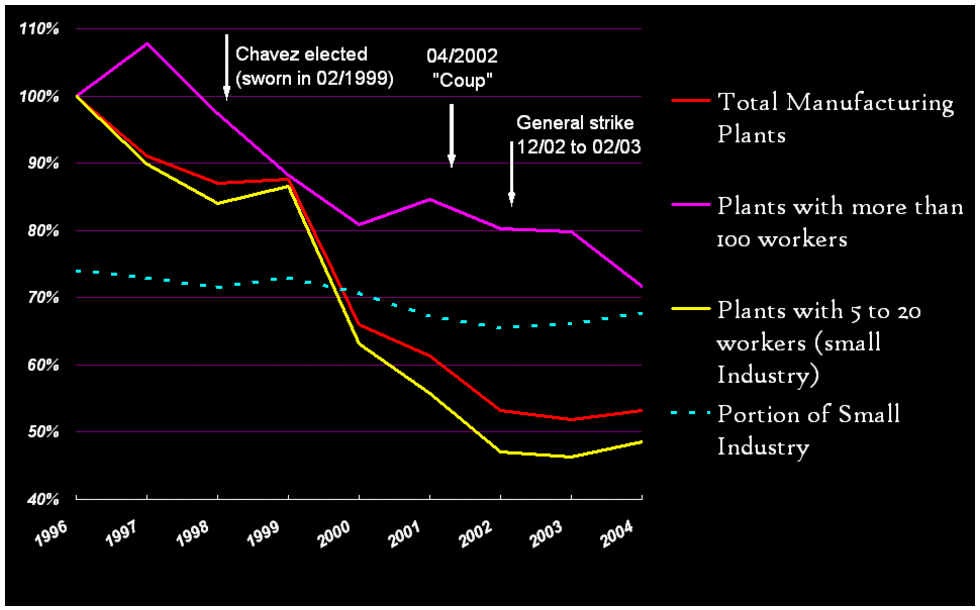
Now, before we interpret these results, we must realize that these cannot explain all of Venezuelan economical performance as it does not look at social programs or to the large creation of cooperatives (from which we have no hard data as to their economic input except unverifiable government numbers), nor does it include the public sector activity. We are here looking at this graph as a reflection on how the general economy confidence and diversity is affected. And the result is not good.
To simplify the data shown by Tal Cual I have limited myself to three lines, one from the total manufacturing plants (red), one from the large manufacturers (more than 100 workers, in fuschia) and one from the small manufacturers (from 5 to 20 workers, the seed for future medium and even large plants, in yellow). And I have added the ratio between small and large manufacturers, a ratio which should be increasing in a country which is experiencing development, exploring new economical options, and decreasing in a country where only established business survive and entrepreneurs are disheartened. Unfortunately for Venezuela this curve (dotted sky blue) tends to drop!
The striking result is that the decline has started before Chavez and was greatly affected by the recession of 1999 and 2000. During that time a combination of low oil prices and a pugnacious period for a new constitution conspired together to close a considerable number of business. However Chavez search of excuses for his management will not be satisfied with these numbers. The tendency to decrease has not been either dramatically exaggerated by the coup or the strike and is far from reverting by the end of 2004 in spite of the vaunted recovery: more production but no more private business creations! If the small business and the total numbers did seem to stop their decline, the larger concerns kept falling all through 2003 and 2004.
Clearly the private sector is not investing, is not generating jobs besides what it might do to recover its pre Chavez production. This graph is unfortunately yet again another example on how easy it is to destroy the economic texture of a country and how difficult it is to create it. The enabling law of 2001, the one which started all the political troubles of the recent years, is the main hindrance for a strong real manufacturing recovery.
The government has no real plans, or at least no plan that make sense. Cooperatives can be a good solution but not when they are organized as ways to get government subsidies as is the case for many of those created these days, thinly disguised cash distribution programs. And the congestion proposals are only scaring the private sector (more on this some other day). In fact the only response is a threat to seize around 700 closed or underperforming manufacturing plants (in english here). As if these businesses, probably closed for economical reasons for now years as seen on the graph above, will just restart because the government wills it so. Or will it all be another cash redistribution program to Chavez newly rich friends that will benefit from the state forcing the sale on the cheap of under used installations? The more than likely unfortunate answer shall not be much delayed.
The Venezuelan Pot calling black the US Kettle
"Cachicamo diciéndole a morrocoy conchudo" is a Venezuelan saying equivalent to "the pot calling the kettle black" or something like that. And it serves as a title for the mini editorial of Tal Cual today by Simon Boccanegra (Miguel is out of town, someone got to translate a little bit of Tal Cual this week :) [I have already mentioned some of the remarks on New Orleans by Chavez here]
--- --- --- --- --- --- ---
Speaking of New Orleans, our ineffable president allowed himself a series of criticisms on the US government actions. Criticisms, by the way, more than deserved from the mouth of others and who if someone has not shown restraint it is the very media of that country, who has beaten Bush to a pulp, whose popularity dropped during the last two weeks to 38%. But the pot of Miraflores lacks absolutely of any moral authority to call the kettle of the White House black. More inept than the Venezuelan government in addressing the Vargas mudslides not even Bush's administration would have been (1). There is Vargas State, as a monument to the laziness, the incapacity and the insensitiveness of the national government. Now, to top it all, six years after, according to a press note, the Seniat (2) has just found out in La Guaira docks two containers full fo food and water __ all decomposed these goodies __ that were sent by the international solidarity to help the refugees of the Vargas shore (3). How about that? The truth is that one can be inefficient, but in matters of inefficiency the government "saviour of the world" is abusing. (4)
--- --- --- --- --- --- ---
Foot notes for our non Venezuelan readers:
--- --- --- --- --- --- ---
Speaking of New Orleans, our ineffable president allowed himself a series of criticisms on the US government actions. Criticisms, by the way, more than deserved from the mouth of others and who if someone has not shown restraint it is the very media of that country, who has beaten Bush to a pulp, whose popularity dropped during the last two weeks to 38%. But the pot of Miraflores lacks absolutely of any moral authority to call the kettle of the White House black. More inept than the Venezuelan government in addressing the Vargas mudslides not even Bush's administration would have been (1). There is Vargas State, as a monument to the laziness, the incapacity and the insensitiveness of the national government. Now, to top it all, six years after, according to a press note, the Seniat (2) has just found out in La Guaira docks two containers full fo food and water __ all decomposed these goodies __ that were sent by the international solidarity to help the refugees of the Vargas shore (3). How about that? The truth is that one can be inefficient, but in matters of inefficiency the government "saviour of the world" is abusing. (4)
--- --- --- --- --- --- ---
Foot notes for our non Venezuelan readers:
- The Vargas disaster was the catastrophe that happened in December 1999 in Venezuela and which proportionally to our country size was as bad as Katrina.
- Seniat is our tax agency which lately makes the IRS look as the good guys.
- La Guaira is the main harbour of Caracas. Together with Puerto Cabello they account for more than half of Venezuela imports. Since 2000 almost yearly containers destined to the Vargas refugees are uncovered. Apparently they cannot even have a good inventory system.
- The latest crusade of Chavez is that he is offering his economic model (?) to counter act the US model. That is fine if it were not for the evangelical tone used by Chavez who seems to start to believe that he is indeed the saviour of the world. At least he has worded the Bolivarian revolution as saving Latin America.
Subscribe to:
Posts (Atom)