Wednesday, October 12, 2005

The tale of Chavez and his nuclear reactor from Argentina.

It seems that Hugo Chavez wants to buy a medium size nuclear reactor from Argentina. According to the article, the reactor is needed to be able to help liquefying the heavy oils of the Orinoco Belt. The news was confirmed by Vice president Jose Vicente Rangel here.

On the other hand, reading yesterday’s late news in El Universal, I learned that the president of PDVSA and minister of oil and energy, Rafael Ramirez, just denied that Venezuela would be interested in buying a reactor from Argentina. The news appeared today in Aporrea (see here) and on the ABN and was the first news this morning in the minci page. I was actually amazed that the face of the smiling minister had even replaced that of Chavez, which is quite unusual in the official news. But, if you link the minci now, you will see that the news about Ramirez’s declaration has disappeared from their site (that is why one always have to get a snapshot of any minci page! ).


The question is why? What is going on?

And who is right, Rangel or Ramirez?

Whoever is right, the decision of buying a nuclear reactor cannot be easily justified in Venezuela.

To put it mildly, it is quite strange that in order to produce extra power to liquefy some of the heavy oil of the Orinoco Belt, a country that produces so much gas and oil like Venezuela would need a nuclear plant. If, indeed, extra power is needed, why not build a non-nuclear thermal plant? Venezuelans have had several plants of that kind built, even in record time, during the oil boom of the 70’s, they have expertise in the management and operation of those plants and they have the raw material: oil and gas.

According to Cadafe, there are at least 16 operating plants of that type in the country.


On the other hand, if a nuclear reactor is bought, it would be a total novelty for Venezuela. There is, to my knowledge, only one experimental nuclear reactor at IVIC and, besides that, there has not been any other nuclear experience in Venezuela. Moreover, it seems that Chavez is not thinking of buying the reactor from a country with long experience in nuclear power either, like the US, Canada or France. He is having talks with Argentina!

According to the Argentineans themselves, the nuclear reactor they would sell to Venezuela would still be a “prototype”… So here are my questions, Mr. Chavez:

1.-what is the business sense of buying a nuclear reactor when an ordinary thermal plant or an electric substation from the hydroelectric transmission can be installed? (see below)
2.- Why buy a technology that has not a proven solid record of reliability?
3.- Why buy a technology that Venezuela has no previous experience in deploying?
4.- Where/when are you going to form the highly qualified professionals to deploy that technology?

But for the reader to be able to grasp the magnitude of question number 1, I must recall that Venezuela not only has plenty of oil, gas and coal but also a lot of water.

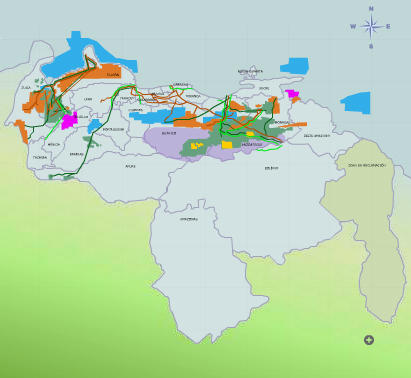
Here in lilac, from PDVSA map page (click the section “maps” on your right), is the region where the Orinoco Oil Belt (Faja bituminosa del Orinoco) is located.


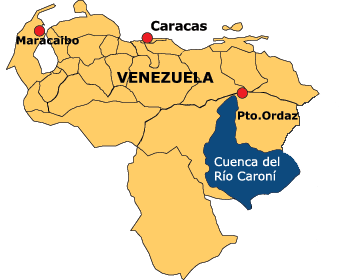
Below, there is a map, extracted from the Edelca page, showing where Venezuela’s huge hydroelectric resources are being exploited.


And, from the map below, one can see the transmission infrastructure from hydroelectric plant Guri to the important regions of the country using 765 Kv and 400 Kv lines.
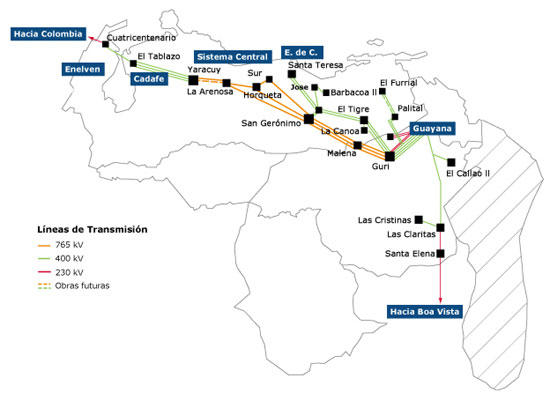


If one looks at this map carefully and compares it with the one of the Orinoco Oil Belt given in PDVSA site, one can easily see that the power needed is right there. The generation, the transmission and the oil sands are quite close together. Moreover, exploring the PDVSA map a little further, one can even find the number of already installed thermal and hydroelectric plants.

So here is another question to Chavez:

Why don’t you use Venezuela’s existing hydroelectric and thermal infrastructure Mr. Chavez? And, if, by any chance, the energy is not enough, why don’t you build a gas or an oil plant….after all, you do have oil and gas, don’t you?

I have an answer. Chavez needs confrontation, and by buying a nuclear reactor he knows that he will be provoking the US.

So having explained all the technical details and having questioned the president about it, we still have to answer the first question of this post.

Who was right? The minister of oil and energy or the Vice president?

My guess is both. The Vice-president, as a savvy politician that exploits Chavez’s natural instincts, may have come up with the idea of stirring the waters to create a new confrontation Chavez-USA. After all, congress elections will take place in a short time and there is nothing like a good confrontation with the US to boost Chavez’s popularity. The minister, on the other hand, must know that the nuclear deal would be quite difficult to justify from the technical and economic point of view.

Having said that, I still find it suspicious that the minister’s declarations were removed from the Minci page today…

You know, like in all autocratic regimes, we are now dealing not only with news, but also with the interpretation of no-news.

Welcome to Chavez’s era!

Jorge Arena.

Note added: A reader from Argentina wrote to me stating that even though he sympathizes with the points made in the article, he regrets my denigrating comments about Argentina. He says that Argentina has more than 50 years of nuclear experience and he provided the following links to follow-up on Argentinean nuclear research:


http://www.na-sa.com.ar/index2.htm

www.invap.com.ar/

www.cnea.gov.ar/

I must say that my comment about Chavez’s choice of Argentina was never intended to be denigrating, and I am very sorry that it was interpreted that way. My intention was to underline that the choice of Argentina as a unique candidate to sell the first nuclear plant to Venezuela seems to be clearly political. Even though Argentina is one of the two only countries with a nuclear program in Latin America, it is not the first one that comes to my mind when I think of countries with extensive experience in building and managing nuclear plants. Before writing the article, I checked this link that seemed to confirm my perception.


Tuesday, October 11, 2005

Back in hell, the Catholic one that is

I am just back in Venezuela though not at home yet. Still a few days until regular blogging resumes.

But the news that got me today was Chavez invoking the Catholic church doctrine to justify land invasions. After having invoked any religion or practice, from feathered Native American rituals, to a crucifix next to his heart at all time, from having proclaimed himself and evangelical to all but travel to Mecca, in his Sunday comic hour-S he justified his land grabs with some Catholic church teachings.

I may die in peace now, I have seen it all.

Friday, October 07, 2005

CNN in hotel rooms

I have learned to dread CNN en español when I travel. At these times I usually do not read much the papers or watch TV but I feel compelled to turn on the TV in the morning while I shower and get ready for either business or tourism. The reason why I dread CNN en español is that whenever I hear the word "Venezuela" it is not for good news (not that CNN, under any of its forms, gives much good news anyway).

Two mornings ago there was Maza Zavala of the central bank announcing that Venezuela had transferred 20 billon US dollars of its reserve to Euro bonds or something of the sort.

Now, I am pretty sure that there could be a lot of pretty good reasons to do such a transfer. Euro bonds, for example, could have higher yields. Or Venezuela suddenly starts importing much more from the Euro zone and needs better support. Whichever the case might be, as new reserves are generated and placed in Euro, old reserves are let to dwindle for payments of different forms of debt. The process could be as short as 6 months when one realizes that a country reserves tend to represent only a few months of imports, kind of a guarantee payment to the provider of goods.

But this time all was made in a hurry because Yo, El Supremo, Castro mini-me, decided that that was that. No studies shown, no cost evaluated, no nothing explained to us, except for the tantrum fit of the bad tempered spoiled brat that presides over our destinies.

However there is one thing that I am quite certain did happen: during this fast transfer a comission was payed somewhere to somebody. Let's assume that the comission was a mere 0.1%. That would still yield as much as 20 MILLION US dollars (or is that a little bit less numerically in Euros?). In other words, Chavez fit cost the country 20 million USD, at the very least, 20 millon that could have been used to refurbish one of the downtrodden Caracas hospitals that Chavez has so ingominously abandonned in his search of foreign glory for him (not Venezuela I need to remind the reader).

Now, would it not be interesting to know who received such a comission for a couple of days of work? And how much of that comission did find its way to some Venezuelan "operators"? I can tell you one thing, I doubt that we will ever be able to find out what chavista hack benefited form this, but we will see the luxurious expenditures at some point, while some suckers scream "Viva Chavez!"

Thursday, October 06, 2005

The Zamorana pistol: an endogenous product development in Hugo Chavez revolution.

Reading this article in Bogotá’s El Tiempo, written by Valentina Lares Martiz, I learned that the revolution is now promoting manufacturing weapons.

The first product will be a 9 mm pistol called “Ezequiel Zamora” in honor of the colorful leader of Venezuelan Federal war that is one of Chavez’s icons. Some of Chavez’s friends have even said that the president believes that he is Zamora’s reincarnation (see here). So the choice for the pistol’s name is quite suggestive.

For the first time there will be fire arms 100% made in Venezuela. Actually, according to the article, the president of Cavim, the industry in charge of producing the arms, says that this will allow the substitution of foreign made weapons.

I am quite proud. Killing machines 100% made in Venezuela, a good legacy of Chavez’s revolution.

When facing the criticism because instead of producing medicines or food, Venezuela is investing in native weapons, the president of Cavim stated that his company is 100% private, although it is associated with the Ministry of Defense.

But you have to pay close attention to the next sentence, which is absolutely sublime. I will copy it here so that all its sense is not lost in translation or that you would think that I am making that up.

"Venezuela no está en una carrera armamentista. Cavim tiene un objetivo social y lo que está haciendo es trabajar, producir armamento, municiones y explosivos",

It says that Venezuela is not in an armament competition. Cavim has a social objective (you read it right!) and what is doing is working, producing weapons, ammunitions and explosives.

Gee! Thanks for explaining! Producing weapons, ammunitions and explosives must really have a profound social objective. Now, this ghost blogger is clueless. I wonder which social objective that could be. Unless it is getting everyone killed to get rid of social problems?

But, if you were still nervous about this weapon business, keep reading, this should make you relax:

..quien aseguró que las armas tampoco están destinadas a atacar alguna nación: "Esa no es nuestra filosofía. Cavim se adapta a la nueva doctrina expresada por el Presidente sobre la defensa de la soberanía".

Cavim’s president assured that the weapons will not be used to attack any nation. “That is not our philosophy. Cavim adopts the new doctrine expressed by the President about the defense of sovereignty”.

What doctrine are we talking about? The one according to which Chavez wants to create an army of two million people? (see Alo Presidente, April 3, 2005, page 37)

After all, this is the government that considers as a “good news” to arm and train peasants (see my article here).

And to complete the picture, let us keep spreading the good news. The advantage of the Zamorana pistols is their low cost, they will be quite affordable. According to the article they will cost 372$, about half the price of an imported 9 mm Glock.

And if you, dear reader, are still not convinced of how wonderful this new Chavista enterprise is, here is the best part. The industrial plant will be able to produce 15000 weapons a year! Isn’t that great?

So, Venezuela, that has one of the highest crime rates of the world and an astounding number of deaths by fire arms, will now produce even more affordable weapons. Since we had not enough of them, with 15000 cheap extra weapons, we will now be able to reach a good level of development and social peace.

Why didn't we figure that out before?

Is this plain goverment stupidity or does it have the intentional objective of keeping arming the people to “defend” the revolution?

What can I say?I am speechless.

Jorge Arena.

Tuesday, October 04, 2005

Brazilian agrarian imperialism?

So Chavez keeps (or was that kept?) talking about his good friend Lula and what an example he is. Well, he would be well advised to follow some of his realpolitik policies.

Last night I was at one of those festivities that close the days in these international trade fairs and I was talking with a group of Brazilians. One topic was the ranches of 30 K and more hectares (multiply by 2 for acres, I think, but I am on the road, cannot check). These ranches sprouting around in the Matto Grosso are fully mechanized, Great Plains style, with fronts lined with dozens of harvesters to collect the soy crop. Followed by a line of equally impressive machines to pick up the harvest or to plant the new one.

I will not discuss the ecological aspect of it, just limit the US reader to contemplate what did happen to the Great Plains before casting a stone to Brazil settlement of the Matto Grosso. However, one thing is sure, Brazil is continuously increasing its exprots of feed stuff. I even heard that poultry is sent big time to the US since Katrina et al. have wrecked chicken production in the South. I wonder if this will have an effect on the price of the chicken imported by MERCAL...

Meanwhile as Brazil is preparing itself to become the granary of the world, for better or for worse, in Venezuela Chavez declares that anything bigger than a few hundred acres should be retruned to the people, while creating a fake "sem terra" movement. He even resorts to import the real thing from Brazil to try to have the Brazilian leaders teach the few Venezuelans farmers to unite (which they will probabaly end up doing but against Chavez when all the promised help fails to materialize, a given if you ask me). And as Brazil keeps exporting more and more food, Venezuela will keep importing more and more...

Escape from Venezuela

Just a note to let you know how difficult it is becoming to leave Venezuela. When I left, it coincided with the departure of the European flights (and no, I unfortunately did not travel to Europe). Well, all the passengers for Europe, including the Air France 747, all passengers for the Caribbean from that section of the Airport, plus some South American and Miami, had to go through A SINGLE X RAY machine... The line to go through it lasted 1.5 hours........ On the other side I did not even had time to get a drink as I had to board almost immediately. Ah! And I forgot that I had to go first through a 20 minutes line just for the National Gurads to check my passport... Plus half an hour in front of my inefficient ticket counter where the conveyor belt was defective (not the fault of the airline, just ariport maintenance).

Hopes for a quieter return were promptly dashed as I was informed that the brand new belt of the brand new arrival terminal was already breaking down (the circuits) and waits of 2 hours to get your bags were not unheard of...

My passport was checked a total of 5 times.......... In the US they are so happy to see you leave that two passport checks are enough.

So, Venezuela keeps its descent into 4th world status (though sometimes one wonders if in the past we were even third world...)

Sunday, October 02, 2005

Travel Announcement

I am travelling outside of Venezuela for business. Hence the already noticeable slowing down in posting. But I am trying to coax my ghost bloggers into stepping in for a couple of posts as things keep moving fast in Venezuela. So, you can keep tuning in (not to mention that in the past they made an outstanding job to liven up the site). In about ten days I should be getting back into normal mode.

And to tell you the truth, I could use a break too, these past three weeks have been exhausting in Venezuela as Chavez is trying to impose on us his crazyness. Thus a few days sort of away of the constant grind should recharge me for the legislative battle that will start in earnest by mid October. But I know myself, any free hotel internet service will find me trying to type something on the run.

Followers