Saturday, October 15, 2005

Narcissistocracy

Thus the beloved leader of the masses decided at the very last minute to fly over to Salamanca for the Iberoamerican summit (Portugal, Spain and all of their ex American colonies, kind of a Commonwealth meeting, with King included). He let plan some doubt as to his trip but we never worried: El Surpremo blasts any summit that crosses his path but never misses any. Apparently the real hold this time was that Castro decided that it was better for him not to attend. There is talk for an arrest warrant for crimes against humanity that he has committed aplenty. Eventually our narcissist president, closer to a rock star than to a serious country manager, flew off to Spain.

Although unrelated I found this note in yesterday Tal Cual quite amusing and, as we say in French, fort à propos. The translated quote first (sorry, no links) and then a few comments for the better understanding of the unsuspecting reader.
People who are not Chavez followers, who for a reason or another had to get inside the hermetic Miraflores Palace, cannot overcome their shock as to the different changes and new designs that have taken place inside to please the president.

They thus revealed that the "Pantano de Vargas Room" has lost the portrait gallery of ex presidents from the democratic era painted by noted Venezuelan artists.

In their place there are pictures of president Hugo Chavez in different poses and in different trips. The secret on these changes was kept through these years due mainly that the private media representatives have been banned the access to the seat of the central government.
I am not familiar with Miraflores Palace, our White House, nor do I expect to become familiar with it for the years to come, but I suspect that there is a room where portraits of previous inhabitants are kept, in particular those of the democratic era who allowed Chavez to reach office. Sometimes reading some Chavez supporters overseas one would be led to think that before Chavez we were living under some sort of bloody dictatorship enjoying the subjection into misery the Venezuelan people. But the fact that Chavez is desperately trying to rewrite is that since 1958, 9 elections yielded 10 presidents reaching office through free and reasonably fair election, something that now has become a distant memory as we are on our way to an El Supremo for life.

The second fact is that if the private media had little access to Chavez since the mid 1999, this one has not subjected himself to a press conference at home since April 2002, the type of press conference that even Bush in the worst moments of the Iraq invasion could not avoid from holding. The only journalists that do manage to sneak a tough question on occasion are foreign journalists, and usually outside of Venezuela. Not that it really bothers Chavez as he bluntly refuses to either answer them or chalk it on the account of some international conspiracy against his pseudo policies. This of course would not be tolerated in their own country by people who find nothing wrong with Chavez dodging accounting for his actions.

Meanwhile, as any could have predicted, the bunkerization of Miraflores has kept apace. No interior view of where Chavez lives and hangs around is exhibited, be it Miraflores or his Airbus toy from which we only know a video snuggled out by somebody that probably got away with it by having his camera on while hanging it over his shoulder in front of unsuspecting guards. Meanwhile at the White House, even during the Iraq war and Bin Laden on the lose, visitors still can visit some of the rooms. Not to mention that guests can speak of their rides on Air Force 1.

Thus how could we be surprised at the announcement that either Chavez or the sycophants that surround him are rewriting history, at least on the walls of Miraflores Palace? Contact with reality is lost fast by people who attempt to become Cosmocrators, even if he visits the king of Spain barely two days after having excoriated once again the Spanish takeover of the Americas. Double standards, double talk, double personalities are usually associated with pathological personalities. Nothing new under the sun.

Friday, October 14, 2005

Panama and Venezuela, plus a shopping gossip

Though with some side travel, my main destination was Panama. Nice little country, very interesting and more so now with the very historical canal. If I may be forgiven from using cheap clichés, I think that together with Tikal and Machu Pichu it is the most significant human achievement in the Americas. Not the biggest, or nicest, or anything of the sort, the stress is on significance, before anyone gets upset.

But I digress. I had a good time there and I enjoyed the little bit I saw of the city. The contrast with Venezuela was rather startling. Very few potholes in the streets. Very few beggars, or street children for that matter (and I went to a seedy part of town to look for guayaberas in a specialty manufacture, a flop by the way). Food was great and cheaper than in Caracas, and with much better service. Tips could be left without afterthoughts. Good beer but lousy rum. People also seemed more optimistic about their future even though Torrijos seems to be sinking in the polls as they are tackling a difficult social security reform. All in all, Panama looked strangely like a Venezuela where things would sort of work out and where general improvement was on its way. Still very Latin, very messy Caribbean but nice, gentle with a method in their madness.

Now the part that scared me the most was describing the Venezuelan situation to the Panama folks I met. They all understood quickly self censorship of the press, police and military privileges, Bolivarian Circles (dignity battalions under Noriega), organized corruption, etc, etc… Their words: Oh! It is just like it was under Noriega! And this went on from business acquaintances to an usher who refused my offer to trade Chavez for Torrijos. Even one of the cab drivers who used to be a Noriega guard that was even sent to Israel for training. He did miss the good old days (amazing that he would feel free to confess such a thing) but he was semi aware at least that it could not have lasted and he moved on with his life, not looking forward for an eventual release of Noriega in a couple of years. We would be so lucky if the chavistas in charge would go as "gracefully" when their turn come.

But the best was the gossip gathered by one of my friends shopping at some mall. There in Joyeria Apollo, if memory serves me well, she was looking at some expensive watches while she was waiting for some friends to purchase something. Aimlessly she asked for the price of one and was told it was 8 000 USD. Of course she gagged and cursed herself for her expensive tastes. But the store clerk noticed her accent and started talking with her about Venezuela. He said that he had a regular customer, a National Assembly representative that did actually bought the same watch a few weeks ago. Apparently the guy is very nice with him, very pleasant and has no problem with his credit card (while me, or my friend, or any "normal" Venezuelan, we are allotted only 4 000 USD a year on our card, the maximum allowed by the strict currency exchange control).

The name? I cannot give it directly as I could get sued for it. After all I was not a direct witness of the scene (nor do I have the means to start an in depth investigation) and there is no reason why I should be blamed for a "slander" that I would have no way to defend against. Let's say that it is the leader of a pro Chavez "willful and able" party, and he wears glasses. His brother has been accused of pocketing road building contracts. He was mentioned in the press as buying and building quite a little farm/countryside home in a state before Zulia; and when he was the mayor of a central municipality he was suspected of a few not very kosher dealings…. Thus him buying an 8 000 USD watches in Panama is really not hard to believe. Like many chavistas cashing in, well, Panama is a good place to wash ill acquired gains: we should look at the airport entries and the frequent visitors. Unfortunately when I go to Panama it is not to hide money I do not have, nor to spend the little bit I manage to scrounge, except for an IPod like gadget and some great sea food. Well, maybe someday when Chavez decides to buy my conscience.

Wednesday, October 12, 2005

The tale of Chavez and his nuclear reactor from Argentina.

It seems that Hugo Chavez wants to buy a medium size nuclear reactor from Argentina. According to the article, the reactor is needed to be able to help liquefying the heavy oils of the Orinoco Belt. The news was confirmed by Vice president Jose Vicente Rangel here.

On the other hand, reading yesterday’s late news in El Universal, I learned that the president of PDVSA and minister of oil and energy, Rafael Ramirez, just denied that Venezuela would be interested in buying a reactor from Argentina. The news appeared today in Aporrea (see here) and on the ABN and was the first news this morning in the minci page. I was actually amazed that the face of the smiling minister had even replaced that of Chavez, which is quite unusual in the official news. But, if you link the minci now, you will see that the news about Ramirez’s declaration has disappeared from their site (that is why one always have to get a snapshot of any minci page! ).


The question is why? What is going on?

And who is right, Rangel or Ramirez?

Whoever is right, the decision of buying a nuclear reactor cannot be easily justified in Venezuela.

To put it mildly, it is quite strange that in order to produce extra power to liquefy some of the heavy oil of the Orinoco Belt, a country that produces so much gas and oil like Venezuela would need a nuclear plant. If, indeed, extra power is needed, why not build a non-nuclear thermal plant? Venezuelans have had several plants of that kind built, even in record time, during the oil boom of the 70’s, they have expertise in the management and operation of those plants and they have the raw material: oil and gas.

According to Cadafe, there are at least 16 operating plants of that type in the country.


On the other hand, if a nuclear reactor is bought, it would be a total novelty for Venezuela. There is, to my knowledge, only one experimental nuclear reactor at IVIC and, besides that, there has not been any other nuclear experience in Venezuela. Moreover, it seems that Chavez is not thinking of buying the reactor from a country with long experience in nuclear power either, like the US, Canada or France. He is having talks with Argentina!

According to the Argentineans themselves, the nuclear reactor they would sell to Venezuela would still be a “prototype”… So here are my questions, Mr. Chavez:

1.-what is the business sense of buying a nuclear reactor when an ordinary thermal plant or an electric substation from the hydroelectric transmission can be installed? (see below)
2.- Why buy a technology that has not a proven solid record of reliability?
3.- Why buy a technology that Venezuela has no previous experience in deploying?
4.- Where/when are you going to form the highly qualified professionals to deploy that technology?

But for the reader to be able to grasp the magnitude of question number 1, I must recall that Venezuela not only has plenty of oil, gas and coal but also a lot of water.

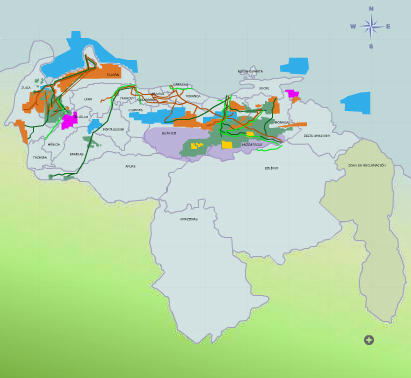
Here in lilac, from PDVSA map page (click the section “maps” on your right), is the region where the Orinoco Oil Belt (Faja bituminosa del Orinoco) is located.


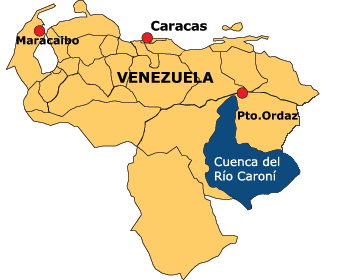
Below, there is a map, extracted from the Edelca page, showing where Venezuela’s huge hydroelectric resources are being exploited.


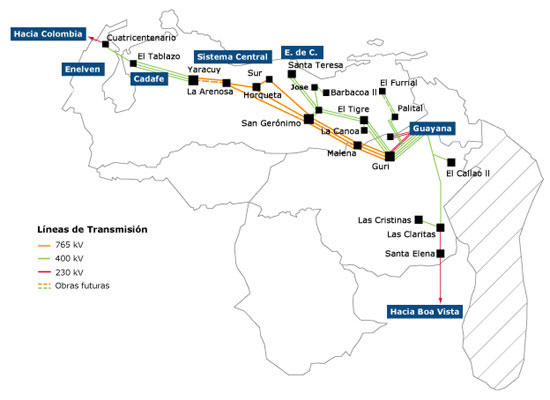
And, from the map below, one can see the transmission infrastructure from hydroelectric plant Guri to the important regions of the country using 765 Kv and 400 Kv lines.


If one looks at this map carefully and compares it with the one of the Orinoco Oil Belt given in PDVSA site, one can easily see that the power needed is right there. The generation, the transmission and the oil sands are quite close together. Moreover, exploring the PDVSA map a little further, one can even find the number of already installed thermal and hydroelectric plants.

So here is another question to Chavez:

Why don’t you use Venezuela’s existing hydroelectric and thermal infrastructure Mr. Chavez? And, if, by any chance, the energy is not enough, why don’t you build a gas or an oil plant….after all, you do have oil and gas, don’t you?

I have an answer. Chavez needs confrontation, and by buying a nuclear reactor he knows that he will be provoking the US.

So having explained all the technical details and having questioned the president about it, we still have to answer the first question of this post.

Who was right? The minister of oil and energy or the Vice president?

My guess is both. The Vice-president, as a savvy politician that exploits Chavez’s natural instincts, may have come up with the idea of stirring the waters to create a new confrontation Chavez-USA. After all, congress elections will take place in a short time and there is nothing like a good confrontation with the US to boost Chavez’s popularity. The minister, on the other hand, must know that the nuclear deal would be quite difficult to justify from the technical and economic point of view.

Having said that, I still find it suspicious that the minister’s declarations were removed from the Minci page today…

You know, like in all autocratic regimes, we are now dealing not only with news, but also with the interpretation of no-news.

Welcome to Chavez’s era!

Jorge Arena.

Note added: A reader from Argentina wrote to me stating that even though he sympathizes with the points made in the article, he regrets my denigrating comments about Argentina. He says that Argentina has more than 50 years of nuclear experience and he provided the following links to follow-up on Argentinean nuclear research:


http://www.na-sa.com.ar/index2.htm

www.invap.com.ar/

www.cnea.gov.ar/

I must say that my comment about Chavez’s choice of Argentina was never intended to be denigrating, and I am very sorry that it was interpreted that way. My intention was to underline that the choice of Argentina as a unique candidate to sell the first nuclear plant to Venezuela seems to be clearly political. Even though Argentina is one of the two only countries with a nuclear program in Latin America, it is not the first one that comes to my mind when I think of countries with extensive experience in building and managing nuclear plants. Before writing the article, I checked this link that seemed to confirm my perception.


Tuesday, October 11, 2005

Back in hell, the Catholic one that is

I am just back in Venezuela though not at home yet. Still a few days until regular blogging resumes.

But the news that got me today was Chavez invoking the Catholic church doctrine to justify land invasions. After having invoked any religion or practice, from feathered Native American rituals, to a crucifix next to his heart at all time, from having proclaimed himself and evangelical to all but travel to Mecca, in his Sunday comic hour-S he justified his land grabs with some Catholic church teachings.

I may die in peace now, I have seen it all.

Friday, October 07, 2005

CNN in hotel rooms

I have learned to dread CNN en español when I travel. At these times I usually do not read much the papers or watch TV but I feel compelled to turn on the TV in the morning while I shower and get ready for either business or tourism. The reason why I dread CNN en español is that whenever I hear the word "Venezuela" it is not for good news (not that CNN, under any of its forms, gives much good news anyway).

Two mornings ago there was Maza Zavala of the central bank announcing that Venezuela had transferred 20 billon US dollars of its reserve to Euro bonds or something of the sort.

Now, I am pretty sure that there could be a lot of pretty good reasons to do such a transfer. Euro bonds, for example, could have higher yields. Or Venezuela suddenly starts importing much more from the Euro zone and needs better support. Whichever the case might be, as new reserves are generated and placed in Euro, old reserves are let to dwindle for payments of different forms of debt. The process could be as short as 6 months when one realizes that a country reserves tend to represent only a few months of imports, kind of a guarantee payment to the provider of goods.

But this time all was made in a hurry because Yo, El Supremo, Castro mini-me, decided that that was that. No studies shown, no cost evaluated, no nothing explained to us, except for the tantrum fit of the bad tempered spoiled brat that presides over our destinies.

However there is one thing that I am quite certain did happen: during this fast transfer a comission was payed somewhere to somebody. Let's assume that the comission was a mere 0.1%. That would still yield as much as 20 MILLION US dollars (or is that a little bit less numerically in Euros?). In other words, Chavez fit cost the country 20 million USD, at the very least, 20 millon that could have been used to refurbish one of the downtrodden Caracas hospitals that Chavez has so ingominously abandonned in his search of foreign glory for him (not Venezuela I need to remind the reader).

Now, would it not be interesting to know who received such a comission for a couple of days of work? And how much of that comission did find its way to some Venezuelan "operators"? I can tell you one thing, I doubt that we will ever be able to find out what chavista hack benefited form this, but we will see the luxurious expenditures at some point, while some suckers scream "Viva Chavez!"

Thursday, October 06, 2005

The Zamorana pistol: an endogenous product development in Hugo Chavez revolution.

Reading this article in Bogotá’s El Tiempo, written by Valentina Lares Martiz, I learned that the revolution is now promoting manufacturing weapons.

The first product will be a 9 mm pistol called “Ezequiel Zamora” in honor of the colorful leader of Venezuelan Federal war that is one of Chavez’s icons. Some of Chavez’s friends have even said that the president believes that he is Zamora’s reincarnation (see here). So the choice for the pistol’s name is quite suggestive.

For the first time there will be fire arms 100% made in Venezuela. Actually, according to the article, the president of Cavim, the industry in charge of producing the arms, says that this will allow the substitution of foreign made weapons.

I am quite proud. Killing machines 100% made in Venezuela, a good legacy of Chavez’s revolution.

When facing the criticism because instead of producing medicines or food, Venezuela is investing in native weapons, the president of Cavim stated that his company is 100% private, although it is associated with the Ministry of Defense.

But you have to pay close attention to the next sentence, which is absolutely sublime. I will copy it here so that all its sense is not lost in translation or that you would think that I am making that up.

"Venezuela no está en una carrera armamentista. Cavim tiene un objetivo social y lo que está haciendo es trabajar, producir armamento, municiones y explosivos",

It says that Venezuela is not in an armament competition. Cavim has a social objective (you read it right!) and what is doing is working, producing weapons, ammunitions and explosives.

Gee! Thanks for explaining! Producing weapons, ammunitions and explosives must really have a profound social objective. Now, this ghost blogger is clueless. I wonder which social objective that could be. Unless it is getting everyone killed to get rid of social problems?

But, if you were still nervous about this weapon business, keep reading, this should make you relax:

..quien aseguró que las armas tampoco están destinadas a atacar alguna nación: "Esa no es nuestra filosofía. Cavim se adapta a la nueva doctrina expresada por el Presidente sobre la defensa de la soberanía".

Cavim’s president assured that the weapons will not be used to attack any nation. “That is not our philosophy. Cavim adopts the new doctrine expressed by the President about the defense of sovereignty”.

What doctrine are we talking about? The one according to which Chavez wants to create an army of two million people? (see Alo Presidente, April 3, 2005, page 37)

After all, this is the government that considers as a “good news” to arm and train peasants (see my article here).

And to complete the picture, let us keep spreading the good news. The advantage of the Zamorana pistols is their low cost, they will be quite affordable. According to the article they will cost 372$, about half the price of an imported 9 mm Glock.

And if you, dear reader, are still not convinced of how wonderful this new Chavista enterprise is, here is the best part. The industrial plant will be able to produce 15000 weapons a year! Isn’t that great?

So, Venezuela, that has one of the highest crime rates of the world and an astounding number of deaths by fire arms, will now produce even more affordable weapons. Since we had not enough of them, with 15000 cheap extra weapons, we will now be able to reach a good level of development and social peace.

Why didn't we figure that out before?

Is this plain goverment stupidity or does it have the intentional objective of keeping arming the people to “defend” the revolution?

What can I say?I am speechless.

Jorge Arena.

Tuesday, October 04, 2005

Brazilian agrarian imperialism?

So Chavez keeps (or was that kept?) talking about his good friend Lula and what an example he is. Well, he would be well advised to follow some of his realpolitik policies.

Last night I was at one of those festivities that close the days in these international trade fairs and I was talking with a group of Brazilians. One topic was the ranches of 30 K and more hectares (multiply by 2 for acres, I think, but I am on the road, cannot check). These ranches sprouting around in the Matto Grosso are fully mechanized, Great Plains style, with fronts lined with dozens of harvesters to collect the soy crop. Followed by a line of equally impressive machines to pick up the harvest or to plant the new one.

I will not discuss the ecological aspect of it, just limit the US reader to contemplate what did happen to the Great Plains before casting a stone to Brazil settlement of the Matto Grosso. However, one thing is sure, Brazil is continuously increasing its exprots of feed stuff. I even heard that poultry is sent big time to the US since Katrina et al. have wrecked chicken production in the South. I wonder if this will have an effect on the price of the chicken imported by MERCAL...

Meanwhile as Brazil is preparing itself to become the granary of the world, for better or for worse, in Venezuela Chavez declares that anything bigger than a few hundred acres should be retruned to the people, while creating a fake "sem terra" movement. He even resorts to import the real thing from Brazil to try to have the Brazilian leaders teach the few Venezuelans farmers to unite (which they will probabaly end up doing but against Chavez when all the promised help fails to materialize, a given if you ask me). And as Brazil keeps exporting more and more food, Venezuela will keep importing more and more...

Followers