Showing posts sorted by relevance for query oil production decline. Sort by date Show all posts

Tuesday, September 25, 2007

Exactly what would it have accomplished to "engage in a debate" with Hitler?

The Wall Street Journal has a fascinating Op-Ed piece which is food for thought, Liberals or not alike. The question asked is whether Columbia receiving Hitler for a speech in 1939 would have made any difference? In other words, are there limits to dialogue and discussion?

The question is not an idle one as Columbia University, this hallowed bastion of New York Liberalism, is receiving Mahmoud Ahmadinejerk, oops!, Ahmadinejad for a speech while this one is coming to the UN conference as if he were your average head of state, Ground Zero visit included. Justly justifying, I think, the title of the piece is "Columbia's Conceit".

At the end of the article we can read the following:
In just a few years, some of these men [who would have received Hitler at Columbia in 1939] will be rushing a beach at Normandy or caught in a firefight in the Ardennes. And the fact that their ideas were finer and better than Hitler's will have done nothing to keep them and millions of their countrymen from harm, and nothing to get them out of its way.
To bring this into some context, for this Venezuelan blog at least, let's observe that Ahmadinejerk is a close ally of Chavez (not Venezuela, Chavez, extremely important distinction).

Serendipity wants that last night in a fit of idleness I watched La Hojilla, the worst political garbage of the state network VTV. Bad luck had it that Chavez linked to La Hojilla at 11:40 PM, from a big room where a U shaped system of tables showed plenty of bleary eyed folks still at work at some conference (we are in an electoral campaign and even if the country infrastructure is crumbling and the shelves are usually empty of milk, sugar and beans, there is a need to project an image of a president working 25 hours a day). While La Hojilla host, a pathetically semi orgasmic giggling Mario Silva, was shown on the little left corner square of the TV set, Chavez occupied most of the screen while explaining to us all the wonders of the Iranian collaboration, how they had to study hard to transform their mills designed for wheat into mills that could process corn and how now Venezuela would be buying plenty of mills from Iran to process the crops.

I cannot stress how wrong this is, how stupid and bad faith was Chavez last night. The problem in Venezuela is not the processing of Corn flour. We are the best at that, and we have even developed a spectacular infrastructure for the very specific needs of the type of corn flour that is needed for our Arepa, a very different quality than what is used in Mexico or elsewhere. Polar and other giant concerns in Venezuela have been perfectly able to supply for now decades enough corn flour to ALL Venezuelans at a very decent price, making it even often the only food item that poor Venezuelan could afford. That reality was even bad enough that Polar corn flour comes even supplemented with some trace elements to try to palliate some of the nutritional deficiencies that come with a diet based on corn flour bread alone.

No matter what Chavez says or said, corn floor production and supply in Venezuela was one of the greatest capitalist success story in that it provided a whole country with a cheap source of food that would allow to stop the hunger crisis of the past in a way no other government was able to do, including this one who can only avoid empty shelves through increasing imports of food, with all the irregularities, waste and corruption that come in a subsidized scheme. The problem in Venezuela today are the ill conceived agrarian policies which are ruining agricultural production. The problem is not processing and distribution of food stuff, the problem is their production, and this is the abject reality that Chavez is so desperate to hide.

But Chavez is willing to jettison what Venezuela does best in order to increase his control on all. Polar et al. must be broken and the Iranian alliance will be the tool, or so he hopes. Chavez will control the food supply to Venezuelans so that we will owe him everything and for this he is binding Venezuela to the most alien culture to the Venezuelan way of life where adultery, beer, string bikini and even gay sex flourish (there are enough repressed and not so repressed homosexuals in Chavez entourage). In Iran all these people risk from public lashing to outright death by stoning.

And Chavez also announced to us, after defending Iran's nuclear program, that one day Venezuela will start its own nuclear program. Until when for Columbia to receive Chavez?

I am not prepared to link Chavez to Hitler, not even Mussolini, and perhaps not even Peron. He is too much of a coward, of a tropical small time thug to manage to create a system that could really threaten the peace of the world (except for the continuous decrease of Venezuelan oil production). Besides, even if he is surrounded by sycophants (the presentation of Hector Navarro last night, the "Science" minister, was particularly pathetic), these ones are of such low quality that I wonder if they could run a concentration camp efficiently. Not that they would not try to do it, after all there is the Tascon list to show to the world that active discrimination is now an everyday occurrence in Venezuela. No, they are just too incompetent: the Chavez regime is held in place by corruption and hand outs through high oil prices while Cuban agents control things behind the scene.

But it cannot denied either that Chavez is a danger. A danger to Venezuelans to begin with. A danger to the world by supporting people like Saddam, Ahmadinejad and Castro, not to mention a discrete support for North Korea, the Taliban and other assorted terrorist groups and common criminals such as the FARC. All the evidence is there, nothing needs to be discussed anymore.

One wonders at Columbia receiving someone who has made the destruction of Israel his personal pet project. Is there any discussion, dialogue possible with such a person? I do not think so, and the Columbia board is looking mighty stupid in receiving someone who has been put on the shit list of even a country like France.

And what about Chavez and his supporters here? As is the case for Ahmadinejad, Chavez becomes everyday more difficult to defend for those who are willing to dig a little bit below the show that Chavez masterfully puts up 24/24. There are certain things that free aspirin distribution cannot hide and even less compensate. Venezuela today is more vulnerable than ever. Besides oil there is nothing we produce in enough quantity to export and trade to compensate for a continued decline in oil production. And with the constitutional changes coming among an already fraudulent electoral campaign, human rights violations will become soon more frequent than even in Iran.

The question that is asked here is how long will dialogue be an option with Chavez and his supporters. Is it even an option today? Already Chavez refuses to answer questions from the press and treats them badly, saying that their questions are stupid and he thus does not need to reply to them. Will in the next future the press even get close enough to ask him how come there is blood on his hands? Will Columbia students treated as stupid if they dare to ask him real questions that even a true blue Liberal would ask? As for Chavez supporters, well, they are now a waste of time and judging to what happens in Internet pages such as this one or in newspapers such as EL Universal, they have stopped making sense and are easily exposed. So, when Ahmadinejerk or Chavez are invited to Columbia, who is there to blame? When are these trouble makers going to be taken for what they really are, even if their people were stupid and ignorant enough to vote for them? When will the likes of John Coatsworth realize that sometimes conflict cannot be avoided and early confrontation and containemt is the only way to avoid further damage?

But I suppose that Coatsworth, some in the Columbia faculty, Chavez and Ahmadinejerk all share something: they are incurable narcissists, those that have long ago adopted the saying that there is no such thing as bad publicity.

--- --- --- --- --- --- --- --- --- --- --- --- --- ---
Since I do not know how long the WSJ keeps up its pieces, I am posting the whole thing below.

Columbia's Conceit
Exactly what would it have accomplished to "engage in a debate" with Hitler?

BY BRET STEPHENS
Tuesday, September 25, 2007

On Saturday John Coatsworth, acting dean of Columbia University's School of International and Public Affairs, made the remark that "if Hitler were in the United States and . . . if he were willing to engage in a debate and a discussion to be challenged by Columbia students and faculty, we would certainly invite him." This was by way of defending the university's decision to host a speech yesterday by Iranian President Mahmoud Ahmadinejad.

An old rule of thumb in debate tournaments is that the first one to say "Hitler" loses. But say what you will about Mr. Coatsworth's comment, it is, at bottom, a philosophical claim: about the purposes of education; about the uses of dialogue; about the obligations of academia; about the boundaries (or absence of boundaries) of modern liberalism and about its conceits. So rather than dismiss the claim out of hand, let's address it in the same philosophical spirit in which it was offered.

A few preliminaries: When Mr. Coatsworth postulated Hitler's visit, he specified the year 1939, just prior to Germany's invasion of Poland and the beginning of World War II. This, then, is not yet the Hitler of Auschwitz, though it is the Hitler of Dachau, the Nuremberg Laws, Guernica and Kristallnacht. Mr. Coatsworth takes the optimistic view that "an appearance by Hitler at Columbia could have led him to appreciate what a great power the U.S. had already become," and thus, presumably, kept America from war.

Less clear is whether Mr. Coatsworth issued his invitation in the name of Columbia's current faculty or on behalf the faculty of the 1930s or '40s. We'll assume the answer is the current faculty, since it's unlikely that a committee led by Jacques Barzun, Mark van Doren, Lionel Trilling or other Columbia luminaries of the day would have had much use for "discussion" with the Führer (though it seems Columbia hosted a speech by Hans Luther, Hitler's U.S. ambassador, in 1933).

What, then, would be the purpose of such an invitation? Columbia's president, Lee Bollinger, offered a clue in a statement issued last week: "Columbia, as a community dedicated to learning and scholarship, is committed to confronting ideas--to understand the world as it is and as it might be," he said. "Necessarily, on occasion this will bring us into contact with beliefs many, most or even all of us will find offensive and even odious. We trust our community, including our students, to be fully capable of dealing with these occasions, through dialogue and reason."

That's an interesting thought, coming from a man who won't countenance an ROTC program on campus. But leave that aside. What's more important is the question of how Columbia defines the set of ideas it believes are worth "confronting," whether its confidence in "dialogue and reason" is well placed and, finally, whether confronting ideas is a sufficient condition for understanding the world.

In a March 1952 essay in Commentary magazine on "George Orwell and the Politics of Truth," Trilling observed that "the gist of Orwell's criticism of the liberal intelligentsia was that they refused to understand the conditioned way of life." Orwell, he wrote, really knew what it was like to live under a totalitarian regime--unlike, say, George Bernard Shaw, who had "insisted upon remaining sublimely unaware of the Russian actuality," or H.G. Wells, who had "pooh-poohed the threat of Hitler." By contrast, Orwell "had the simple courage to point out that the pacifists preached their doctrine under condition of the protection of the British navy, and that, against Germany and Russia, Gandhi's passive resistance would have been to no avail."

Trilling took the point a step further, assailing the intelligentsia's habit of treating politics as a "nightmare abstraction" and "pointing to the fearfulness of the nightmare as evidence of their sense of reality." To put this in the context of Mr. Coatsworth's hypothetical, Trilling might have said that in hosting and perhaps debating Hitler, Columbia's faculty and students would not have been "confronting" him, much as they might have gulled themselves into believing they were. Hitler at Columbia would merely have been a man at a podium, offering his "ideas" on this or that, and not the master of a huge terror apparatus bearing down on you. To suggest that such an event amounts to a confrontation, or offers a perspective on reality, is a bit like suggesting that one "confronts" a wild animal by staring at it through its cage at a zoo.

There is also the question of just what ideas would be presented by Hitler at Mr. Coatsworth's hypothetical conference, and whether they would be an accurate reflection of his beliefs and intentions. In his 1933 speech, Ambassador Luther made the case for Hitler's "peaceful intentions" in Europe, according to historian Rafael Medoff. Millions of Europeans believed this right up to September 1939, just as millions of Americans did right up to December 1941.

Let's assume, however, that Hitler had used the occasion of his speech not just to dissimulate but to really air his mind, to give vent not just to Germany's historical grievances but to his own apocalyptic ambitions. In "Terror and Liberalism" (2003), Columbia alumnus Paul Berman observes the way in which prewar French socialists--keenly aware and totally opposed to Hitler's platform--nonetheless took the view that Germany had to be accommodated and that the real threat to peace came from their own "warmongers and arms manufacturers." This notion, Mr. Berman writes, rested in turn on a philosophical belief that "even the enemies of reason cannot be the enemies of reason. Even the unreasonable must be, in some fashion, reasonable."

So there is Adolf Hitler on our imagined stage, ranting about the soon-to-be-fulfilled destiny of the Aryan race. And his audience of outstanding Columbia men are mostly appalled, as they should be. But they are also engrossed, and curious, and if it occurs to some of them that the man should be arrested on the spot they don't say it. Nor do they ask, "How will we come to terms with his world?" Instead, they wonder how to make him see "reason," as reasonable people do.

In just a few years, some of these men will be rushing a beach at Normandy or caught in a firefight in the Ardennes. And the fact that their ideas were finer and better than Hitler's will have done nothing to keep them and millions of their countrymen from harm, and nothing to get them out of its way.

Mr. Stephens is a member of The Wall Street Journal's editorial board. His column appears in the Journal Tuesdays.

-The end-

Tuesday, January 09, 2007

What Venezuelans voted for: socialism of the XXI century (a.k.a. rehashed communism)

The other day I was musing about how angry Chavez looked in spite of his 63% victory of December 3. That is, it seemed that for a third term victory he was rather upset at getting only 63% of the vote share. Well, today we learned that he meant business and that he is going to screw real good the 37% that did not vote for him (never mind those who did not vote at all).

The occasion was the swearing in of his new cabinet. It turned out to be a major overhaul of his cabinet, now much more "radical" than before, and also three more than before for a grand total of 27. Anyone remotely looking professional (that is, possibly slightly moderate or not nonsensical) has been removed. Now, more than ever, devotion to the beloved El Supremo is the norm. And never mind of course the now historical promise of cutting down bureaucracy by cutting down the number of cabinet positions to 12 max ... but more about this later in the post.

During the swearing-in ceremony (note, Chavez has not been sworn in yet for his new term but who cares...) Chavez gratified us with the specific announcements that indicate to us what that socialism of the XXI century is all about (remember, it was kept very vague during the campaign; tonight we know why). I will start with the executive resumé: it is more of the same failed socialo-communist models of the XX century; and as they were, totally doomed for failure. Except that the price of oil might slow down the collapse for a while.

I could give you the catalogue with abundant comments but that would be tiresome. Just three points that will make the situation clear and explicit for the patient reader. But before you read it is very important that you keep in mind that THE REAL REASON for everything is to create a power structure that will ensure that Chavez will say in power until kingdom comes, or he dies, whichever comes last. If you do not get this, then you will not understand what follows and only risk mental confusion.

The enabling law. This curious structure of Venezuelan legal procedure was a courtesy of sorts that was granted to any new incoming administration, EVEN if this one had not obtained a congressional majority. That special law granted the new president a limited amount of special powers that allowed him to emit a series of law-decrees. That is, certain laws were emitted by decree without parliamentary procedure on certain very specific topics. What is incomprehensible is that holding a 100% majority in the National Assembly who is now a mere rubber stamp for any law which is usually written by some governmental dependency, Chavez feels that it is important he gets a vast array of special powers to emit a series of decrees. Are the National Assembly appointed chavista (calling them elected strains intelligence) so lousy that Chavez has no patience with them? Is the country crisis so important that we cannot even consult with the people in this so called “participatory democracy”?

We now get the full measure of the man: no more participation not even from his very own parliament. Direct decrees and fuck this!

Why does he do that? Because he cannot help himself but also because the country is nearly bankrupt. After giving so much money away to buy his election, he needs to get back things under control to try, desperately, to erase the very highest inflation of the continent and to intervene all the economic factors that will allow him to moderate inflation (and purge more "enemies"). That is, any debate on certain economic regulations that might or might not be needed would risk to bring forth very inconvenient facts and data. Such as, say, the slow decline of oil price as Venezuelan oil production is also going down.

Nationalization of the Venezuelan telecom, CANTV.
This might be a little bit trickier to understand but stay with me and you will find it obvious.

CANTV used to be state owned. Then to obtain a phone you needed to get on a waiting list and it could take a year for you to get a phone number. If you knew someone and were willing to pay a significant bribe, well you could get it in 6 months. And of course long distance calls were near impossible, and multiple phone lines for business a dream. Some people would not move because they could not carry their phone with them and had to wait until their new home was connected. I remember that my first job had about 300 workers and only 4 phone lines. You had to write down your name on a list to get a phone call out and forget about getting emergency phone calls from home at work. Today the average wait is less than a week, and you can get as many phone lines as you are willing to pay for. Forget about that in a few years, once Chavez nationalizes CANTV.

But still, this would seem stupid. Why nationalize the basic landline company when there are 2 other private cell phone companies who are starting land lines projects, wireless internet project and what not? Not to mention cable TV... Well, the reason is to scare people, to bring a discrete terror. Everyone knows that in Venezuela landlines are currently monitored by the government at will. CANTV has enough employees and enough chavista employees within that the government can monitor whomever it wants without requiring a court order. True, you could avoid CANTV by subscribing to the other private concerns (as long as they remain private) but the fear factor will settle. Thus “conspiracies” as well as legitimate political activities or business will slow down. Who will discuss a juicy business deal if s/he thinks the government is listening too and could send you the IRS/SENIAT to your office a few weeks after the deal is concluded? No one will admit anything personal over the phone…CANTV or not…….

Nationalizing energy concerns. Whether companies were private (Caracas utilities from the very start, now AES owned) or were privatized or are mixed deals (the heavy oil of the Orinoco tar sands), they are all to become property of the state. Of course this will fail to produce more oil, will conduct to indirect privatization no matter what as Venezuelan oil production falls while budgetary needs increase.

As for electricity. Most electrical providers within Venezuela are state owned, and deficient in general. But the private Caracas service is good. So good compared to the other ones that it brings to mind an anecdote. About three years ago I wanted to buy an AC system multi split, that is, a single compressor but 2 separate chillers for two different rooms. I was in Caracas looking for prices at a reputed merchant. When the guy realized I wanted to buy it for my place in Yaracuy HE REFUSED TO SELL IT TO ME. He told me that the electronic controls of the multi split systems were too delicate for use outside of Caracas, that the amount of claims he had received had forced him to sell these devices only to the people who got their juice from AE&S. No comments.

So, why does Chavez wants to nationalize things that work well when all the country knows that the state owned utilities are woefully deficient? For one simple reason: patronage. How patronage works? At least at two levels. First, these industries are big employers. So he can fire all the workers that appear in the Tascon list and replace them with bona fide chavistas. After the “rojo, rojito” comment you know it will be like that. Then he can keep packing the joint with chavista faithful. Since service and efficiency will not be factors anymore, what is the problem with paying three guys instead of one? With an occasional devaluation you can afford these meager pay checks for that sector, who in addition would be so scared to lose that flimsy job that they will vote for Chavez gratefully for ever and ever.

But it also works in another form of patronage. AE&S is always complaining that the barrios are stealing electricity from Caracas grid. The Caracas regular housing of course must foot that bill by being overcharged for the stolen electricity that the government refuse to force barrios to pay. Now the barrios will be able to steal all what they want, and be happy and vote for Chavez, while the middle class might get a lousy service but will pay less at least. In the culture of chavista mediocrity, this is thought as getting votes for Chavez from the Middle Class.

Socialism? Indeed!!!! What we are promised is the inefficient form of socialism. No social democracy here, pure inefficient socialism, the one who paradoxically make the people ever more dependent from the state. Exactly what Chavez needs to stay in power for ever. Oh! And they were other announcements but the smart reader of this blog got the point.

I thus hope it as all clear now. We are waiting for the sigh of relief of the 63% jerks who voted for Chavez as reality is about to bite them in the ass. Half of the "novelas" (soap operas) in Venezuela are about to go, public utilities already a mess are about to get worse, oil income will go down. But Chavez has mounted a great show, sure to give him a lot of front pages around the world tomorrow, and while people start theorizing uselessly about this vapid socialism of the XXI century nobody will look at the financial mess of Venezuela and how Chavez is preparing a lot of controls to avoid facing the hole he dug himself.

Footnote (on purpose). The OAS secretary was also deeply and disturbingly insulted by Chavez, but for once I agree with Chavez. Insulza has been taken for a ride and now he knows what Venezuelans have been telling him all along. Chavez has used him well, got extreme leniency for all his electoral truancies and now that Insulza is of no more use for him he is discarded, just as Chavez discards anything on his way. Let's see if there is some spine in the OAS, or it might as well close as an all but useless institution that has accomplished very little in its undistinguished history. Good riddance of Insulza (who can probably forget a run for the Chilean presidency) and the OAS.

But Insulza could find a way to redeem himself soon: after all, there is more to come as the Bolivar governor is already openly calling for newspapers take over. Even the Guardian of London is noticing.


Tuesday, September 13, 2005

The Industrial tissue of Venezuela

One indicator of the good health of an economy is the measure of its manufacturing capacity. Even when manufacturing is a small portion of the economy, that it grows, that it generates new jobs, is always a sure sign that the future prospects of a country are good.

In the past two years numbers have been thrown right and left to try to pass the effect on Venezuela of the amazing increase in oil price as a genuine economic growth. Indeed, early this year there was a sense, already fading, that things might be going a little bit better. Many reasons for it, but my own explanation was that all the government spending has been stimulating consumption and some sectors, well, they had to grow. But it is an artificial growth, very much threatened by other governmental polices such as the massive foodstuff import through Mercal to distribute subsidized governmental grocery stores. Food plans do work for a while but rarely, if ever, do they promote food stuff production. For example Venezuela which used to produce all the chicken or meat it consumed, now must import a fair share of it.

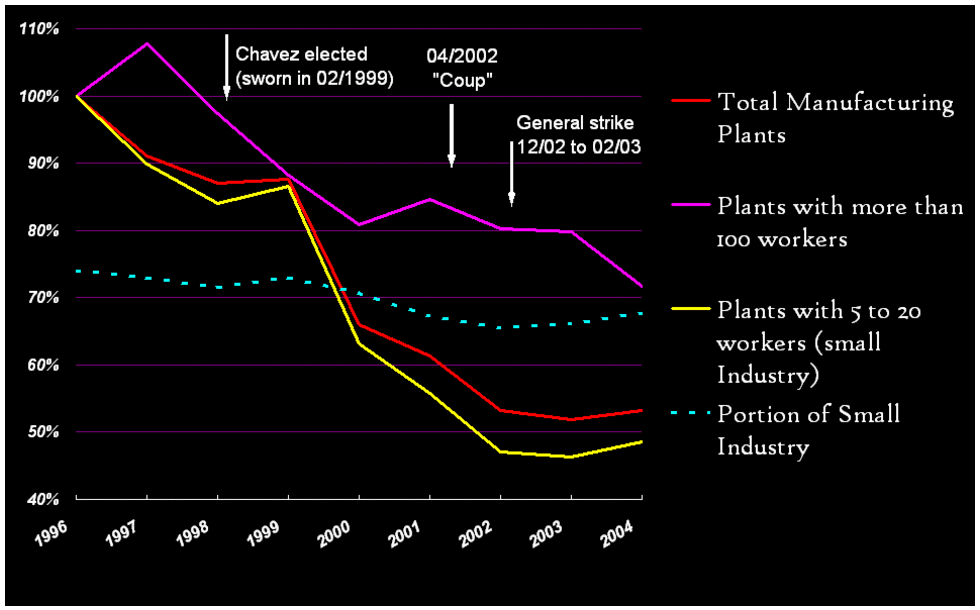
But I digress as for today's point. Tal Cual published the numbers from Conindustria (a manufacturers association) which simply count how many manufacturing plants exist in Venezuela, regardless of the sector they belong to. As usual I did not like the presentation in absolute numbers so I normalized it all to 1996 as 100%. A little bit of Excel and graphics and you can see the result below. I have included the three top political moments in Venezuela's recent history, those that conceivably would have affected the most manufacturing creation: Chavez election in 1998, the April events of 2002 and the 2002-2003 strike.


Now, before we interpret these results, we must realize that these cannot explain all of Venezuelan economical performance as it does not look at social programs or to the large creation of cooperatives (from which we have no hard data as to their economic input except unverifiable government numbers), nor does it include the public sector activity. We are here looking at this graph as a reflection on how the general economy confidence and diversity is affected. And the result is not good.

To simplify the data shown by Tal Cual I have limited myself to three lines, one from the total manufacturing plants (red), one from the large manufacturers (more than 100 workers, in fuschia) and one from the small manufacturers (from 5 to 20 workers, the seed for future medium and even large plants, in yellow). And I have added the ratio between small and large manufacturers, a ratio which should be increasing in a country which is experiencing development, exploring new economical options, and decreasing in a country where only established business survive and entrepreneurs are disheartened. Unfortunately for Venezuela this curve (dotted sky blue) tends to drop!

The striking result is that the decline has started before Chavez and was greatly affected by the recession of 1999 and 2000. During that time a combination of low oil prices and a pugnacious period for a new constitution conspired together to close a considerable number of business. However Chavez search of excuses for his management will not be satisfied with these numbers. The tendency to decrease has not been either dramatically exaggerated by the coup or the strike and is far from reverting by the end of 2004 in spite of the vaunted recovery: more production but no more private business creations! If the small business and the total numbers did seem to stop their decline, the larger concerns kept falling all through 2003 and 2004.

Clearly the private sector is not investing, is not generating jobs besides what it might do to recover its pre Chavez production. This graph is unfortunately yet again another example on how easy it is to destroy the economic texture of a country and how difficult it is to create it. The enabling law of 2001, the one which started all the political troubles of the recent years, is the main hindrance for a strong real manufacturing recovery.

The government has no real plans, or at least no plan that make sense. Cooperatives can be a good solution but not when they are organized as ways to get government subsidies as is the case for many of those created these days, thinly disguised cash distribution programs. And the congestion proposals are only scaring the private sector (more on this some other day). In fact the only response is a threat to seize around 700 closed or underperforming manufacturing plants (in english here). As if these businesses, probably closed for economical reasons for now years as seen on the graph above, will just restart because the government wills it so. Or will it all be another cash redistribution program to Chavez newly rich friends that will benefit from the state forcing the sale on the cheap of under used installations? The more than likely unfortunate answer shall not be much delayed.

Thursday, May 17, 2007

The Wall Street Journal does Yaracuy

I am not too sure what kind of cosmic conjunction has brought these two papers together but on the same day both the new York Times and the Wall Street Journal publish an extensive article on the land problems of Yaracuy, my humble home state now on the front page of the WSJ (it was not front page in the NYT...). Since it is subscriber only I am delighted to report that already 4 readers have sent me a copy of the WSJ article. Impressive. For those like me who cannot afford a WSJ subscription (now that I think of it the WSJ should give me a courtesy one considering all the free advertising that they got through this blog), I have put a copy here.

The first thing to be said is that the WSJ opus is much more direct and plainly condemnatory of Chavez policies than the NYT does. This by itself is not surprising, and contrary to what some might infer, it makes the lecture of the NYT even more necessary. Simon Romero deals more with the psychological impact of the issues, a tremendous impact, whereas Jose de Cordoba focuses more on the negative economical consequences (and future aggravated psy impact?). Thus it is truly something that we have these two reads on the same day (and even better if we consider the not very optimistic Forero piece on the Washington Post also published today about the communal councils, who supposedly will direct some of these land grabs as the WSJ so justly qualify the land invasions in Yaracuy). Now, let's comment on the WSJ piece (which comes with a great slide show).

First we get the hard hitting fact: from 10 000 tons a year of sugar cane the farm went down to zero. The lost crop has been replaced at best by some banana/plantain stuff. Sugar is missing on the markets but bananas can always be found, as well as plantains. The reader can already draw its first conclusion. A drastic one at that considering that banana is the easiest crop to grow in Venezuela low lands such as Yaracuy and as such is the one with the lowest financial return unless you can export it all. As a cash crop substitute, bananas are a bust!

The next thing is that Cordoba provides us with more hard data (it is the WSJ after all) and we can read the following:
Since coming to power, the Chavez government has handed over 8.8 million acres, an area bigger than Maryland, for use by the poor. While much of this was state-owned land that was either idle or leased to ranchers, some 4.5 million acres were "recovered" from private owners, Mr. Chavez said recently. In some cases, the government compensated them. In most others, like Mr. Lecuna's, it has simply turned a blind eye to land invasions.

At least now we do get the first numbers I have seen of state lands involved in redistribution schemes. I cannot vouch for that number and I suppose Mr. Cordoba is well informed, but I am tempted to believe him considering that Chavez has probably given state land away but prefers to highlight for political reasons the ones he takes away from private owners.

And right after that there is another line that pretty much closes the article even though we are barely half way through it:
But so far, the effect has been to undercut production of beef, sugar and other foods, as productive land is handed to city dwellers with no knowledge of farming. Established farmers and ranchers, fearing their land may be seized next, are cutting investment in their operations to a minimum.

Nothing that readers of this blog did not already know, by the way. Still I will add yet one more excerpt that illustrates quite well how Chavez is fooling less and less people.
Mr. Chavez blames the shortages on "speculation" by distributors and producers. Agriculture Minister Elias Jaua recently called a news conference to deny there's been any decline in food production during the eight years of Chavez rule. The central bank stopped publishing agricultural statistics in 2005. A private farm association called Fedeagro estimates Venezuela grew 8% less food last year than the year before, citing factors including the price controls, land seizures and the wave of kidnappings of farmers.

All of this yours truly can verify on his own. Cordoba is not making anything up: if things go that way and if by bad luck oil production, or prices, or both, were to fall down, we will starve. Or limit ourselves to bananas.

The rest of the article is more concerned with illustrative details, but it includes a more complete description of the previous land reforms which already had ended the absentee landlord system. The implication is simple: this is not about absentee landlords anymore, it is a naked land grab for political reasons mostly.

Mr. Cordoba also underlines that the mision to train this new peasants plucked out from the cities is named now Mision Che Guevara, named for the notorious assassin, economy destructor, and a sure sign of the radicalization of the process (confirming that chavismo is preparing to kill recalcitrant landowners if necessary?).

But perhaps the best moment of the article, the
most telling one, is when Mr. Cordoba interviews the Branger Family of Hato Piñero and Paraima. This noted land grab, of lands fit only for some grazing and ecological tourism, was to give to peasants to plant whatever they wanted. And they have failed, as they were bound to do. I quote because it is worth it:
But the co-op members have seen their pastures dry up in the searing sun of the dry season. Some gave up. Others, in desperation, have turned to the Branger family for help.

How often has that happening Venezuela? Always, be it under AD, or under Copei or now under Chavez. That is what populism does best, to excite the masses, to give them a few free bees and then let them hang high and dry.

But the best was in fact for the end: a fabulous description of all the corruption associated with these land schemes and how oblivious of that Chavez is. He does not care about he results of his policies and of his agrarian ones probably even less. The only thing that matters for Chavez is to have a good show every week and if thousands of people rob the country during that time, he does not care. Pathetic, and great for the WSJ to report it so bluntly and even, let's not be afraid of words, scathingly.

Unfortunately the WSJ piece lacks one thing, a closer look at the hopes that Chavez repeated shows raise in some of the population. This perhaps is the biggest damage that the whole thing will create, a class of bitter, failed peasants that could end up in guerrilla, banditry or what not. But that is why the NYT article completes this one so well. Even a bleeding heart liberal must get the message that there must be a better way than the Chavez abuses of power who end up destroying everything, even those that he is supposedly trying to help. Sad, very sad.


-The end-

Sunday, April 25, 2004

A Chavez séance on the Venezuelan Economy
Rewriting the history books, in three parts (II)

Saturday 24, April 2004

The growing economy

Yes indeed, the economy is growing. But when the country dug a hole with a 25% drop, a 6 % increase still leaves you in the hole. Let’s look at some indicators that Chavez highlighted.

The Venezuelan stock exchange has been the most performing one in South America. True. But why? Very simple. When the currency control exchange was installed, it did happen that the stock of CANTV, the Venezuelan phone company was freely negotiated in Caracas or New York. In other words, one could buy CANTV stock in VEB and sell it in USD. Traders of course took advantage of this way to go around the currency control and imposed a price far higher than the official exchange rate. Thus was born the street value of the VEB, now around 3,500 to the official 1,929 VEB to the USD. Of course this stimulated extraordinarily the trading of CANTV to levels that made the Caracas stock exchange quite "performing". Without forgetting of course bond issues that can be negotiated in US markets for USD after having been bought first in VEB.

Venezuela has the highest growth rate of South America. Tue again, although for the last 6 months only. But why? Well, Venezuela is getting out of the worst GDP drop of South America through 2002 AND 2003. No wonder! But how "good" is this growth rate?

Unbelievably, one of the directors of the Central Bank declared to the official State news agency, Venpres, that the growth rate was real and was not a recovery! In other words Venezuela does not need to recover from the 25% drop. All the business that went bankrupt do not matter. The high jobless rate is a fiction.

And all of this in open contradiction to the words of the Central Bank President, declaring to ALL the press that the present numbers were just a recuperation of productive capacity that had stopped since 2002. Do they read the same reports?

And let's not even discuss what other economists say.

Not to be left behind, the finance minister Nobrega states poker faced that the Venezuelan growth rate will be above 6.5% for 2004, perhaps even reaching 9%.

I suppose that the official explanation is that the business that went belly up were not "Bolivarian" and their dismissal just brings the economy to its just bolivarian value. The growth would be, I speculate, because good bolivarian companies can now operate in a real bolivarian market. Only growth in a bolivarian market is real growth, the rest only a product of the globalization evil.

Of course this is only official propaganda that his underlings feed to Chavez whose understanding of the economy is rather rudimentary and definitely ideological. The fact is that the observed recovery is just due to the fact that the businesses that survived the calamitous decline are now slowly edging back to a level of production that is still below their full potential. The businesses that did close are not reopening. Investment is limited to maintenance. Earnings are weak, when they exist. There is no way to sustain even a 5% growth rate if private investment and new business creation are not in the picture. The 9 % of this year, if we reach them, could become quickly a 0%, or less, next year! As long as Chavez refuses a political settlement, there will be no confidence in the prospects of the Venezuelan economy. It is really quite simple and quite independent of any good numbers that might circumstantially happen today.

Investments are coming! Partially true at best. The only ones that are coming from outside are the ones that are required for governmental business. Oil production and some public works. These will only favor the business class that Chavez is trying to create by selecting who gets government contracts. I use the term selecting as the word "bidding" seems to have disappeared from the Venezuelan lexicon. And when one will discount the "commissions" paid to selected officials so as to get the business one can wonder how much of this will trickle down to the Venezuelan economy.

The only investments made by Venezuelans these days are the bond issues that the government is emitting. By losing some of their investment in VEB due to a conversion penalty, people do get to take legally out of the country a few thousand USD and hide them overseas. The government meanwhile does manage to grab 1 billion USD from its reserves and dispose of these dollars without having to go through CADIVI and without significant budgetary constraints. This of course fuels inflation, and people are not fooled. Each time a bond issue comes to the markets the street value of the dollar drops. But within a very few days it increases again. The last bond was no exception: the street value of the VEB by Wednesday had dropped to 2,900 from a high of 3,500. Friday it was back at 3,000 and by mid to late May I reckon it will be again at 3,500.

Friday, April 20, 2018

Venezuela is officially a basket case

It is hard to overstate the importance of the communique of US Treasury Secretary Steven Mnuchin. Today he made it official that the situation of Venezuela is dire, that there is no way it can get help as long as Maduro and Co. are in charge, but that there is a will to help massively if the conditions are right. Let's go by parts.

The attendees

The following countries were represented at the meeting: Argentina, Brazil, Canada, Colombia, France, Germany, Guatemala, Italy, Japan, Mexico, Panama, Paraguay, Peru, Spain, the United Kingdom, and the United States.

Of course, those are the usual suspects but this time we have JAPAN. I mean, the potential of the Venezuelan default, of its unstoppable drop in oil production and of its potential millions of economic refugees make this a world crisis. Note that China (and even less Russia) do not participate in such kind of meetings since having so many skeletons in its closet it stays clear from any closet elsewhere. Never mind that Chinese are not known internationally for their generosity...

The reason

Wednesday, January 08, 2003

VENEZUELAN ANALYSIS

VENEZUELAN ANALYSIS
Sunday 29, December 2002

Since the strike is going on and I have little to do, I gathered my thoughts and wrote a little assay to try to help some people that asked to understand some of the root problems that Venezuela faces today. It is a bit long but I hope interesting for those that want to know more about it. Soon I will give one of my updates, I have written enough for today.

-----------------------------------

I have observed that there is a significant difference between the information that can be found about Venezuela overseas and what we actually experience ourselves. Also some of you had interesting questions. I think it would be a good thing to try to resume briefly the roots and nature of the opposition to Chavez, which have led us to the current conflict.

From 1958 until Chavez election in 1998 Venezuela has been ruled by a democracy of sorts. That is, we pretty much elected what could be seen at times a legal dictator that ruled for 5 years. What made the system bearable was that indeed fair elections were held every 5 years and more often than not the party in office lost the election. In addition there was some sense that the judicial, for all of its imperfections, at least prevented major abuses by the government in place. Last but not least, after decades of miscellaneous strongmen, there was a feeling in the ruling class that emerged in 1958 of maintaining the appearance of a working democracy.

The failure of this system resides in several factors. The strong presidential character was of course one as presidents came to be seen as messiahs of sorts. This led to a marked populist bend since to get elected in a politically backward society you needed to promise more than the other guy. Since you were not able to provide at the end of the 5 years term your party risked loosing the election. This loss happened in 5 out of the 8 general elections held. As the population grew the money lubricant that came from oil became less and less sufficient to maintain a political class content of living on oil revenues and never seriously concerned on creating other sources of wealth, sources that would have required more work for the government.

The basic economical policies were those of a state living off the oil rent. Sets of subsidies, vain attempts at price control, and suspicious patronage deals lead to the creation of an economical “class” that depended on state contracts for its prosperity. A prosperous entrepreneurial class is less easy to control than a patronage linked economy, and thus less favored by populists of all kind. Obviously, this type of political system, with at best moderate checks and balances, is ripe for the development of corruption. This one became a serious problem in the late 70ies when the price of oil increased suddenly. With the economical downturn of the 80ies and 90ies, corruption got out of hand.

Of course, that does not mean that free economical factors did not exist, but they were not favored in the grand scheme of things and could not reach their potential. Another perverse effect of the system was that when the opposition reached power, instead of cleaning up the left over bureaucracy, it satisfied itself by adding a new layer on top of it. The effect was somehow diminished by the fact that naturally the bureaucracy was divided itself in political factors so an incoming administration needed not to replace too many people. But election workers needed to be paid off, and an administration job was the easiest way to do it. Slowly but surely a huge bureaucratic state developed.

By the 90ies the system had clearly failed. The only important reform attempted was to separate the election for governors and mayors from the general election, while giving them more power. This first step toward a decentralized system brought immediate positive results, but it was too late to reverse two decades of decline. When Chavez run for office we had a bloated, inefficient and underpaid bureaucracy. A corruption bolstered by this very inefficient state apparatus. And a totally exhausted political class unable to come to grip with its failure and thus leave the scene or undertake the painful measures that had become unavoidable to reestablish some equilibrium in the damaged economical tissue.

This was the backdrop of the 1998 general election, a “fin de regne” atmosphere, aggravated by an unfavorable conjuncture where the oil price was rock bottom. Chavez, a failed military that managed to come out of his failed 1992 coup a hero, managed to agglutinate 20 years of social resentment around him and swept to victory. His coalition was very heterogeneous. It included people that saw in him simply a military that would be able to put order into the country and deal effectively with rampant crime due to economical decline. It included leftist failures that saw in him and his populist “caring for the poor” language their chance to reach office finally. It also included some of that economical government depending class that thought that tying their fate to his campaign they would be able to make Chavez indebted to them after financing his campaign.

Chavez won office with one promise: to start the Bolivarian Revolution. This very ambiguous notion, which owes very little to Simon Bolivar, would proceed in consecutive steps. First a new constitution that would allow Chavez to sweep away the old order and give him the means for his “pacific” revolution. Second, as a consequence of the first step he would apply economical changes that would increase productivity and create a working welfare state based on solidarity. And third, the regeneration of the Venezuelan people by changing the workings of the army, the administration, education, etc… Of course many people saw the dangers there but the political class was too discredited to put forth any serious opposition.

The crux of the matter is that like many revolutions, the Bolivarian Revolution has its roots in a reaction to modern times. The discourse of Chavez is anti globalization (which has brought him wide international notoriety and support) while applying actually some very strong monetarist policies that have resulted in a major economical crisis. Chavez has been helped by nostalgia that can be found in his chosen help. For example the majority of his cabinet comes from the oldest university in Venezuela (UCV) whose professors over the years have managed to make it into a little empire of privileges. It is amazing to observe that some of the reforms that they promote leave intact their alma mater, when not actually strengthening its benefits. The warmed up leftist rhetoric is outdated and clearly looks back to the good old days of business bad, workers good, without realizing the deep economical connections that have come to decide policies in modern socialist or business oriented government. The language of some chavista sectors does reflect that simplistic duality. This “reactionary” outlook can be seen even in the economical sectors that supported him, hankering for a protectionist past that was threatened by globalization. They saw in Chavez’s nationalism an assurance of maintained trade barriers, if not their return into the fold of patronage. As it is painful to watch today, these false premises were the harbingers of the disintegration that we observe now, where extremes on each side try to remove the political clutter on their side.

Thus started the “Peaceful Bolivarian Revolution”. In its initial stages Chavez scored a series of successes. He won the general election of 1998; the referendum of 1999 (by 90%); the constituent assembly where a changed electoral system gave him 95% delegates with less than 60% vote (not a very auspicious way to create consensus, a good thing for constitutions); the constitution referendum of December 1999 (with 70% and first suspicions as to the validity of the vote); the 2000 general election (where he got a majority of governorships and city halls); and the December trade union referendum (which he won but with an astounding 70% abstention and all sorts of voting problems). This string of victories obviously gave the impression of a very popular leader with a clear mandate to do whatever it takes to get the country out of the crisis. Yet this image is misleading. All the electoral contests had 50% or more of abstention. The constitutional referendum was actually rushed and no national debate could take place seriously to discuss the contents of the document elaborated by the constitutional assembly. This one even cut two months of its scheduled time and as a consequence did not have time to consider the transition period arrangements adequately (this major error came back to haunt Chavez administration sooner than soon). In other words, for two years Chavez scored big but not solid victories. People trusted him more than his constitution or the people that hung on his coattails. And a flawed constitution that had to be implemented by opportunists and other hanger-on was promised trouble, as some observers pointed out as early as fall 1999.

Trouble came in three steps. One, the failed attempt at gaining control over the historical largest trade union (CTV) by the referendum of December 2000. This led to a forced series of elections within the CTV. Chavez cronies tried to grab control but workers trusted more the tested leaders of the past. After all, you know your union man better than your country president. A renewed CTV became the first political force to say no to Chavez in spite of his feeble attempts to create a parallel union. The second factor was that after the renewal of the political personnel in the 2000 July elections, Chavez had the Supreme Court and some of the important judicial functionaries named with his supporters or even cronies. The outcry was considerable as people that did not shared Chavez vision of things realized that courts will offer little protection in case of constitutional conflict. And this has already come to pass. For Chavez and his folks democracy is just elections. Concepts such as protection of minorities are alien to majority rule. Inasmuch as the new constitution has important rights included, these are only so good as the people that will apply them.

The third failure came from the need to adapt many laws to the new constitution. The personalist style of Chavez and his confusion about his electoral score and the reality of his support made him believe that he could get away with any law he wanted. He got a fast track law that allowed him to publish 49 (!) new or refurbished economic laws without much consulting of the affected sectors. The reaction was immediate and on December 10 2001 the first “paro” or work stoppage that united classical trade unions and business took place. Since then Chavez was ousted briefly in April 2002; and in December 2002 a soon to be a one month old “paro” started demonstrating the rapid unraveling of the country structures.

But what lies below all macro factors? Which is the real situation in the Venezuelan social sectors? What is behind the myths widely spread? The first comment that one comes across, in simplistic approaches to the Venezuelan situation is poverty. The number of 80% of people in deep poverty is actually misleading. As is the case, statistics can yield all sorts of information. True, levels of poverty in Venezuela are higher today than 20 years ago. True, there is too much poverty and it can be seen in Caracas as the slum areas are precarious shanties clinging to the hills that surround Caracas. However, look at the consumption numbers in Venezuela and you will see for example that Venezuelans are the highest per capita consumers of personal hygiene products. Or the biggest consumer per capita of energy in South America. You will see that many of these shanties have TV, and sometimes even satellite TV. You can also read that the life expectancy is significantly higher than the South American average, as is alphabetization levels. And the birth rate, still high, has been decreasing steadily in the last two decades. So? 80% poverty? Did this include the huge informal sector of the Venezuelan economy? How do you define poverty? Is this definition the same as in Bolivia, the poorest country in South America? The truth is that the hopes for an economical improvement of the population have been dashed in the 80ies and the situation has clearly degraded. Yet, we are still way above most of South America, and there is recovery potential. The Venezuelan feels poorer than what he really is, and definitely poorer than yesterday. This realization is used by politicians to garner votes.

Another interesting development is the perception in the foreign media that the Venezuelan media has ceased to be objective and has become the main opposition party. This is partly true at best. In the halcyon days of Chavez, when he benefited of approval ratings reaching 80% in some polls, the collapsed political parties could not offer anything. Some newscasters and opinion journalists did offer some constructive and substantial criticism. Chavez those days did not bother in refuting them. When the first evidence of governmental ineptitude, and of major corruption cases, came forward, these criticisms became stronger and more journalists joined the fray. Still Chavez was unmoved. And then things started not going too smoothly for Chavez. By mid 2000 after some clear questions on the electoral validity of the recent elections Chavez started attacking the media accusing them of liars. However, he had made a major mistake in dealing with the media. At the height of his popularity he simply did not take the opportunity to limit the projection of the audiovisual media, thinking perhaps that his popularity would stay high forever. He had a way to curtail some of contents of TV as the new constitution included a “true information” clause. This classical piece of hubris came back to haunt him. If he thought that he could limit the liberty of the media by the time he got around it was too late: the perception of censorship would have been too obvious. So he did the next best thing, send constant personal attacks to some journalists and media groups. His followers, hardened by his words and what has become a shameful impunity due to the complacent judicial have started harassing the press. Today dozens of journalists have been attacked, injured, robbed of their material or see it destroyed, and even one died in April 11. This is a country where journalist go to cover public rallies from the government followers wearing helmets and bullet proof vests, as if they were covering a war zone. This is a country where the president and some officials only declare to the state owned media, where the president has abused of his right to force transmission of his messages through all audio media, simultaneously, at prime time. And where the opposition has no way to reply on the state owned media.

Needless to say that this has affected the mood and nature of the nightly news and talk shows. Indeed, objectivity does not seem to be present for the casual foreign observer, but this casual foreign observer should also see a few things: the way the media, all the media, has been attacked; that still the private media opens its channel to Chavez supporters to come and talk, whereas the state owned tax payer supported TV has become a simple propaganda tool where rarely an important opposition figure is invited; that newspapers have kept most of their pro Chavez columnist, including El Universal, the only paper to oppose Chavez from the very start, that still lets Chavez’s brother publish his weekly column.

Another interesting approach is to defend the legality of Chavez rule. Many foreign observers say that Chavez has been duly elected and why can’t people just wait for the end of the term. I even read serious US writers say that the Venezuelan constitution did not allow for early elections so the claims of the opposition lacked validity. US reporters have of course a very legalistic point of view. Well, to begin with Venezuela is obviously in crisis. How else can one understand that hundred of thousand of people take to the street more than once a week? How else can one understand that the oil industry is able to have stopped production of oil and derivatives to no more than 10% of the November production, and this with the nationalist government using imported foreign workers, publicly paying huge bonuses to those that will cross the picket lines. This for a government that claims to be socialist and pro poor and pro worker rights. Early elections not legal? What about the 1999 referendum for a new constitution when the 1961 constitution did not include the referendum figure? The point is that Chavez does not want to run in elections where he will not have a clear advantage and this is to see for whomever scratches deeper than the surface.

But the most nefarious comment, seen in some European press, is the race card. According to many European commentators, Chavez, himself a mix of black, white and native, stands for the downtrodden masses that happen to be black. Consequently the white rich and powerful opposition do not want to lose its privileges and has been trying to sabotage any of Chavez initiatives. This view is particularly cherished by the anti globalization people. They have found in Chavez a supporter and a financier as the Venezuelan government has spent significant amounts of money to organize symposiums here and abroad. As usual things are not what they seem to be. To begin with, Chavez own cabinet is whiter than blacker. If it is true that the lower economical groups can find some identification with him, you can find that the million people marches include everyday more and more blacks. And what does black mean in Venezuela? This country is perhaps the one where race mixing has advanced the most in the Americas, with the possible exception of Brazil. If indeed the darker your skin the likelier you are to be on the bottom of the economical ladder, it remains that two mayors of Caracas have been black, one presidential candidate has been black and made it second in the election of 1993. More than one president was not “really” white. Congress was never lily white. But for some reason Chavez use of the racial card seems to hit somewhere. Again, if Venezuela had a reasonable social mobility in the 60ies and 70ies, this was stopped not as much by racism but rather by economical misfortunes. After all, did not Chavez get elected by 56% of the vote? Or are 56% of Venezuelan black?

The truth is that in Venezuela with the application of the new constitution and the actions of Chavez, the perceptions of people have changed. Where they saw a strong reformer now they see a friend of Fidel Castro, the carrier of an ideology thought gone for good. What is taking place now is a fight for the type of society we want. The choice is on one side to deepen decentralization, modernize the economic rules of the game, make the government less powerful, not the regulator of all activity. On the other side there is a return to a failed past where the only private enterprise is the small enterprise, with all the big business in either state control or controlled by multinationals who do not care about local politics (the new look of the left such as seen in Cuba that has opened its tourism industry to big hotel chains), where the government controls most policies, at all levels of government, where even private education will be closely supervised by the government. In other words Venezuelans realize that this is not what they had in mind when they voted for Chavez. We are facing a change of society that is imposed on us and we do not want it.

I hope that this will give enough information to allow the interested reader to make up his or her own mind about what is really going on here, how we came to such a difficult situation.

Friday, December 31, 2010

After a legislative coup, a sort of economy coup: massive devaluation in Venezuela

And yet you would not believe that there was such a massive devaluation if you read only the headlines of Google news.  Words like "unification" pop up to hide the fact that about half of the imports of Venezuela will now cost 65% more in USD than they did today.

Thursday, November 22, 2007

Chavez new constitution: Article 98

Patents and the decline of science and technology in Venezuela

In May I posted information published by the National Science Foundation (NSF) that discussed science and engineering in Latin America. In it they reported that Brazil, Argentina, and Mexico have been trending upwards in technology development to become "high-tech exporters". Not surprisingly Venezuela ranked the lowest of the countries scored, mainly because: "[it] suffered because it was considered the riskiest or least attractive site for foreign investment". Instead of stimulating foreign and domestic investment and encourage technology development, the Chavez government has made decisions that adversely affect Venezuelans competitiveness and economy while currently they are taking steps to further discourage innovation. Specifically within the constitutional reform, to be voted on December 2nd, a modification to article 98 is planned. The original article states:

Cultural creation is free. This freedom includes the right to invest in, produce and disseminate the creative, scientific, technical and humanistic work, as well as legal protection of the authors rights in his works. The State recognizes and protects intellectual property rights in scientific, literary and artistic works, inventions, innovations, trade names, patents, trademarks and slogans, in accordance with the conditions and exceptions established by law and the international treaties executed and ratified by the Republic in this field.


Modified article 98 - text changes are underlined

Cultural creation is free. This freedom includes the right to cultural diversity pertaining to invention, production and dissemination for creative works, scientific, technological, and humanistic, including the legal protection and rights to the author for their work. The state recognizes the rights of all to participate in the cultural community, enjoy the arts, and participate in scientific technological progress, and enjoy their benefits.

The most concerning aspect of this reform is that it limits protection to cultural diversity, to the exclusion of any protection that may be strictly intellectual or economic. In addition, the term "cultural diversity" is non-specific, how should one define it or interpret it? More than likely the interpretation will be left to the court system which is controlled by Chavez.

A simple interpretation of the new article suggests that most science and technology would not be protected since most do not contribute to cultural diversity. There are countless examples of how this will affect Venezuela, from books to merchants with the sole goal of bringing everything under state. State control has proven to be inefficient and a hindrance on scientific and technological progress, the participation of the private sector and intellectual property protection is essential for it to flourish.

It is clear that the Chavez government is reforming and will interpret the new article in a way that will significantly decrease intellectual property rights and severely limit patent protection. In the words of National Assembly member Carlos Escarra these are economic (i.e. capitalist) rights not cultural rights. Cultural rights constitute art, poetry, and literature whereas "inventions" have economic benefits. Apparently, Escarra fails to realize that art, music, and literature do have economic benefits to the inventor, through the sale of their work.

It is unfortunate that the new reform is designed to decrease patent protection since it is well established that patent protection, along with property rights and decreasing state bureaucracy play key roles in spurring innovation and economic development, ultimately leading to decreased poverty. This is not a new concept, but Chavez seems intent on creating a society based on a barter system and where some of the most important technological advances, such asOrimulsion is being phased out while giving the Chinese the technological knowhow for production while collecting little to no royalties.

The proposed reform to article 98 is simply putting on paper what the Chavez has been doing for years, either directly or indirectly though his actions. To see how Venezuela has declined in technological innovation we can look at the number of U.S. patents awarded to individuals in Venezuela (see graph below).


In the graph we see that Venezuela averaged about 32 patents a year from 1993 to 2002. From 2002 to 2006 the number patents dropped sharply to 15 after hitting a 13 year low of 10 in 2005. The most probably explanation for this sharp drop in patents is Chavez's decision to purge PDVSA of political opponents, particularly those such as the PhD investigators at PDVSA research institute (INTEVEP), where 66% (108 out of 164) were fired. The loss of highly skilled/educated individuals comes at a huge loss to the State, making it less competitive, reducing innovation and investment, resulting in a less diverse economy and loss of potential revenue. The loss of these investigators is particularly damaging to PDVSA since it accounts for the bulk of the economy and requires technological innovation to stay competitive among the other oil companies. Sadly this loss is long term since the time and investment required to create a highly skilled worker with a PhD is high, approximately 5 years of education and $300,000 not counting the experience needed post PhD. Making the Venezuelan situation worse is that most of these skilled workers have left, and/or have been prevented from working in Venezuela, thus they have emigrated and sought jobs with other petroleum companies taking their knowledge and skills with them. So who loses? Venezuela.

Over the years we have seen how Chavez has made decisions that adversely affect innovation in Venezuela, now the Chavez government is poised to modify article 98 which will further discourage investment and innovation that will not only affect the oil industry but the wider economy. The Venezuelan chamber of franchises has already stated that modification to article 98 will negatively affect that business sector, which has seen significant growth recently and now accounts for 2.2% of the GDP.

The modification of article 98 is an obvious decision by the Chavez government that will only lead to decreased technological innovation in Venezuela. However, this is only one decision, although a significant one, among many that Chavez has made during the past 10 years that will adversely affect Venezuela for many years.

--- --- --- --- --- --- ---
Kensey writes his own blog, Venezuela US topics, and he can be reached there also for further questions.


-The end-

Sunday, November 30, 2008

The 2008 Venezuelan results: 3 - Yaracuy as the epitome of all that is wrong with the Venezuelan Political System

In the second post of this series I alluded to the possibility that Chavez has reached his plateau and that he will never again get a result as good as what he got last Sunday. The reason I advance is that the caudillo model he offers is reaching exhaustion: after the most brutal campaign he could come up with, he fails to recover his 2006 numbers, while the opposition grows significantly in some urban areas. Looking at the Yaracuy results where we see the ignominious end of another caudillo, Eduardo Lapi, we can see in that state the perfect mirror of a political system that I hope is reaching its end. Note: this article will be the longest of this series, I promise that the next two installments will be less than half the length of this one. Consider it a compensation for not having written on Yaracuy much during the campaign as I watched in horror what was going on.

The Yaracuy story: the decline of Eduardo Lapi


Eduardo Lapi was the very energetic governor of Yaracuy. Triumphantly reelected in 2000 he could boast of one of the best managed states in Venezuela. Even though representing one of the smallest states he did managed to get enough national recognition that he ended as a representative of the opposition during the difficult negotiations of 2003 sponsored by the OAS and the Carter Center. Incidentally, these promised to veil for the well being of the opposition negotiators and today all of them have felt into hard times, Lapi even being in exile, and not a word form the OAS or the Carter Center.

In 2004, during the hard campaign for the Recall Election of Chavez, Lapi was one of the biggest movers, even exposing his life. He did stir the locals effectively. And he became thus a Chavez target. That eventually Chavez won the referendum in Yaracuy did not help him much. Three months after in October Lapi failed to be reelected governor in questionable elections, but he accepted the results. Yaracuy had the lowest abstention that year, a witness of how Lapi was able to stir the electorate even in the post Recall Election depression.

Things went downhill fast. Soon the mediocre, Chavez appointed, drug addict governor, Carlos Gimenez, found some way to accuse Lapi. Even though no solid evidence was presented and even though Lapi was quiet at home in Yaracuy, he was arrested and jailed because "he could escape", said Gimenez. Fine, except that the trial was never started and eventually Lapi's life was put in danger and he had to escape jail. Presently he lives in exile. You can get many of these details by searching the label Lapi.

Of course the objective of these highly unjust and illegal actions was to get rid of Lapi politically. While Gimenez succeeded at that, he failed at running the state. In the barely three years he was in office Yaracuy became a beacon for crime while services started to fail, in particular the San Felipe Central Hospital which is now considered one of the worst in Venezuela. Gimenez administration has been so bad and so corrupt that he wears the dubious distinction of being the only chavista governor investigated for corruption charges. These charges were solid enough that he was removed form office. Yet, while he awaits the end of the investigation and a possible trial, Gimenez walks the streets free. Lapi, condemned and jailed without a trial for much less than what Gimenez did, lives in exile and fears for his life.

And then the elections came. Lapi, probably, I assume, resentful that Yaracuy did not protest strongly enough the injustices that were made against him, decided to vindicate himself by winning the election, even from exile. That was a mistake, at least in the opinion of this blogger because his candidature was just too easily subjected to any legal maneuver that would leave us without a viable option in front of the chavista challenge. Besides, Yaracuy is backward enough that a campaign has to be run by pressing the flesh. Quickly the whole scheme got out of hand when Lapi refused to participate in any opposition unity front. This resulted in a break up of the unity pact observed elsewhere in the country. Weeks went by and things got even worse as Convergencia and Lapi decided to launch their candidates anywhere regardless of previous agreements reached by the opposition: it was Lapi or nothing. As a state we were taken hostage by Lapi and judging from the results we did not like it.

What was going to happen did happen. Apparently Lapi was high enough in polls that the high court decided that he could not run after all, a few days before the end of the campaign. I personally do not think he was that high in the polls. I think that all along chavismo had threaded a web in which Lapi got trapped. By letting him run, the CNE ensured a deep opposition division. And by removing Lapi a few days before the end of the campaign the TSJ made sure that there was not enough time for the opposition to repair the damage while weakening the Lapi camp. It worked: irresponsibly Lapi did not accept any unity deal and put his lame brother to run the show. The stupidity of the other side of the opposition not to understand what was at stake at this point, the refusal to swallow hard to salvage at least a few town halls, did the rest of the work and you can appreciate the consequences in the table below. This tasteless naked ambition display for people that are in fact in the supplicant line made me angry enough that for a few days I even considered not voting!!!! I voted eventually, but some did not, or not for Lapi.

The governor results: the undeserving winner

The table below shows without any doubt that not only Lapi strategy to take all of Yaracuy failed, but in the process he probably contributed AT THE SAME TIME to a weakening of the opposition and a strengthening of chavismo. Since Chavez is the one that runs the campaign of the guys he appoints to be elected governor, I call his alliances through the years "Chavez votes", in red. Since Lapi is equally as arrogant a caudillo as Chavez is, though more efficient administrator, I call the opposition votes "Lapi's votes" in blue.


I have put all the results for Yaracuy since 2004. It is easy to see the decline of the opposition electorate since then. In fact, perhaps alone of all states (Lara is special), the opposition FAILS to recover its 2007 number of SI!!!! This is even more dramatic when we look at the Convergencia vote, Lapi's movement: from being stronger than Chavez MVR in 2004, it is now 1 to 3 compared to the PSUV. The result is clear, the political destruction of Lapi has been successful, and was helped along by Lapi's own arrogance and errors.

Why such a catastrophic decline? Yaracuy is a relatively backward state, and a very dependent state now that Gimenez administration brought a considerable economical decline. Yaracuyanos voted in a pragmatic way: the lower classes know very well that a Lapi victory will not bring them much benefit, no matter how much they might like Lapi and miss the good old days when services sort of worked. The PSUV candidate was the only sensible choice if you live in the country side and have very little possibility of independent income. Chavez strategy of rendering the countryside dependent from the central state for its well being has beautifully worked in Yaracuy where considerable farm land invasions have destroyed agricultural production and impoverished the state. Take a drive through the state and it is for all to see. Even the New York Times and the Wall Street Journal did special numbers on Yaracuy agricultural destruction!

In addition in the few months since Gimenez has been ousted, a provisional administration supervised by today's governor elect had time to repair in part chavismo image and deflect all the blame on PODEMOS from where Gimenez came from. When things are awful, any small improvement looks really good, and better than what it really is. A Stockholm syndrome of sorts.

The only problem in here is that the winner of the governor's mansion is Julio Leon Heredia, a sectarian ideologue, the perfect man for Chavez to do all the dirty work still to be done to destroy once and for all whatever is left of the old Yaracuy. Not that there is much left anyway, nor that there is much worth saving here, Lapi himself was an iconoclast of sorts, busy ensuring his power by ways not too dissimilar to Chavez if more civilized. But Julio Leon is not even liked by the local chavistas. He failed at previous attempts to gain office, any office. His most stinging defeat was when he run for the National Assembly in 2005 when a dissident chavista, Ricardo Capella, beat him with only 12.748 votes! The only case in the whole country as the opposition had withdrawn from the ballot. Julio Leon comes to office because the Gimenez administration was so bad, so many people were so involved with its fraudulent ways that Julio Leon escaped the damage because no one liked him at the start. An apparatchik man that manages to pass as a new comer!

As additional information I included the numbers of PODEMOS. Gimenez was from PODEMOS before he went to the PSUV. You can see the effect on PODEMOS, when this one went from 12,2% in 2006, to 0,3% last Sunday. Nice job! All were Chavez votes after all.

The Mayors results: how Primero Justicia sabotaged the opposition results?

Primero Justicia should not escape the blame for all that went wrong in Yaracuy. Four years ago Primero Jusiticia seemed a good fit to recover what was a possibly mutating Convergencia. After all both can trace their origins to COPEI brand. Rationality would have even indicated that Primero Justicia should have fused with Convergencia in Yaracuy. But it seems that Lapi would have none of it and that Julio Borges, a caudillo of sorts himself, decided that he could pick up the remains of Convergencia on his own. Well, not only it did not work out, but Yaracuy was surrendered in full to chavismo: all districts went red this time around! Primero Justicia will be held responsible for the disaster and UNT who has stuck with Lapi will probably become the Yaracuy visible face of the opposition. After a fast rise from o,3% to 3.1% between 2004 and 2006, its fall to 1,8% last Sunday is a bad omen for Primero Justicia. A look at mayoral results will illustrate better what I mean.

The results of San Felipe are in the table below.


The first thing to look at is the Chavez vote. It is in ascent but dips badly in 2007 where the NO makes a surprise strong showing. But then it was the worst time of the Gimenez administration. However the recovery of 2008 is noteworthy in that chavismo fails to recover, by far, the 2006 vote number. Furthermore, cross voting was important when you observe that the chavista candidate, Francisco Capdevielle gets ONLY 37.4% of the vote while Julio Leon gets 52.6%. The opposition does not have much to brag about anyway since it also fails to recover its 2007 NO vote when you combine the Lapi and non-Lapi oppo vote. Even Primero Justicia does not escape that cross voting, a clear sanction to its choices. Miguel Ponente a decent candidate whose main endorsement was Primero Justicia did manage a second position and got more than half of its votes from Primero Justicia. But at the governor level for San Felipe PJ votes drops from the 3979 gained at the mayor level to 1827 votes at the governor level where it did not back Lapi. Considering that San Felipe should be by far the starting point for a P.J. conquest of Yaracuy and seeing that it barely brought half of its state wide votes, clearly, whatever strategy Julio Borges had went horribly wrong with the voters. Leaving many like me really angry at Primero Justicia for having brought us the curse of a total state loss.

For Convergencia the result is equally bad. The imposed at the last minute candidate de la Cruz came in third, ruining the chances of Ponente, a decent candidate. Not only that but de la Cruz fails to get the Convergencia vote: at governor level for San Felipe they get 7393 while at town hall level they get only 4617! I regret that exit polls are scant in this country because there would be a fascinating story of voter sanction to be written in San Felipe. True, the appearance of a slimy third party candidate, Salame, who had the most visible local campaign (paid by whom?) could explain a lot; but one thing is certain, if the opposition had rallied behind Ponente who could only afford a discrete campaign, the dynamics might have pushed him above Capdevielle.

A Ponente success was possible because the PSUV candidate was a very poor choice for the PSUV as the result plainly show. Francisco Capdevielle used to be the editor of a local rag, Yaracuy al Dia, and thought that this was enough credential for politics. Whenever he run he lost, and bad. You can see in 2004 when he run as a dissident chavista how little he got, wrecking the chances of Gamarra to get elected in a year where the opposition abstention was heavy. The PSUV named him because they probably did not think he would win anyway and also because he worked in the local state government to try to recover some the mess left by Gimenez. Now, thanks to the PJ/Lapi fight, we, in San Felipe, are stuck with a nightmare mayor, delusional about his worth, and without a mandate, which probably will radicalize him even more.

For illustration I am also showing an even more pathetic case, the one from Independencia district which is in reality the Western part of San Felipe. There mayor Parra Barrios was running for reelection. This Convergencia mayor was barely elected 4 years ago benefiting from a chavista division (Gimenez had been such a bad mayor that his sister came in third). This time, Gimenez out of the way, the dissident chavista of 2004 comes back as the official PSUV and carries the district. Unfortunately for us Parra Barrios was considered possibly the best mayor of Yaracuy in the last 4 years, and you can see it by the cross voting where a lot of supporters of the "other" oppo option went to vote for him anyway.

What is very damning for P.J. in this case is that its total votes that went to Pastora, 135, would have been more than enough to put Parra Barrios over the top!!! Did P.J. not realize that Parra Barrios was ahead, that he was a good mayor, that he deserved reelection, that Pastora had no chance? The loss of Independencia is solely attributable to P.J. insistence in supporting a candidate that had no chance whatsoever!!! We, the people who are goign to suffer the possible negative consequences of this, are not going to forget the dreadful role of P.J. in Yaracuy. At least in Independencia I got a better feed back from Alvarado than for Leon or Capdevielle.....

To complete the Yaracuy survey and to illustrate how strongly the cacique Chavez has managed to impact the traditional political culture of the country side I include the results of the Veroes district. This district is the low lands close to the sea, the site of old sugar cane plantations and slavery. As such it has the highest proportion of African American and agrarian conflict. Chavez should get there 70 % of the vote, and he does.

If you examine this table carefully you will also notice that when Lapi was managing himself Yaracuy and the campaign, he was getting reasonable results in Veroes. But once he is out, the Convergencia apparatus dwindles fast and limits itself to urban centers as they do not have the guts Lapi had to seek votes even in Veroes. Caudillos share this characteristics: be it Chavez or Lapi they have the gall to speak their mind and go where it takes to win (though Chavez does that less and less). That explains the extraordinary decline of the Convergencia vote. One thing we can also note there is the stupendous decline of voting in 2007! Veroes is a true Podunck backwaters area interested only when there is a need to elect the Cacique. Other elections simply do not register there. And P.J. 49 votes, well, I need not explain... As long as it cannot have at least 300 votes in Veroes it can forget about Yaracuy.

Conclusions

Yaracuy is the perfect example on how the caudillo/cacique qualities of Chavez have managed to conquer the rural areas of Venezuela. The more urban areas resisted better but any encouraging result was made impossible when you found also another caudillo pretending to impose his will. When Lapi was in charge he could influence enough rural votes to be reelected because people sensed that they could vote for him and still keep receiving whatever services they were receiving. Besides the cacique Lapi was next door whereas the cacique Chavez was in Caracas. Lapi was more scary...

But these same people knew perfectly well that a Lapi in exile, even if he won, could not guarantee access to whatever they had access to today. Never mind the brutal campaign of Chavez that was really scary for people hanging on a thread for their daily bread. The large and undeserved victory of Julio Leon Heredia is at least in part explained by this social reality since it cannot be explained at all by his inexistent charisma.

The good news here is that Lapi is now politically dead and probably buried for good. In his arrogance he took such gambles that now he is left with no one to speak for him in Yaracuy. No one elected that is, with some political clout to keep Lapi in the martyrdom news. You do not get fame or win future elections through a battery of lawyers fighting a judicial system staked against you: you get fame by confronting the abuses against you by being there yourself. Lapi's arrogance left him worse, much, much worse than what he was a few weeks ago. Not only politically but in the mood of the people who will blame him for 4 years of deep chavismo, in case, as it almost certainly will be the case, the new mayors fail. He probably will remain in exile for years.

We got rid of one caudillo. Now we need to wait until the drop in oil prices coupled to more arrogance from Caracas teaches us not to trust in caudillos ever again. With this thought at least the results of last Sunday have a silver leaning for Yaracuy.

Epilogue

The recovery of Yaracuy for the opposition has been made tremendously difficult. Not only it will have no district where to base itself as a showcase of good administration, but its only and lone leader is politically dead. The only ones that could have replaced him are also out such as Parra Barrios. Convergencia only gets a lone representative at the Legislative council. There is nothing she can do when you consider the well known sectarian nature of the incoming administration who will try to find ways to silence her from day one. Obama it ain't.

I think that Convergencia days are now over and the party should examine itself closely, say bye bye to Lapi and seek new horizons with an out of state machinery that will help them launch a credible challenge in 2012 where it should be able to recover at least San Felipe, but not much more. Yaracuy is in PSUV hands safely until at least 2016. Even a bad Leon Heredia administration will not hurt chavismo considering that the disastrous Gimenez rule did not stop the PSUV from increasing its vote count! By wrecking the independence and self respect of the state the Gimenez administration has been at least very successful in one thing: giving Yaracuy tied up to Chavez.

AS far as I am concerned Convergencia should dissolve itself and go over to UNT. There is no UNT leadership yet in Yaracuy, so the good Convergencia local leaders could get the UNT nod without too much trouble and get help from Zulia. Going to P.J. would be a huge mistake as this one needs first to clean up its act, to apologize to Yaracuy. But I do not see Borges doing that, if you ask me, he showed too much contempt for us last month. Too many people in what should be the starting blocks of PJ in the state, San Felipe and Independencia, are mad at PJ. This one would be better advised to go elsewhere to invest politically. This blogger, for one, who gave 2 of his 4 votes cast last Sunday to Primero Justicia will probably never give his votes again to P.J., or at least as long as Borges is its leader. If UNT people want to contact me, I am open to propositions.


-The end-

Followers