There are many ways to write a routine article to review a year. As far as this blogger is concerned 2008 will mark the year when the pseudo Bolivarian Revolution has been proved without a doubt to be only a vehicle for Chavez personal ambition to retain power forever. Or, in other words, 2008 will come down as the year where it became impossible to ignore the undemocratic nature of Chavez and his followers.
That is good in a perverse way, in that now we have a clearer panorama of the situation. Now it will be very difficult for any supporter of chavismo to dare support this masquerade.
A simple summary will be enough to refresh any one’s memory and to sustain my point.
In December 2007 Chavez lost his first vote when he tried to modify the constitution in order to accumulate more power for himself. A true democrat can always be appreciated in defeat. Chavez was a sore loser. If on the first night he grudgingly accepted defeat (after a considerable delay) a couple of days after he showed how bitter he was posing in the middle of his generals, just as the landscape of Caracas was being dotted with posters warning that he was not giving up.
The first sign of what was to come was when the Electoral Board, CNE, failed to release the final results of the referendum. To this date we still do not know the exact margin of victory for the NO. In what democratic country one can observe such a disregard in telling the people the result of a supposedly free and fair election? Thus the political umpire of Venezuela was the second in exposing its naked partiality.
Through 2008 a series of decree laws established many of the provisions that were rejected in 2007. The argument here is not whether these changes could have been applied through laws without a constitutional change. The point is that Chavez tried to get them through a constitutional change, the people said NO and Chavez went ahead anyway.
At the end of 2008 Chavez tried to transform what should have been regional elections into a plebiscite on himself. Never as for these elections the machine of state was used to the extent it was used to favor one side, the Chavez side. Never was a presidential language as foul as the one used by Chavez during this campaign where political adversaries where labeled traitors and worse. But again, the specifics of the election, as tasteless as they were, are not the real point, nor the final results: the riveting moment was when chavismo refused to relinquish the few places won by the opposition or when it pillaged and turned them into nothing before finally allowing the newly elected officials to take charge. The opposition officials were served notice that they would not be allowed the means to exert the position for which the people elected them.
To crown this already telling year, Chavez within hours started yet a new electoral campaign where he threw aside all pretense of the noble aims that he tried to make us believe guided him: a single amendment to the constitution to allow his reelection. Simply put, Chavez is blackmailing the country with the reactionary argument that if he is not allowed to run for office again, that if he must leave office one way or the other, the country will fall into chaos. The implication here is not that Chavez should be allowed to run again for election, the implication is that not only he should be allowed to do so but that he should be allowed to use any forcible mean to ensure that he is reelected. Make no mistake: this coming referendum is also a referendum on Chavez campaign style, on the material abuses he commits, on how he twists the law to remove any opponent that could become a threat to his hold on power. Those who will vote YES on the February 2009 referendum will also vote to allow a man to use such tactics that he will never be threatened at the ballot box. We saw those tactics in 2008, they include from incomplete electoral results release to restrictions of civil rights to whomever displeases him.
Those are the only things worth retaining from the 2008 year in Venezuela. All the rest are mere distracting details.
Showing posts sorted by relevance for query election 2008. Sort by date Show all posts
Showing posts sorted by relevance for query election 2008. Sort by date Show all posts
Monday, December 29, 2008


Wednesday, February 18, 2009
The 2009 results, the hidden meaning
The good news is that I can do the whole analysis in one single post: after all, the 2008 analysis still mostly applies and what we need to understand is simply why Chavez managed to mobilize better his base. After all, the opposition does not have much to complain: in spite of a rather weak to dismal campaign (it depends on the areas) it still manages to increase its share of the vote once again.
Thus this post will be organized in small, parts to address simply the main points.
Why Chavez increased his vote?
Very simple: he made a campaign blitz as we had never seen before, forcing all public administration employees to hit the streets all the time, threatening, blackmailing, and what not. Of course, state money use was no object. And yet the rather dismal campaign closing show of Avenida Bolivar indicates that the SI vote was one of lassitude rather than one of certainty, as if many of his supporters thought "well, we are stuck with him, he will never give up, we might as well give him what he wants to see if he leaves us alone for a while".
The machinery in the country side was spectacular as people were carted and monitored all along. I have a friend who happened to be the president of a voting "mesa" in a pro Chavez district, even though she is opposition. She told me that:
So in fact the question might be: with all this display of brute strength how come Chavez got ONLY 54%?
Free and fair elections?
No way, not at all. Those who pretend to the contrary are simply either uninformed or are plain liars. Your choice. If you still think otherwise, well, you have not read what I just wrote above.
Why the opposition lost
Very simple, it could not go beyond the No es No slogan, never replied to the charge that it was going to kill the Misiones, even though these are working less and less well, killed by chavismo inefficacy and corruption. In fact I suspect that the students are solely responsible for the opposition maintaining and increasing its vote count.
If to this you add the grotesque abuses of Chavez, well, there is no mystery.
Again, as long as the political leadership of the opposition does not unite behind a clear message and at least a clear shared leadership, Chavez will win. Even if there is an economic crisis because Chavez will always have more money than the opposition and will not be afraid to use even worse tactics than what he has done so far. Period.
How the vote moved
The interesting fact of this vote result is that both chavismo and anti chavismo increased their vote counts, a rather unusual event in elections. On this respect my very cautious and not optimistic predictions went down anyway. I made three predictions: that the opposition would get at least 4.763.000 votes and it did, which is score one for me; that the NO would win narrowly, thus score 0 for me; that chavismo would get more than what it got in November which it did but no more than 5.188.000 while it went almost a million above, big score -1 for me. However getting back to check my predictions I realized with great horror that this 5.188.000 number I reported was wrong, not what I had calculated in my tables (it should have been the 5.300 of 2008). Oh well, too bad, I am screwed anyway. I need an editor... but then again none of you caught my mistake!
How did this play out at the national level? I did use the CNE results of the first bulletin and for the table below I did not bother checking how these had changed with the third bulletin , it would not matter much for what I have to say (by the way, is it that not EXTRAORDINARY that the CNE has the nearly complete results of last Sunday and we are still waiting for the 2007 complete results? Am I the only one bothered by that at this point?)
In the table below what I simply did was to highlight the results where one side increased its vote, at every level, from one election to the next (red chavismo, blue oppo). You can observe by yourself the interesting phenomenon that in 2007 ALL went down for Chavez, in 2008 all went up but in 2009 actually some went down again! The opposition shows a more "coherent progression where all states more or less keep increasing their vote, albeit slowly. Clearly, the quality of Chavez leadership at a given election is what determines how he scores, the opposition benefiting from a more steady progression (rounded votes, X1000).

Interesting details
There were a few noteworthy items worth remarking. In no particular order.
Tachira, Libertador and Miranda: the revenge of the victims. In these states where chavismo has been particularly brutal in not recognizing the victory of the opposition the people have paid Chavez back. In Tachira chavismo drops by 20,000 and the opposition grows by 40,000. Cesar Perez Vivas can look forward a rematch where this time he will win easily if they dare annul the election, with state assembly victory as a bonus point for him. In Miranda chavismo grows (a state particularly sensitive to the Misiones) but Capriles grows as much. In fact the district of Guaicaipuro (Los Teques), whose newly elected chavista mayor has been sort of appointed as the chavismo face in the state, has lost ground. Winning with 50% in 2009, Guaicaipuro goes NO this time around. In Sucre (Petare) the poor district insulted by Chavez who said it was full of golf courses, well, Ocariz led the NO to victory with 166 to 129. Even in Libertador the SI victory was very weak ensuring that Caracas at large voted massively for the NO, validating Ledezma rule clearly. Note that in Libertador (also sensitive to Misiones and public worker blackmailing) the NO gained 100 000 votes from 2008 whereas the SI had a progression of only 60 000 from last November.
Aragua and Sucre red tide. There the demise of PODEMOS implies the loss of its electoral machinery and the amazing take over of chavismo. Even Maracay who was barely lost by PJ last November is now taken over by the SI with a 112 to 105.
The dissident 2008 vote. It seems to have spread evenly betweenabstention, chavismo and opposition as we can see for Trujillo, Portuguesa and Guarico. But in Barinas chavismo returns triumphant.
Primero Justicia is punished. In the states where the maneuvers of Primero Justicia led to opposition division in 2008, this one does not improve much as chavismo advances decisively. Clearly a demoralized opposition did not have the heart to campaign hard (as I saw personally in Yaracuy). Yes, I know, I should not single out PJ for that division but in these three states at least it was at the heart of the maneuvers and lost its shirt (Bolivar, Aragua and Yaracuy).
Rosales is not the absolute kingmaker in Zulia? In an interesting twist in Zulia the SI lost by less than chavismo lost in 2008. Could it be that an eternal reelection of Rosales was not to everyone's liking? However there might be another less palatable explanation: many Rosales supporters might not have voted NO, but SI to retain their man. We certainly see that phenomenon in Nueva Esparta were the reelected governor is probably already starting to plan his third term campaign.
Merida and Lara: where the opposition had really the wrong man in 2008. In these two states the opposition improved greatly its votes from November 2008. Then in Merida clearly the defeat was due to a lousy candidate for the opposition. But in Lara it was because many in the opposition went directly to support Falcon who suddenly realizes that his ample victory was not as strong as he might have thought at first.
Is there a hidden message in all of this?
Definitely: Caucaguita. As I wrote in an earlier post analyzing the results of 2008, the popular and poor district of Caucaguita inside of Sucre municipality is still going heavily Chavez but the opposition is creeping slowly and continuously. I have updated my slide from then and you can observe it by yourselves.
 The vote of the E and D sectors are not all locked up for chavimso. I truly think that last Sunday Chavez reached his last real victory. In votes and in percentage he has gone down from 2006 and in spite of all the advantage he had he could not repeat his 2006 number. Short of forcing people to vote for him at gun point I do not know what he can do to improve his latest score.
Which of course does not mean that the opposition is going to win anytime soon. If it wants to wait for the natural attrition of chavismo, this one as a few good years still ahead.
The future?
With Chavez regained power to stay in office his ability to blackmail and threaten his own supporters to follow him are renewed. That is, for the lifted term limits for all, within chavismo at least they all know that without Chavez blessing NONE of them can go for reelection. Now for the next 4 years at least they all need to outdo each other in sycophancy to be allowed to run for office again.
With the display of power abuse we have been witnessing since last summer leading to that paroxysm in January you know that free and fair elections in Venezuela is something that does not exist any more. Next election will be even worse.
Only economic collapse can maybe remove Chavez from office. And even that is not certain as we see how Mugabe and Castro tactics are kindly observed by chavismo.
My friends, we are in a military dictatorship. Oh, a "legal" one for sure, validated by some form of voting scheme, but a dictatorship nevertheless. Watch as it turns ugly.
Epilogue
And thus I conclude what is probably my last election coverage. There is no interest anymore for me to cover future elections as they will be even less free and much less fair than this one. The CNE as it stands is totally sold out to Chavez and it is, in my opinion, only a matter of time for the last "neutral" member of the CNE to either give up or be expelled, something that Chavez has already publicly demanded. If it is true that the voting moment by itself could be qualified as "normal", as long as international observers refuse to notice the amount of fraud that takes place BEFORE the vote, elections are simply useless. The inner logic of the political regime is to be more and more repressive and soon even the voting act by itself will not be acceptable.
I must say without false modesty that still to date my electoral evaluations are the most comprehensive ones you will see on the web, and probably even in Venezuelan papers who lamely repeat the numbers without bothering to look for what they really mean. And I do not even have access to the polls that these people read all the time... As I wrote before, the only guy that really would appreciate these posts of mine is Chavez himself who is the finest politician in Venezuela even if he is totally gross and repulsive. If anyone knows the Venezuelan electoral map and its pulse, it is him, just as Mitterrand knew in France and just as Sarkozy seems to know (they are the only examples that I can come up with of people who knew their electoral business as Chavez does, better than their entourage; Speaker Tip O'Neal was also excellent but he had no presidential timber).
I will write one or two more posts related to electoral interpretation of last Sunday and then move this blog to its next phase. Thus enjoy the graphs above because you are not going to see much of them anymore.
-The end-
Thus this post will be organized in small, parts to address simply the main points.
Why Chavez increased his vote?
Very simple: he made a campaign blitz as we had never seen before, forcing all public administration employees to hit the streets all the time, threatening, blackmailing, and what not. Of course, state money use was no object. And yet the rather dismal campaign closing show of Avenida Bolivar indicates that the SI vote was one of lassitude rather than one of certainty, as if many of his supporters thought "well, we are stuck with him, he will never give up, we might as well give him what he wants to see if he leaves us alone for a while".
The machinery in the country side was spectacular as people were carted and monitored all along. I have a friend who happened to be the president of a voting "mesa" in a pro Chavez district, even though she is opposition. She told me that:
- at 5:30AM she had to start her day with an argument against the military in charge of the security because there were plenty of chavista supporters trying to hide their support with hats that simply had a red star on it or some other allusive item. She threatened to put a white hat herself to finally force them naked head.
- as the vote proceeded she had to fight back attempts at voting "in company" as the military in charge said he did not see why people could not take a "trusted friend" along to vote. Even the CNE representative had to side with my friend, rule book in hand, to explain once and again that only physically handicapped people were allowed to bring someone along.
- then she counted at least half a dozen "returning voters", as in people that had not voted in years who suddenly appeared, all expenses paid from wherever they had moved to in Venezuela, to vote for the SI.
So in fact the question might be: with all this display of brute strength how come Chavez got ONLY 54%?
Free and fair elections?
No way, not at all. Those who pretend to the contrary are simply either uninformed or are plain liars. Your choice. If you still think otherwise, well, you have not read what I just wrote above.
Why the opposition lost
Very simple, it could not go beyond the No es No slogan, never replied to the charge that it was going to kill the Misiones, even though these are working less and less well, killed by chavismo inefficacy and corruption. In fact I suspect that the students are solely responsible for the opposition maintaining and increasing its vote count.
If to this you add the grotesque abuses of Chavez, well, there is no mystery.
Again, as long as the political leadership of the opposition does not unite behind a clear message and at least a clear shared leadership, Chavez will win. Even if there is an economic crisis because Chavez will always have more money than the opposition and will not be afraid to use even worse tactics than what he has done so far. Period.
How the vote moved
The interesting fact of this vote result is that both chavismo and anti chavismo increased their vote counts, a rather unusual event in elections. On this respect my very cautious and not optimistic predictions went down anyway. I made three predictions: that the opposition would get at least 4.763.000 votes and it did, which is score one for me; that the NO would win narrowly, thus score 0 for me; that chavismo would get more than what it got in November which it did but no more than 5.188.000 while it went almost a million above, big score -1 for me. However getting back to check my predictions I realized with great horror that this 5.188.000 number I reported was wrong, not what I had calculated in my tables (it should have been the 5.300 of 2008). Oh well, too bad, I am screwed anyway. I need an editor... but then again none of you caught my mistake!
How did this play out at the national level? I did use the CNE results of the first bulletin and for the table below I did not bother checking how these had changed with the third bulletin , it would not matter much for what I have to say (by the way, is it that not EXTRAORDINARY that the CNE has the nearly complete results of last Sunday and we are still waiting for the 2007 complete results? Am I the only one bothered by that at this point?)
In the table below what I simply did was to highlight the results where one side increased its vote, at every level, from one election to the next (red chavismo, blue oppo). You can observe by yourself the interesting phenomenon that in 2007 ALL went down for Chavez, in 2008 all went up but in 2009 actually some went down again! The opposition shows a more "coherent progression where all states more or less keep increasing their vote, albeit slowly. Clearly, the quality of Chavez leadership at a given election is what determines how he scores, the opposition benefiting from a more steady progression (rounded votes, X1000).

Interesting details
There were a few noteworthy items worth remarking. In no particular order.
Tachira, Libertador and Miranda: the revenge of the victims. In these states where chavismo has been particularly brutal in not recognizing the victory of the opposition the people have paid Chavez back. In Tachira chavismo drops by 20,000 and the opposition grows by 40,000. Cesar Perez Vivas can look forward a rematch where this time he will win easily if they dare annul the election, with state assembly victory as a bonus point for him. In Miranda chavismo grows (a state particularly sensitive to the Misiones) but Capriles grows as much. In fact the district of Guaicaipuro (Los Teques), whose newly elected chavista mayor has been sort of appointed as the chavismo face in the state, has lost ground. Winning with 50% in 2009, Guaicaipuro goes NO this time around. In Sucre (Petare) the poor district insulted by Chavez who said it was full of golf courses, well, Ocariz led the NO to victory with 166 to 129. Even in Libertador the SI victory was very weak ensuring that Caracas at large voted massively for the NO, validating Ledezma rule clearly. Note that in Libertador (also sensitive to Misiones and public worker blackmailing) the NO gained 100 000 votes from 2008 whereas the SI had a progression of only 60 000 from last November.
Aragua and Sucre red tide. There the demise of PODEMOS implies the loss of its electoral machinery and the amazing take over of chavismo. Even Maracay who was barely lost by PJ last November is now taken over by the SI with a 112 to 105.
The dissident 2008 vote. It seems to have spread evenly betweenabstention, chavismo and opposition as we can see for Trujillo, Portuguesa and Guarico. But in Barinas chavismo returns triumphant.
Primero Justicia is punished. In the states where the maneuvers of Primero Justicia led to opposition division in 2008, this one does not improve much as chavismo advances decisively. Clearly a demoralized opposition did not have the heart to campaign hard (as I saw personally in Yaracuy). Yes, I know, I should not single out PJ for that division but in these three states at least it was at the heart of the maneuvers and lost its shirt (Bolivar, Aragua and Yaracuy).
Rosales is not the absolute kingmaker in Zulia? In an interesting twist in Zulia the SI lost by less than chavismo lost in 2008. Could it be that an eternal reelection of Rosales was not to everyone's liking? However there might be another less palatable explanation: many Rosales supporters might not have voted NO, but SI to retain their man. We certainly see that phenomenon in Nueva Esparta were the reelected governor is probably already starting to plan his third term campaign.
Merida and Lara: where the opposition had really the wrong man in 2008. In these two states the opposition improved greatly its votes from November 2008. Then in Merida clearly the defeat was due to a lousy candidate for the opposition. But in Lara it was because many in the opposition went directly to support Falcon who suddenly realizes that his ample victory was not as strong as he might have thought at first.
Is there a hidden message in all of this?
Definitely: Caucaguita. As I wrote in an earlier post analyzing the results of 2008, the popular and poor district of Caucaguita inside of Sucre municipality is still going heavily Chavez but the opposition is creeping slowly and continuously. I have updated my slide from then and you can observe it by yourselves.
 The vote of the E and D sectors are not all locked up for chavimso. I truly think that last Sunday Chavez reached his last real victory. In votes and in percentage he has gone down from 2006 and in spite of all the advantage he had he could not repeat his 2006 number. Short of forcing people to vote for him at gun point I do not know what he can do to improve his latest score.
Which of course does not mean that the opposition is going to win anytime soon. If it wants to wait for the natural attrition of chavismo, this one as a few good years still ahead.
The future?
With Chavez regained power to stay in office his ability to blackmail and threaten his own supporters to follow him are renewed. That is, for the lifted term limits for all, within chavismo at least they all know that without Chavez blessing NONE of them can go for reelection. Now for the next 4 years at least they all need to outdo each other in sycophancy to be allowed to run for office again.
With the display of power abuse we have been witnessing since last summer leading to that paroxysm in January you know that free and fair elections in Venezuela is something that does not exist any more. Next election will be even worse.
Only economic collapse can maybe remove Chavez from office. And even that is not certain as we see how Mugabe and Castro tactics are kindly observed by chavismo.
My friends, we are in a military dictatorship. Oh, a "legal" one for sure, validated by some form of voting scheme, but a dictatorship nevertheless. Watch as it turns ugly.
Epilogue
And thus I conclude what is probably my last election coverage. There is no interest anymore for me to cover future elections as they will be even less free and much less fair than this one. The CNE as it stands is totally sold out to Chavez and it is, in my opinion, only a matter of time for the last "neutral" member of the CNE to either give up or be expelled, something that Chavez has already publicly demanded. If it is true that the voting moment by itself could be qualified as "normal", as long as international observers refuse to notice the amount of fraud that takes place BEFORE the vote, elections are simply useless. The inner logic of the political regime is to be more and more repressive and soon even the voting act by itself will not be acceptable.
I must say without false modesty that still to date my electoral evaluations are the most comprehensive ones you will see on the web, and probably even in Venezuelan papers who lamely repeat the numbers without bothering to look for what they really mean. And I do not even have access to the polls that these people read all the time... As I wrote before, the only guy that really would appreciate these posts of mine is Chavez himself who is the finest politician in Venezuela even if he is totally gross and repulsive. If anyone knows the Venezuelan electoral map and its pulse, it is him, just as Mitterrand knew in France and just as Sarkozy seems to know (they are the only examples that I can come up with of people who knew their electoral business as Chavez does, better than their entourage; Speaker Tip O'Neal was also excellent but he had no presidential timber).
I will write one or two more posts related to electoral interpretation of last Sunday and then move this blog to its next phase. Thus enjoy the graphs above because you are not going to see much of them anymore.
-The end-
Thursday, September 16, 2010
The next National Assembly?
After the series of posts on electoral analysis this is my prediction for the composition of the next National Assembly, as a summary of all of these posts. NOTE: they were written in an early August perspective and today I would already change a few things but that will have to wait a few days for a new post on the matter.
The graph above was obtained with the following parameters:
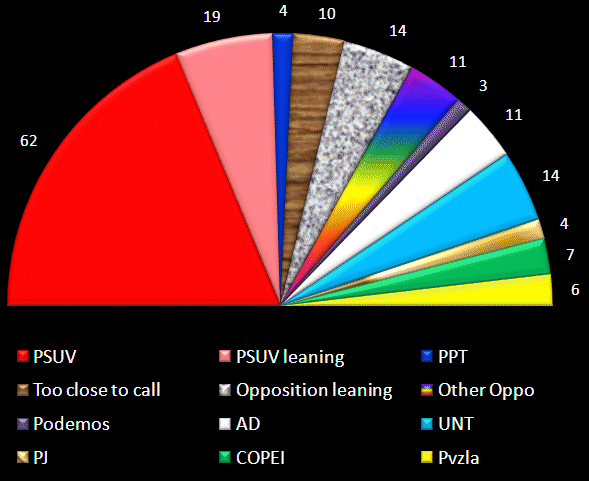 |
| The final assembly, maybe? Situation August 2010. |
The graph above was obtained with the following parameters:
Saturday, August 21, 2010
The 2010 election predictions: general terms
I have been dragging forever but at barely one month from voting day it is time to dust my files, gather the new information and settle to work out my predictions for next month National Assembly elections. Thus this first post limited to general consideration of the situation and the parameters I will use to predict the results. I do not know whether I will be able to be done by September 26 (the more so that Chavez is edgy and makes me write a lot on some other stuff ) but I will try to cover as much as possible. For more detail on what comes below you can refer to many earlier posts under the tag "2010 elections" which specifically cover some of the issues mentioned.
General electoral conditions
Friday, February 13, 2009
The Venezuela 2009 vote II: The Venezuela News and Views prediction
Will this be enough for Chavez to win next Sunday?

This blackberry picture is taken Avenida La Paz of San Felipe, around 10 AM Tuesday. In it you can see a PDVAL truck distributing selected food items at bargain prices. This scene repeats every morning, with people standing in line every morning to get whatever item the truck brought in that day. This has been going on now for weeks and the reason why I decided to take a picture is that they have added boldly the SI sign that until now was more discretely placed, since it is forbidden by the CNE. This picture encapsulates perfectly well what the Bolivarian revolution has become: a system to reward the faithful, to teach them to stand in line patiently, to express adequate support if they wish to keep receiving subsidized items, and without any institution to enforce the rule of law, or rather selective as to whom the law is applied. In short: a society of consenting beggars.
The question this time around is whether this crass populism will be enough to carry the day next Sunday? Because after ten years of such strategy we can start to wonder how long until people start getting tired of watching their leaders driving by in expensive SUV with SI written on their windows in washable white while they stand in line for food.
But how to evaluate this exhaustion? The polls during this latest campaign have been contradictory, and I am talking about the serious polls. There seems to be a slight edge in favor of the NO but this is dubious as no clear trend can be seen. The NO started high and fell on the harshness of Chavez campaign. But when this one started using violence against students, and blackmailing the country, the NO did not prevail again but the SI stopped growing. In other words this election has become the most emotional of our elections since 1998, as if it were possible to become more emotional than 2004 or 2005. Probably the fate of the election will be settled on Sunday as people reach the voting station, a cheap truism come true.
I have been trying to predict the result but after many complex and fascinating tables I realized that it was in fact quite simple. Thus I will divide my predictions in two sections: first the reasonable approach to it based on what I have been writing since the previous elections and then take a few wild guesses as to the emotional factors that may change my numbers.
The raw reasonable numbers.
The advantage this time around is that we have a very fresh result, the regional elections of November 2008, and a not so fresh result but a result very related to the actual vote, the December 2007 referendum result. I have added up what I consider the opposition vote and the chavista vote. I rounded them up and did not pay attention to the occasional mini candidate so my numbers might not quite match those found elsewhere. All numbers in thousand of thousand.
In 2007 the opposition got a clear 4505 (and probably more if the CNE had published the results, still not done). In 2008 there is a weak retreat to 4382. It is lower than what can be seen elsewhere because I did not include minor stuff. This is improved if we add a few minor candidates and also by the dissidence of chavismo, 362, one step away from opposition to Chavez. Chavismo did better going up from 4379 to 5570. As such we can have our starting point in the third column for 2009: Chavez has 5570, the opposition its vote share plus half of the dissidence for a total of 4563 since it is difficult that the bitterness of Chavez onslaught on the dissidence can be easily forgotten. I estimate 2 million abstention votes up for grab as those still “missing” from Chavez from 2006. The other abstention I consider chronic abstention which is unlikely to be much motivated this time around, thus I base my “potential vote” on 2006 presidential data.
That 1007 votes advantage for chavismo perhaps looks good but it is not. In previous discussion of the 2007 result I calculated that the abstention within the opposition was compensated by about 500 000 votes from chavismo that went NO in 2007. In November 2008 a lot of these folks either stayed home or went back to chavismo, but there is absolutely no guarantee for chavismo that they will not go again for the NO. On the other hand a more energized opposition who has been able to score a few successes since 2007 is less likely to suffer from abstention. Thus the first question is how much of these 2 million votes still missing can Chavez recover to compensate for what he is going to lose.
In one of the tables I did I calculated the states where Chavez had recovered the most versus the states where he recovered less of his 2006 votes. I also recall that I wrote that the result he got in November 2008 is a peak for him, considering the intensity of the campaign and how he involved himself into it. So yes, there might be some room to improve a little further but in some states where the recovery was lower. But even pairing it all up I still calculate that Chavez can only add 318 votes to what he got last November. His potential grand total, or maximum vote he can get Sunday will thus be 5570 + 318 = 5888. But to this you must remove a natural abstention of, say 200, and wonder about what would happen to the 500 that abandoned Chavez in 2007. Clearly, many of them might have got back for the regional election but many will vote again NO. Let’s estimate this total at 350 that will go to the opposition and 150 that will abstain. Thus I predict that chavismo SI will not go above 5888 - (200 + 500) = 5188.
The opposition starts with 4563 once we have speculated as to where the “chavismo” dissidence might go. It will not lose 500 this time around as it is more self confident and thinks that voting can actually achieve something. So let’s just assume a 150 abstention. And to this we can add the 350 that comes from chavismo that says NO. The total is thus 4563 – 150 + 350 = 4763. Thus my second prediction, the NO will get at least 4763 votes. The difference between the potential NO and SI is suddenly much less daunting. But chavismo wins by 400. But that I am not predicting.
The subjective factors.
As such if we use rational election follow up chavismo would win by 400. But will it? This election is marked by two factors: an emotional content beyond what we have ever seen and an opposition which has found again, for all its still permanent failures, a reason to fight. Besides with 3 new governors and the Caracas Mayor it gets more media exposure and spokespeople. To this you add an obscene campaign and unbearable pressure from chavismo and there is no telling how that rather meager 400 000 votes will in fact play. I for one think that watching how ungraceful chavismo was in its Miranda, Carabobob, Tachira and Caracas losses might provoke enough chavista to stay home, or even vote for the new governors and mayors as a way to force the government to listen to them and cooperate in solving problems. All polls reflect an exhaustion of the electorate of the constant fighting, pretty much a union factor among all political tendencies. Also the undue pressure on public workers will probably make many of them get their revenge at the ballot.
How all these very subjective factors play, it is rather difficult to measure. For once many serious pollsters are talking of a “hidden” voter, as they confess unable to really give reliable numbers. The atmosphere in the streets seems to go for the NO (not in Yaracuy where the political suicide of the opposition last November allow me my third prediction in that the SI will win here with 58% of the vote). Still the only campaign we see is the SI as it even appears at Globovision. But the NO campaign is there if anything by news of students arrested in Barinas, Tachira, and Carabobo.
I think that the Chavez campaign has been too much for the country and that it will backfire and that the opposition will get much more than the 4763, enough to overcome the NO but in yet another close result that will not settle anything. In the tables I tried to do to account for these speculations I came up with this result: a NO victory by less than 150 000.
I did calculate that almost two weeks ago, just three days before the Datanalisis poll that put the SI/NO on statistical error, meaning that the SI was winning by the narrowest of margins. I am sorry that I had not published my calculation then because Datanalisis would have agreed with me and I would have scored big. Oh well… However my numbers explain very well why the opposition message in the closing days of the campaign is for all to go and vote and stay to count the ballots. Clearly a 150 000 lead must be watched and nurtured as much as possible because it would be very easy for chavismo to cheat if given a chance.
But I do not want to sound pessimistic, I think that the opposition is going to do better than expected in all the states it won last November, and probably carry Barinas and Caracas/Libertador. As such the victory of the NO could be as high as by 400 000 votes which would represent a 4 to 6% respectable spread. But I am conservative in speculations and stick with my first call of 150 000, with more votes for each side than in 2007, as my final prediction.
In truth, of all predictions I gave in recent elections, this is the one I feel the least good about, meaning that anything can actually come out from next Sunday ballot. Clearly, if my predictions are proven wrong by the NO winning by 400 000 or more, I will not be upset. After all the dismal show of chavismo in Caracas today gives me hope that I might be dead wrong :)
As for what it will all mean, you will need to wait for my Saturday post.
-The end-
This blackberry picture is taken Avenida La Paz of San Felipe, around 10 AM Tuesday. In it you can see a PDVAL truck distributing selected food items at bargain prices. This scene repeats every morning, with people standing in line every morning to get whatever item the truck brought in that day. This has been going on now for weeks and the reason why I decided to take a picture is that they have added boldly the SI sign that until now was more discretely placed, since it is forbidden by the CNE. This picture encapsulates perfectly well what the Bolivarian revolution has become: a system to reward the faithful, to teach them to stand in line patiently, to express adequate support if they wish to keep receiving subsidized items, and without any institution to enforce the rule of law, or rather selective as to whom the law is applied. In short: a society of consenting beggars.
The question this time around is whether this crass populism will be enough to carry the day next Sunday? Because after ten years of such strategy we can start to wonder how long until people start getting tired of watching their leaders driving by in expensive SUV with SI written on their windows in washable white while they stand in line for food.
But how to evaluate this exhaustion? The polls during this latest campaign have been contradictory, and I am talking about the serious polls. There seems to be a slight edge in favor of the NO but this is dubious as no clear trend can be seen. The NO started high and fell on the harshness of Chavez campaign. But when this one started using violence against students, and blackmailing the country, the NO did not prevail again but the SI stopped growing. In other words this election has become the most emotional of our elections since 1998, as if it were possible to become more emotional than 2004 or 2005. Probably the fate of the election will be settled on Sunday as people reach the voting station, a cheap truism come true.
I have been trying to predict the result but after many complex and fascinating tables I realized that it was in fact quite simple. Thus I will divide my predictions in two sections: first the reasonable approach to it based on what I have been writing since the previous elections and then take a few wild guesses as to the emotional factors that may change my numbers.
The raw reasonable numbers.
The advantage this time around is that we have a very fresh result, the regional elections of November 2008, and a not so fresh result but a result very related to the actual vote, the December 2007 referendum result. I have added up what I consider the opposition vote and the chavista vote. I rounded them up and did not pay attention to the occasional mini candidate so my numbers might not quite match those found elsewhere. All numbers in thousand of thousand.

In 2007 the opposition got a clear 4505 (and probably more if the CNE had published the results, still not done). In 2008 there is a weak retreat to 4382. It is lower than what can be seen elsewhere because I did not include minor stuff. This is improved if we add a few minor candidates and also by the dissidence of chavismo, 362, one step away from opposition to Chavez. Chavismo did better going up from 4379 to 5570. As such we can have our starting point in the third column for 2009: Chavez has 5570, the opposition its vote share plus half of the dissidence for a total of 4563 since it is difficult that the bitterness of Chavez onslaught on the dissidence can be easily forgotten. I estimate 2 million abstention votes up for grab as those still “missing” from Chavez from 2006. The other abstention I consider chronic abstention which is unlikely to be much motivated this time around, thus I base my “potential vote” on 2006 presidential data.
That 1007 votes advantage for chavismo perhaps looks good but it is not. In previous discussion of the 2007 result I calculated that the abstention within the opposition was compensated by about 500 000 votes from chavismo that went NO in 2007. In November 2008 a lot of these folks either stayed home or went back to chavismo, but there is absolutely no guarantee for chavismo that they will not go again for the NO. On the other hand a more energized opposition who has been able to score a few successes since 2007 is less likely to suffer from abstention. Thus the first question is how much of these 2 million votes still missing can Chavez recover to compensate for what he is going to lose.
In one of the tables I did I calculated the states where Chavez had recovered the most versus the states where he recovered less of his 2006 votes. I also recall that I wrote that the result he got in November 2008 is a peak for him, considering the intensity of the campaign and how he involved himself into it. So yes, there might be some room to improve a little further but in some states where the recovery was lower. But even pairing it all up I still calculate that Chavez can only add 318 votes to what he got last November. His potential grand total, or maximum vote he can get Sunday will thus be 5570 + 318 = 5888. But to this you must remove a natural abstention of, say 200, and wonder about what would happen to the 500 that abandoned Chavez in 2007. Clearly, many of them might have got back for the regional election but many will vote again NO. Let’s estimate this total at 350 that will go to the opposition and 150 that will abstain. Thus I predict that chavismo SI will not go above 5888 - (200 + 500) = 5188.
The opposition starts with 4563 once we have speculated as to where the “chavismo” dissidence might go. It will not lose 500 this time around as it is more self confident and thinks that voting can actually achieve something. So let’s just assume a 150 abstention. And to this we can add the 350 that comes from chavismo that says NO. The total is thus 4563 – 150 + 350 = 4763. Thus my second prediction, the NO will get at least 4763 votes. The difference between the potential NO and SI is suddenly much less daunting. But chavismo wins by 400. But that I am not predicting.
The subjective factors.
As such if we use rational election follow up chavismo would win by 400. But will it? This election is marked by two factors: an emotional content beyond what we have ever seen and an opposition which has found again, for all its still permanent failures, a reason to fight. Besides with 3 new governors and the Caracas Mayor it gets more media exposure and spokespeople. To this you add an obscene campaign and unbearable pressure from chavismo and there is no telling how that rather meager 400 000 votes will in fact play. I for one think that watching how ungraceful chavismo was in its Miranda, Carabobob, Tachira and Caracas losses might provoke enough chavista to stay home, or even vote for the new governors and mayors as a way to force the government to listen to them and cooperate in solving problems. All polls reflect an exhaustion of the electorate of the constant fighting, pretty much a union factor among all political tendencies. Also the undue pressure on public workers will probably make many of them get their revenge at the ballot.
How all these very subjective factors play, it is rather difficult to measure. For once many serious pollsters are talking of a “hidden” voter, as they confess unable to really give reliable numbers. The atmosphere in the streets seems to go for the NO (not in Yaracuy where the political suicide of the opposition last November allow me my third prediction in that the SI will win here with 58% of the vote). Still the only campaign we see is the SI as it even appears at Globovision. But the NO campaign is there if anything by news of students arrested in Barinas, Tachira, and Carabobo.
I think that the Chavez campaign has been too much for the country and that it will backfire and that the opposition will get much more than the 4763, enough to overcome the NO but in yet another close result that will not settle anything. In the tables I tried to do to account for these speculations I came up with this result: a NO victory by less than 150 000.
I did calculate that almost two weeks ago, just three days before the Datanalisis poll that put the SI/NO on statistical error, meaning that the SI was winning by the narrowest of margins. I am sorry that I had not published my calculation then because Datanalisis would have agreed with me and I would have scored big. Oh well… However my numbers explain very well why the opposition message in the closing days of the campaign is for all to go and vote and stay to count the ballots. Clearly a 150 000 lead must be watched and nurtured as much as possible because it would be very easy for chavismo to cheat if given a chance.
But I do not want to sound pessimistic, I think that the opposition is going to do better than expected in all the states it won last November, and probably carry Barinas and Caracas/Libertador. As such the victory of the NO could be as high as by 400 000 votes which would represent a 4 to 6% respectable spread. But I am conservative in speculations and stick with my first call of 150 000, with more votes for each side than in 2007, as my final prediction.
In truth, of all predictions I gave in recent elections, this is the one I feel the least good about, meaning that anything can actually come out from next Sunday ballot. Clearly, if my predictions are proven wrong by the NO winning by 400 000 or more, I will not be upset. After all the dismal show of chavismo in Caracas today gives me hope that I might be dead wrong :)
As for what it will all mean, you will need to wait for my Saturday post.
-The end-
Saturday, October 28, 2006
How to dissolve the National Assembly of Venezuela?
This week a new issue came surprisingly to the forefront. Rosales, always finding ways to get the limelight and throw chavismo on the defensive did it beautifully by announcing that he would need a new National Assembly.
Indeed, the current assembly which is 100% sycophantic Chavez is not the best way to effect national reconciliation and good government if Rosales were to be elected next December. Some chavistas were not amused and said that the National Assembly could not be dissolved, that it would be a coup. This is wrong, as I will explain below. However the anecdote is always there with chavismo. Desiree Santos is a former journalist who has become the main engineer of limitation of civil rights new laws (the gag law owes a lot to her who knows exactly how to silence her former colleagues). As a reward she has been named the vice president of that National Assembly. Well, Desiree came out rather mad against the possible dissolution. One wonders why? After all if we are to believe the Zogby poll that circulated this week, chavismo is more than certain to be reelected. So why discuss a renewal of the National Assembly? Perhaps Desiree reads other polls not as encouraging?
Before discussing the legalities of the dissolution one should refocus the problem in a more constructive way.
If we go back to the government surveys that give Chavez anywhere between 50 and 60%, one should already wonder what good will it be for him to keep a 100% chavista assembly. Let’s assume a favorable result of Chavez of 60% and only 40% to Rosales, the Recall Election result. Well, how can Chavez justify to the rest of the world that he is indeed a democrat when 40% of the country has NO REPRESENTATION? What serious country will sign a serious treaty with Venezuela after December 3? Indeed, in December 2005 the opposition boycotted the election and it paid the price through 2005. But if the opposition runs and gets 40%, or even only 30%, that will call on the legitimacy of the parliament. The situation will change and Chavez will find that his pleasant monochromatic assembly will quickly turn into an albatross around his neck. Of course if he plans to establish a non-democratic regime then it will not matter. Is this what Chavez wants?
Thus it is my thesis that no matter who wins the election, he shall require a new National Assembly sooner than later.
The question now is how to do it. It is not that difficult.
The election result, whichever it will be, will require a new political system. If Chavez wins he will have to choose to remain a democrat or to move forward and establish a “no-return” socialist state which in fact will mean only that he is in charge until he dies. If Chavez decides to remain a democrat, then he will require a new assembly. It is that simple. For him that will be very easy. He can ask his deputies to resign all en masse and then new elections will be called. The opposition will not object and fresh from his presidential victory Chavez will likely manage to still get a commanding 2/3 majority but this time a legal AND a legitimate one.
The situation is more complex in the case of Rosales because well, the chavista unanimity will refuse to lose the fat paycheck they are getting (not to mention the nice “tips” they get for an occasional “service” to their “constituents”). But Rosales will need to do something about it and soon: he will not be able to pass a single law as I doubt that more than 50% will defect chavismo to join him. Well, there are several ways.
The first one is to call for a national pact and convince chavismo that it is in everyone’s best interest to have the National Assembly resign and go to new elections. In the 1999 constitution the election will be held to substitute a resigning or dead deputy and thus it will be elected ONLY to finish the current term, that is, less than 4 years by the time the election is held.
As this is certainly not going to happen, then there are three other options. The first one, a Recall Election on Assembly members, is ruled out immediately since Rosales cannot wait for June 2008 to hold such an election.
The second one will be to send the new Vice President to propose a law project in which he engages his/her responsibility. If the parliament rejects the law, then the Vice President is automatically dismissed. When this happens three times in a legislature, then the president has the right to dissolve the parliament according to article 240 which is quite clear on that (Desiree should check her own constitution). Of course this requires Rosales to name three Vice Presidents in a row as soon as possible and send them to the Assembly as fast as possible. Either the Assembly will be forced to approve the laws proposed or soon enough we could be facing new elections, as early as the third quarter of 2007.
And of course there is the call for a constitutional reform. This can be done drastically if chavismo is particularly obstructionist. Calling for a constituent assembly, or more amicably by calling an amendment such as term reduction of both President and Assembly can be done according to articles 341, 342, 347, 348, not to mention the famous 350.
In other words, it is possible to dissolve the Assembly and it will be very convenient no matter which side wins. Any heated argument against it can only be coming from sectors afraid of losing their privileges. Period.
Indeed, the current assembly which is 100% sycophantic Chavez is not the best way to effect national reconciliation and good government if Rosales were to be elected next December. Some chavistas were not amused and said that the National Assembly could not be dissolved, that it would be a coup. This is wrong, as I will explain below. However the anecdote is always there with chavismo. Desiree Santos is a former journalist who has become the main engineer of limitation of civil rights new laws (the gag law owes a lot to her who knows exactly how to silence her former colleagues). As a reward she has been named the vice president of that National Assembly. Well, Desiree came out rather mad against the possible dissolution. One wonders why? After all if we are to believe the Zogby poll that circulated this week, chavismo is more than certain to be reelected. So why discuss a renewal of the National Assembly? Perhaps Desiree reads other polls not as encouraging?
Before discussing the legalities of the dissolution one should refocus the problem in a more constructive way.
If we go back to the government surveys that give Chavez anywhere between 50 and 60%, one should already wonder what good will it be for him to keep a 100% chavista assembly. Let’s assume a favorable result of Chavez of 60% and only 40% to Rosales, the Recall Election result. Well, how can Chavez justify to the rest of the world that he is indeed a democrat when 40% of the country has NO REPRESENTATION? What serious country will sign a serious treaty with Venezuela after December 3? Indeed, in December 2005 the opposition boycotted the election and it paid the price through 2005. But if the opposition runs and gets 40%, or even only 30%, that will call on the legitimacy of the parliament. The situation will change and Chavez will find that his pleasant monochromatic assembly will quickly turn into an albatross around his neck. Of course if he plans to establish a non-democratic regime then it will not matter. Is this what Chavez wants?
Thus it is my thesis that no matter who wins the election, he shall require a new National Assembly sooner than later.
The question now is how to do it. It is not that difficult.
The election result, whichever it will be, will require a new political system. If Chavez wins he will have to choose to remain a democrat or to move forward and establish a “no-return” socialist state which in fact will mean only that he is in charge until he dies. If Chavez decides to remain a democrat, then he will require a new assembly. It is that simple. For him that will be very easy. He can ask his deputies to resign all en masse and then new elections will be called. The opposition will not object and fresh from his presidential victory Chavez will likely manage to still get a commanding 2/3 majority but this time a legal AND a legitimate one.
The situation is more complex in the case of Rosales because well, the chavista unanimity will refuse to lose the fat paycheck they are getting (not to mention the nice “tips” they get for an occasional “service” to their “constituents”). But Rosales will need to do something about it and soon: he will not be able to pass a single law as I doubt that more than 50% will defect chavismo to join him. Well, there are several ways.
The first one is to call for a national pact and convince chavismo that it is in everyone’s best interest to have the National Assembly resign and go to new elections. In the 1999 constitution the election will be held to substitute a resigning or dead deputy and thus it will be elected ONLY to finish the current term, that is, less than 4 years by the time the election is held.
As this is certainly not going to happen, then there are three other options. The first one, a Recall Election on Assembly members, is ruled out immediately since Rosales cannot wait for June 2008 to hold such an election.
The second one will be to send the new Vice President to propose a law project in which he engages his/her responsibility. If the parliament rejects the law, then the Vice President is automatically dismissed. When this happens three times in a legislature, then the president has the right to dissolve the parliament according to article 240 which is quite clear on that (Desiree should check her own constitution). Of course this requires Rosales to name three Vice Presidents in a row as soon as possible and send them to the Assembly as fast as possible. Either the Assembly will be forced to approve the laws proposed or soon enough we could be facing new elections, as early as the third quarter of 2007.
And of course there is the call for a constitutional reform. This can be done drastically if chavismo is particularly obstructionist. Calling for a constituent assembly, or more amicably by calling an amendment such as term reduction of both President and Assembly can be done according to articles 341, 342, 347, 348, not to mention the famous 350.
In other words, it is possible to dissolve the Assembly and it will be very convenient no matter which side wins. Any heated argument against it can only be coming from sectors afraid of losing their privileges. Period.
Friday, December 19, 2008
The 2008 Venezuelan results: 7 - Conclusions
It is rather late to give the conclusions of the November 23 electoral joust. But a new election sneaked in and well, you know, I had to cover two elections at once. Thus this post can be considered the last of the 2008 series but also the preamble of the 2009 series. And to illustrate this duality I will like to look at the Lara state results.
Lara is a very interesting state because it is supposed to be a chavista bastion and yet as the table on the right, click to enlarge, shows it has a high electoral instability, meaning that chavismo can never be sure how it will perform there. And at a referendum time this is quite a handicap as the 2007 "surprise" illustrates when Chavez lost the referendum in Lara. It is also interesting to observe that the percentage of votes obtained in Lara bears little relationship with the actual amount of votes gained there. The top vote getting was for Chavez in 2006, but Henry Falcon gets 7% more share with almost 70 000 votes less. And yet chavismo should not be happy with that result at all: at least 100 000 of these votes are cross votes from the opposition!!!
If you look at the 2008 details you will see that there were almost 120 000 more votes cast for governor than for the state legislature. I know it is more difficult and maybe less interesting to vote for legislators, but that is quite a difference, is it not? And when you look at who lost the most votes you can see by yourself that the PSUV lost 50.000 but its allies more than 100.000! However the opposition in spite of its division loses much less. In fact, Primero Justicia gets more vote in the legislature list than for the governor they supported!
There is only one explanation for the numbers that you see in that table on the right: the new governor of Lara, Henry Falcon, is a free agent of chavismo, well, almost, and a significant chunk of chavismo will not follow Chavez every time. From 2006 to 2007 chavismo lost 120.000. But it did not recover them to elect Falcon: at least 100.000 of his electors came from the opposition. Chavismo must be worried sick about Lara this time around: not only Lara could contribute even more to a NO result next February, but a solid NO victory could even force the hand of Falcon to become in turn a dissident. All that is at stake for Chavez in 2009 is illustrated in Lara!
And this is perhaps the most important result of 2008: Chavez might have reached his last historical plateau. If we believe chavismo account of 53% of the popular vote it is way below the 66% of Chavez two years ago, the more damaging that the regional election campaign became a plebiscite on Chavez due to his grotesque intervention in the election. Indeed chavismo did win more votes than the opposition on November 23 but as we have seen there are many factors that diminish greatly whatever positive might reside in that 53. For example, key states were lost. For example, dissidence might not have been as strong as expected but the way in which chavismo dealt with it will come back to haunt them. For example rural vote might have gone for Chavez, but all indicate that a significant fraction of it was a "dependency" vote. Maybe individually these things are not that big, but taken together they are very ominous for the next referendum.
But the opposition should not gloat as much as some of its spokespeople do. It still lack in vote even though it has been growing steadily since 2006. And even if it wins next February, its difficulty at unifying its electorate weakens its future perspectives. The arrogance of a a few local leaders was enough to cause the loss of at least 10% of the districts that should have gone to the opposition. The opposition has thus three urgent tasks that it must conduct almost simultaneously:
- get ready for the amendment referendum.
- find a way to effect better unity for the municipal council elections later in 2009.
- offer a real program that can carry the opposition to a National Assembly victory in 2010.
The work starts today, Xmas or not.
-The end-
Lara is a very interesting state because it is supposed to be a chavista bastion and yet as the table on the
 right, click to enlarge, shows it has a high electoral instability, meaning that chavismo can never be sure how it will perform there. And at a referendum time this is quite a handicap as the 2007 "surprise" illustrates when Chavez lost the referendum in Lara. It is also interesting to observe that the percentage of votes obtained in Lara bears little relationship with the actual amount of votes gained there. The top vote getting was for Chavez in 2006, but Henry Falcon gets 7% more share with almost 70 000 votes less. And yet chavismo should not be happy with that result at all: at least 100 000 of these votes are cross votes from the opposition!!!
If you look at the 2008 details you will see that there were almost 120 000 more votes cast for governor than for the state legislature. I know it is more difficult and maybe less interesting to vote for legislators, but that is quite a difference, is it not? And when you look at who lost the most votes you can see by yourself that the PSUV lost 50.000 but its allies more than 100.000! However the opposition in spite of its division loses much less. In fact, Primero Justicia gets more vote in the legislature list than for the governor they supported!
There is only one explanation for the numbers that you see in that table on the right: the new governor of Lara, Henry Falcon, is a free agent of chavismo, well, almost, and a significant chunk of chavismo will not follow Chavez every time. From 2006 to 2007 chavismo lost 120.000. But it did not recover them to elect Falcon: at least 100.000 of his electors came from the opposition. Chavismo must be worried sick about Lara this time around: not only Lara could contribute even more to a NO result next February, but a solid NO victory could even force the hand of Falcon to become in turn a dissident. All that is at stake for Chavez in 2009 is illustrated in Lara!
And this is perhaps the most important result of 2008: Chavez might have reached his last historical plateau. If we believe chavismo account of 53% of the popular vote it is way below the 66% of Chavez two years ago, the more damaging that the regional election campaign became a plebiscite on Chavez due to his grotesque intervention in the election. Indeed chavismo did win more votes than the opposition on November 23 but as we have seen there are many factors that diminish greatly whatever positive might reside in that 53. For example, key states were lost. For example, dissidence might not have been as strong as expected but the way in which chavismo dealt with it will come back to haunt them. For example rural vote might have gone for Chavez, but all indicate that a significant fraction of it was a "dependency" vote. Maybe individually these things are not that big, but taken together they are very ominous for the next referendum.
But the opposition should not gloat as much as some of its spokespeople do. It still lack in vote even though it has been growing steadily since 2006. And even if it wins next February, its difficulty at unifying its electorate weakens its future perspectives. The arrogance of a a few local leaders was enough to cause the loss of at least 10% of the districts that should have gone to the opposition. The opposition has thus three urgent tasks that it must conduct almost simultaneously:
- get ready for the amendment referendum.
- find a way to effect better unity for the municipal council elections later in 2009.
- offer a real program that can carry the opposition to a National Assembly victory in 2010.
The work starts today, Xmas or not.
-The end-
Wednesday, September 15, 2010
The 2010 election predictions: Aragua and Carabobo
When I started this project I did not know if I was going to have enough time to finish it. Thus originally I had planned to leave for the end Bolivar and the Llanos, the regions that I know less about, hoping that in case I lacked time the rest of the discussion would be enough to give a good idea of the September 26 election result. But as I plodded my way through I realized that the election will be decided in the two states of Aragua and Carabobo, the industrial heartland of the country, and thus found the motivation to write it all and leave that discussion for the end.
With 18 seats these two states represent 11% of the representatives to be elected in the new assembly. If everywhere else in the country results can be guessed more or less accurately, in these two states it is where we are more likely to find interesting and significant shifts. That is, Zulia is for the opposition: that the PSUV gains 1 or 3 seats really does not affect much the overall picture. Same story in the Llanos where the PSUV is going to win and where the opposition gains will not be enough to imperil a putative chavista majority. But in Carabobo, through gerrymandering, the opposition is not certain at all to fulfill its potential and in Aragua, the chavista bastion will still be carried by the PSUV but will be quite damaged. For the opposition to win the National Assembly it is a must that it resists the gerrymandering of Carabobo AND that it breaches the PSUV monopoly in Aragua, and for chavismo it is essential that the Aragua hegemony is preserved and that the opposition does not reach half of the Carabobo seats otherwise its majority will be too thin for comfort.
With 18 seats these two states represent 11% of the representatives to be elected in the new assembly. If everywhere else in the country results can be guessed more or less accurately, in these two states it is where we are more likely to find interesting and significant shifts. That is, Zulia is for the opposition: that the PSUV gains 1 or 3 seats really does not affect much the overall picture. Same story in the Llanos where the PSUV is going to win and where the opposition gains will not be enough to imperil a putative chavista majority. But in Carabobo, through gerrymandering, the opposition is not certain at all to fulfill its potential and in Aragua, the chavista bastion will still be carried by the PSUV but will be quite damaged. For the opposition to win the National Assembly it is a must that it resists the gerrymandering of Carabobo AND that it breaches the PSUV monopoly in Aragua, and for chavismo it is essential that the Aragua hegemony is preserved and that the opposition does not reach half of the Carabobo seats otherwise its majority will be too thin for comfort.
Tuesday, August 14, 2012
Venezuela's electoral numbers 2012: 1- Caucagüita or why Capriles should win
If we look at the evolution of voting pattern in Caucagüita, Capriles should win in October.

One of the unheralded bellwether districts of Venezuela is a Caracas semi slum area, Caucagüita, East of the Sucre district of Petare. I have already written about it and for this entry removed the 2004 local election number so as to make it more about Chavez, in case you compare with previous graphs. After all, in October 2004, fresh after the recall election, the local vote was an anticlimax, not only the opposition staying home but also a lot of chavistas.

One of the unheralded bellwether districts of Venezuela is a Caracas semi slum area, Caucagüita, East of the Sucre district of Petare. I have already written about it and for this entry removed the 2004 local election number so as to make it more about Chavez, in case you compare with previous graphs. After all, in October 2004, fresh after the recall election, the local vote was an anticlimax, not only the opposition staying home but also a lot of chavistas.
Thursday, August 16, 2012
Venezuela's electoral numbers 2012: 2- the three key states
The contours of the October vote are getting clearer as we advance in the campaign. Still, as it is always the case in any election, there is what one calls "battleground" or "key states" which are the ones to watch. I think that this time around the ones to watch are Anzoategui, Bolivar and Lara. Let's start with Anzoategui and Bolivar, in the Eastern part of the country, where I think that not only the election will be decided but also the margin of victory (1). I am not considering Miranda or Zulia which are a given for Capriles. If he loses there, there is no point about worrying how he does elsewhere. Also Aragua should remain Chavez while Carabobo will go opposition, each one with comparable margins thus cancelling each other. Hence my choices below.

All the graphs are designed from the same CNE, electoral board, data: presidential result of 2006, governor result of 2008 and legislative result of 2010, as the most motivating elections so as to have the lowest abstention number (which as you will see varies widely). When the opposition goes divided I add it all up (Lara and Bolivar 2008, Lara 2010).

All the graphs are designed from the same CNE, electoral board, data: presidential result of 2006, governor result of 2008 and legislative result of 2010, as the most motivating elections so as to have the lowest abstention number (which as you will see varies widely). When the opposition goes divided I add it all up (Lara and Bolivar 2008, Lara 2010).
Monday, August 11, 2008
Of the uselesness of recall elections: Venezuela 2004, Bolivia 2008
[Updated]
Today Bolivia wasted precious time and resources in an electoral campaign that has solved nothing. All those that mattered won, no one punched down the other side and the country is in fact more divided than ever. Just as in Venezuela the Recall Election of 2004 solved nothing, allowing Chavez to retain office and unleash on the country the most corrupt and inefficient government of our democratic history. That is, assuming that Chavez is a democratic government which is something that has been questionable for quite a while. In both cases I squarely put the blame on the system of recall elections which after the example of Bolivia today is proven a useless system for our Latin cultural approach to politics. But first each result.
Bolivia 2008
The results are pretty much as expected. Evo Morales and his vice retain power with an increased percentage from 2005. But with a country more divided than ever. Indigenous people of the Altiplano voted massively for their man, no matter what, but the mixed races low land, at the heart of Bolivia economy voted against Morales. In fact, tensions were so bad that Morales at the end could not campaign there (not that the low-lands governor could campaign in the Altiplano for that matter...). So Morales seems to have gained over 60% of the votes but today he cannot travel in half of the country.
But even his own victory in the Altiplano has already the seeds of his future problems: the Oruro Prefect (kind of governor) also on the ballot apparently lost. And yet he was a man of Morales, who carried Oruro without problems. Thus we can already see the same pattern than in Venezuela, the pro-Morales vote is an emotional one whose coattails do not seem to work very well. In fact, interestingly, all could be happy as even those who lost got MORE votes than in 2005.
Even his own improvement in the Altiplano, revoking the Prefect of La Paz, is not necessarily a good long term prospect. To begin with Paredes was elected with a minority vote, and became an accidental opponent. Clearly, as soon as the Recall Election was called for he knew he was doomed, that his chances were null. Yet he did get close to 40% of the votes and now, freed of governing duties, and a victim in public opinion, he could soon become a much more dangerous opponent to Morales than what he would be had he retained his seat.
The regional opposition also can claim victory, though in all fairness the 60%+ of Morales, coattails or not, clouds prospects some. But the "media luna" Prefects all seem to have won with more than 50% of the vote, in particular the more radical one of the biggest province of Santa Cruz who got more than 70%. So now, considering that the loss of La Paz is meaningless since there was little Paredes could do against Morales in the capital, we have 4 ratified prefects, 1 for the opposition that was not required to stand the recall election as freshly elected (Chuquisaca), 3 for Morales and one, Cochabamba where the losing prefect announced long ago that he did not recognize the election (and who did not lose by that much anyway). If we consider that the loss of La Paz was pre-compensated by the election of an indigenous woman opposing Morales in Chuquisaca, the opposition is actually better off as geographically they all now hold together territorially, with the second capital, Sucre, in their hands, sort of anyway.
What next for Bolivia?
Think the US circa 1859-60. That is your reference point. And if you think that Morales with 60% of the vote will be able to force the army to retake Santa Cruz, you will be seriously disappointed. If the "media luna" were to break away, the Bolivian army would break apart, just as Robert E. Lee left the US army to lead the Southern one, after Virginia decided to bolt. Morales is the winner of a country more divided than ever, with the discomforting thought that many of those who voted for him ALSO did vote for an opposition Prefect and thus he cannot rely on his 60%+ to force acceptation the fraudulent constitution he has not been able to bring up to a vote. Nor can he rely on the La Paz inhabitants who voted for him to also get guns and go down to submit Santa Cruz. Bolivia simply squandered yet another opportunity where the only one who can claim to have gained a very little, and I am being generous, is Morales who at least has been able to maintain indigenous unity.
Now, they all have only one option, to climb down from their mutual arrogant positions, no matter how valid those ones are, and renegotiate the constitution project to send it to referendum. If this does not happen then the most probable outcome will be the break up of Bolivia. Venezuela will not be able to help as I am 99% sure that public opinion here will not accept it and that would be the end of Chavez (nor will Colombia, Peru or Brazil accept more involvement of Venezuela than what they are seeing today).
Venezuela 2004
The Recall Election process of Venezuela in 2004 did not solve any of the problems of Venezuela, just as today´s vote solved nothing in Bolivia as it did not address the underlying problems of the country: it was just an act to see who is the "Cacique". In fact we can today say that it aggravated the political problem even if the first result was for Chavez to win 22 out 24 states three months later.
First, the country became irremediably divided in tow irreconcilable camps with a "do not care" floating group who showed little spine as long as government benefits reached them. The 3 million+ of the Tascon list will never forgive becoming second class citizens. But what was worse than that, the Chavez victory and the Tascon list allowed him to transform progressively his followers into his subjects. They are starting to resent that. If to this we add that since then Chavez has felt free to violate the constitution and to apply at will unacceptable pressures to improve his electoral chances, and to buy any person he needed to buy, you can see that the neglect in their duties of the Carter Center and the OAS in 2004 only served to postpone the denouement of the crisis toward a new outcome that will be in all likelihood violent.
All proportions and local considerations observed, today Boliva started its transit towards a more violent outcome than what it could have achieved if it did not waste its time in an useless Recall Election.
The intellectual fraud behind Recall Election systems
After the result in Bolivia and Venezuela I am ready to toss out this system once and for all, at least for all of Latin America. Its first two applications did not work in that they only they exacerbated the crisis. True, the local good results of the opposition in Bolivia make this conclusion perhaps premature, but I am afraid that I will be proven right.
Why can't a Recall Election work in our countries? Because it personalizes the vote, it makes it an emotional demand on the voters. They are asked to punish one guy without the convenient excuse to be able to say "Oh, but the other one promised me something that interested me more. Next time I will vote again for you, worry not!". Such a vote forces the voter to make a definite choice and thus radicalizes the political process, driving away the normal give an take that politics in a democracy should be about. Not to mention that if the elector voted in the past for the politician to be revoked, you are forcing him or her to admit that they were wrong then, something that few people enjoy.
Reelections are less taxing. To begin with you can say "well, s/he has these flaws but overall I prefer him/her to the other guy". Or you can say "Well, he screwed up on this. To teach him I will vote for her, and is she does not work out, well, I will vote again for him". Think about the psychological underlining of these statements about your own responsibility in voting and you will understand better. A Recall Election does not offer you that moral ambiguity.
If to this you add a culture of love for the strong man, with racial undertones, you can quickly see that Recall Elections can only work in reasonably homogeneous cultures such as in Japan. And I doubt that.
No, for our Latin countries what we need is shorter terms, until people over time learn that they must vote responsibly (yet Western Democracies history seem to indicate that they are still quite far from voter responsibility!). People must learn that when they vote for a jerk, they have to put up with that jerk for the full term. If the jerk is simply unbearable there are other ways to remove him or her, and in Venezuela we have shown that we could remove presidents without Recall Elections or coup d'etat. Or has the world forgotten that Carlos Andres Perez was legally removed from office one year before he completed his second term? And for an offense that was a child's game compared to Chavez offenses today. In Venezuela the next constitutional reform we should consider is to shorten the presidential term, and, as far as I am concerned, remove reelection, ever. In fact I am becoming almost an Athenian as all ex rulers should receive the Ostraka, with a very nice pension for sure.
Update
Last night it was late enough that I forgot to include links to my Bolivian web sources. You can read more in the MAB blog and in the Blog from Bolivia, which shows what good PSF are able to do. If we were so lucky here in Venezuela....
This morning MAB carries graphs from La Razon which confirm what I was writing last night: there was a lot of crossover voters which do tarnish the victory of Morales some (I am not so sure it does tarnish the wins from opposition Prefects in the same way since all of them got MORE, way more votes some time than what they got three years ago).
The recall of Evo is confirmed in Chuquisaca. Thus his win in Cochabamba will not help him that much. And now the media luna is a more solid territorial crescent.
Rural and city vote is very split everywhere, the same phenomenon we observe in Venezuela with Chavez, as education and business drive away like garlic the vampirism of state control. this is dramatic in Potosi, the province that gave Evo its largest victory with 80.8%. The rural vote there was 94.1% FOR Evo but a much lower 68.5% in urban areas.
Crossover voting is more prevalent and important than what I thought at first. For example in La Paz the NO to Evo is 22.9% but the YES to Paredes was twice that amount, at 42.3%.
The division of the country is made clearer if we look at the average Evo Victory. In the 5 provinces he won, the average percentile SI is 70.8%. But in the four he lost the percentile average SI is 44.3%!!!! A difference of 25%!!!! It hardly gets more divided than that.
- -- --- ---- ----- ------
A funny note. The coverage of the ABN, the Chavez news agency, focused on the Santa Cruz media not focusing on the Morales victory. Example here. It is amusing because it really shows not only the embarrassing partiality of the ABN, but also its ignorance of how other countries operate when not all is fixated in their capital city, like it happens in Venezuela with Caracas (y lo demas es monte y culebra). Probably the ABN never caught on that in Santa Cruz everybody knew Morales would win and they were just much more interested into what score would their man do at home. Poor ABN, they probaly think that the life of Bolivan media revolves around Morales just like the life of Venezuelan media revolves aound Chavez.
-The end-
Today Bolivia wasted precious time and resources in an electoral campaign that has solved nothing. All those that mattered won, no one punched down the other side and the country is in fact more divided than ever. Just as in Venezuela the Recall Election of 2004 solved nothing, allowing Chavez to retain office and unleash on the country the most corrupt and inefficient government of our democratic history. That is, assuming that Chavez is a democratic government which is something that has been questionable for quite a while. In both cases I squarely put the blame on the system of recall elections which after the example of Bolivia today is proven a useless system for our Latin cultural approach to politics. But first each result.
Bolivia 2008
The results are pretty much as expected. Evo Morales and his vice retain power with an increased percentage from 2005. But with a country more divided than ever. Indigenous people of the Altiplano voted massively for their man, no matter what, but the mixed races low land, at the heart of Bolivia economy voted against Morales. In fact, tensions were so bad that Morales at the end could not campaign there (not that the low-lands governor could campaign in the Altiplano for that matter...). So Morales seems to have gained over 60% of the votes but today he cannot travel in half of the country.
But even his own victory in the Altiplano has already the seeds of his future problems: the Oruro Prefect (kind of governor) also on the ballot apparently lost. And yet he was a man of Morales, who carried Oruro without problems. Thus we can already see the same pattern than in Venezuela, the pro-Morales vote is an emotional one whose coattails do not seem to work very well. In fact, interestingly, all could be happy as even those who lost got MORE votes than in 2005.
Even his own improvement in the Altiplano, revoking the Prefect of La Paz, is not necessarily a good long term prospect. To begin with Paredes was elected with a minority vote, and became an accidental opponent. Clearly, as soon as the Recall Election was called for he knew he was doomed, that his chances were null. Yet he did get close to 40% of the votes and now, freed of governing duties, and a victim in public opinion, he could soon become a much more dangerous opponent to Morales than what he would be had he retained his seat.
The regional opposition also can claim victory, though in all fairness the 60%+ of Morales, coattails or not, clouds prospects some. But the "media luna" Prefects all seem to have won with more than 50% of the vote, in particular the more radical one of the biggest province of Santa Cruz who got more than 70%. So now, considering that the loss of La Paz is meaningless since there was little Paredes could do against Morales in the capital, we have 4 ratified prefects, 1 for the opposition that was not required to stand the recall election as freshly elected (Chuquisaca), 3 for Morales and one, Cochabamba where the losing prefect announced long ago that he did not recognize the election (and who did not lose by that much anyway). If we consider that the loss of La Paz was pre-compensated by the election of an indigenous woman opposing Morales in Chuquisaca, the opposition is actually better off as geographically they all now hold together territorially, with the second capital, Sucre, in their hands, sort of anyway.
What next for Bolivia?
Think the US circa 1859-60. That is your reference point. And if you think that Morales with 60% of the vote will be able to force the army to retake Santa Cruz, you will be seriously disappointed. If the "media luna" were to break away, the Bolivian army would break apart, just as Robert E. Lee left the US army to lead the Southern one, after Virginia decided to bolt. Morales is the winner of a country more divided than ever, with the discomforting thought that many of those who voted for him ALSO did vote for an opposition Prefect and thus he cannot rely on his 60%+ to force acceptation the fraudulent constitution he has not been able to bring up to a vote. Nor can he rely on the La Paz inhabitants who voted for him to also get guns and go down to submit Santa Cruz. Bolivia simply squandered yet another opportunity where the only one who can claim to have gained a very little, and I am being generous, is Morales who at least has been able to maintain indigenous unity.
Now, they all have only one option, to climb down from their mutual arrogant positions, no matter how valid those ones are, and renegotiate the constitution project to send it to referendum. If this does not happen then the most probable outcome will be the break up of Bolivia. Venezuela will not be able to help as I am 99% sure that public opinion here will not accept it and that would be the end of Chavez (nor will Colombia, Peru or Brazil accept more involvement of Venezuela than what they are seeing today).
Venezuela 2004
The Recall Election process of Venezuela in 2004 did not solve any of the problems of Venezuela, just as today´s vote solved nothing in Bolivia as it did not address the underlying problems of the country: it was just an act to see who is the "Cacique". In fact we can today say that it aggravated the political problem even if the first result was for Chavez to win 22 out 24 states three months later.
First, the country became irremediably divided in tow irreconcilable camps with a "do not care" floating group who showed little spine as long as government benefits reached them. The 3 million+ of the Tascon list will never forgive becoming second class citizens. But what was worse than that, the Chavez victory and the Tascon list allowed him to transform progressively his followers into his subjects. They are starting to resent that. If to this we add that since then Chavez has felt free to violate the constitution and to apply at will unacceptable pressures to improve his electoral chances, and to buy any person he needed to buy, you can see that the neglect in their duties of the Carter Center and the OAS in 2004 only served to postpone the denouement of the crisis toward a new outcome that will be in all likelihood violent.
All proportions and local considerations observed, today Boliva started its transit towards a more violent outcome than what it could have achieved if it did not waste its time in an useless Recall Election.
The intellectual fraud behind Recall Election systems
After the result in Bolivia and Venezuela I am ready to toss out this system once and for all, at least for all of Latin America. Its first two applications did not work in that they only they exacerbated the crisis. True, the local good results of the opposition in Bolivia make this conclusion perhaps premature, but I am afraid that I will be proven right.
Why can't a Recall Election work in our countries? Because it personalizes the vote, it makes it an emotional demand on the voters. They are asked to punish one guy without the convenient excuse to be able to say "Oh, but the other one promised me something that interested me more. Next time I will vote again for you, worry not!". Such a vote forces the voter to make a definite choice and thus radicalizes the political process, driving away the normal give an take that politics in a democracy should be about. Not to mention that if the elector voted in the past for the politician to be revoked, you are forcing him or her to admit that they were wrong then, something that few people enjoy.
Reelections are less taxing. To begin with you can say "well, s/he has these flaws but overall I prefer him/her to the other guy". Or you can say "Well, he screwed up on this. To teach him I will vote for her, and is she does not work out, well, I will vote again for him". Think about the psychological underlining of these statements about your own responsibility in voting and you will understand better. A Recall Election does not offer you that moral ambiguity.
If to this you add a culture of love for the strong man, with racial undertones, you can quickly see that Recall Elections can only work in reasonably homogeneous cultures such as in Japan. And I doubt that.
No, for our Latin countries what we need is shorter terms, until people over time learn that they must vote responsibly (yet Western Democracies history seem to indicate that they are still quite far from voter responsibility!). People must learn that when they vote for a jerk, they have to put up with that jerk for the full term. If the jerk is simply unbearable there are other ways to remove him or her, and in Venezuela we have shown that we could remove presidents without Recall Elections or coup d'etat. Or has the world forgotten that Carlos Andres Perez was legally removed from office one year before he completed his second term? And for an offense that was a child's game compared to Chavez offenses today. In Venezuela the next constitutional reform we should consider is to shorten the presidential term, and, as far as I am concerned, remove reelection, ever. In fact I am becoming almost an Athenian as all ex rulers should receive the Ostraka, with a very nice pension for sure.
Update
Last night it was late enough that I forgot to include links to my Bolivian web sources. You can read more in the MAB blog and in the Blog from Bolivia, which shows what good PSF are able to do. If we were so lucky here in Venezuela....
This morning MAB carries graphs from La Razon which confirm what I was writing last night: there was a lot of crossover voters which do tarnish the victory of Morales some (I am not so sure it does tarnish the wins from opposition Prefects in the same way since all of them got MORE, way more votes some time than what they got three years ago).
The recall of Evo is confirmed in Chuquisaca. Thus his win in Cochabamba will not help him that much. And now the media luna is a more solid territorial crescent.
Rural and city vote is very split everywhere, the same phenomenon we observe in Venezuela with Chavez, as education and business drive away like garlic the vampirism of state control. this is dramatic in Potosi, the province that gave Evo its largest victory with 80.8%. The rural vote there was 94.1% FOR Evo but a much lower 68.5% in urban areas.
Crossover voting is more prevalent and important than what I thought at first. For example in La Paz the NO to Evo is 22.9% but the YES to Paredes was twice that amount, at 42.3%.
The division of the country is made clearer if we look at the average Evo Victory. In the 5 provinces he won, the average percentile SI is 70.8%. But in the four he lost the percentile average SI is 44.3%!!!! A difference of 25%!!!! It hardly gets more divided than that.
- -- --- ---- ----- ------
A funny note. The coverage of the ABN, the Chavez news agency, focused on the Santa Cruz media not focusing on the Morales victory. Example here. It is amusing because it really shows not only the embarrassing partiality of the ABN, but also its ignorance of how other countries operate when not all is fixated in their capital city, like it happens in Venezuela with Caracas (y lo demas es monte y culebra). Probably the ABN never caught on that in Santa Cruz everybody knew Morales would win and they were just much more interested into what score would their man do at home. Poor ABN, they probaly think that the life of Bolivan media revolves around Morales just like the life of Venezuelan media revolves aound Chavez.
-The end-
Saturday, May 31, 2008
The 2008 election gambles: part 2, Chavez’s strategy
The internal elections of Chavez party, the PSUV offer a good insight into the poor democratic mindset of these people, as well as the authoritarian character of Chavez. Tal Cual today devotes a full article on this. We learn that the 5039 “aspiring candidates” have until midnight to convince their co-believers. That is, the primary campaign did not even last a month. This, as many districts had more than a dozen “aspirators” (115 just for Caracas mayor). On Sunday they hope to get a million folks casting ballots even though the PSUV claims more than 5 million militants, which makes anyone wonder as to how uncommitted are chavista militants….
Yet, so far so good, one would say. But when we read how the candidates will eventually become officially nominated things do not look so good. According to Tal Cual, no matter how many votes you get, the three top vote getters in a given circumscription are brought to Chavez. Because to be elected you need 50% +1 vote AND at least 15% more votes than whomever trails you. Otherwise it is Chavez who decides who gets the nod.
You might still say,” well, you know, they need to make sure that no moles get inside the PSUV”. But then you learn that the results will not be made public. Yes, that is right, we will not know who got what votes, we will get Chavez himself on June 5 inform us, in cadena I presume, the happy winners. In conclusion, if Chavez does not like you, you can only be reasonably sure to win the nomination if you get about 60% of the vote, assuming that Chavez would not dare to go against such a lopsided result.
Thus we have our pre-taste of the November elections: Chavez will do all that is within his reach to stop any one disagreeing with him to reach a local elected position. Significant cheating and fraud can be expected. How can we thus discuss a Chavez electoral strategy? Well, very simply by separating what he is already doing and what he started doing and will probably do. This separation is not that specious: chavismo has already been cheating significantly in previous elections (1). The thing is that now that Chavez is in trouble he will need to do more than what he has done so far to retain as much power as possible. Open cheating is, this time, expected.
What Chavez has been doing
This part is very simple to discuss. I will just list the main items with a brief reminder. Any additional information can be searched for in the extensive electoral archives of this blog or elsewhere.
The CNE irregularities. These are many and range from very questionable electoral rolls to an astounding permissiveness in turning a blind eye to the government electoral abuses, in particular the financial ones. These taken together give a bonus edge to chavismo that I can estimate at anything between 5 to 10% of the votes, something that becomes crucial with local elections that can be decided with handful of votes.
Judicial silence. The judicial system of Venezuela is now closely controlled by chavismo. Thus if you introduce any recourse against any tasteless or fraudulent electoral practice, the TSJ will reply to you, if at all, AFTER the election. Some times years after. Many contentious cases of the 2000 elections have yet to be settled…
Media abuse. At election time Chavez increases dramatically the use of cadenas. That is, under the flimsiest of excuses he commandeers ALL TV emissions, AND ALL radio emissions for a speech or activity that lasts as long as he wants. True, he tries to avoid the mention of words such as “election” “vote” “candidate X”, but he is very skilled at innuendos so that these cadenas become basically political campaign. Meanwhile the opposition has little or no access to state media, even to run paid political adds. There is also another aspect to it: state media cover most chavista electoral events as if they were news, for hours in a row if necessary, while the scantiest of opposition coverage is only shown when international observers are in town. Just last night, for example, VTV covered for hours the closing PSUV campaign in Anzoategui, Chavez speech included
Money, money. This is of course the biggest carrot and stick of all. At election time public coffers and PSUV coffers lose any distinction. Public employees are expected to miss their jobs so as to make bulk at diverse electoral activities. The PSUV has yet to release any detailed report on its electoral activities and from where they got all the huge amount of money they spend. And these funds also cover booze, t-shorts, fire works and the like. I personally watched 4 years ago when Chavez came to support now disgraced Gimenez for the Yaracuy State House how someone was buying half a dozen generators in cash to power the meeting loud speakers. I do not know if you know how much an electric generator costs but paying half a dozen in cash was quite an impressive feat. I have wondered on occasion where these generators ended up… By the way, the law conveniently forbids the state to finance electoral campaigns so the opposition can never match in this wildest dreams what the government steals form public coffers for its own campaigns, and even less the possibility to request an investigation to be opened (see above).
Safe candidates. We saw this already on how the PSUV is proceeding to elect its folks. 4 years ago there was not even such a pretense: all candidates were directly named by Chavez or through a commission set by him. Still, Chavez in four years has managed to run afoul of several figures: Carabobo’s Acosta, Monagas’s Briceño, Caracas ‘s Barreto, are among the ones that are barred from reelection by the PSUV and will need to run on their own if they pretend to regain their office. The case of Briceño though is special and he might still get the nod. But others who had clear pretensions had a hard time in being accepted by Chavez, the most interesting case being Falcon in Lara. Initial attempts at barring him form running failed when polls were considered and he threatened to run no matter what. Suddenly Chavez electoral henchmen pretended to have picked him. This time around Chavez seeks ever more control. He seeks to compensate for the refusal of the constitutional reform last December which would have accelerated centralization. Now he will name the most faithful of the faithful to make sure that they will let themselves be spoiled of their local roles and perks as Chavez needs to take these roles over, centralizing all in Caracas.
What Chavez will need to do
Since all of the above (and a few other tricks) are apparently not enough to ensure a landslide, a new set of artifacts have been added.
Control who runs inside the opposition. From the many political fights and dramas of this past decade a new generation of leaders have risen. True, they might not be good enough or heavy weighty enough to challenge Chavez for national office, yet. But they certainly can challenge most of the chavista mediocrities that were put in place 4 years ago. For example all polls in Caracas put Leopoldo Lopez as a shoo in. But Caracas is something that Chavez cannot afford to lose, pride wise. So chavismo came up with a scheme inspired from countries which practice it regularly: disbarment of sorts (Russia, Iran, Belarus…). In short, using a contradiction between an organic law (those who require special voting rules) and the constitution, the ultimate enabler of the regime, the one who all but officially sponsors corruption, has decided that at least 400 people are not eligible for office. I just posted something that explains this in detail so no need to go deeper into this, except to stress once again that according to article 42 only a judicial sentence can remove political rights from a citizen, and Clodosvaldo actions ARE NOT a judicial sentence, at least if we are to believe the chavista fable that there is a separation of powers in Venezuela.
Accepting “approximate” electoral results. An extremely grave precedent has been made last December: at this typing we do not know for sure what the exact result of the referendum of December 2 was (2). The CNE uses the lamest of excuses: “the final result will not be affected anyway, the NO won”. This is so wrong on so many levels that one does not know where to start. Is the CNE that incompetent? What are they hiding? How can any political party come up with electoral strategies if the votes are not well counted? When comes November the election of Governor X shows a “positive trend” for his victory, should we accept this as good enough? Then again it seems that for chavismo this is not a problem: the PSUV internal elections results will not be published altogether, as explained at the start of this post. Now, EVEN if we assumed that a case could be made for incomplete result publication for a national referendum where the trend is clear, how could we ever accept that for the election of a small town mayor which might be decided with a handful of votes? It is easy to imagine all the controversy that will happen when local elections results are contested next November with a CNE that will make it impossible for the self proclaimed victim to go to courts to settle the issue. The potential for mischief and discouragement of this situation has not been exploited yet, but be sure that chavismo is ready to make the most out of it.
Outright cheating. I am placing this as a new category because there are now so many ways that the government and Chavez through the CNE have used to cheat indirectly that the temptation for outright electoral rigging will be very difficult to resist. Outright cheating under Chavez has been widely suspected and, as far as I am concerned, proven. However there is one thing that has made it impossible to pursue this until the very end: the refusal of the opposition political parties to make a stand on that issue. This is something that has been often decried in this blog when complaining about the opposition political parties: in an election there was cheating or there was not. If there was cheating, it is the duty of political parties to go until the bitter end to fight it. If they cannot prove it, or if chavismo indeed won a given election, THEN the opposition political establishment must accept the result. It is the failure of opposition leaders to submit to this litmus test that has been, in my opinion, the main cause to the still large abstention movement that has wrecked so much damage for the opposition at election time. Indeed, it is disheartening to vote for folks that have no backbone, that will not defend the vote you cast for them. Watching this sorry spectacle for the past 4 years will be the main inducement for chavismo to finally cross the line of outright cheating. Why should they fear for a strong response if outright cheating is only observed at some key places that chavismo deems vital, such as placing Mario Silva in Carabobo? Why should not chavismo bet that if they hand to the opposition 4 or 5 states they will accept to be robbed of 2 or 3 states?
The campaign theme.
Notice that I did not even put the plural in the subtitle above. The easiest part of this post to write is precisely this: what platform will Chavez chose to run on, or rather, demand his candidates to run on?
Right off the bat we know what he will not run on: states and cities right. The failed constitutional reform was meant to abolish regional organizations through atomization of the power structure so as to make it totally dependent of the central government grants. A new form of centralization, and an effective gutting of popular power. Thus none of the candidates promoted by chavismo will unfurl the banner of local particularism, they will all run on their support to Chavez and the need for the region to vote for them to ensure that Caracas will favor them. Any local project will be promoted with something like “if you want this, then you need to vote for me otherwise Caracas will never give you the credits for that”. It will be more subtly stated but I can assure you that he message will be crystal clear for the masses.
But if the local masses still have any doubt Chavez has already set to work on clarifying any doubt. His main and unique campaign slogan so far is that voting for the opposition is voting against him, is voting for the evil empire, is voting against the revolution and thus “no volveran!” is the cri du jour. How chavistas will convince Cocorote voters to vote for their man if not the Marines will land on helicopter at Cocorote empty fields to set a base and go on overthrowing Chavez remains to be seen, but that is the strategy that Chavez will use. After all he has no choice: 4 years controlling of all but two states and more than two thirds of town halls have demonstrated what a sorry lot we gave us 4 years ago. The record cannot be defended and it is better to pretend that all were traitors to begin with, that we must start anew form scratch with this time true revolutionaries and that we must unite against Colombia and the US. As a primal theme of campaign it is difficult to fall any lower. Will the country be stupid enough to fall for it? Will Chavez avoid the extraordinary cross over tendency of Venezuelans when they vote at the local level? (3)
We will see, but the gamble has been set by Chavez. Now the question is what the opposition will do about it.
PD: the fist installment of this overview of the November election can be found here. It would help to read it if you do not understand some of the stuff written here, as I do try to avoid repetitiveness. In a few days I will write on the opposition and my first predictions for November.
--- --- --- --- --- --- ---
1) The last election that has been accepted by all without question has been the December 1998 vote who gave us now 10 years of curse. Every other election has been questioned either as far as it legality or its conduction or its results, not forgetting “all of the above”.
2) At this typing, not a single result from at any Venezuelan embassy has been reported on the web page of the CNE. One could perhaps argue that some ballots were lost at some distant location. but how come that 6 months after the vote the results of Miami consulate are not known? There is no excuse.
3) 2004 regional elections were run under the cloud of the failed recall election bid, as huge chunks of opposition voters staid home. It is thus more useful to go back to the 200o elections. Then many states gave a victory to Chavez while electing by a similar margin an opposition candidate for governor. This year election will see a much more combative opposition and a much discredited chavista political class while Chavez will not be on the ballot. The cross voting tradition might make a stunning come back.
-The end-
Yet, so far so good, one would say. But when we read how the candidates will eventually become officially nominated things do not look so good. According to Tal Cual, no matter how many votes you get, the three top vote getters in a given circumscription are brought to Chavez. Because to be elected you need 50% +1 vote AND at least 15% more votes than whomever trails you. Otherwise it is Chavez who decides who gets the nod.
You might still say,” well, you know, they need to make sure that no moles get inside the PSUV”. But then you learn that the results will not be made public. Yes, that is right, we will not know who got what votes, we will get Chavez himself on June 5 inform us, in cadena I presume, the happy winners. In conclusion, if Chavez does not like you, you can only be reasonably sure to win the nomination if you get about 60% of the vote, assuming that Chavez would not dare to go against such a lopsided result.
Thus we have our pre-taste of the November elections: Chavez will do all that is within his reach to stop any one disagreeing with him to reach a local elected position. Significant cheating and fraud can be expected. How can we thus discuss a Chavez electoral strategy? Well, very simply by separating what he is already doing and what he started doing and will probably do. This separation is not that specious: chavismo has already been cheating significantly in previous elections (1). The thing is that now that Chavez is in trouble he will need to do more than what he has done so far to retain as much power as possible. Open cheating is, this time, expected.
What Chavez has been doing
This part is very simple to discuss. I will just list the main items with a brief reminder. Any additional information can be searched for in the extensive electoral archives of this blog or elsewhere.
The CNE irregularities. These are many and range from very questionable electoral rolls to an astounding permissiveness in turning a blind eye to the government electoral abuses, in particular the financial ones. These taken together give a bonus edge to chavismo that I can estimate at anything between 5 to 10% of the votes, something that becomes crucial with local elections that can be decided with handful of votes.
Judicial silence. The judicial system of Venezuela is now closely controlled by chavismo. Thus if you introduce any recourse against any tasteless or fraudulent electoral practice, the TSJ will reply to you, if at all, AFTER the election. Some times years after. Many contentious cases of the 2000 elections have yet to be settled…
Media abuse. At election time Chavez increases dramatically the use of cadenas. That is, under the flimsiest of excuses he commandeers ALL TV emissions, AND ALL radio emissions for a speech or activity that lasts as long as he wants. True, he tries to avoid the mention of words such as “election” “vote” “candidate X”, but he is very skilled at innuendos so that these cadenas become basically political campaign. Meanwhile the opposition has little or no access to state media, even to run paid political adds. There is also another aspect to it: state media cover most chavista electoral events as if they were news, for hours in a row if necessary, while the scantiest of opposition coverage is only shown when international observers are in town. Just last night, for example, VTV covered for hours the closing PSUV campaign in Anzoategui, Chavez speech included
Money, money. This is of course the biggest carrot and stick of all. At election time public coffers and PSUV coffers lose any distinction. Public employees are expected to miss their jobs so as to make bulk at diverse electoral activities. The PSUV has yet to release any detailed report on its electoral activities and from where they got all the huge amount of money they spend. And these funds also cover booze, t-shorts, fire works and the like. I personally watched 4 years ago when Chavez came to support now disgraced Gimenez for the Yaracuy State House how someone was buying half a dozen generators in cash to power the meeting loud speakers. I do not know if you know how much an electric generator costs but paying half a dozen in cash was quite an impressive feat. I have wondered on occasion where these generators ended up… By the way, the law conveniently forbids the state to finance electoral campaigns so the opposition can never match in this wildest dreams what the government steals form public coffers for its own campaigns, and even less the possibility to request an investigation to be opened (see above).
Safe candidates. We saw this already on how the PSUV is proceeding to elect its folks. 4 years ago there was not even such a pretense: all candidates were directly named by Chavez or through a commission set by him. Still, Chavez in four years has managed to run afoul of several figures: Carabobo’s Acosta, Monagas’s Briceño, Caracas ‘s Barreto, are among the ones that are barred from reelection by the PSUV and will need to run on their own if they pretend to regain their office. The case of Briceño though is special and he might still get the nod. But others who had clear pretensions had a hard time in being accepted by Chavez, the most interesting case being Falcon in Lara. Initial attempts at barring him form running failed when polls were considered and he threatened to run no matter what. Suddenly Chavez electoral henchmen pretended to have picked him. This time around Chavez seeks ever more control. He seeks to compensate for the refusal of the constitutional reform last December which would have accelerated centralization. Now he will name the most faithful of the faithful to make sure that they will let themselves be spoiled of their local roles and perks as Chavez needs to take these roles over, centralizing all in Caracas.
What Chavez will need to do
Since all of the above (and a few other tricks) are apparently not enough to ensure a landslide, a new set of artifacts have been added.
Control who runs inside the opposition. From the many political fights and dramas of this past decade a new generation of leaders have risen. True, they might not be good enough or heavy weighty enough to challenge Chavez for national office, yet. But they certainly can challenge most of the chavista mediocrities that were put in place 4 years ago. For example all polls in Caracas put Leopoldo Lopez as a shoo in. But Caracas is something that Chavez cannot afford to lose, pride wise. So chavismo came up with a scheme inspired from countries which practice it regularly: disbarment of sorts (Russia, Iran, Belarus…). In short, using a contradiction between an organic law (those who require special voting rules) and the constitution, the ultimate enabler of the regime, the one who all but officially sponsors corruption, has decided that at least 400 people are not eligible for office. I just posted something that explains this in detail so no need to go deeper into this, except to stress once again that according to article 42 only a judicial sentence can remove political rights from a citizen, and Clodosvaldo actions ARE NOT a judicial sentence, at least if we are to believe the chavista fable that there is a separation of powers in Venezuela.
Accepting “approximate” electoral results. An extremely grave precedent has been made last December: at this typing we do not know for sure what the exact result of the referendum of December 2 was (2). The CNE uses the lamest of excuses: “the final result will not be affected anyway, the NO won”. This is so wrong on so many levels that one does not know where to start. Is the CNE that incompetent? What are they hiding? How can any political party come up with electoral strategies if the votes are not well counted? When comes November the election of Governor X shows a “positive trend” for his victory, should we accept this as good enough? Then again it seems that for chavismo this is not a problem: the PSUV internal elections results will not be published altogether, as explained at the start of this post. Now, EVEN if we assumed that a case could be made for incomplete result publication for a national referendum where the trend is clear, how could we ever accept that for the election of a small town mayor which might be decided with a handful of votes? It is easy to imagine all the controversy that will happen when local elections results are contested next November with a CNE that will make it impossible for the self proclaimed victim to go to courts to settle the issue. The potential for mischief and discouragement of this situation has not been exploited yet, but be sure that chavismo is ready to make the most out of it.
Outright cheating. I am placing this as a new category because there are now so many ways that the government and Chavez through the CNE have used to cheat indirectly that the temptation for outright electoral rigging will be very difficult to resist. Outright cheating under Chavez has been widely suspected and, as far as I am concerned, proven. However there is one thing that has made it impossible to pursue this until the very end: the refusal of the opposition political parties to make a stand on that issue. This is something that has been often decried in this blog when complaining about the opposition political parties: in an election there was cheating or there was not. If there was cheating, it is the duty of political parties to go until the bitter end to fight it. If they cannot prove it, or if chavismo indeed won a given election, THEN the opposition political establishment must accept the result. It is the failure of opposition leaders to submit to this litmus test that has been, in my opinion, the main cause to the still large abstention movement that has wrecked so much damage for the opposition at election time. Indeed, it is disheartening to vote for folks that have no backbone, that will not defend the vote you cast for them. Watching this sorry spectacle for the past 4 years will be the main inducement for chavismo to finally cross the line of outright cheating. Why should they fear for a strong response if outright cheating is only observed at some key places that chavismo deems vital, such as placing Mario Silva in Carabobo? Why should not chavismo bet that if they hand to the opposition 4 or 5 states they will accept to be robbed of 2 or 3 states?
The campaign theme.
Notice that I did not even put the plural in the subtitle above. The easiest part of this post to write is precisely this: what platform will Chavez chose to run on, or rather, demand his candidates to run on?
Right off the bat we know what he will not run on: states and cities right. The failed constitutional reform was meant to abolish regional organizations through atomization of the power structure so as to make it totally dependent of the central government grants. A new form of centralization, and an effective gutting of popular power. Thus none of the candidates promoted by chavismo will unfurl the banner of local particularism, they will all run on their support to Chavez and the need for the region to vote for them to ensure that Caracas will favor them. Any local project will be promoted with something like “if you want this, then you need to vote for me otherwise Caracas will never give you the credits for that”. It will be more subtly stated but I can assure you that he message will be crystal clear for the masses.
But if the local masses still have any doubt Chavez has already set to work on clarifying any doubt. His main and unique campaign slogan so far is that voting for the opposition is voting against him, is voting for the evil empire, is voting against the revolution and thus “no volveran!” is the cri du jour. How chavistas will convince Cocorote voters to vote for their man if not the Marines will land on helicopter at Cocorote empty fields to set a base and go on overthrowing Chavez remains to be seen, but that is the strategy that Chavez will use. After all he has no choice: 4 years controlling of all but two states and more than two thirds of town halls have demonstrated what a sorry lot we gave us 4 years ago. The record cannot be defended and it is better to pretend that all were traitors to begin with, that we must start anew form scratch with this time true revolutionaries and that we must unite against Colombia and the US. As a primal theme of campaign it is difficult to fall any lower. Will the country be stupid enough to fall for it? Will Chavez avoid the extraordinary cross over tendency of Venezuelans when they vote at the local level? (3)
We will see, but the gamble has been set by Chavez. Now the question is what the opposition will do about it.
PD: the fist installment of this overview of the November election can be found here. It would help to read it if you do not understand some of the stuff written here, as I do try to avoid repetitiveness. In a few days I will write on the opposition and my first predictions for November.
--- --- --- --- --- --- ---
1) The last election that has been accepted by all without question has been the December 1998 vote who gave us now 10 years of curse. Every other election has been questioned either as far as it legality or its conduction or its results, not forgetting “all of the above”.
2) At this typing, not a single result from at any Venezuelan embassy has been reported on the web page of the CNE. One could perhaps argue that some ballots were lost at some distant location. but how come that 6 months after the vote the results of Miami consulate are not known? There is no excuse.
3) 2004 regional elections were run under the cloud of the failed recall election bid, as huge chunks of opposition voters staid home. It is thus more useful to go back to the 200o elections. Then many states gave a victory to Chavez while electing by a similar margin an opposition candidate for governor. This year election will see a much more combative opposition and a much discredited chavista political class while Chavez will not be on the ballot. The cross voting tradition might make a stunning come back.
-The end-
Saturday, February 21, 2009
The consequences of the 2009 vote
You cannot have an election and win or lose it and not suffer or benefit of its consequences. In a strange paradox this Venezuelan election might be a unique example on how all will suffer from its consequences, victors and losers alike. To make my point clear I will start first by the moral or psychological meaning of that election. And at the end I will try to speculate on what this election means on more mundane matters, such as what the opposition is supposed to do.
The new Venezuelan political map
Forget about which states went red or blue or white or green this time around, this is truly inconsequential. This election was defined mainly by the nature of the electoral campaign which, I need to remind the reader, has been lasting since last summer. This has been the most brutal campaign that we have seen in Venezuela history. The abuses and vituperations of Chavez during the campaign have been there for all to see. As a consequence we have to accept the fact that the 54% of the population have condoned, accepted, approved of a campaigning style, and a governing style, which clearly is meant to be a “us against them” and thus “we must destroy them before they destroy us”.
Besides the obvious conclusion that democracy is dead in Venezuela what we have now is a rogue regime which is going to be diligently pursuing the ultimate elimination of its political opposition. As such we must accept, no matter how hard this might be conceive, that the 54% of people who voted for Chavez can be divided into two groups: a group that seeks the destruction of any option that is not the one they support and another group that might or might not agree with the method but who is decided to turned its gaze elsewhere as long as they are not reached by the splatter. Or if you prefer it more crudely, they do not care that, say, blogger Duquenal is dragged out of his home as long as their public sector job or their little social grant is not jeopardized. True, once Chavez runs out of money and stops providing as he ahs been doing they might decide to oppose him, but they will never oppose him actively on ethical or moral principles when their neighbor is dragged out, or expropriated, or forced to leave the country, or fired from a governmental job for expressing his or her opinion in private. Chavez has succeeded brilliantly at least in one thing: he has neatly split Venezuela in two.
Why the need to break apart the country? Because this is about the only way to have a real chance to remain in power until he dies. Why does he need to remain in power until he dies? Because his ego is immense, but more importantly because he knows that if one day a real judicial system returns to Venezuela he will finish his days in jail.
Those who disagree or do not understand this are absolutely unable to understand what is going today in Venezuela, what is really at stake, not only for Venezuela but for the world. For the world because regimes like Venezuela cannot fail to fall into supporting subversion, conspiracy, drug trafficking, slavery and what not. Enough evidence of this is already being collected around and making its way slowly but surely through the proper channels. Or has anyone forgotten about the Miami Maletagate? That Venezuela has become under Chavez a major drug transit point? Is it not evidence that Venezuela moral decrepitude is spilling all over?
Any political action that is undertaken ignoring what I have written above is simply destined to failure. Chavismo does not play by the rules of civilized world, it plays by the rules of Mafia sponsored street gangs. That does not mean we must treat him with the same “rules”, but it means that nice conventional rules of civilization do not work against him, like they did not work against Hitler, Mussolini, Peron, Mugabe, etc…
Why was the election won/lost?
Very simple: Chavez and his people went with all they had, set a trap on a financially broke opposition who helped along by acting like a deer looking at a car lights while a brave student movement tried to have the deer jump in the ditch. As such the improvement in vote counts for the opposition is NOTHING to cheer about, it only means that there is a potential to beat Chavez someday if the right strategy comes into place. But as one can write that Chavez probably will never again obtain 6 million votes in a free and fair election, one can also write that with its current strategy the opposition will not be able to grow further. The students did all what they could. Now, they need to go back to their books, and prepare themselves to assume power in a decade or so of they keep playing their cards right. The next decade is for Chavez unless finally the political opposition comes up with a way to ditch him.
Students in other countries have been able to create miracles (Serbia, even Ukraine) but they failed in other (Azerbaijan for example). The reason is very simple; a student movement has a chance to triumph in a country that is culturally ready to understand their message of freedom and personal responsibility nurtured by hope for a better future. Venezuela as the 54% result tells us is a country not interested in personal freedom but in charismatic leaders and what they have to give away.
A troubling observation is that the opposition failed in one crucial item, in reminding people that if the NO vote won Chavez would remain for still four more years. It seems that too many SI voters actually believed the Chavez lies that the revolution would be over, that the Barrio Adentro modules would be closed as soon as the NO was declared the winner. If on one thing as simple as elaborating a message upon this chavista lie failed, I personally fail to see how they will tackle bigger lies of Chavez.
Why no one wins?
The opposition obviously lost and lost big. It does not matter that it gained in votes: the first polls of December were giving the opposition 10% ahead. In one and a half month of campaign Chavez reversed these polls. This is almost unheard of.
Then we must also acknowledge that it was in the cards last November when it came brashly victory when the popular vote had gone for Chavez. True, symbolically the victory was quite good, but it was far from a smashing defeat to Chavez. He knew it very well and his amendment move was to make sure that the symbolically defeat of November 2008 would be forgotten or blamed elsewhere.
But Chavez is no big winner either. He might have won but he did not recover his 2006 number even though this was a flash presidential election in all but name, even if he threw the baby, the tub, the water the soap and even the lotion. He is wearing out, no matter what the opposition does and there is nothing he can do about it because it is called “too many years in office” and no democratic regime can survive this exhaustion unless it crosses the line toward authoritarianism. So right now he looks like a winner but some oil workers just went on strike this week, and other strikes are promised elsewhere. No grace period this time around.
But what is worse for Chavez is he risks to take this victory as a mandate of sorts and thus he will feel free to go further and thus commit bigger mistakes. His reelection in 2012 is yet to be ensured even though he has already started his campaign for it. In fact, it is quite possible that his inability to manage the coming crisis could create him big problem with his own base as early as the end of 2009.
What is chavismo going to do?
Now? Whatever Chavez says. By allowing Chavez to run again in 2012 they have castrated themselves. Now, more than ever, the magic finger of Chavez will decide who figures and who does not. People like Henri Falcon must have felt a cold chill on their neck when the result was announced. We in the opposition are already used to see Chavez as a dictator, now chavismo is going to learn. Until now they thought that it was a transitory period while the revolution triumphed. Now that it is installed they are going to find out that there was nothing transitory about it.
What can the opposition do, or rather, should do?
Since this is going to be in part the type of things that will be discussed in the “new look” VN&V I am going only to give a brief summary of what I think it should do. Details as weeks go by.
Although since Sunday I have not bought a paper or put on TV talk shows I still did cross them as I surfed for mindless entertainment (reruns of Two and Half Men were particularly welcome this week). One night there was that journalist in Globovision saying, I kid you not, that the “opposition is sooo democratic”. Well, it is not. True, it is way more democratic than chavismo, no comparison, but it is far from being an example of democracy and that is costing them a lot. For example no political party has held a real serious internal election where tendencies clearly clashed and where the new “buró politico” is a fair compromise of the results. In 2008 although I agreed that primaries were not the panacea, the opposition was unable to come to terms with it and do them promptly in problem states such as Bolivar. I bet you that if primaries had been held in Merida, Tachira and Bolivar in September we would have carried the three states and picked up an assembly majority in Tachira. Maybe it would have been good enough a victory that Chavez might not have dared to push his amendment.
Thus the first thing for the opposition is to establish clearly its democratic nature so that people can compare it clearly to the undemocratic nature of the chavista side. Maybe enough will finally get the point and start voting against Chavez. How to do that? Very simple, come up NOW, TODAY, with a democratic system to nominate all the candidates to the municipal elections later this year. Even doing that fast and well will ensure at best a third of the seats at stake, courtesy of the unfair electoral system, but if the opposition does not do that fast, it might even fail to gain the majority in the Sucre district of Miranda where the NO did handsomely well last Sunday.
The second thing to start working now is to create a collective leadership formed by the elected officials of last November. They need to stick together to resist better the onslaught that Chavez is sending their way. And they are the natural spokespeople of the opposition: they are elected, for God’s sake! Forget about all the minor players: the ones that count, the only ones that should matter are the governors and mayors elected. This of course goes along creating a unitary government base in order to present something better than “No es No”.
And while all of this is going on the opposition MUST also create a better electoral machinery to make sure that at least chavismo does not abuse of its power at voting time. It is amazing the stories we have been hearing this week, how people’s vote was not what they voted for (printed SI when they voted NO), how people were carted to voting centers, how the military threatened anyone who complained about the abuses of the voting officers, how some were even briefly detained because they refused to back down in their just protest, the number of centers with 100% SI, etc… Even if only 10% of the voting stations are not monitored by the opposition that is enough cheating possibility for chavismo to swing a national close vote. The opposition must find ways to be everywhere…
Only after all of this done can the opposition consider fighting for parliament or president. Before that it is simply a waste of time and people like me as of now will start considering staying home as a valid electoral choice. People like me are starting to get tired of hearing pre electoral newscast that the opposition has monitors everywhere just to learn that my friend was left alone at El Junquito to fend for herself against a bully military violating rules.
And to en on a personal note: I did call to a number sent to me to offer material help to voting stations attendant. I offered to buy a cell phone and a 100 BS call card. Well, I am still waiting for the return phone call….. I am not upset about the student who kindly attended my call. But she was clearly overwhelmed and alone. She probably simply did not have the material time to link me to a Yaracuy opposition witness. It was not her fault, it was the fault of the local Yaracuy politicians who ruined the opposition chances here for at least a decade. Maybe I should switch my registration to Valencia or even Caracas for next election where I can do some good.
-The end-
The new Venezuelan political map
Forget about which states went red or blue or white or green this time around, this is truly inconsequential. This election was defined mainly by the nature of the electoral campaign which, I need to remind the reader, has been lasting since last summer. This has been the most brutal campaign that we have seen in Venezuela history. The abuses and vituperations of Chavez during the campaign have been there for all to see. As a consequence we have to accept the fact that the 54% of the population have condoned, accepted, approved of a campaigning style, and a governing style, which clearly is meant to be a “us against them” and thus “we must destroy them before they destroy us”.
Besides the obvious conclusion that democracy is dead in Venezuela what we have now is a rogue regime which is going to be diligently pursuing the ultimate elimination of its political opposition. As such we must accept, no matter how hard this might be conceive, that the 54% of people who voted for Chavez can be divided into two groups: a group that seeks the destruction of any option that is not the one they support and another group that might or might not agree with the method but who is decided to turned its gaze elsewhere as long as they are not reached by the splatter. Or if you prefer it more crudely, they do not care that, say, blogger Duquenal is dragged out of his home as long as their public sector job or their little social grant is not jeopardized. True, once Chavez runs out of money and stops providing as he ahs been doing they might decide to oppose him, but they will never oppose him actively on ethical or moral principles when their neighbor is dragged out, or expropriated, or forced to leave the country, or fired from a governmental job for expressing his or her opinion in private. Chavez has succeeded brilliantly at least in one thing: he has neatly split Venezuela in two.
Why the need to break apart the country? Because this is about the only way to have a real chance to remain in power until he dies. Why does he need to remain in power until he dies? Because his ego is immense, but more importantly because he knows that if one day a real judicial system returns to Venezuela he will finish his days in jail.
Those who disagree or do not understand this are absolutely unable to understand what is going today in Venezuela, what is really at stake, not only for Venezuela but for the world. For the world because regimes like Venezuela cannot fail to fall into supporting subversion, conspiracy, drug trafficking, slavery and what not. Enough evidence of this is already being collected around and making its way slowly but surely through the proper channels. Or has anyone forgotten about the Miami Maletagate? That Venezuela has become under Chavez a major drug transit point? Is it not evidence that Venezuela moral decrepitude is spilling all over?
Any political action that is undertaken ignoring what I have written above is simply destined to failure. Chavismo does not play by the rules of civilized world, it plays by the rules of Mafia sponsored street gangs. That does not mean we must treat him with the same “rules”, but it means that nice conventional rules of civilization do not work against him, like they did not work against Hitler, Mussolini, Peron, Mugabe, etc…
Why was the election won/lost?
Very simple: Chavez and his people went with all they had, set a trap on a financially broke opposition who helped along by acting like a deer looking at a car lights while a brave student movement tried to have the deer jump in the ditch. As such the improvement in vote counts for the opposition is NOTHING to cheer about, it only means that there is a potential to beat Chavez someday if the right strategy comes into place. But as one can write that Chavez probably will never again obtain 6 million votes in a free and fair election, one can also write that with its current strategy the opposition will not be able to grow further. The students did all what they could. Now, they need to go back to their books, and prepare themselves to assume power in a decade or so of they keep playing their cards right. The next decade is for Chavez unless finally the political opposition comes up with a way to ditch him.
Students in other countries have been able to create miracles (Serbia, even Ukraine) but they failed in other (Azerbaijan for example). The reason is very simple; a student movement has a chance to triumph in a country that is culturally ready to understand their message of freedom and personal responsibility nurtured by hope for a better future. Venezuela as the 54% result tells us is a country not interested in personal freedom but in charismatic leaders and what they have to give away.
A troubling observation is that the opposition failed in one crucial item, in reminding people that if the NO vote won Chavez would remain for still four more years. It seems that too many SI voters actually believed the Chavez lies that the revolution would be over, that the Barrio Adentro modules would be closed as soon as the NO was declared the winner. If on one thing as simple as elaborating a message upon this chavista lie failed, I personally fail to see how they will tackle bigger lies of Chavez.
Why no one wins?
The opposition obviously lost and lost big. It does not matter that it gained in votes: the first polls of December were giving the opposition 10% ahead. In one and a half month of campaign Chavez reversed these polls. This is almost unheard of.
Then we must also acknowledge that it was in the cards last November when it came brashly victory when the popular vote had gone for Chavez. True, symbolically the victory was quite good, but it was far from a smashing defeat to Chavez. He knew it very well and his amendment move was to make sure that the symbolically defeat of November 2008 would be forgotten or blamed elsewhere.
But Chavez is no big winner either. He might have won but he did not recover his 2006 number even though this was a flash presidential election in all but name, even if he threw the baby, the tub, the water the soap and even the lotion. He is wearing out, no matter what the opposition does and there is nothing he can do about it because it is called “too many years in office” and no democratic regime can survive this exhaustion unless it crosses the line toward authoritarianism. So right now he looks like a winner but some oil workers just went on strike this week, and other strikes are promised elsewhere. No grace period this time around.
But what is worse for Chavez is he risks to take this victory as a mandate of sorts and thus he will feel free to go further and thus commit bigger mistakes. His reelection in 2012 is yet to be ensured even though he has already started his campaign for it. In fact, it is quite possible that his inability to manage the coming crisis could create him big problem with his own base as early as the end of 2009.
What is chavismo going to do?
Now? Whatever Chavez says. By allowing Chavez to run again in 2012 they have castrated themselves. Now, more than ever, the magic finger of Chavez will decide who figures and who does not. People like Henri Falcon must have felt a cold chill on their neck when the result was announced. We in the opposition are already used to see Chavez as a dictator, now chavismo is going to learn. Until now they thought that it was a transitory period while the revolution triumphed. Now that it is installed they are going to find out that there was nothing transitory about it.
What can the opposition do, or rather, should do?
Since this is going to be in part the type of things that will be discussed in the “new look” VN&V I am going only to give a brief summary of what I think it should do. Details as weeks go by.
Although since Sunday I have not bought a paper or put on TV talk shows I still did cross them as I surfed for mindless entertainment (reruns of Two and Half Men were particularly welcome this week). One night there was that journalist in Globovision saying, I kid you not, that the “opposition is sooo democratic”. Well, it is not. True, it is way more democratic than chavismo, no comparison, but it is far from being an example of democracy and that is costing them a lot. For example no political party has held a real serious internal election where tendencies clearly clashed and where the new “buró politico” is a fair compromise of the results. In 2008 although I agreed that primaries were not the panacea, the opposition was unable to come to terms with it and do them promptly in problem states such as Bolivar. I bet you that if primaries had been held in Merida, Tachira and Bolivar in September we would have carried the three states and picked up an assembly majority in Tachira. Maybe it would have been good enough a victory that Chavez might not have dared to push his amendment.
Thus the first thing for the opposition is to establish clearly its democratic nature so that people can compare it clearly to the undemocratic nature of the chavista side. Maybe enough will finally get the point and start voting against Chavez. How to do that? Very simple, come up NOW, TODAY, with a democratic system to nominate all the candidates to the municipal elections later this year. Even doing that fast and well will ensure at best a third of the seats at stake, courtesy of the unfair electoral system, but if the opposition does not do that fast, it might even fail to gain the majority in the Sucre district of Miranda where the NO did handsomely well last Sunday.
The second thing to start working now is to create a collective leadership formed by the elected officials of last November. They need to stick together to resist better the onslaught that Chavez is sending their way. And they are the natural spokespeople of the opposition: they are elected, for God’s sake! Forget about all the minor players: the ones that count, the only ones that should matter are the governors and mayors elected. This of course goes along creating a unitary government base in order to present something better than “No es No”.
And while all of this is going on the opposition MUST also create a better electoral machinery to make sure that at least chavismo does not abuse of its power at voting time. It is amazing the stories we have been hearing this week, how people’s vote was not what they voted for (printed SI when they voted NO), how people were carted to voting centers, how the military threatened anyone who complained about the abuses of the voting officers, how some were even briefly detained because they refused to back down in their just protest, the number of centers with 100% SI, etc… Even if only 10% of the voting stations are not monitored by the opposition that is enough cheating possibility for chavismo to swing a national close vote. The opposition must find ways to be everywhere…
Only after all of this done can the opposition consider fighting for parliament or president. Before that it is simply a waste of time and people like me as of now will start considering staying home as a valid electoral choice. People like me are starting to get tired of hearing pre electoral newscast that the opposition has monitors everywhere just to learn that my friend was left alone at El Junquito to fend for herself against a bully military violating rules.
And to en on a personal note: I did call to a number sent to me to offer material help to voting stations attendant. I offered to buy a cell phone and a 100 BS call card. Well, I am still waiting for the return phone call….. I am not upset about the student who kindly attended my call. But she was clearly overwhelmed and alone. She probably simply did not have the material time to link me to a Yaracuy opposition witness. It was not her fault, it was the fault of the local Yaracuy politicians who ruined the opposition chances here for at least a decade. Maybe I should switch my registration to Valencia or even Caracas for next election where I can do some good.
-The end-
Sunday, September 12, 2010
The 2010 election predictions: Oriente
Oriente, the North Eastern part of Venezuela, used to be Accion Democratica land. As such it had no problem to become chavista land within a few years. In 2008 chavismo took everything but the small island of Margarita, a sweep that left me quite surprised. After all, we are not talking here of a region with particular affinities for a Llanero president: people of Oriente are a little bit different than the rest of the country, speak faster, swallow the ending of many of their words and look at Caracas like some alien city. Since the Monagas brothers, if memory serves me well, the 4 states of Oriente have only given Venezuela one president, Lusinchi, in 1983-1988. Their last attempt was the disastrous candidacy of Alfaro Ucero from Monagas that did so much to bring Chavez to power. That does not mean Oriente has not participated in Venezuela history: it has its shares of heroes, ministers, writers and artists. But perhaps there is some lingering effect that the Spanish province of Nueva Andalucia was attached quite late in the XVII century to Caracas and Orientales like to stay among themselves.
Saturday, August 28, 2010
The 2010 election predictions: The Andes
The Andes region, Trujillo, Merida and Tachira states, used to be seen as a common entity, from their high mountain physiognomy to their political similarities. Not any more. Tachira is now decidedly in the opposition camp while Trujillo has truly become an unconquerable chavista fortress. Merida remains mercurial but then again it is the largest of the three, the one with the most flat land, the hot and humid region of El Vigia, the one with the highest peak of the country. Let's start with the simplest one: Trujillo.
For some reason this northerner of the Andean states has become a bastion of chavismo. In 2008 Hugo Cabezas was dropped out of nowhere by Chavez and still managed to win with 170,000 votes, the double than its next rival from the coalition opposition. And if opposition was in the hope of better days, it should keep in mind that the candidate of the Communist Party and PPT coalition (Trujillo was the rare division within chavismo) got 38,000, half of what the opposition won.
Trujillo
For some reason this northerner of the Andean states has become a bastion of chavismo. In 2008 Hugo Cabezas was dropped out of nowhere by Chavez and still managed to win with 170,000 votes, the double than its next rival from the coalition opposition. And if opposition was in the hope of better days, it should keep in mind that the candidate of the Communist Party and PPT coalition (Trujillo was the rare division within chavismo) got 38,000, half of what the opposition won.
Saturday, March 17, 2007
How to deal with chavismo: watch them eat their young
Didalco Bolivar is about to get the boot.

Well, not quite yet but he is on the target line. But before I talk about this amusing event, I have to say that the first image that came to my mind when I heard the news was that famous Goya painting on the right, a nightmarish horror of Saturn (Revolutions) eating his children (discarded revolutionaries).
So, what happened? Didalco Bolivar is the multi reelected Governor of Aragua state. How good a governor? Not very good if you ask me. How good a pro-Chavez governor? Probably the best one of the lot. On occasion work carries me thought back roads of Aragua and I can assure you that they are among the best kept roads of Venezuela. Compare them to the roads of, say, Miranda under Diosdado Cabello, and you can see that there are chavista governors and chavista opportunist. Bolivar is in the first lot.
In fact, Didalco Bolivar was responsible enough of a governor that when Chavez broke with the MAS, Didalco, who was never much more than a lukewarm chavista, decided to go with MAS break up faction which formed PODEMOS to remain with Chavez. That is, Didalco knew very well that breaking up with Chavez would only affect his people and decided that he owed himself to people who voted for him before anyone else.
Well, times have suddenly changed. Chavez in his mad drive to control has decided to create a unique party under his boot. And junior partners are not following. Didalco Bolivar is the main elected figure of PODEMOS, the governor of the 5th largest state of Venezuela in votes. And low and behold, the CNE announced that yes, there could be a recall election drive against Didalco so he could get unseated sometime later this year.
Nothing wrong with that apparently, no? Democracy at work, no? Not so fast.
Didalco has been largely reelected in 2004, with perhaps the biggest majority of any reelected governor in Venezuela. So, it would be highly improbable that a recall election would work against him since not only the YES must beat the NO, but the YES must be higher than the 2004 result. But it gets better: Didalco CANNOT run again and in less than 2 years he will be out anyway. So, why bother spending a zillion on a Recall Election when the guy has his days numbered anyway?
Why?
Well, for one thing it is the beginning of the generalized tracking down of PODEMOS. Chavez cannot accept that PODEMOS is not obeying him with adequate servility and like it happened to any of Chavez ally who dared to express its differing opinion, the totalitarian machine has been launched. Didalco is one of the few chavista local leaders that does has a real following, even a small national stature THAT HE WON BEFORE CHAVEZ BECAME PRESIDENT. That is, Didalco owes less to Chavez than Chavez owes to Didalco. You will understand that this is totally unacceptable tot he beloved Supremo of the beloved people.
The second thing, less apparent for the outside observer, is that Aragua has no chavista leader with enough stature to succeed Didalco. Even though Didalco had record votes, it is less than certain that Aragua would remain safely in chavista hands. Any Aragua leader of note is AGAINST Chavez. Chavista leaders are a long list of utter mediocrities and could only win with a strong field work of Chavez supporting them, plus lots of money and some help from the CNE. Which of course will happen, but Chavez does not want to be bothered. Or take chances. If he were able to get rid of Didalco this year he could ensure that a chavista could be placed for the remaining year until the late 2008 elections and perhaps retain without too much effort that sea, once the new chavista governor gets some exposure.
So, according to Didalco the CNE obliged and curiously he is the only governor on the Recall Election list so far, even though there are plenty of much worse governors such the one in Yaracuy that richly deserve to get booted. But all of these governors have always been extremely careful to put Chavez first, and them second. Didalco did not put himself first but Aragua is certainly not as littered with gaudy and trashy pro Chavez propaganda as you can see in other states. Lukewarm but sincere is not enough these days and Didalco, well, he is on the hot seat. Note, he does not mind at all and he already announced today that he would fight a Recall Election, in case this one did manage to get enough signatures.
But it gets better: Didalco stated today that he was against a “unique chavista party”, that the people were the owners of their vote and that candidates for elected offices should not be named by “el dedazo” ('the finger' meaning decided by Chavez, Miraflores and apparatchiks). He also defended private property! Take that Chavez!
And you dear opposition reader stay put and enjoy. It is going to become a recurring show in the country. And if you want to support Didalco and live in Aragua, it is very simple, do not sign any petition for Recall Election, let’s see if Chavez manages the 20% of the artificially bloated electoral roll. And by the way, watch as Didalco and PODEMOS are starting to criticize the CNE as a flawed and partial organism. Geeeeez, about time they noticed!
-The end-

Well, not quite yet but he is on the target line. But before I talk about this amusing event, I have to say that the first image that came to my mind when I heard the news was that famous Goya painting on the right, a nightmarish horror of Saturn (Revolutions) eating his children (discarded revolutionaries).
So, what happened? Didalco Bolivar is the multi reelected Governor of Aragua state. How good a governor? Not very good if you ask me. How good a pro-Chavez governor? Probably the best one of the lot. On occasion work carries me thought back roads of Aragua and I can assure you that they are among the best kept roads of Venezuela. Compare them to the roads of, say, Miranda under Diosdado Cabello, and you can see that there are chavista governors and chavista opportunist. Bolivar is in the first lot.
In fact, Didalco Bolivar was responsible enough of a governor that when Chavez broke with the MAS, Didalco, who was never much more than a lukewarm chavista, decided to go with MAS break up faction which formed PODEMOS to remain with Chavez. That is, Didalco knew very well that breaking up with Chavez would only affect his people and decided that he owed himself to people who voted for him before anyone else.
Well, times have suddenly changed. Chavez in his mad drive to control has decided to create a unique party under his boot. And junior partners are not following. Didalco Bolivar is the main elected figure of PODEMOS, the governor of the 5th largest state of Venezuela in votes. And low and behold, the CNE announced that yes, there could be a recall election drive against Didalco so he could get unseated sometime later this year.
Nothing wrong with that apparently, no? Democracy at work, no? Not so fast.
Didalco has been largely reelected in 2004, with perhaps the biggest majority of any reelected governor in Venezuela. So, it would be highly improbable that a recall election would work against him since not only the YES must beat the NO, but the YES must be higher than the 2004 result. But it gets better: Didalco CANNOT run again and in less than 2 years he will be out anyway. So, why bother spending a zillion on a Recall Election when the guy has his days numbered anyway?
Why?
Well, for one thing it is the beginning of the generalized tracking down of PODEMOS. Chavez cannot accept that PODEMOS is not obeying him with adequate servility and like it happened to any of Chavez ally who dared to express its differing opinion, the totalitarian machine has been launched. Didalco is one of the few chavista local leaders that does has a real following, even a small national stature THAT HE WON BEFORE CHAVEZ BECAME PRESIDENT. That is, Didalco owes less to Chavez than Chavez owes to Didalco. You will understand that this is totally unacceptable tot he beloved Supremo of the beloved people.
The second thing, less apparent for the outside observer, is that Aragua has no chavista leader with enough stature to succeed Didalco. Even though Didalco had record votes, it is less than certain that Aragua would remain safely in chavista hands. Any Aragua leader of note is AGAINST Chavez. Chavista leaders are a long list of utter mediocrities and could only win with a strong field work of Chavez supporting them, plus lots of money and some help from the CNE. Which of course will happen, but Chavez does not want to be bothered. Or take chances. If he were able to get rid of Didalco this year he could ensure that a chavista could be placed for the remaining year until the late 2008 elections and perhaps retain without too much effort that sea, once the new chavista governor gets some exposure.
So, according to Didalco the CNE obliged and curiously he is the only governor on the Recall Election list so far, even though there are plenty of much worse governors such the one in Yaracuy that richly deserve to get booted. But all of these governors have always been extremely careful to put Chavez first, and them second. Didalco did not put himself first but Aragua is certainly not as littered with gaudy and trashy pro Chavez propaganda as you can see in other states. Lukewarm but sincere is not enough these days and Didalco, well, he is on the hot seat. Note, he does not mind at all and he already announced today that he would fight a Recall Election, in case this one did manage to get enough signatures.
But it gets better: Didalco stated today that he was against a “unique chavista party”, that the people were the owners of their vote and that candidates for elected offices should not be named by “el dedazo” ('the finger' meaning decided by Chavez, Miraflores and apparatchiks). He also defended private property! Take that Chavez!
And you dear opposition reader stay put and enjoy. It is going to become a recurring show in the country. And if you want to support Didalco and live in Aragua, it is very simple, do not sign any petition for Recall Election, let’s see if Chavez manages the 20% of the artificially bloated electoral roll. And by the way, watch as Didalco and PODEMOS are starting to criticize the CNE as a flawed and partial organism. Geeeeez, about time they noticed!
-The end-
Subscribe to:
Posts (Atom)