One of the dramas of regimes that range between autocratic to totalitarian is that the big leaders have a hard time in getting good help. I mean, they can easily attract through power, money, or both, people capable of doing all the nasty things required for the beloved Supremo to remain in office. But that is all. Professional people, experienced people, people aware of their own value, have a hard time putting up with the tantrums and bad manners of the leaders of such regimes and prefer to exile themselves or to stick to some low management job and spend their lives in discretion, waiting for better days. In general the result is countries that on the surface seem to work well enough but who are in fact very fragile and with time simply start crumbling. Nobody cares enough for things to be done as they should be, or worse, nobody in charge has an idea what to do. When that last situation occurs, these deficient bureaucrats manage to survive by doing the only thing that really matters: praise and suck up to the beloved Father so it really does not matter much whether trains run on time or not.
Showing posts sorted by relevance for query monedero. Sort by date Show all posts
Showing posts sorted by relevance for query monedero. Sort by date Show all posts
Monday, October 01, 2007


Monday, December 19, 2011
Juan Carlos Monedero, otra joya del chavismo
Miguel en su blog nos informa de una entrevista publicada en ABC de España de Juan Carlos Monedero, esa joya del chavismo, uno de los "intelectuales" que dirigen el Centro Internacional Miranda, esa cosa que trata de darle algo de sentido al socialismo del siglo XXI y que a decir verdad ha sido de lo mas discreto en estos ultimos dos años, a medida que ahora unicamente la opinion del Supremo cuenta. En fin, las respuestas que dio Miguel me dejaron algo insastisfecho, y ademas con la necesidad de poner tambien algo en español para que nadie se lo pierda, señalando a ese farsante chupa dolares (o euros?). ¡Ah! Se me olvidaba, como la Golinger en el New York Times, el tipo en los comentarios de la entrevista escribe que la entrevista fue mal editada. ¡Es que creen que uno es bolsa!
Puse un texto en ABC pero aqui abajo me permito ponerlo otra vez para que ustedes lo puedan disfrutar tambien:
A Juan Carlos Monedero
Puse un texto en ABC pero aqui abajo me permito ponerlo otra vez para que ustedes lo puedan disfrutar tambien:
A Juan Carlos Monedero
Tuesday, May 15, 2007
A compendium of chavismo neo-whatever
At Tal Cual today it almost seems that they did a special collector's issue, a keepsake for future generations as to how chavismo has advanced in brain washing, personality cults, and a sad repeat of all the tares already observed in previous authoritarian regimes. Since it is such a rich issue I have lifted a few articles of their subscriber's only section and put them in my Documents on Venezuela page. All in Spanish because it is too long to translate it all, but I will try to give you the gist of the different articles.
The editorial in the cover
 Tal Cual is amazed at the magnitude that the personality cult on Chavez is reaching. Literally when we consider the picture on the left which is a poster that covers all the height of the SENIAT (IRS) building in Chacao (it is the illustration of the front page, I just changed the legend which contained part of the editorial. Click to enlarge). Now the great beloved leader has every day less and less to envy to some of his colleagues such as Castro or Kimmy boy in kimchee land. So Teodoro Petkoff reminds us that even though Chavez is apparently not in the league of the other posters brought back for the occasion from the history books, he also reminds us that all and everyone of these attempts at glorification of the great leaders ended up with torn down statues.
Tal Cual reminds us that personality cult, be it with babies or not, is always an additional strong tool of control, one part of the "big Brother is watching you" even if it is static posters. And that one of the direct effects of such cult is to actually lower the human condition of those who happily partake in it.
Also Tal Cual, at the end of the editorial, reminds the SENIAT that they have moved so their inspectors do not get lost on the way since as it is usual when Tal Cual criticizes the SENIAT, a tax audit follows closely. But in Venezuela we all know that the SENIAT is just now one of the repressive arms of the state as anyone not in communion with the nascent cults is curiously audited over and over. Could anyone imagine a gigantic poster of any US president covering the IRS office? (1)
Jose Vicente Rangel brought down to earth
The mini editorial written by "Simon Boccanegra" is a jewel. It takes directly to task ex Vice President Jose Vicente Rangel for undertaking on his own a crusade for the personal security of Venezuelans. Tal Cual reminds JVR that he was in office for a total of 8 years, most of them as defense minister and vice president, jobs closely linked with the citizens ability to sleep tight at night. How come if under his watch things got so bad he has now the nerve to make it his crusade? What did he do for the best part of these 8 years?
And cruelly it underlines the immense discredit that JVR suffers today: "quien no lo conozca que lo compre" whoever does not know about it [him, pun of sorts] may buy it.
A spectacular interview wit one of the top ideologues of XXI century socialism
Chavismo has established recently the Centro Internacional Miranda which is supposed to be a foundation/think tank where a few people have been hired to develop some meat for the XXI century socialism ideological bare bones. From the list of members I am underwhelmed. The direction is of course safely controlled by political appointees least some originality were to emerge from the state funded academic think tank (yes, state funded, of course with all the implications of having politicians such as El Troudi or Navarro at the helm). And the list of "cooperants" to give them a name, includes Eva Golinger and Chesa Boudin. The same Eva Golinger by the way who wrote to me to complain that I pointed out that Venzuelanalysis had started putting Chavez and babies years ago in its articles. But this blog is often ahead of the times and it has been several years that Venezuelanalysis is linked with that "Chavez kissing babies" comment on the right red side...
Well, one of the prized possessions of that CIM team is Juan Carlos Monedero, a Spaniard leftist that has found a good way to "finance his research" if we use academic standards. He has been popping out in the news lately to the point that Tal Cual Alejandro Botia asked him for a detailed interview. Beyond the impressive ability that Monedero has to dodge the point blank questions, insistently repeated under different ways by Botia, we come out of that interview realizing that Monedero might not have an idea yet of what he is talking about or working on. That is, the Socialism of the XXI still does not exist as a concept, and the only thing we know about it is what it pretends not to be. I have rarely read such a poor way to intellectually define a new theory than by starting strictly on the "I am not" aspects of it. A worthwhile read if your Spanish is good enough!
Let's say that I am not holding my breath for brilliant publications from the CIM. However I will say one thing for Monedero: as an apologist of Chavez he is more effective than Julia Buxton!
Chavez 's library
And to finish I could not pass on the Ibsen Martinez reflexion on the books that Chavez supposedly has read. Not that there are not other articles in that Tal Cual such as a riveting expose by Guerra on why Chavez will have to nationalize the Venezuelan banking system as he runs out of cash. Or the way an Argentina newspaper narrates the ridicule to which Castro and Chavez subjected themselves on the Ethanol reversal.
But Ibsen's piece has two virtues of note, it reflects yet another way of the personality cult (what the leader reads is as good as the Gospel) and whether the beloved reader actually understands what he reads. In fact I think that even Barbara Walters had commented on how many books Chavez has read (but memory might fail me on that one though I am sure that someone of notoriety has commented on that in the US). The incident of Chomsky mention by Chavez at the UN last year is in everybody's mind, by the way.
The mystery here is how come Chavez has the time to read at all. There have been consistent rumors that in fact at Miraflores there is a special cell that reads books for Chavez and serves him Cliff's notes versions of such books. And he does have a prodigious memory for silly details. In a way I think it is fine that a president does that, at least if well done it promotes reading and education of the populace. But unfortunately if "summaries" are the case with Chavez then it is not well done. Or Chavez does not understand what he reads. Your pick. At any rate after a book is recommended by Chavez there comes all sorts of cute stories afterwards of his people pretending that they rushed to read the book to be able to understand life, the universe and everything else.
Ibsen gives many examples of which I have selected a very telling one. Apparently he heard some chavista student or something tell his friend that Victor Hugo's Les Miserables narrated the life in Paris of the 1871 French Commune, very fashionable these days in chavista circles such as the CIM which tries to give an ideological and historical basis to the the Communal Council under creation. Unfortunately the book was published in 1862 and narrates the barricades of previous French revolutions; and does not take any political side by the way.
1) let me take this opportunity to remind you that the Venezuelan Army has instructed its soldiers to salute their officers with "patria, socialismo o muerte" which in addition of being grammatically incorrect reminds us of the famous sieg heil of other days. Miguel even has the picture of the order. And I can point out readers to my post about Nuremberg and chavismo ceremonies. Some might think that we make these things up but I will remind them that truth sometime is stranger than fiction.
-The end-
The editorial in the cover
 Tal Cual is amazed at the magnitude that the personality cult on Chavez is reaching. Literally when we consider the picture on the left which is a poster that covers all the height of the SENIAT (IRS) building in Chacao (it is the illustration of the front page, I just changed the legend which contained part of the editorial. Click to enlarge). Now the great beloved leader has every day less and less to envy to some of his colleagues such as Castro or Kimmy boy in kimchee land. So Teodoro Petkoff reminds us that even though Chavez is apparently not in the league of the other posters brought back for the occasion from the history books, he also reminds us that all and everyone of these attempts at glorification of the great leaders ended up with torn down statues.
Tal Cual reminds us that personality cult, be it with babies or not, is always an additional strong tool of control, one part of the "big Brother is watching you" even if it is static posters. And that one of the direct effects of such cult is to actually lower the human condition of those who happily partake in it.
Also Tal Cual, at the end of the editorial, reminds the SENIAT that they have moved so their inspectors do not get lost on the way since as it is usual when Tal Cual criticizes the SENIAT, a tax audit follows closely. But in Venezuela we all know that the SENIAT is just now one of the repressive arms of the state as anyone not in communion with the nascent cults is curiously audited over and over. Could anyone imagine a gigantic poster of any US president covering the IRS office? (1)
Jose Vicente Rangel brought down to earth
The mini editorial written by "Simon Boccanegra" is a jewel. It takes directly to task ex Vice President Jose Vicente Rangel for undertaking on his own a crusade for the personal security of Venezuelans. Tal Cual reminds JVR that he was in office for a total of 8 years, most of them as defense minister and vice president, jobs closely linked with the citizens ability to sleep tight at night. How come if under his watch things got so bad he has now the nerve to make it his crusade? What did he do for the best part of these 8 years?
And cruelly it underlines the immense discredit that JVR suffers today: "quien no lo conozca que lo compre" whoever does not know about it [him, pun of sorts] may buy it.
A spectacular interview wit one of the top ideologues of XXI century socialism
Chavismo has established recently the Centro Internacional Miranda which is supposed to be a foundation/think tank where a few people have been hired to develop some meat for the XXI century socialism ideological bare bones. From the list of members I am underwhelmed. The direction is of course safely controlled by political appointees least some originality were to emerge from the state funded academic think tank (yes, state funded, of course with all the implications of having politicians such as El Troudi or Navarro at the helm). And the list of "cooperants" to give them a name, includes Eva Golinger and Chesa Boudin. The same Eva Golinger by the way who wrote to me to complain that I pointed out that Venzuelanalysis had started putting Chavez and babies years ago in its articles. But this blog is often ahead of the times and it has been several years that Venezuelanalysis is linked with that "Chavez kissing babies" comment on the right red side...
Well, one of the prized possessions of that CIM team is Juan Carlos Monedero, a Spaniard leftist that has found a good way to "finance his research" if we use academic standards. He has been popping out in the news lately to the point that Tal Cual Alejandro Botia asked him for a detailed interview. Beyond the impressive ability that Monedero has to dodge the point blank questions, insistently repeated under different ways by Botia, we come out of that interview realizing that Monedero might not have an idea yet of what he is talking about or working on. That is, the Socialism of the XXI still does not exist as a concept, and the only thing we know about it is what it pretends not to be. I have rarely read such a poor way to intellectually define a new theory than by starting strictly on the "I am not" aspects of it. A worthwhile read if your Spanish is good enough!
Let's say that I am not holding my breath for brilliant publications from the CIM. However I will say one thing for Monedero: as an apologist of Chavez he is more effective than Julia Buxton!
Chavez 's library
And to finish I could not pass on the Ibsen Martinez reflexion on the books that Chavez supposedly has read. Not that there are not other articles in that Tal Cual such as a riveting expose by Guerra on why Chavez will have to nationalize the Venezuelan banking system as he runs out of cash. Or the way an Argentina newspaper narrates the ridicule to which Castro and Chavez subjected themselves on the Ethanol reversal.
But Ibsen's piece has two virtues of note, it reflects yet another way of the personality cult (what the leader reads is as good as the Gospel) and whether the beloved reader actually understands what he reads. In fact I think that even Barbara Walters had commented on how many books Chavez has read (but memory might fail me on that one though I am sure that someone of notoriety has commented on that in the US). The incident of Chomsky mention by Chavez at the UN last year is in everybody's mind, by the way.
The mystery here is how come Chavez has the time to read at all. There have been consistent rumors that in fact at Miraflores there is a special cell that reads books for Chavez and serves him Cliff's notes versions of such books. And he does have a prodigious memory for silly details. In a way I think it is fine that a president does that, at least if well done it promotes reading and education of the populace. But unfortunately if "summaries" are the case with Chavez then it is not well done. Or Chavez does not understand what he reads. Your pick. At any rate after a book is recommended by Chavez there comes all sorts of cute stories afterwards of his people pretending that they rushed to read the book to be able to understand life, the universe and everything else.
Ibsen gives many examples of which I have selected a very telling one. Apparently he heard some chavista student or something tell his friend that Victor Hugo's Les Miserables narrated the life in Paris of the 1871 French Commune, very fashionable these days in chavista circles such as the CIM which tries to give an ideological and historical basis to the the Communal Council under creation. Unfortunately the book was published in 1862 and narrates the barricades of previous French revolutions; and does not take any political side by the way.
1) let me take this opportunity to remind you that the Venezuelan Army has instructed its soldiers to salute their officers with "patria, socialismo o muerte" which in addition of being grammatically incorrect reminds us of the famous sieg heil of other days. Miguel even has the picture of the order. And I can point out readers to my post about Nuremberg and chavismo ceremonies. Some might think that we make these things up but I will remind them that truth sometime is stranger than fiction.
-The end-
Thursday, April 14, 2011
There are definitely problematic neural connections in the brains of chavistas
These days the mood of chavistas seem to be oscillating dangerously between shit scared and batshit crazy. If you forgive me the vulgarity. My S.O. and his co workers of a ministry that shall remain nameless were forced to go to yesterday's April 13 march, which apparently, free subway and all, was not as spectacular as previous editions. Rain? Fatigue at the ever repeated rittornello? Public workers diving to escape into the first subway station they could manage to do? He still managed to send me a few pictures and I chose two that truly represent how out there in space chavismo is navigating.
Supporting Qaddafi
 |
| "Murderers of Libya's people, Obama and Clinton" |
Saturday, May 30, 2009
Tales of the bizarre: the Chavez will/will not debate Vargas Llosa ends in "¡Chavez arrugó!"
These past few weeks rich in bizarre events have managed to be outdone by today's offering.
This week CEDICE (1) in Venezuela held a symposium on occasion of its 25th anniversary. So it invited intellectuals, economists and politicians of the Liberal wing of Latin America to participate. NOTE: the is NOT Liberal in the US sense but Liberal as in the rest of the world sense, that is free markets, capitalism, democracy, etc, something that does not apply even to the US GOP fully as the US is in its politics as well as its sports, unique... Let's use the term neo-liberal to simplify things, very different from neo-con, though neo-liberal does not describe the CEDICE attendance in full.
So far so good, except that chavismo quickly showed how upset it was at CEDICE being able to gather so many prominent figures of neo-liberalism, or not (Vargas Llosa, Krause and Castañeda among other luminaries). Quickly we saw an amazingly discombobulated Vanessa Davies alerting the Venezuelan people about all the lies that would be said at the CEDICE symposium. Apparently only the Latin American left is allowed to proselytize everywhere....
I will pass on the details, like the harassment at the airport of such figures as Mario Vargas Llosa, ex runner up Peruvian presidential candidate, on the short list for the next Nobel Literature Prize for Latin America, author of the "Fiesta del Chivo" about the demise of the Trujillo dictatorship and thus a "bête noire" of the Chavez regime.
Chavez in his 4 days marathon Alo Presidente challenged the intellectuals attending the CEDICE event to come to his Alo Presidente and debate ideas. CEDICE thought for a while and accepted the debate but on one condition: it will be held between Mario Vargas Llosa and Chavez himself, in equal conditions of time and responses. After all as Castañeda pointed out a day earlier, to debate underlings of Chavez he does not need to come to Venezuela, he can find them anywhere. And he is right, as the occasional appearance of a PSF brings to this blog: experience showed that debating extensively PSF is a waste of time, so for people way more involved than Castañeda I can understand that debating, say, Monedero or Ramonet is simply not worth his time while in Venezuela. Surely he will bump into them someday at home or elsewhere with more leisure.
The reply of Chavez was rather quick and I saw it almost within minutes from CEDICE announcement, live on TV. He replied from his running Alo Presidente, mocking CEDICE and eventually reaching extreme lameness by saying that he was not in the same league as Mario Vargas Llosa. I agree with Chavez, all that Mario Vargas Llosa is he owes it to his work, his mind, his intellect and his genuine life experience with the necessary evolutions included in the life of someone who has functioning neurons. Chavez is stuck in a time warp and anything that he thinks he can boast of he got it solely on one merit: getting the Venezuelan people to entrust him with the key of the vault so Chavez could spend the last ten years buying sycophantic good will.
Let's not be afraid of words: Chavez run scared and refused the debate with Vargas Llosa, not even as a private meeting at Miraflores that Vargas Llosa would have probably accepted, even posing for a picture that would have benefited more Chavez than Vargas Llosa as smartly observed by "el ciudadano".
But see, after so many years of being surrounded by sycophants that laugh at any of his stupid jokes or inane vulgarity, Chavez is simply afraid to be in a real debate, with equal opportunities for both sides. Just as the PSF here refuse to debate in a format where all participants are limited to three entries to make a single point. They prefer to write elsewhere that this blog is not worth reading, their right of course though I will observe that I do publish my ratings while they do not publish theirs in case they want to compare "leagues" as their beloved leader.
When free insults, when intimidation are not tools that can be used by chavistas, they simply back down and run as Chavez did tonight. Just as it happened a few days ago when the Presidents of the UCV and Simon Bolivar University were greeted with a heckling mob at the ministry of universities where a dialogue was supposed to be held; just as the dissident students where entrapped at the Nazional Assembly summer 2007. In each case, as well as others, the only reply was to walk out or refuse to go. Chavistas can only "discuss" when they control all and thus can drown any uncomfortable truth with crowd screams. The coward method.
PS: closing this post we find the interview that CNN did to Vargas Llosa after the Chavez put down attempt. With video included, but in Spanish, sorry. The dignity of Vargas Llosa compared to the truculence of Chavez is just amazing. Not to mention that Vargas Llosa showed that Chavez lied once again about his passport. By the way Vargas Llosa reminds us that Chavez NEVER debated anyone, that he is ALWAYS as a monologue, even an autistic one (dixit Vargas Llosa).
PS2: "arrugó" is a colloquial term in Venezuela used to describe those who launch a dare and then excuse themselves.
1) CEDICE = Center to Divulge Economical Knowledge (Centro de Divulgación del Conocimiento Económico)
-The end-
This week CEDICE (1) in Venezuela held a symposium on occasion of its 25th anniversary. So it invited intellectuals, economists and politicians of the Liberal wing of Latin America to participate. NOTE: the is NOT Liberal in the US sense but Liberal as in the rest of the world sense, that is free markets, capitalism, democracy, etc, something that does not apply even to the US GOP fully as the US is in its politics as well as its sports, unique... Let's use the term neo-liberal to simplify things, very different from neo-con, though neo-liberal does not describe the CEDICE attendance in full.
So far so good, except that chavismo quickly showed how upset it was at CEDICE being able to gather so many prominent figures of neo-liberalism, or not (Vargas Llosa, Krause and Castañeda among other luminaries). Quickly we saw an amazingly discombobulated Vanessa Davies alerting the Venezuelan people about all the lies that would be said at the CEDICE symposium. Apparently only the Latin American left is allowed to proselytize everywhere....
I will pass on the details, like the harassment at the airport of such figures as Mario Vargas Llosa, ex runner up Peruvian presidential candidate, on the short list for the next Nobel Literature Prize for Latin America, author of the "Fiesta del Chivo" about the demise of the Trujillo dictatorship and thus a "bête noire" of the Chavez regime.
Chavez in his 4 days marathon Alo Presidente challenged the intellectuals attending the CEDICE event to come to his Alo Presidente and debate ideas. CEDICE thought for a while and accepted the debate but on one condition: it will be held between Mario Vargas Llosa and Chavez himself, in equal conditions of time and responses. After all as Castañeda pointed out a day earlier, to debate underlings of Chavez he does not need to come to Venezuela, he can find them anywhere. And he is right, as the occasional appearance of a PSF brings to this blog: experience showed that debating extensively PSF is a waste of time, so for people way more involved than Castañeda I can understand that debating, say, Monedero or Ramonet is simply not worth his time while in Venezuela. Surely he will bump into them someday at home or elsewhere with more leisure.
The reply of Chavez was rather quick and I saw it almost within minutes from CEDICE announcement, live on TV. He replied from his running Alo Presidente, mocking CEDICE and eventually reaching extreme lameness by saying that he was not in the same league as Mario Vargas Llosa. I agree with Chavez, all that Mario Vargas Llosa is he owes it to his work, his mind, his intellect and his genuine life experience with the necessary evolutions included in the life of someone who has functioning neurons. Chavez is stuck in a time warp and anything that he thinks he can boast of he got it solely on one merit: getting the Venezuelan people to entrust him with the key of the vault so Chavez could spend the last ten years buying sycophantic good will.
Let's not be afraid of words: Chavez run scared and refused the debate with Vargas Llosa, not even as a private meeting at Miraflores that Vargas Llosa would have probably accepted, even posing for a picture that would have benefited more Chavez than Vargas Llosa as smartly observed by "el ciudadano".
But see, after so many years of being surrounded by sycophants that laugh at any of his stupid jokes or inane vulgarity, Chavez is simply afraid to be in a real debate, with equal opportunities for both sides. Just as the PSF here refuse to debate in a format where all participants are limited to three entries to make a single point. They prefer to write elsewhere that this blog is not worth reading, their right of course though I will observe that I do publish my ratings while they do not publish theirs in case they want to compare "leagues" as their beloved leader.
When free insults, when intimidation are not tools that can be used by chavistas, they simply back down and run as Chavez did tonight. Just as it happened a few days ago when the Presidents of the UCV and Simon Bolivar University were greeted with a heckling mob at the ministry of universities where a dialogue was supposed to be held; just as the dissident students where entrapped at the Nazional Assembly summer 2007. In each case, as well as others, the only reply was to walk out or refuse to go. Chavistas can only "discuss" when they control all and thus can drown any uncomfortable truth with crowd screams. The coward method.
PS: closing this post we find the interview that CNN did to Vargas Llosa after the Chavez put down attempt. With video included, but in Spanish, sorry. The dignity of Vargas Llosa compared to the truculence of Chavez is just amazing. Not to mention that Vargas Llosa showed that Chavez lied once again about his passport. By the way Vargas Llosa reminds us that Chavez NEVER debated anyone, that he is ALWAYS as a monologue, even an autistic one (dixit Vargas Llosa).
PS2: "arrugó" is a colloquial term in Venezuela used to describe those who launch a dare and then excuse themselves.
1) CEDICE = Center to Divulge Economical Knowledge (Centro de Divulgación del Conocimiento Económico)
-The end-
Wednesday, October 10, 2007
New taxes in Venezuela sure to boost inflation
There is this:
 And there is that: business will pay a 1.5% tax on any transaction they do through November and December (and maybe later but that is not decided yet!!!!!)
The first conclusion of this new scandalous tax we must make is that the already low rank in business competitiveness will take yet another hit. Although at this point Venezuela been so low in the international rankings, I doubt it will make much difference. Private business in Venezuela is not hiring, is not expanding, and in the best of cases is happy at working at full capacity waiting for the government to take it over through the spurious expropriations contemplated in the new constitution. The only sectors that are in "expansion" are low capital consuming import and distribution. Read: the government associates (or not) who import everything we eat and redistribute it around. With a warehouse and a few trucks they are in business. Even if Chavez takes their business away (e.g. for Mercal), chances are their investment has been long recovered.
But let's go into the detail of this tax which is a naked admission by the government of the failure of its anti inflation policies. Yes, a FAILURE OF THE ANTI INFLATIONARY POLICIES.
The tax will be paid on any transaction that private business makes (state business might be exempted, this is not quite clear at this point). Only payroll payments will be exempt, supposedly to protect employees from being charged for that tax. It does not matter, they will pay for it in inflation as I am going to show next.
So, let's look at a food production chain, say, chicken. Companies that import goods to raise chicken pay 1.5% at importation time when they pay their CADIVI bill (if they have CADIVI access). Most of the time they sell their goods to animal feed plants, veterinarian facilities, local producers of specific goods made from imported raw material, etc.... These people pay another 1.5%. The products make it to the chicken producers. Another 1.5% added. When the cycle of raising chickens is done, the chicken farmer sells the chicken to a processing system, another 1.5% is thus added. Then the chicken is distributed to grocery stores and we get another 1.5%.
Total? 5 x 1.5 = 7.5% increased cost.
By the time the new tax works its way through the production chain we are set to observe at the very least a 3 to 5% inflation boost in many items (not all increases, wages do not increase, etc...). Thus, the private worker who was "spared" the tax will end up paying it anyway. Money does not grow on trees, no matter what Chavez and Monedero think, and the new tax cost will be passed on to the final customers.
But that is not the reason why I wanted to write on this subject even though the above explanation was necessary. The reason I wanted to stress this is that we are seeing again another governmental failure of its financial and economical policies. The reader should wonder why at this point, with the oil prices so high and with the claimed production of PDVSA so good the government needs to create such a brutal tax. Brutal not only for business but more brutal for consumers.
The origin is the use of lowering the sales tax to fight inflation. Through 2007 at two opportunities the government has lowered its sales tax in the hope of lowering inflation levels. This has of course has failed. In spite of sales tax going down from 14 to 9 %, inflation keeps apace and will likely be as high as last year, betraying a tendency to rise over time!
But in lowering sales tax the government has also lowered its revenues, something which economist warned the government at the time. But when did the Chavez administration listen to economists in Venezuela? This "supply side from hell" maneuver backfired badly for several reasons but for one mainly: the government kept increasing its spending as 2007 became yet another election year. The Chavez administration is starting to be called the "apotheosis of populism" in that no other Venezuelan administration has been giving away so much money to so many people without anything in return except for a promise of voting for Chavez. And chavismo is finding the hard truth of populists systems: they only survive through new promises and new spending: whenever they need to balance the books they lose support immediately.
So, faced with reality (no new private investment in production, decreasing oil revenues due as much through a decreased production in oil as well as a doubling of the PDVSA payroll, and a galloping corruption to crown it all) the government needs to find fresh cash FAST, before the December election. This is to give all sorts of year end bonus to the public sector to convince them to vote for Chavez in December (in Venezuela year end bonus must be given by law BEFORE December). Thus Chavez has decided to force the private sector to finance part of his constitutional referendum campaign with what should be considered an exaction. Chavismo knows very well that the public will only start feeling the pinch AFTER the vote takes place, that is, once the inventories are sold at the old price and after the new goods at the new prices hit the shelves. December inflation for all that I know could be as high as 5%, but the new constitution will have been approved. At least that is what Chavez hope anyway.
At any rate, when we see how easy the government does and undoes taxes and how the new constitution will make private property a very relative term, soon it will look good for Venezuelan business men, or those who are left, to start moving to more appealing markets such as Haiti.
PS: There is a detail that I am putting apart because I do not know if it is sheer governmental incompetence or just plain meanness from their part.
The Chavez administration has the gall to claim that this new tax will help fight inflation as it will remove money from the streets. Forgetting conveniently that it will put them into the government pocket to redistribute as fast as it comes in.
But what is worse in my eyes, is that the government forgot that a Sales Tax is not as punitive on people and inflation as the new tax they are imposing. Why you may ask? Because sales taxes are indirectly deductible. That is, as a company all the sales tax I would be charging can be compensated by the ones that I paid. That is, the sales taxes is carried over to the final customer but that tax has a limited effect on how I operate my business and my cost structure. With the new emergency tax business we will receive a direct hit that cannot be compensated except a price increase on the products we sell. There is no attenuation possible as nothing can be deducted. This is true from Polar to the little grocery store at the corner. In the end, as it is always the case, customers get screwed.
-The end-
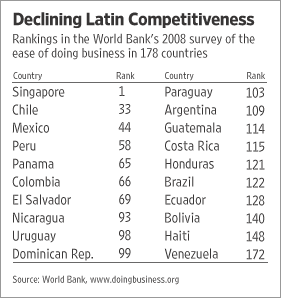 And there is that: business will pay a 1.5% tax on any transaction they do through November and December (and maybe later but that is not decided yet!!!!!)
The first conclusion of this new scandalous tax we must make is that the already low rank in business competitiveness will take yet another hit. Although at this point Venezuela been so low in the international rankings, I doubt it will make much difference. Private business in Venezuela is not hiring, is not expanding, and in the best of cases is happy at working at full capacity waiting for the government to take it over through the spurious expropriations contemplated in the new constitution. The only sectors that are in "expansion" are low capital consuming import and distribution. Read: the government associates (or not) who import everything we eat and redistribute it around. With a warehouse and a few trucks they are in business. Even if Chavez takes their business away (e.g. for Mercal), chances are their investment has been long recovered.
But let's go into the detail of this tax which is a naked admission by the government of the failure of its anti inflation policies. Yes, a FAILURE OF THE ANTI INFLATIONARY POLICIES.
The tax will be paid on any transaction that private business makes (state business might be exempted, this is not quite clear at this point). Only payroll payments will be exempt, supposedly to protect employees from being charged for that tax. It does not matter, they will pay for it in inflation as I am going to show next.
So, let's look at a food production chain, say, chicken. Companies that import goods to raise chicken pay 1.5% at importation time when they pay their CADIVI bill (if they have CADIVI access). Most of the time they sell their goods to animal feed plants, veterinarian facilities, local producers of specific goods made from imported raw material, etc.... These people pay another 1.5%. The products make it to the chicken producers. Another 1.5% added. When the cycle of raising chickens is done, the chicken farmer sells the chicken to a processing system, another 1.5% is thus added. Then the chicken is distributed to grocery stores and we get another 1.5%.
Total? 5 x 1.5 = 7.5% increased cost.
By the time the new tax works its way through the production chain we are set to observe at the very least a 3 to 5% inflation boost in many items (not all increases, wages do not increase, etc...). Thus, the private worker who was "spared" the tax will end up paying it anyway. Money does not grow on trees, no matter what Chavez and Monedero think, and the new tax cost will be passed on to the final customers.
But that is not the reason why I wanted to write on this subject even though the above explanation was necessary. The reason I wanted to stress this is that we are seeing again another governmental failure of its financial and economical policies. The reader should wonder why at this point, with the oil prices so high and with the claimed production of PDVSA so good the government needs to create such a brutal tax. Brutal not only for business but more brutal for consumers.
The origin is the use of lowering the sales tax to fight inflation. Through 2007 at two opportunities the government has lowered its sales tax in the hope of lowering inflation levels. This has of course has failed. In spite of sales tax going down from 14 to 9 %, inflation keeps apace and will likely be as high as last year, betraying a tendency to rise over time!
But in lowering sales tax the government has also lowered its revenues, something which economist warned the government at the time. But when did the Chavez administration listen to economists in Venezuela? This "supply side from hell" maneuver backfired badly for several reasons but for one mainly: the government kept increasing its spending as 2007 became yet another election year. The Chavez administration is starting to be called the "apotheosis of populism" in that no other Venezuelan administration has been giving away so much money to so many people without anything in return except for a promise of voting for Chavez. And chavismo is finding the hard truth of populists systems: they only survive through new promises and new spending: whenever they need to balance the books they lose support immediately.
So, faced with reality (no new private investment in production, decreasing oil revenues due as much through a decreased production in oil as well as a doubling of the PDVSA payroll, and a galloping corruption to crown it all) the government needs to find fresh cash FAST, before the December election. This is to give all sorts of year end bonus to the public sector to convince them to vote for Chavez in December (in Venezuela year end bonus must be given by law BEFORE December). Thus Chavez has decided to force the private sector to finance part of his constitutional referendum campaign with what should be considered an exaction. Chavismo knows very well that the public will only start feeling the pinch AFTER the vote takes place, that is, once the inventories are sold at the old price and after the new goods at the new prices hit the shelves. December inflation for all that I know could be as high as 5%, but the new constitution will have been approved. At least that is what Chavez hope anyway.
At any rate, when we see how easy the government does and undoes taxes and how the new constitution will make private property a very relative term, soon it will look good for Venezuelan business men, or those who are left, to start moving to more appealing markets such as Haiti.
PS: There is a detail that I am putting apart because I do not know if it is sheer governmental incompetence or just plain meanness from their part.
The Chavez administration has the gall to claim that this new tax will help fight inflation as it will remove money from the streets. Forgetting conveniently that it will put them into the government pocket to redistribute as fast as it comes in.
But what is worse in my eyes, is that the government forgot that a Sales Tax is not as punitive on people and inflation as the new tax they are imposing. Why you may ask? Because sales taxes are indirectly deductible. That is, as a company all the sales tax I would be charging can be compensated by the ones that I paid. That is, the sales taxes is carried over to the final customer but that tax has a limited effect on how I operate my business and my cost structure. With the new emergency tax business we will receive a direct hit that cannot be compensated except a price increase on the products we sell. There is no attenuation possible as nothing can be deducted. This is true from Polar to the little grocery store at the corner. In the end, as it is always the case, customers get screwed.
-The end-
Saturday, November 17, 2007
For your reading pleasure: what Chavez wants to do and what will really happen
For your reading pleasure I have two things today.
Simon Romero writes a major article, major as in big here, on what the referendum to be held in two is about. Yet I am not quite satisfied with this New York Times piece. I understand that Romero cannot be outright against Chavez constitutional changes where he is publishing. I sense that he certainly feels the danger behind Chavez move and he has the smarts to quote Barrera Tyszka who coins the "tyranny of popularity" to describe Chavez regime. The reader will come out of that article definitely worrying about the future of Venezuela (at least the democratic reader which I do hope are the NYT majority readers). But there is still something missing. Could it be that Romero includes academics in Chavez power base when all the evidence is to the contrary as chavismo is unable to win a faculty election in all serious and independent university, when not a single high flying Venezuelan academic is supporting the regime, where the only luminaries are imported mediocrities such as Spain's Monedero?
Perhaps that is what is missing in Venezuela coverage today: that there are few noteworthies that are willing to support the regime and that all support comes from a love relationship between Chavez and a large section of the masses. Romero gets it right when he senses that fervent chavistas will vote SI even if they do not agree with the changes because they trust Chavez no matter what. But perhaps Romero should have been more careful about judging the support to Chavez elsewhere. Also, he could have underlined that after all these chavismo excesses are only made possible through US diplomacy mistakes and its refusal to grow less dependent on Venezuelan oil.
At any rate, Romero at least offers a clear glimpse at what is awaiting Venezuela, a legally elected autocracy without hope of return to democracy except through violent means. But he only hints at the implications (well, the article can only be so long, the NYT is not a blog). If you want to look at the consequences you could start very well on the story of Citgo as researched and told by the Wall Street Journal (hat tip AC). There you will read how Chavez policies have been slowly but surely gutting Citgo, making miss its chance to become one of the leading oil companies in the world, leaving it now to face a slow extinction.
Of course, at 100 USD a barrel Citgo with Venezuela support will not go bankrupt, but that is not the point. The point is that Citgo under a good management and the insured Venezuelan oil supply could have become a leading US company, one of these whose words shape US policies. Instead it is slowly but surely becoming an average business at the sufferance of the US public who is more and more staying away of Citgo. Not that it matters much anyway as Citgo has become unable to supply its clients and gave up hundreds and hundreds of its affiliates.
The reason behind the dismantlement of Citgo is the need for fast cash by Chavez. Not for him long term business plans: it is now or never. Thus, the purchase of Citgo which cost a considerable effort to the old PDVSA. Now, by just signing some contract sale, oil terminals and refineries in the US are sold and the revenue is spent happily by Chavez in unproductive social programs, gifts to other countries, corruption and what not. That is right, assets go up in intangible smoke of no benefit for Venezuela except for a temporary political benefit for Chavez. The assets that PDVSA acquired at difficult times with rather sharp acumen are squandered. It is difficult to see how the new PDVSA would recover them someday if it needed them again. The opportunities of the 90ies are gone for good in the oil industry.
The WSJ paper also tells us two very interesting items about the future of Venezuela, even if only Citgo is studied. First, the secrecy that now surrounds Citgo. Citgo has sold any stocks or bonds it might have and is now out of SEC control. That is not too important in a way, through worrying. What is more important is that now Citgo is managed through a board of directors that are not US (it is not clear if there is at least one US guy on it), and a board which acts in total secrecy. Secrecy! That is a word that characterizes well the new look of the Chavez movement and one of the goal of the new constitution where the people will have definitively no access to the government accounts. In other words there is no way for an independent inquiry to see how well Citgo (or any state controlled business in Venezuela ) is doing. At least for Citgo we can have some day tax returns at the IRS which will give us profits over revenues. But for the rest of Venezuela we will only know how much the revolution of Chavez has cost us once he is out of office. A reason by the way powerful enough for him to cling to power for ever and ever.
The other item expanded in the WSJ ties up with what I wrote above, that none of the Venezuelan best and brightest are in bed with chavismo. The board of Citgo includes two foreigners, Bernard Mommner described as a French Marxist mathematician (and a very discrete power player within chavismo with a reported lavish European life style) and the Mexican Juan Carlos Boué (who, by his name, might also be of French origin). These two characters had espoused in the past the theory that PDVSA was not bringing home enough of its profits by investing too much overseas. In such way they demonstrated clearly that they did not know how a capitalist business must work, through constant investment to keeps its competitive edge, its market share and its future prospect. After all, whatever PDVSA bought overseas was still owned by Venezuela and could eventually ensure a comfortable income once the investment was absorbed.
The strategy of PDVSA was based at a time where Venezuelan oil was not well quoted and where oil in general was thought as a long term cheap commodity. But PDVSA had planted the seeds to become a major world player once oil woudl go up again. Instead by listening to advisers such as Mommer and Boué Venezuela is reverting to a colonial exploitative system where it will sell its oil to the highest bidder, becoming thus economically dependent on the highest bidder, being that one the US, China, India or Europe. Because the higher bidder will also pose its conditions and the unquenchable thirst of Chavez will make him eventually accept the conditions imposed.
And thus we see the future of Venezuela where Chavez will repulse the Venezuelan intellectual elites and thus will have to rely more and more on international mercenaries. Meanwhile in the streets even people that know better are deciding to vote SI because they just love Chavez.
-The end-
Simon Romero writes a major article, major as in big here, on what the referendum to be held in two is about. Yet I am not quite satisfied with this New York Times piece. I understand that Romero cannot be outright against Chavez constitutional changes where he is publishing. I sense that he certainly feels the danger behind Chavez move and he has the smarts to quote Barrera Tyszka who coins the "tyranny of popularity" to describe Chavez regime. The reader will come out of that article definitely worrying about the future of Venezuela (at least the democratic reader which I do hope are the NYT majority readers). But there is still something missing. Could it be that Romero includes academics in Chavez power base when all the evidence is to the contrary as chavismo is unable to win a faculty election in all serious and independent university, when not a single high flying Venezuelan academic is supporting the regime, where the only luminaries are imported mediocrities such as Spain's Monedero?
Perhaps that is what is missing in Venezuela coverage today: that there are few noteworthies that are willing to support the regime and that all support comes from a love relationship between Chavez and a large section of the masses. Romero gets it right when he senses that fervent chavistas will vote SI even if they do not agree with the changes because they trust Chavez no matter what. But perhaps Romero should have been more careful about judging the support to Chavez elsewhere. Also, he could have underlined that after all these chavismo excesses are only made possible through US diplomacy mistakes and its refusal to grow less dependent on Venezuelan oil.
At any rate, Romero at least offers a clear glimpse at what is awaiting Venezuela, a legally elected autocracy without hope of return to democracy except through violent means. But he only hints at the implications (well, the article can only be so long, the NYT is not a blog). If you want to look at the consequences you could start very well on the story of Citgo as researched and told by the Wall Street Journal (hat tip AC). There you will read how Chavez policies have been slowly but surely gutting Citgo, making miss its chance to become one of the leading oil companies in the world, leaving it now to face a slow extinction.
Of course, at 100 USD a barrel Citgo with Venezuela support will not go bankrupt, but that is not the point. The point is that Citgo under a good management and the insured Venezuelan oil supply could have become a leading US company, one of these whose words shape US policies. Instead it is slowly but surely becoming an average business at the sufferance of the US public who is more and more staying away of Citgo. Not that it matters much anyway as Citgo has become unable to supply its clients and gave up hundreds and hundreds of its affiliates.
The reason behind the dismantlement of Citgo is the need for fast cash by Chavez. Not for him long term business plans: it is now or never. Thus, the purchase of Citgo which cost a considerable effort to the old PDVSA. Now, by just signing some contract sale, oil terminals and refineries in the US are sold and the revenue is spent happily by Chavez in unproductive social programs, gifts to other countries, corruption and what not. That is right, assets go up in intangible smoke of no benefit for Venezuela except for a temporary political benefit for Chavez. The assets that PDVSA acquired at difficult times with rather sharp acumen are squandered. It is difficult to see how the new PDVSA would recover them someday if it needed them again. The opportunities of the 90ies are gone for good in the oil industry.
The WSJ paper also tells us two very interesting items about the future of Venezuela, even if only Citgo is studied. First, the secrecy that now surrounds Citgo. Citgo has sold any stocks or bonds it might have and is now out of SEC control. That is not too important in a way, through worrying. What is more important is that now Citgo is managed through a board of directors that are not US (it is not clear if there is at least one US guy on it), and a board which acts in total secrecy. Secrecy! That is a word that characterizes well the new look of the Chavez movement and one of the goal of the new constitution where the people will have definitively no access to the government accounts. In other words there is no way for an independent inquiry to see how well Citgo (or any state controlled business in Venezuela ) is doing. At least for Citgo we can have some day tax returns at the IRS which will give us profits over revenues. But for the rest of Venezuela we will only know how much the revolution of Chavez has cost us once he is out of office. A reason by the way powerful enough for him to cling to power for ever and ever.
The other item expanded in the WSJ ties up with what I wrote above, that none of the Venezuelan best and brightest are in bed with chavismo. The board of Citgo includes two foreigners, Bernard Mommner described as a French Marxist mathematician (and a very discrete power player within chavismo with a reported lavish European life style) and the Mexican Juan Carlos Boué (who, by his name, might also be of French origin). These two characters had espoused in the past the theory that PDVSA was not bringing home enough of its profits by investing too much overseas. In such way they demonstrated clearly that they did not know how a capitalist business must work, through constant investment to keeps its competitive edge, its market share and its future prospect. After all, whatever PDVSA bought overseas was still owned by Venezuela and could eventually ensure a comfortable income once the investment was absorbed.
The strategy of PDVSA was based at a time where Venezuelan oil was not well quoted and where oil in general was thought as a long term cheap commodity. But PDVSA had planted the seeds to become a major world player once oil woudl go up again. Instead by listening to advisers such as Mommer and Boué Venezuela is reverting to a colonial exploitative system where it will sell its oil to the highest bidder, becoming thus economically dependent on the highest bidder, being that one the US, China, India or Europe. Because the higher bidder will also pose its conditions and the unquenchable thirst of Chavez will make him eventually accept the conditions imposed.
And thus we see the future of Venezuela where Chavez will repulse the Venezuelan intellectual elites and thus will have to rely more and more on international mercenaries. Meanwhile in the streets even people that know better are deciding to vote SI because they just love Chavez.
-The end-
Monday, July 29, 2013
The IAEPHC is born. We may finally start understanding something of the twisted mind of Chavez
 |
| Hefty, hefty..... |
Let's start by saying that the work is going to be epic. Not because Hugo Chavez left a body of work worth analyzing but because he did not leave anything written except for a few newspaper columns and some letters. What Chavez is leaving are hours and hours and yet more hours of rants. Though "rant" is not a good description of Chavez speeches, the French "déblatérer" would be better, describing abundant and violent speech against something. But I digress.
Subscribe to:
Posts (Atom)