And thus I am on December 28 in a hurry to write something as events keep going on in Venezuela. There is no time for a holiday pause. What, with the regime's shenanigans and the opposition division and only 7 days left for the new National Assembly to be sworn in!
Showing posts with label constitution changes. Show all posts
Showing posts with label constitution changes. Show all posts
Monday, December 28, 2015


Sunday, August 04, 2013
Is Venezuelan opposition dragged into a coherent strategy?
The end result of this week may be unexpected. Both sides accumulated failure after failure and yet, the opposition may have come on top significantly with the real tool it needs most: a strategy.
Tuesday, June 25, 2013
Dreams of constitutional repression
That ever self serving pseudo panacea of our sub continent, calling for a constitutional assembly to solve problems that politicians have no resolve to deal with directly, is being invoked all around. After all, the brilliant example of Chavez who called for a constitutional assembly to solve Venezuelan problems is there for all: not only he did not solve any of his country problems, but he made them worse, and he certainly did solve the financial future of his relatives and friends, ending himself as a president for life.
These weeks we heard from different points a call for some form of constitutional assembly, and in all cases it comes from a group of people that are unable of unwilling to have their way and thus want to use the mechanism. Let's not be afraid of words here, what they all want really is a soft, legal repression, that will silence down those that are not allowing them to get their way.
These weeks we heard from different points a call for some form of constitutional assembly, and in all cases it comes from a group of people that are unable of unwilling to have their way and thus want to use the mechanism. Let's not be afraid of words here, what they all want really is a soft, legal repression, that will silence down those that are not allowing them to get their way.
Wednesday, November 14, 2012
Preposterous pre constitutional pre posturing
The few faithful readers left to this blog would certainly not have been surprised last week when chavismo decided to start "talks" on constitutional programming for the 2013-2019 program of government which must undoubtedly lead to a new attempt at modifying the constitution of 1999.
In a text published on October 21 I explained as clearly as I could that chavismo had to seek a constitutional modification in order to avoid an election were Chavez going to croak before January 2017. amen of seeking to make the presidency hereditary within the Chavez family so as to avoid unpleasant succession wars. I really do not need to add anything to that previous post, except to make limited comments as to the timing and methods chosen by chavismo.
In a text published on October 21 I explained as clearly as I could that chavismo had to seek a constitutional modification in order to avoid an election were Chavez going to croak before January 2017. amen of seeking to make the presidency hereditary within the Chavez family so as to avoid unpleasant succession wars. I really do not need to add anything to that previous post, except to make limited comments as to the timing and methods chosen by chavismo.
Tuesday, May 29, 2012
No political trouble that cannot be solved by a tiny constitutional amendment
What to make of Chavez dernière boutade? He simply just thought of it, an amendment to enshrine the Misiones into the Constitution. That is right, all the social programs that he has been doing more or less legally since 2003, which have been his political lifeblood, suddenly he fells like he should put them inside the Constitution (1). There is no need to discuss whether they should be enshrined: a mere law would suffice to make all of these Misiones legal. The interest is elsewhere.
Thursday, May 14, 2009
The current electoral campaign of Chavez: towards a new constitution?
Rocio San Miguel who now writes for Tal Cual puts up clearly a case scenario that is worth considering and that I was tinkering with, though not daring yet to write about it. But as is often the case, procrastination pays and instead of writing about the topic I just need to translate today's article of San Miguel. In short, it is the possible preparation of Chavez to write a brand new constitution and end once and for all any legal possibility for the opposition to access power through democratic means. Somme comments of mine at the end.
The campaign
The softening work on society, that Chavez has been doing in recent months on all fronts, is clear and purposeful, and has been observed by few.
The third stage of the revolution has begun. Chavez has said it explicitly.
In the economic sector [he is]affecting even those who were hitherto untouchables, expropriating land, establishing restrictions on all types of activity carried out, introducing the novelty of the end of private property and approving right and left laws that sustain the twenty-first century socialism.
In the social sphere [he is] activating the Ministry of Communes, to impose a legal concept to eliminate the role of mayors, especially those who are not aligned with the regime and to transfer from the presidency economic resources "direct" for projects that once "Venezuela" thought they could be managed in a decentralized country, without passing through the filter of forced adherence to a political project.
In politics [he] has taken out of the way opponents by disqualifying them, by giving the order to open legal proceedings against them, going as far as depriving them of liberty.
In the military sphere, perhaps society least known area, a fierce offensive is at play and has led in recent months to dozens of requests of retirement, especially from those without formal duties, the so called ‘institutionals’, who openly had been separated from the National Armed Forces active duty for being seen against the process of politicization of the Venezuelan military structure.
In the midst of all, there is no halt in the presidential cadenas, the distribution of "White Line” [kitchen appliances], foreign travels, the threat of opening new trials to private media, updating via “red points” the registration of the chavista PSUV, the restart of the show “La Hojilla”, the giving away, the demagoguery and threats to anyone who dissents from the regime.
Where is Chavez going? The president is in an electoral campaigning for the only exit for which the democratic society is not ready, [the] election of a National Constituent Assembly to be announced just as the referendum on February 15 [was announced].
With a date already set in Miraflores and not so late as to allow the opposition, including the independent sectors, to get prepared.
The parliamentary elections of 2010 would thus be annulled and who knows if the 2012 presidential elections too. Chavez feels he is winning. He is doing his polls and he is also promoting their results.
The center of gravity of his staying in power goes through a maneuver not without risks but surprising to prevent his opponents to organize.
This hypothesis would give as a voting date the month of June [the necessary referendum to call for a constituent assembly]. The election for a National Constituent Assembly [would be] on September 15, 2009 catching the country demobilized during the "convenient" student vacations, an opposition without logistics and a National Army in its highest point of demoralization of the last 10 years. It is worth reflecting on this scenario.
--- --- --- --- --- --- --- ---
Rocio San Miguel has been very active in civil rights issues and other political stuff since she came to notoriety as one of the first victims of the Tascon apartheid list to go public and seek legal redress. Since then she has been threatened but has not stopped from making TV appearances where she likes to discuss military and security matters (she worked at borders control before being fired) and writing for Tal Cual in addition of compiling Tascon List abuses.
Her article was difficult to translate because her style is not amenable to English translation and her text is really for local consumption as even, say, Colombians would have trouble understanding all the facts she takes for public knowledge. Thus the need for me to add many brackets and even words whose were not directly suggested by the original.
This being said, what can we make of her hypothesis? Well, it makes sense, even if she makes it sound easier to do for Chavez than what it really would be. After all the simple application of the lot of laws recently passed, that would remain unchallenged in courts, is enough for him to get what he wants the most now, an effective opposition neutralization that would allow smooth reelection in 2012. By 2018 we would be fully Zimbabwed so he would have no trouble for yet a new reelection.
But Chavez has two problems that he cannot just solve with he current legal situation. First he must run for reelection in 2012 and he is not sure that the crisis would be far behind and oil income high enough to ensure a smooth reelection. Second, to obtain his reelection amendment last February he had to accept that everyone could be reelected. This has always gone against his nature and we can be pretty sure that he needs to have this removed as he needs that lever to control any of his followers that would dare to run for reelection on their own (and likely win since the incumbent advantage has become so obscene today).
By calling for a new constitution with the pretext to enshrine the new "popular laws" he would get the two things that are at the core of his political project which is a legal and pseudo democratic way to remain president for life. The cynicism could be pushed far enough by him to put again term limits even for himself as long as he gets a fresh start in the new constitution of 2010. Even two seven years terms might be enough since at the end of them he would be 69 years old. Heck, he could even give two 4 year terms for everyone else and three 7 years for himself and pass it! Thus he would reach without any trouble the ripe age of 76 when his current crimes would be forgotten and he would be able to hand power down to any chosen heir. After all, who is remembering Fidel and Che's crimes in the current Cuban transition (and I do not have in mind only the Fidel to Raul one, but the one coming soon for Raul)?
It makes sense. And for more reasons than what is written above. If I had not written about such scenarios before it is because I had not weighted them enough; but more importantly because it would have forced me to write a specific post about the incompetence of the opposition unable to come up with a bold scenario of its own. For example right now the opposition should promote a constituent assembly to revoke the seizure of Caracas by gauleiter Faria(s), the new threat against private property and freedom of expression, just to name two causes worth moving one's butt. Instead what we see is a limited effort including only Caracas people when 46% of the country said NO last February with a number which probably increased since then. There is not even talk of recall election on the Nazional Assembly! Something that could work quite well at least in Caracas and Zulia, handing down to Chavez a strong psychological blow!!!!
I do not know if San Miguel scenario will happen, though it is interesting to consider the possibility (and make that a must for the opposition). After all Chavez could resort to yet another simpler referendum to end decentralization once and for all, based on the "comunas" demagoguery. Other referenda ideas can easily come up to achieve specific ends provided a bone is attached to each one of them, such as the reelection bone for all in last February. It is certainly true that the opposition is vulnerable right now but any Constituent Assembly this time around will have enough opposition to offer a concrete vocal platform that would be very difficult to silence. I doubt that today Chavez can repeat his 1999 win of 97% seats for 60% of the vote when he would be very hard pressed to get even 55% without outright cheating, with an opposition much more motivated than in 1999 which would definitely get enough seats to make a ruckus.
But then again the Chavez of today is certainly much more willing to have the CNE do all the necessary cheating to ensure him the majority he needs for quick new constitution approval.
-The end-
The campaign
The softening work on society, that Chavez has been doing in recent months on all fronts, is clear and purposeful, and has been observed by few.
The third stage of the revolution has begun. Chavez has said it explicitly.
In the economic sector [he is]affecting even those who were hitherto untouchables, expropriating land, establishing restrictions on all types of activity carried out, introducing the novelty of the end of private property and approving right and left laws that sustain the twenty-first century socialism.
In the social sphere [he is] activating the Ministry of Communes, to impose a legal concept to eliminate the role of mayors, especially those who are not aligned with the regime and to transfer from the presidency economic resources "direct" for projects that once "Venezuela" thought they could be managed in a decentralized country, without passing through the filter of forced adherence to a political project.
In politics [he] has taken out of the way opponents by disqualifying them, by giving the order to open legal proceedings against them, going as far as depriving them of liberty.
In the military sphere, perhaps society least known area, a fierce offensive is at play and has led in recent months to dozens of requests of retirement, especially from those without formal duties, the so called ‘institutionals’, who openly had been separated from the National Armed Forces active duty for being seen against the process of politicization of the Venezuelan military structure.
In the midst of all, there is no halt in the presidential cadenas, the distribution of "White Line” [kitchen appliances], foreign travels, the threat of opening new trials to private media, updating via “red points” the registration of the chavista PSUV, the restart of the show “La Hojilla”, the giving away, the demagoguery and threats to anyone who dissents from the regime.
Where is Chavez going? The president is in an electoral campaigning for the only exit for which the democratic society is not ready, [the] election of a National Constituent Assembly to be announced just as the referendum on February 15 [was announced].
With a date already set in Miraflores and not so late as to allow the opposition, including the independent sectors, to get prepared.
The parliamentary elections of 2010 would thus be annulled and who knows if the 2012 presidential elections too. Chavez feels he is winning. He is doing his polls and he is also promoting their results.
The center of gravity of his staying in power goes through a maneuver not without risks but surprising to prevent his opponents to organize.
This hypothesis would give as a voting date the month of June [the necessary referendum to call for a constituent assembly]. The election for a National Constituent Assembly [would be] on September 15, 2009 catching the country demobilized during the "convenient" student vacations, an opposition without logistics and a National Army in its highest point of demoralization of the last 10 years. It is worth reflecting on this scenario.
--- --- --- --- --- --- --- ---
Rocio San Miguel has been very active in civil rights issues and other political stuff since she came to notoriety as one of the first victims of the Tascon apartheid list to go public and seek legal redress. Since then she has been threatened but has not stopped from making TV appearances where she likes to discuss military and security matters (she worked at borders control before being fired) and writing for Tal Cual in addition of compiling Tascon List abuses.
Her article was difficult to translate because her style is not amenable to English translation and her text is really for local consumption as even, say, Colombians would have trouble understanding all the facts she takes for public knowledge. Thus the need for me to add many brackets and even words whose were not directly suggested by the original.
This being said, what can we make of her hypothesis? Well, it makes sense, even if she makes it sound easier to do for Chavez than what it really would be. After all the simple application of the lot of laws recently passed, that would remain unchallenged in courts, is enough for him to get what he wants the most now, an effective opposition neutralization that would allow smooth reelection in 2012. By 2018 we would be fully Zimbabwed so he would have no trouble for yet a new reelection.
But Chavez has two problems that he cannot just solve with he current legal situation. First he must run for reelection in 2012 and he is not sure that the crisis would be far behind and oil income high enough to ensure a smooth reelection. Second, to obtain his reelection amendment last February he had to accept that everyone could be reelected. This has always gone against his nature and we can be pretty sure that he needs to have this removed as he needs that lever to control any of his followers that would dare to run for reelection on their own (and likely win since the incumbent advantage has become so obscene today).
By calling for a new constitution with the pretext to enshrine the new "popular laws" he would get the two things that are at the core of his political project which is a legal and pseudo democratic way to remain president for life. The cynicism could be pushed far enough by him to put again term limits even for himself as long as he gets a fresh start in the new constitution of 2010. Even two seven years terms might be enough since at the end of them he would be 69 years old. Heck, he could even give two 4 year terms for everyone else and three 7 years for himself and pass it! Thus he would reach without any trouble the ripe age of 76 when his current crimes would be forgotten and he would be able to hand power down to any chosen heir. After all, who is remembering Fidel and Che's crimes in the current Cuban transition (and I do not have in mind only the Fidel to Raul one, but the one coming soon for Raul)?
It makes sense. And for more reasons than what is written above. If I had not written about such scenarios before it is because I had not weighted them enough; but more importantly because it would have forced me to write a specific post about the incompetence of the opposition unable to come up with a bold scenario of its own. For example right now the opposition should promote a constituent assembly to revoke the seizure of Caracas by gauleiter Faria(s), the new threat against private property and freedom of expression, just to name two causes worth moving one's butt. Instead what we see is a limited effort including only Caracas people when 46% of the country said NO last February with a number which probably increased since then. There is not even talk of recall election on the Nazional Assembly! Something that could work quite well at least in Caracas and Zulia, handing down to Chavez a strong psychological blow!!!!
I do not know if San Miguel scenario will happen, though it is interesting to consider the possibility (and make that a must for the opposition). After all Chavez could resort to yet another simpler referendum to end decentralization once and for all, based on the "comunas" demagoguery. Other referenda ideas can easily come up to achieve specific ends provided a bone is attached to each one of them, such as the reelection bone for all in last February. It is certainly true that the opposition is vulnerable right now but any Constituent Assembly this time around will have enough opposition to offer a concrete vocal platform that would be very difficult to silence. I doubt that today Chavez can repeat his 1999 win of 97% seats for 60% of the vote when he would be very hard pressed to get even 55% without outright cheating, with an opposition much more motivated than in 1999 which would definitely get enough seats to make a ruckus.
But then again the Chavez of today is certainly much more willing to have the CNE do all the necessary cheating to ensure him the majority he needs for quick new constitution approval.
-The end-
Friday, January 30, 2009
What you vote for, really, when you mark the SI case in two weeks
A lot of hand wringing is taking place in Venezuela, provoked by the onanistic desires of Chavez. The escalade has been swift, from the violence that we see now everyday to the tremendous pressure put by the government on the country, a vicious system worthy of the Tascon list maneuvers of 2004. Now that scare tactics seem to pay off for chavismo, rather than discussing the pro and cons or whether polls are getting it, I think it better to remind folks who vote for the SI what their vote means, in real life. Let me stress to those inclined to vote SI that they are not voting for removing term limits, they are voting to perpetuate a style of government and of making politics.
If you vote SI you approve of violence as a legitimate electoral tool. You approve that the party in power can accuse their democratic political opponents of traitors. You thus approve that violence is used against those who pretend to vote NO, and that this violence continues after the election.
If you vote SI you approve of blackmail as a legitimate tool of electioneering and thus as a legitimate tool of ruling after the election. If you vote SI you approve that all public workers can be dismissed strictly on political criteria, that all government business and contracting needs to fulfill first a political criteria for their approval.
If you vote SI then for you the extraordinary blatant use of public property by the sitting government to foster its political fortunes is acceptable. You thus approve of public money spent at every level for objectives that are not the direct improvement of all citizens lives. And thus you approve of the corruption that will follow the electoral victory of the government. You must understand that those who will win will see it perfectly natural to keep considering public funds as their war booty.
If you vote SI you approve that the National Assembly castrated itself to become a simple registry chamber for the executive power which will be now officially Chavez alone. You also approve that the High Court emitted all the necessary rulings to make what is an electoral and constitutional fraud a legalized fraud. You also approve that the electoral umpire can flaunt its partiality towards a sitting president.
If you vote SI you approve of the way Chavez runs electoral campaigns. Thus you give him a blank check so that in the future he can apply even worse pressure on his political opponent than he does today. That is, you are approving that he uses the power of the state, the power of tribunals, the power of institutions, the fire power of the Army to silence any opposition.
If you vote SI and the SI wins you are telling those who vote NO today that in the future they will be entitled to use the same violence against you if they want. But if you vote NO and the NO wins you will have put the first stone to rebuild a system where all of these abuses will be one day banished.
Now, you may have other reasons to vote SI, reasons that I hope are better than what is implied above. Or perhaps your only reason is that you are a beneficiary of a Mision or hold a precarious government job. However you must keep in mind that if the SI wins on February 15 those who will have voted NO will identify all of the SI voters as the people who approved that the government made them second class citizens. You will be identified as those who think that political repression is fair. You will be labeled as those who agreeed that the NO voters be forced to shut up if they want to be able to go along on their daily business.
If you voted SI, do not be surprised if one day chavismo goes knocking at your door to threaten you and there is no one of your NO voting neighbors there to defend you. Or even worse, they might be there but could not care less about what happens to you.
In other words, if you vote SI you are voting to divide once and for all Venezuela in two irreconcilable camps that will try to destroy each other sooner than later.
You are perfectly entitled to a SI vote but you need to understand that you will not be able to escape the consequences of your SI vote.
-The end-
Tuesday, October 09, 2007
Two Latin Americas (and two US)
This week started with yet a new display on why Latin America might never be able to get from under its undeveloped status: our love for inane myth. Not that other cultures do not fall under the sway of their own myth which on occasion can spell disaster for them, but it seems that in Latin America we have developed a talent to seek such myths even when they come with a warning label.
On the other hand, we have a US that still does not get it and sometimes seems to be doing all what it cans to perpetuate such myths, making one wonder if the subconscious of the US actually wants us to remain "primitive" (or was that exotic?)
The "Che" 40 year death commemoration
I do not want to talk much about that. Words fail me to explain why a mass murderer can be shown today as a beacon of love and peace. I am not talking about our delirious tropi-banana local Venezuelan potentate, so blinded by "che" cult, that he said a few days ago that any graduating MD that joined private practice was just a mercenary, was not in his eyes an MD (ensuring this way that Venezuela will not be forming good doctors anymore). No, I am talking about the opinions on the Che that many youth expressed when any mic would be placed in front of them. Apparently years of ignoring the reality of the Che in schools have created a generation that believes that the Che was the iconic 13th disciple. Maybe Dr. Mengele supporters might want to review their promotional strategy. They could look in the US where merchandising has yielded handsome dividends by selling tons of memorabilia to people who the Che would have so much loved to destroy.
An Ecuadoran constituent assembly
Although this piece f news is technically a week old I am including it here as it truly belongs to the topic of inane myths ruling our conduct. It is not idle to remember that Correa, Ecuador president for one year now was elected on a second round ballot AFTER having arrived second in a first round, with not even 30% of the popular vote. Yet, for some unexplainable reason he has managed to get high ratings and pulled out an electoral victory one week ago which will give him a solid majority to push any constitution he feels like. The Venezuelan script is so far followed to the letter, even though Correa should have the credentials to be a more democratic leader than our local tropi-potentate. When you see someone like Oppenheimer who has talked to all LatAm presidents describe Correa as one of the most arrogant leaders he ever met, then you might get a clue...
I am not going to worry much about Correa. The only chance he has to make his project to become life president of Ecuador (his protest to the contrary are lame and after tropi-bananator example we all know much better) is to succeed in bringing Ecuador out of the US dollar belt. I doubt that Ecuadorans will vote for a new currency now that they are starting to enjoy the benefits of a solid currency. But one never knows, countries have done the suicide thing. Besides it would not be the first time that Ecuadorans elected a wildly popular leader to toss him out even faster.
No, what is interesting here is that a mass hysteria is leading the country to believe that yet a new constitution will solve the problems of the country. They could have asked Colombians how that did work for them. They could ask Venezuelans how this is working out for them. They could have asked how Bolivians are coping with it. Not to mention other such attempts such as Peru and Brazil who on the long run have not floundered as badly. Apparently the new constitution mantra has become a new myth, the latest offering for messianic leaders to reach power.
And the US, from the height of the longest serving constitution of the continent seems unable (or unwilling?) to even offer constructive advice. Not that it should, but it would be nice to hear a US president say that constitutions are only as good as the people who apply them. Then again, that would question certain US presidents, would it not?
A free trade referendum in Costa Rica
Fortunately to compensate for a bad electoral result in Ecuador and the anti modernity folly of the Che we had a good vote in Costa Rica. No matter whether one agrees with Free Trade Agreements, anyone should at least understand that a small country like Costa Rica can only survive and thrive in an open economy. The garden variety of FTA to apply can be discussed, but they are a must for a country who has only nature and its people skills to sell. Well, for a few weeks we were concerned that Costa Rica would turn its back to any FTA. For the tropi-bananism that would have been a good result since their objective is to create a free trade zone where mediocrity is the commodity and oil the rewards for servility. Colder heads prevailed. Even if the margin is narrow, soon Costa Ricans will start enjoying for example the benefits of modern communication technology at lower prices, and will be able to retain investors and increase their market share in the only market that counts for the Caribbean, for better or worse the US. It is that or exporting migrants to the US: there was no other choice unfortunately. For those who doubt this I would urge them to observe the results of the nationalizations of CANTV and EAS in tropi-bananaland: service is noticeably down and the joints have been taken over barely 6 months ago!
But that Tico success as usual did not come with the help of the US. I am not impressed by the new democratic congress leadership. And I would be a registered Democrat if I lived in the US (if anything because Dem primaries are usually much more interesting). I do understand that they do have a need to deal with Iraq but their anti Bush rhetoric is coloring some aspects that should not be touched, that should be bi-partisan no matter what. The Washington Post editorial today has a very nice summary of that referendum battle in Costa Rica, and inasmuch as the Post is considered a Liberal paper, it clearly and willfully endorsed the Costa Rican result as a victory.
Thus it is with dismay that I read in that editorial:
That is wrong on many levels. First, no one asked them to do so (even if trade unions asked them, Costa Rica is too small a country to be a threat). Second, foreign policy is conducted by the executive power. This one requiring a two third approval of treaties in the Senate CANNOT negotiate anything it wants. Foreign policy in the US is usually a bi-partisan affair by necessity, at the very least when a treaty will result form a given initiative. Third, it was a lie as the State Department promptly pointed out. And last but certainly not least, it did go squarely against US interests in the region. Amen of US intervention in a Costa Rican affair by the Democrats in Congress!!!!
I observe with the greatest dismay that the Congressional leadership is slowly but surely, (for personal vendetta?) taking a policy that is detrimental for the US interests in the region and which in the medium term can only profit the anti US agenda in the area. There is something worrisome when Democrats start looking at their navel as it is certainly not the Republicans who will take them out this self gazing.... If in a way that Costa Rica demarche might have been a token thrown to trade unions by Pelosi so she can be freer for bigger things, it is not reassuring that the Colombian FTA approval is all but doomed, which will result in dire consequences for the US, starting with increased drug supplies. What incentives will be left for ANY Colombian government once they are told that the US does not want an FTA with them? In case Pelosi et al. have forgotten, the only incentive that Colombians have to stop growing coca leaves is to grow or manufacture stuff to sell the US. That is it for Congress, or doing an Iraq on Colombia; and we all know how that worked.
-The end-
On the other hand, we have a US that still does not get it and sometimes seems to be doing all what it cans to perpetuate such myths, making one wonder if the subconscious of the US actually wants us to remain "primitive" (or was that exotic?)
The "Che" 40 year death commemoration
I do not want to talk much about that. Words fail me to explain why a mass murderer can be shown today as a beacon of love and peace. I am not talking about our delirious tropi-banana local Venezuelan potentate, so blinded by "che" cult, that he said a few days ago that any graduating MD that joined private practice was just a mercenary, was not in his eyes an MD (ensuring this way that Venezuela will not be forming good doctors anymore). No, I am talking about the opinions on the Che that many youth expressed when any mic would be placed in front of them. Apparently years of ignoring the reality of the Che in schools have created a generation that believes that the Che was the iconic 13th disciple. Maybe Dr. Mengele supporters might want to review their promotional strategy. They could look in the US where merchandising has yielded handsome dividends by selling tons of memorabilia to people who the Che would have so much loved to destroy.
An Ecuadoran constituent assembly
Although this piece f news is technically a week old I am including it here as it truly belongs to the topic of inane myths ruling our conduct. It is not idle to remember that Correa, Ecuador president for one year now was elected on a second round ballot AFTER having arrived second in a first round, with not even 30% of the popular vote. Yet, for some unexplainable reason he has managed to get high ratings and pulled out an electoral victory one week ago which will give him a solid majority to push any constitution he feels like. The Venezuelan script is so far followed to the letter, even though Correa should have the credentials to be a more democratic leader than our local tropi-potentate. When you see someone like Oppenheimer who has talked to all LatAm presidents describe Correa as one of the most arrogant leaders he ever met, then you might get a clue...
I am not going to worry much about Correa. The only chance he has to make his project to become life president of Ecuador (his protest to the contrary are lame and after tropi-bananator example we all know much better) is to succeed in bringing Ecuador out of the US dollar belt. I doubt that Ecuadorans will vote for a new currency now that they are starting to enjoy the benefits of a solid currency. But one never knows, countries have done the suicide thing. Besides it would not be the first time that Ecuadorans elected a wildly popular leader to toss him out even faster.
No, what is interesting here is that a mass hysteria is leading the country to believe that yet a new constitution will solve the problems of the country. They could have asked Colombians how that did work for them. They could ask Venezuelans how this is working out for them. They could have asked how Bolivians are coping with it. Not to mention other such attempts such as Peru and Brazil who on the long run have not floundered as badly. Apparently the new constitution mantra has become a new myth, the latest offering for messianic leaders to reach power.
And the US, from the height of the longest serving constitution of the continent seems unable (or unwilling?) to even offer constructive advice. Not that it should, but it would be nice to hear a US president say that constitutions are only as good as the people who apply them. Then again, that would question certain US presidents, would it not?
A free trade referendum in Costa Rica
Fortunately to compensate for a bad electoral result in Ecuador and the anti modernity folly of the Che we had a good vote in Costa Rica. No matter whether one agrees with Free Trade Agreements, anyone should at least understand that a small country like Costa Rica can only survive and thrive in an open economy. The garden variety of FTA to apply can be discussed, but they are a must for a country who has only nature and its people skills to sell. Well, for a few weeks we were concerned that Costa Rica would turn its back to any FTA. For the tropi-bananism that would have been a good result since their objective is to create a free trade zone where mediocrity is the commodity and oil the rewards for servility. Colder heads prevailed. Even if the margin is narrow, soon Costa Ricans will start enjoying for example the benefits of modern communication technology at lower prices, and will be able to retain investors and increase their market share in the only market that counts for the Caribbean, for better or worse the US. It is that or exporting migrants to the US: there was no other choice unfortunately. For those who doubt this I would urge them to observe the results of the nationalizations of CANTV and EAS in tropi-bananaland: service is noticeably down and the joints have been taken over barely 6 months ago!
But that Tico success as usual did not come with the help of the US. I am not impressed by the new democratic congress leadership. And I would be a registered Democrat if I lived in the US (if anything because Dem primaries are usually much more interesting). I do understand that they do have a need to deal with Iraq but their anti Bush rhetoric is coloring some aspects that should not be touched, that should be bi-partisan no matter what. The Washington Post editorial today has a very nice summary of that referendum battle in Costa Rica, and inasmuch as the Post is considered a Liberal paper, it clearly and willfully endorsed the Costa Rican result as a victory.
Thus it is with dismay that I read in that editorial:
Senate Majority Leader Harry Reid (D-Nev.)and House Speaker Nancy Pelosi (D-Calif.) wrote Costa Rica's ambassador in Washington to say that Costa Rica would not necessarily lose current U.S. trade benefits under the Caribbean Basin Initiative, which expires in September, if the pact were rejected.
That is wrong on many levels. First, no one asked them to do so (even if trade unions asked them, Costa Rica is too small a country to be a threat). Second, foreign policy is conducted by the executive power. This one requiring a two third approval of treaties in the Senate CANNOT negotiate anything it wants. Foreign policy in the US is usually a bi-partisan affair by necessity, at the very least when a treaty will result form a given initiative. Third, it was a lie as the State Department promptly pointed out. And last but certainly not least, it did go squarely against US interests in the region. Amen of US intervention in a Costa Rican affair by the Democrats in Congress!!!!
I observe with the greatest dismay that the Congressional leadership is slowly but surely, (for personal vendetta?) taking a policy that is detrimental for the US interests in the region and which in the medium term can only profit the anti US agenda in the area. There is something worrisome when Democrats start looking at their navel as it is certainly not the Republicans who will take them out this self gazing.... If in a way that Costa Rica demarche might have been a token thrown to trade unions by Pelosi so she can be freer for bigger things, it is not reassuring that the Colombian FTA approval is all but doomed, which will result in dire consequences for the US, starting with increased drug supplies. What incentives will be left for ANY Colombian government once they are told that the US does not want an FTA with them? In case Pelosi et al. have forgotten, the only incentive that Colombians have to stop growing coca leaves is to grow or manufacture stuff to sell the US. That is it for Congress, or doing an Iraq on Colombia; and we all know how that worked.
-The end-
Monday, October 08, 2007
Venezuela constitutional electoral round up
It has been now one month and a half that Hugo Chavez had made his constitutional proposal. Time to review briefly where we are standing.
Cold facts for chavismo
The most perturbing fact for chavismo is that the poll numbers are not what they were expecting them to be. With a comatose opposition and supposedly a sky high popular Chavez, all serious polls coincide in that the proposal of Chavez is not stirring any enthusiasm in the crowds even though these might not be ready to break up with him yet.
I am not going into the details of the polls, it is still too early yet, and more importantly all polls exhibit an acknowledgment by most of the people that they have no idea what the proposals are all about. In practical terms that means that pollsters are discovering that most people do not like such things as unlimited reelection of limitations of private property. They even find that the sweet deals thrown in to bribe the electors such as the 30 hours week (6 hours a day max in a country that works mostly 5 days a week) are not generating much enthusiasm. The hoi polloi smelling a rat? Whatever it is, Chavez today has announced that he was not opposed to some modifications to this original proposal. His polls must not be too good.
However they also find that a majority of those who have decided to vote are inclined to vote for Chavez, EVEN if they have no idea on what the constitutional change is all about. In other words, a time of anguish for chavismo who is even trying to bring the vote up to the first Sunday of December, if possible. Chavismo is not willing to take chances, to let people finally get around reviewing the proposals and realize that they suck big time. Obviously this is the part of the polls message that chavismo is getting loud and clear: the more people know about the “reforma” the less they like it.
That is even more perturbing as the opposition seems to be still comatose and when some of its erstwhile allies are about to start campaigning for the NO at any time. From what I have written a few weeks ago in as series of post, the reader will remember that it is not enough for Chavez to win, he needs to win convincingly. With a 52 to 48 victory his position outside of Venezuela would be compromised and the country will become even harder to rule. You cannot impose such a tough constitutional reform when 48% of the people are against it. This is the royal road toward major social trouble. If Chavez wants to sleep tight at night, and wants to have time to cultivate his international image he needs, without any cheating, a 60% victory with less than 40% abstention. Nothing less than that will do. And he is not getting it so far.
Certainly some folks would argue that Chavez does not care, that he presides over a government of thugs and that he only needs to win by one vote, even if 90% of the country does not bother voting. That would work for a presidential or parliamentarian election, but a new constitution cannot be voted, cannot work if half of the country opposes it. History books are littered with failed constitutions that were voted without a good enough consensus.
The comatose opposition
The opposition is barely breathing. Yes, whatever is left of it, Primero Justicia and Nuevo Tiempo are trying strategies to at least show to the world how undemocratic Chavez and his lackeys are. But that is pretty much all. If it were not through the limited coverage of Globovision, and some newspapers, you would hear or read very little on how bad the constitutional proposals are.
But there is a debate and mysteriously the word is spreading. People are aware of what is going on even if their alleged leaders seem on occasion wishy-washy about it. For those that have followed the first articles commented in the constitutional project published at “Venezuela’s Constitutional Reform” it should be clear that the time of niceties is over and that a militant and clear speaking opposition is needed. Certainly, on the surface, the “reforma” does little more than make constitutional all the violations that Chavez has been doing since the year 2000. So, why worry? Well, read again something like the comment on Article 11, just to name one, and see how far Chavez will be legally allowed to go.
Considering that we already know that there will be no international observers for this referendum, one would think that if the opposition political parties are not leading the debate, they would at least try to get enough people to monitor the polling centers this December. A treacherous CNE certainly requires close monitoring. But , as far as this blogger is concerned, it seems like the opposition parties are not aware that an election is coming. This paradoxically could be good as I was writing a few weeks ago that there was a need for the civil society, NGO, students and other folks to lead the debate against Chavez. But the ones that supposedly have the skill to coordinate the electoral activities are still the political parties; and of this activity I see little so far.
But there is a reason behind that catatonic state: the eternal debate between abstention and participation is rearing its ugly head again. As I have said long ago, the opposition political leadership has only itself to blame for that since on the morning of August 16 2004 it screamed fraud and then never investigated it, attending all the subsequent electoral activities as if nothing. In politics this is not forgiven easily: either there was fraud and that issue should have been pursued to its last consequences, or there was not fraud and that case the opposition should have acknowledged its defeat and examine the reasons. But such introspection has been eluding the opposition leaders ever since 2004 which explains simply why so many who oppose Chavez do not want to vote for the opposition leadership either.
At any rate, whether abstention or voting is the appropriate strategy for next December is something that should not be discussed yet. Maybe starting November 15 depending on how things go. But right now the only thing gained by the abstention camp is to demobilize all efforts. That is right, discussing abstention so early only plays into Chavez hands. As far as I have been able to see, no abstention promoter is coming out with a serious plan for after the voting day. Nothing, zilch, nada. Not that the pro vote guys are offering much better, but at least they are placing themselves in the path of democracy and an eventual political reconstruction. But the abstention camp still thinks that by staying home they will unseat Chavez. Though they will not even seat home as they will go to the malls, to the beach or whatever.
Still, there is one guy that passes for abstentionist but who at least has a fresher approach: Hernan Escarra. In his opinion it is not a matter to go to vote or not, it is a matter to stop the referendum from taking place, not voting been only one of the tools for that. Hernan Escarra at least is showing enough gall to even put his life at stake by calling for massive civil disobedience through article 350 of the constitution.
But I am not too pessimistic. Chavismo is having so many obvious internal problems with that “reforma” that amazingly the opposition is still on time to take advantage of them. At this point I am not willing to waste more time in suggestions: I have come to realize that the Venezuela opposition so called leaders at this point still have no idea who they are dealing with. They do not seem to know that Chavez is just the chief of a band of thugs and should be dealt as such. And they have not realized that the opposition voter is tired of Rosales and Borges and Petkoff who have lost the recent battles. It might be unfair to blame them for that but no one ever said that politics were fair. What people perceive in Borges and, in particular, with the rather pathetic case of Rosales, is that they are clinging to positions that they do not realize they have lost long ago. Instead of shepherding new blood they are doing what the Adecos did all their lives, block new leadership. They should look at what happened to AD.
But I digress. There is one good thing for the opposition in spite of all of its errors: the text of the “reforma” is so bad, the revulsion is slowly but surely reaching so many people that we are set for possible surprises, even a postponement of the vote on the referendum! In fact if Chavez wants to force the issue in December it could backfire badly for him in most unpredictable ways. PODEMOS to Borges suddenly finding agreement in a massive abstention which would make null any electoral result? A portion of the opposition deciding to protest on election day? A sudden civil movement that all of Chavez CNE driven fraud is unable to stop from voting NO?
There are things that even “mision” money, abundant as it might be, cannot buy. The 6 hours work day is a poor argument in a country where 50% of the people work outside of normal channels. A new promise of social security sounds hollow after 9 years in office. Other abstract changes such as the “new power geometry” are scary because difficult to understand while showing Chavez personal ambition. Also, people can accept a National Assembly elected by less of 20% of the voters but not a constitution. A meaningless victory would weaken Chavez within his camp, a camp who will realize on December 10 that it is the main target of many of these proposed “reforms”. And thus all dangers become possible.
-The end-
Cold facts for chavismo
The most perturbing fact for chavismo is that the poll numbers are not what they were expecting them to be. With a comatose opposition and supposedly a sky high popular Chavez, all serious polls coincide in that the proposal of Chavez is not stirring any enthusiasm in the crowds even though these might not be ready to break up with him yet.
I am not going into the details of the polls, it is still too early yet, and more importantly all polls exhibit an acknowledgment by most of the people that they have no idea what the proposals are all about. In practical terms that means that pollsters are discovering that most people do not like such things as unlimited reelection of limitations of private property. They even find that the sweet deals thrown in to bribe the electors such as the 30 hours week (6 hours a day max in a country that works mostly 5 days a week) are not generating much enthusiasm. The hoi polloi smelling a rat? Whatever it is, Chavez today has announced that he was not opposed to some modifications to this original proposal. His polls must not be too good.
However they also find that a majority of those who have decided to vote are inclined to vote for Chavez, EVEN if they have no idea on what the constitutional change is all about. In other words, a time of anguish for chavismo who is even trying to bring the vote up to the first Sunday of December, if possible. Chavismo is not willing to take chances, to let people finally get around reviewing the proposals and realize that they suck big time. Obviously this is the part of the polls message that chavismo is getting loud and clear: the more people know about the “reforma” the less they like it.
That is even more perturbing as the opposition seems to be still comatose and when some of its erstwhile allies are about to start campaigning for the NO at any time. From what I have written a few weeks ago in as series of post, the reader will remember that it is not enough for Chavez to win, he needs to win convincingly. With a 52 to 48 victory his position outside of Venezuela would be compromised and the country will become even harder to rule. You cannot impose such a tough constitutional reform when 48% of the people are against it. This is the royal road toward major social trouble. If Chavez wants to sleep tight at night, and wants to have time to cultivate his international image he needs, without any cheating, a 60% victory with less than 40% abstention. Nothing less than that will do. And he is not getting it so far.
Certainly some folks would argue that Chavez does not care, that he presides over a government of thugs and that he only needs to win by one vote, even if 90% of the country does not bother voting. That would work for a presidential or parliamentarian election, but a new constitution cannot be voted, cannot work if half of the country opposes it. History books are littered with failed constitutions that were voted without a good enough consensus.
The comatose opposition
The opposition is barely breathing. Yes, whatever is left of it, Primero Justicia and Nuevo Tiempo are trying strategies to at least show to the world how undemocratic Chavez and his lackeys are. But that is pretty much all. If it were not through the limited coverage of Globovision, and some newspapers, you would hear or read very little on how bad the constitutional proposals are.
But there is a debate and mysteriously the word is spreading. People are aware of what is going on even if their alleged leaders seem on occasion wishy-washy about it. For those that have followed the first articles commented in the constitutional project published at “Venezuela’s Constitutional Reform” it should be clear that the time of niceties is over and that a militant and clear speaking opposition is needed. Certainly, on the surface, the “reforma” does little more than make constitutional all the violations that Chavez has been doing since the year 2000. So, why worry? Well, read again something like the comment on Article 11, just to name one, and see how far Chavez will be legally allowed to go.
Considering that we already know that there will be no international observers for this referendum, one would think that if the opposition political parties are not leading the debate, they would at least try to get enough people to monitor the polling centers this December. A treacherous CNE certainly requires close monitoring. But , as far as this blogger is concerned, it seems like the opposition parties are not aware that an election is coming. This paradoxically could be good as I was writing a few weeks ago that there was a need for the civil society, NGO, students and other folks to lead the debate against Chavez. But the ones that supposedly have the skill to coordinate the electoral activities are still the political parties; and of this activity I see little so far.
But there is a reason behind that catatonic state: the eternal debate between abstention and participation is rearing its ugly head again. As I have said long ago, the opposition political leadership has only itself to blame for that since on the morning of August 16 2004 it screamed fraud and then never investigated it, attending all the subsequent electoral activities as if nothing. In politics this is not forgiven easily: either there was fraud and that issue should have been pursued to its last consequences, or there was not fraud and that case the opposition should have acknowledged its defeat and examine the reasons. But such introspection has been eluding the opposition leaders ever since 2004 which explains simply why so many who oppose Chavez do not want to vote for the opposition leadership either.
At any rate, whether abstention or voting is the appropriate strategy for next December is something that should not be discussed yet. Maybe starting November 15 depending on how things go. But right now the only thing gained by the abstention camp is to demobilize all efforts. That is right, discussing abstention so early only plays into Chavez hands. As far as I have been able to see, no abstention promoter is coming out with a serious plan for after the voting day. Nothing, zilch, nada. Not that the pro vote guys are offering much better, but at least they are placing themselves in the path of democracy and an eventual political reconstruction. But the abstention camp still thinks that by staying home they will unseat Chavez. Though they will not even seat home as they will go to the malls, to the beach or whatever.
Still, there is one guy that passes for abstentionist but who at least has a fresher approach: Hernan Escarra. In his opinion it is not a matter to go to vote or not, it is a matter to stop the referendum from taking place, not voting been only one of the tools for that. Hernan Escarra at least is showing enough gall to even put his life at stake by calling for massive civil disobedience through article 350 of the constitution.
But I am not too pessimistic. Chavismo is having so many obvious internal problems with that “reforma” that amazingly the opposition is still on time to take advantage of them. At this point I am not willing to waste more time in suggestions: I have come to realize that the Venezuela opposition so called leaders at this point still have no idea who they are dealing with. They do not seem to know that Chavez is just the chief of a band of thugs and should be dealt as such. And they have not realized that the opposition voter is tired of Rosales and Borges and Petkoff who have lost the recent battles. It might be unfair to blame them for that but no one ever said that politics were fair. What people perceive in Borges and, in particular, with the rather pathetic case of Rosales, is that they are clinging to positions that they do not realize they have lost long ago. Instead of shepherding new blood they are doing what the Adecos did all their lives, block new leadership. They should look at what happened to AD.
But I digress. There is one good thing for the opposition in spite of all of its errors: the text of the “reforma” is so bad, the revulsion is slowly but surely reaching so many people that we are set for possible surprises, even a postponement of the vote on the referendum! In fact if Chavez wants to force the issue in December it could backfire badly for him in most unpredictable ways. PODEMOS to Borges suddenly finding agreement in a massive abstention which would make null any electoral result? A portion of the opposition deciding to protest on election day? A sudden civil movement that all of Chavez CNE driven fraud is unable to stop from voting NO?
There are things that even “mision” money, abundant as it might be, cannot buy. The 6 hours work day is a poor argument in a country where 50% of the people work outside of normal channels. A new promise of social security sounds hollow after 9 years in office. Other abstract changes such as the “new power geometry” are scary because difficult to understand while showing Chavez personal ambition. Also, people can accept a National Assembly elected by less of 20% of the voters but not a constitution. A meaningless victory would weaken Chavez within his camp, a camp who will realize on December 10 that it is the main target of many of these proposed “reforms”. And thus all dangers become possible.
-The end-
Thursday, September 13, 2007
A constitutional proposal for the readers
I have gone through an interesting experience: only describing some of the proposals of Chavez for his new constitution has a surprising effect on chavistas. I have tried it on three of my chavista co workers. In one case I only got a blank stare, that stare from somebody who could not care less who is president of Venezuela but who votes Chavez because he likes him. Period. The other two, well, it was another story. I could see clearly in their eyes a new doubt (if Isaias Rodriguez can see the truth in the eyes of the main Anderson murder case non-witness so can Daniel Duquenal see in other folks eyes). I have come thus to the empirical conclusion that the best way to defeat the infamous Chavez proposal is to go to the chavista people and tell them. After all, if the NO wins, they still get to keep Chavez for 5 more years, an almost win-win situation for them. Note: some polls seem to be confirming my empirical observation ;)
Unfortunately inasmuch as this blogger has decided to start discussing here every single proposal of Chavez and to demonstrate how wrong they are, there is something called the lack of time, and also the need to cover other topics. Thus I am opening the blog to any reader that would be willing to help. I am aware that writing it in English is not such a direct vote getter, but providing solid arguments to readers can either allow them to write better letter to the editors in their local community, and for those who live in Venezuela, well, the translation will be easy for the articles you want to use to discuss the reform with co-workers or at the grocery store line. The modus operandi will be as follow:
- Chose which article you wish to discuss. You can find the complete proposal where you have old and new article side by side in a PDF document offered by El Universal. If you do not like PDF there are other sites which are carrying discussion on the proposals, such as Venezuela Analitica. El Universal also carries an English news special section on the "reform" where you can find some help. Google has also a fairly good translation tool and I am willing to help if you need the meaning of some specific words.
- As soon as you have chosen an article BE SURE TO LET ME KNOW ASAP to reserve your spot. Just to make sure your article has already been selected, that you will not work for nothing. NOTE: you can chose more than one article, which will be greatly appreciated by this overworked blogger. If you chose more than one to combine them in some general point, fine, but try to avoid putting more than two-three articles together.
- I do not know whether a complete English translation already exists, but if you cannot find it you will need to translate AT LEAST the new article to include it in your post.
- Your post should be as brief and to the point as possible. It should start with the translation of the article you chose or at least a coherent summary for the long articles (such as the one renaming Caracas). After the translation, it is hoped that within no more than 4 paragraphs you will be able to make your point.
- It is also important, for the sake of objectivity that you try very hard to find something, anything, positive about the proposal you have chosen to discuss. A positive detail against ten negative details always reinforce your critical arguments.
- You must provide an e-mail address where other readers can write to you directly to ask further questions if they like to, or at the very least be willing to reply to any comment that is addressed in the comment section of your article (I will relax some the rules of moderation if necessary as I believe that rebuttal of any pro Chavez supporter can only add more information and strength to your criticism).
- Each post will have for title: "Chavez new constitution: article # XYZ " (unless somebody can come up with a better proposal but the article number should always appear).
- This blog of course reserves the right to accept or reject any article, as well as suggesting fair criticism. However if English is not your main language I am willing to help you write the proposal, you still need to do the research.
It is my hope that by October first we will have published a critic of every "reformed" article and thus created a data base that anyone will be able to consult. I will use a special tag word for these articles.
So, you always wanted to do something, here is your chance for armchair activism. And remember, the sooner you commit to an article, the sooner you get to chose the one you want to write about, leaving for me all the tough and boring ones :)
ADDED LATER: those who want to ALSO post their articles in Spanish, I'll do that. I think it is a good idea, but the article must be first in English. I really have no time to do the translation into Spanish (though if some people do not want to write but are willing to translate into Spanish, let me know and I will forward you the posts: that help would be equally important as writing actual posts).
-The end-
Unfortunately inasmuch as this blogger has decided to start discussing here every single proposal of Chavez and to demonstrate how wrong they are, there is something called the lack of time, and also the need to cover other topics. Thus I am opening the blog to any reader that would be willing to help. I am aware that writing it in English is not such a direct vote getter, but providing solid arguments to readers can either allow them to write better letter to the editors in their local community, and for those who live in Venezuela, well, the translation will be easy for the articles you want to use to discuss the reform with co-workers or at the grocery store line. The modus operandi will be as follow:
- Chose which article you wish to discuss. You can find the complete proposal where you have old and new article side by side in a PDF document offered by El Universal. If you do not like PDF there are other sites which are carrying discussion on the proposals, such as Venezuela Analitica. El Universal also carries an English news special section on the "reform" where you can find some help. Google has also a fairly good translation tool and I am willing to help if you need the meaning of some specific words.
- As soon as you have chosen an article BE SURE TO LET ME KNOW ASAP to reserve your spot. Just to make sure your article has already been selected, that you will not work for nothing. NOTE: you can chose more than one article, which will be greatly appreciated by this overworked blogger. If you chose more than one to combine them in some general point, fine, but try to avoid putting more than two-three articles together.
- I do not know whether a complete English translation already exists, but if you cannot find it you will need to translate AT LEAST the new article to include it in your post.
- Your post should be as brief and to the point as possible. It should start with the translation of the article you chose or at least a coherent summary for the long articles (such as the one renaming Caracas). After the translation, it is hoped that within no more than 4 paragraphs you will be able to make your point.
- It is also important, for the sake of objectivity that you try very hard to find something, anything, positive about the proposal you have chosen to discuss. A positive detail against ten negative details always reinforce your critical arguments.
- You must provide an e-mail address where other readers can write to you directly to ask further questions if they like to, or at the very least be willing to reply to any comment that is addressed in the comment section of your article (I will relax some the rules of moderation if necessary as I believe that rebuttal of any pro Chavez supporter can only add more information and strength to your criticism).
- Each post will have for title: "Chavez new constitution: article # XYZ " (unless somebody can come up with a better proposal but the article number should always appear).
- This blog of course reserves the right to accept or reject any article, as well as suggesting fair criticism. However if English is not your main language I am willing to help you write the proposal, you still need to do the research.
It is my hope that by October first we will have published a critic of every "reformed" article and thus created a data base that anyone will be able to consult. I will use a special tag word for these articles.
So, you always wanted to do something, here is your chance for armchair activism. And remember, the sooner you commit to an article, the sooner you get to chose the one you want to write about, leaving for me all the tough and boring ones :)
ADDED LATER: those who want to ALSO post their articles in Spanish, I'll do that. I think it is a good idea, but the article must be first in English. I really have no time to do the translation into Spanish (though if some people do not want to write but are willing to translate into Spanish, let me know and I will forward you the posts: that help would be equally important as writing actual posts).
-The end-
Wednesday, August 29, 2007
A few simple ideas for the political opposition in Venezuela
I am watching with increasing preoccupation the stumbles of the Venezuelan political opposition barely two weeks after Chavez officially announced his constitutional plans. In fact, considering that preliminary polls seem to indicate that the majority of the country would be rejecting the referendum as presented now, in spite of the candy included such as a 30 hours work week for most in Venezuela (1), I am not seeing the opposition moving assertively to capitalize on such an initial advantage.
I mean, some things are taking place but I see no coordination of effort, and some wild declarations that could come back later biting in the rear those who uttered them. For example Rosales speaks, recklessly, of 130 000 units to be activated to argue around the country against the said referendum. 130 000? Who is he kidding? I would laugh my head off if the PSUV would state such a bold claim: with Rosales I feel like weeping when I read such braggadocio.
Meanwhile the usual suspects are already claiming that we should stay at home massively on referendum day. They are of course not telling us what to do to actually stop Chavez, nor are they volunteering to lead a new march to Miraflores to remove Chavez from office. What gives? How long are we going to allow them to pretend that they lead us?
Finally the softer opposition thinks that one way or the other they will force Chavez to accept the 344. I mean, it is right to ask for it to show that Chavez is not a democrat, but it seems that actually PJ and the MAS might be believing that Chavez will see the light and suddenly will allow to split the proposal in 3 voting blocks. When will Julio Borges get it? We are not in democracy anymore and unless you are willing to take personal chances to force for the 344 to be applied, then you should abstain to speak on that.
The other day I wrote extensively on the things that the opposition should be considering doing. I am not expecting the political opposition to even read my ideas but anyway I will try to give them some suggestions again. They will not read them I am sure but at least it will be written somewhere so on December 10, when disaster befalls on us I will be able to wash my hands from the whole mess. Note: this post does not concern the dissident students and NGO such as Radar de los Barrios as their strategy is of course different from the one of the political opposition.
In no particular order:
- Create some coordinating commission of acceptable intellectuals. Put them in charge to publish every couple of days a rebuttal item per item from every single proposal of Chavez. One single item, two days of full exposure by all. But the political opposition itself should not descend much into the debate, just hammering on “NO to Chavez forever, 2012 is enough” ("Chavez hasta el 2012"?) and taking up what the commission says, according to every political group flavor. That way you do counter the proposal but you do not risk to be ensnared by the chavista trap. The commission? A couple of well known human rights lawyers, Teodoro Petkoff, a couple of reputable journalists, a prominent ex-chavista as the spokes person, no more than a dozen folks in total. And they should travel to announce their comments so that all of the country is visited, told, each main city taking turns to debate one of the proposals.
- Meet. Create a summit where all the non-abstention folks get together and decide to split strategies. If PJ wants to do the 344, and COPEI wants to go door to door, fine, but make it appear as if you had decided to share the tasks.
- Announce clearly that abstention is an option and that the bad CNE will be sole responsible for it. But also say that the debate will be done on a possible abstention strategy late October at the earliest. Invite the chronic abstentionists to either join the campaign until late October or shut up at least until then, or offer right now a post election strategy. Be clear and forceful on that: demand that they tell you what will they do after the vote, no matter what the results are.
- Create an electoral commission. Let it alone deal with the CNE. Say to the the CNE that that commission, that should include SUMATE (I will in another post why), is your representative. Let that commission deal with the CNE and IGNORE THE CNE YOURSELVES. It will be always time to go late October and wage war on the CNE. The CNE is not the issue right now. That commission should be a small group of respected lawyers, plus someone from SUMATE and someone from Ojo Electoral, to force them to take position. If they refuse, then they will have demonstrated their pro Chavez bent and we will not need to worry about them anymore.
- Advertise overseas. Look at chavismo: it is already preparing an international propaganda blitz. Prepare a half dozen teams of trained people willing to travel on short notice to attend important forums, visit important newspapers and politicians overseas. And do not send the tired old guard of Timoteo Zambrano or Asdrubal Aguiar. Their time is gone thought they should be asked to work hard at organizing the meetings. You need to show that there is a grassroots movement against the constitutional coup d’etat and you will only create this through new faces, of all ages, all races, both sexes, all social conditions. Each traveling group should be accompanied by a seasoned expert who makes the contacts but those who speak should be workers, students, churchmen, bloggers, journalists, home makers, business people, whatever. Groups formed according to the country visited, no more that 5 people are necessary per group. Remember, their work will be crucial for the after December 9 vote, in preparing a favorable opinion overseas to support democracy if Chavez starts cheating of becomes rough if the polls are not good to him. These people should be picked and trained through September and should travel through October mostly.
- And also create a local welcome group of grassroots origins so that visiting journalists do not fall into the same "escualido" traps as before. You can learn from chavismo there. Take this journalists to visit clear examples of autocracy, of refusal to account for actions, show them that what Chavez wants is more power so that he can hide his failures better.
- Tell the media to be wise and inform. As the proposals get better understood many chavistas will have second thoughts. Convince the media that the debate is against Chavez remaining after 2012, not just against Chavez.
- And please, please, no pretty posturing. The republic’s fate is at stake. If Chavez wins convincingly YOU WILL BE ALL OUT OF A JOB; IF NOT IN JAIL SOON. So, for once, share, cooperate, and do not dish each other. Otherwise we will all stay home no matter what you say. In fact, you might become so irrelevant that we will do what the students and Radar de los Barrios tells us to do (do not miss Miguel translation here).
--- --- --- --- ---
1) the proposal if for 36 hours a week, no more than 6 a day. Since a majority of Venezuelan business and public administration work only five days and people WILL NOT go back to work on Saturdays, the work week will effectively be reduced to 30 hours, same paycheck. The reader can imagine the consequences for the country of 25% less production suddenly. Of course, the rank and file chavista that Chavez seeks to mobilize has no clue.
-The end-
I mean, some things are taking place but I see no coordination of effort, and some wild declarations that could come back later biting in the rear those who uttered them. For example Rosales speaks, recklessly, of 130 000 units to be activated to argue around the country against the said referendum. 130 000? Who is he kidding? I would laugh my head off if the PSUV would state such a bold claim: with Rosales I feel like weeping when I read such braggadocio.
Meanwhile the usual suspects are already claiming that we should stay at home massively on referendum day. They are of course not telling us what to do to actually stop Chavez, nor are they volunteering to lead a new march to Miraflores to remove Chavez from office. What gives? How long are we going to allow them to pretend that they lead us?
Finally the softer opposition thinks that one way or the other they will force Chavez to accept the 344. I mean, it is right to ask for it to show that Chavez is not a democrat, but it seems that actually PJ and the MAS might be believing that Chavez will see the light and suddenly will allow to split the proposal in 3 voting blocks. When will Julio Borges get it? We are not in democracy anymore and unless you are willing to take personal chances to force for the 344 to be applied, then you should abstain to speak on that.
The other day I wrote extensively on the things that the opposition should be considering doing. I am not expecting the political opposition to even read my ideas but anyway I will try to give them some suggestions again. They will not read them I am sure but at least it will be written somewhere so on December 10, when disaster befalls on us I will be able to wash my hands from the whole mess. Note: this post does not concern the dissident students and NGO such as Radar de los Barrios as their strategy is of course different from the one of the political opposition.
In no particular order:
- Create some coordinating commission of acceptable intellectuals. Put them in charge to publish every couple of days a rebuttal item per item from every single proposal of Chavez. One single item, two days of full exposure by all. But the political opposition itself should not descend much into the debate, just hammering on “NO to Chavez forever, 2012 is enough” ("Chavez hasta el 2012"?) and taking up what the commission says, according to every political group flavor. That way you do counter the proposal but you do not risk to be ensnared by the chavista trap. The commission? A couple of well known human rights lawyers, Teodoro Petkoff, a couple of reputable journalists, a prominent ex-chavista as the spokes person, no more than a dozen folks in total. And they should travel to announce their comments so that all of the country is visited, told, each main city taking turns to debate one of the proposals.
- Meet. Create a summit where all the non-abstention folks get together and decide to split strategies. If PJ wants to do the 344, and COPEI wants to go door to door, fine, but make it appear as if you had decided to share the tasks.
- Announce clearly that abstention is an option and that the bad CNE will be sole responsible for it. But also say that the debate will be done on a possible abstention strategy late October at the earliest. Invite the chronic abstentionists to either join the campaign until late October or shut up at least until then, or offer right now a post election strategy. Be clear and forceful on that: demand that they tell you what will they do after the vote, no matter what the results are.
- Create an electoral commission. Let it alone deal with the CNE. Say to the the CNE that that commission, that should include SUMATE (I will in another post why), is your representative. Let that commission deal with the CNE and IGNORE THE CNE YOURSELVES. It will be always time to go late October and wage war on the CNE. The CNE is not the issue right now. That commission should be a small group of respected lawyers, plus someone from SUMATE and someone from Ojo Electoral, to force them to take position. If they refuse, then they will have demonstrated their pro Chavez bent and we will not need to worry about them anymore.
- Advertise overseas. Look at chavismo: it is already preparing an international propaganda blitz. Prepare a half dozen teams of trained people willing to travel on short notice to attend important forums, visit important newspapers and politicians overseas. And do not send the tired old guard of Timoteo Zambrano or Asdrubal Aguiar. Their time is gone thought they should be asked to work hard at organizing the meetings. You need to show that there is a grassroots movement against the constitutional coup d’etat and you will only create this through new faces, of all ages, all races, both sexes, all social conditions. Each traveling group should be accompanied by a seasoned expert who makes the contacts but those who speak should be workers, students, churchmen, bloggers, journalists, home makers, business people, whatever. Groups formed according to the country visited, no more that 5 people are necessary per group. Remember, their work will be crucial for the after December 9 vote, in preparing a favorable opinion overseas to support democracy if Chavez starts cheating of becomes rough if the polls are not good to him. These people should be picked and trained through September and should travel through October mostly.
- And also create a local welcome group of grassroots origins so that visiting journalists do not fall into the same "escualido" traps as before. You can learn from chavismo there. Take this journalists to visit clear examples of autocracy, of refusal to account for actions, show them that what Chavez wants is more power so that he can hide his failures better.
- Tell the media to be wise and inform. As the proposals get better understood many chavistas will have second thoughts. Convince the media that the debate is against Chavez remaining after 2012, not just against Chavez.
- And please, please, no pretty posturing. The republic’s fate is at stake. If Chavez wins convincingly YOU WILL BE ALL OUT OF A JOB; IF NOT IN JAIL SOON. So, for once, share, cooperate, and do not dish each other. Otherwise we will all stay home no matter what you say. In fact, you might become so irrelevant that we will do what the students and Radar de los Barrios tells us to do (do not miss Miguel translation here).
--- --- --- --- ---
1) the proposal if for 36 hours a week, no more than 6 a day. Since a majority of Venezuelan business and public administration work only five days and people WILL NOT go back to work on Saturdays, the work week will effectively be reduced to 30 hours, same paycheck. The reader can imagine the consequences for the country of 25% less production suddenly. Of course, the rank and file chavista that Chavez seeks to mobilize has no clue.
-The end-
Monday, August 27, 2007
The campaign Chavez will run
Today we got a serious hint as to how Chavez will run the referendum campaign: a referendum/election that is once more set on him, his persona, his character. Love it or leave it, literally. The opposition will be well advised to realize this ASAP.
This morning I woke up with a migraine. So, after 800mg of Ibuprofen I went back to bed until I could emerge in a daze around 11AM (no, no hard partying last night, I just suffer of recurrent migraines). I suppose that the Ibuprofen having left me numb, as I surfed TV at low volume I saw the beginning of today's Alo Presidente. I admit that I never watch it though on occasion I will watch a cadena. But Chavez was in an Oriente beach, a region that I particularly know and care for. So, the dumbness helping I decided to veg out in front of the TV. I was not disappointed: soon he was removing his shoes and waded into the water to met some children that were enthusiastically waiting for the chance. All with that arranged spontaneity" that characterizes so well the regime made for TV shows.....
I will pass on the lame comments on how he wished that he could go and take a dive in the water but he was "enslaved" to his job. The thing is that right then and there I understood what would the campaign of Chavez be: trust me, I love you, I love your kids, vote for these "reforms" and you will be the better for it. There will be no debate, nothing, just the same love me, hate the non-rojo-rojito folks of last year.
Of course, seeing Chavez ruining his tailor made pants by wading in the water for show was too much for me, I shut the TV and went for a cold shower. But tonight as I checked out the headlines of the day, that impression I had was widely confirmed.
The tidbits were juicy and point out to Chavez circling the wagons and preparing once again his "it is us against them". Perhaps the worst offense was for CNN female journalists that made fun of his wish to change Venezuela's time zone. On that account he should also insult me who excoriated his ridiculous decision much worse that the Colombian born anchors of CNN. In fact Chavez went ahead and said that it was a shame that "latinas" would make fun of Chavez. It was not a lapsus bruti, it was a deliberate attack on CNN: he repeated at least three times that it was a shame that "latinas" would make fun of him. While of course giving the usual anti media cum imperium speech. If you doubt me you can listen Chavez own words, nicely offered in a short clip by RNV, the state propaganda radio system. They actually think that Chavez did good, unbelievable!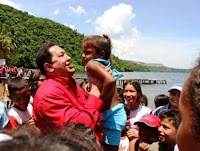
You can hear here Chavez as his most vulgar, machista, manipulator self; but also at his most offended. Because that he had to go against CNN that strongly only verifies what I wrote about: he made his own that time zone proposal and he is personally offended when people point out how ridiculous and out of touch with the real needs of the country Chavez has become, even if he carries kids in his arms while ruining his tailor made slacks paid by the tax payer. By the way, Chavez could not advance anything but banalities as to the change of official hour, just "studies" that we would love to see. But peer review is probably not inside chavista lexicon.
But RNV also carries another victim of chavismo anger: European public opinion who is very perturbed about Chavez wishes for life presidency. And in this case we even have another journalist, from the Guardian nothing less, who did not get insulted like the CNN ones, but was certainly not praised much. In fact I wonder what Rory Carroll thought about the "special" research report that was done by the constitutional commission (named by Chavez alone, let's not forget). That commission wasted precious tax payer money for something that this blogger would have gladly have done for free: to find out that there are no term limits in many European countries. But I am sure that this report did not carry the considerable restraints that exist in Europe that make it possible that parliamentarian systems have no term limits, or that kings and queens do not need to be submitted to recall election, as Chavez grossly joked about. It is always amazing when willful ignorance is presented as virtue and I suppose that in a regime of mediocrity ignorance must look as a virtue. Note: I wonder if it would take me as long to trash that report as it took me to expose how ignorant of the French political system Chavez is.
But anyway, these plus the announcement that 5% of the budget will be for direct transfer to the comunas the tone was set, in my opinion, for the coming campaign. People of course will forget that the 25% due to the states was never fulfilled thinking that perhaps a meager 5% might actually percolate to them. My opinion on that is that the 5% will go ONLY to chavista communities, and will be skimmed largely for political purposes before something truly trickles down. But I am such a cynic....
The tone will be clearly US AGAINST THEM. The campaign again will be aggressive. Debate and discussion will be absent. Chavez will never be questioned and if a journalist manages to sneak in a question like today, he will be put in his or her place (another Chinese journalist was nicely trying to get a more precise meaning for XXI century socialism and will return home not much wiser). And if you doubt me for a second look at the more than fascist declarations of corrupt Miranda governor Diosdado Cabello saying that those who do not like Chavez or the reform are welcome to leave, that there is enough people around Chavez and that we are not neded.
So, what is the opposition to do? I will not change yet what I wrote about it a couple of days ago, but I would like to add something: saying NO just tot he reelection could end up become counter productive because it will help Chavez make this contest a referendum on him and not his proposals. And that, my friends, he has a very good chance to win without cheating! He has learned long ago how to manipulate an ignorant base that could not care less whether there are terms limits in Estonia or whether the Central Bank is autonomous. For them the only question that matters is "what is in it for me?".
If we make this campaign an us against Chavez then stupid proposals such as the 36 hours will be seen by some as a guarantee to get more money for less work, EVEN if they are currently unemployed. That is the wonder when you deal with an electorate whose largest chunk has been kept in ignorance since well before Chavez. He certainly has not tried to change that. Did you know that the SAT this year in Venezuela gave 70% of high school graduates with not enough skills to attempt college? (1)
So it is going a little bit more tricky than expected to campaign. Saying NO to reelection and sticking to it could backfire dramatically. And even trying to stick to corruption alone, to bags full of cash alone might not be enough. Time for the leadership of the opposition to rise to the challenge. So far I see very little of it, which might explain why Chavez is already going to the "me or them" thing: to knock off the opposition effort from the very start!
A ruined pair of slacks is a very small price to pay for yet another victory.
--- --- --- --- --- - --
1) Confidential report from a friend working in one of the education ministries. This predicted result is certainly why Chavez wants to suppress the Venezuelan SAT equivalent so as to force the universities to accept more students even if these have no chance to succeed. I am waiting by the way for the comparison between private school and public school SAT result.
-The end-
This morning I woke up with a migraine. So, after 800mg of Ibuprofen I went back to bed until I could emerge in a daze around 11AM (no, no hard partying last night, I just suffer of recurrent migraines). I suppose that the Ibuprofen having left me numb, as I surfed TV at low volume I saw the beginning of today's Alo Presidente. I admit that I never watch it though on occasion I
 will watch a cadena. But Chavez was in an Oriente beach, a region that I particularly know and care for. So, the dumbness helping I decided to veg out in front of the TV. I was not disappointed: soon he was removing his shoes and waded into the water to met some children that were enthusiastically waiting for the chance. All with that arranged spontaneity" that characterizes so well the regime made for TV shows.....
I will pass on the lame comments on how he wished that he could go and take a dive in the water but he was "enslaved" to his job. The thing is that right then and there I understood what would the campaign of Chavez be: trust me, I love you, I love your kids, vote for these "reforms" and you will be the better for it. There will be no debate, nothing, just the same love me, hate the non-rojo-rojito folks of last year.
Of course, seeing Chavez ruining his tailor made pants by wading in the water for show was too much for me, I shut the TV and went for a cold shower. But tonight as I checked out the headlines of the day, that impression I had was widely confirmed.
The tidbits were juicy and point out to Chavez circling the wagons and preparing once again his "it is us against them". Perhaps the worst offense was for CNN female journalists that made fun of his wish to change Venezuela's time zone. On that account he should also insult me who excoriated his ridiculous decision much worse that the Colombian born anchors of CNN. In fact Chavez went ahead and said that it was a shame that "latinas" would make fun of Chavez. It was not a lapsus bruti, it was a deliberate attack on CNN: he repeated at least three times that it was a shame that "latinas" would make fun of him. While of course giving the usual anti media cum imperium speech. If you doubt me you can listen Chavez own words, nicely offered in a short clip by RNV, the state propaganda radio system. They actually think that Chavez did good, unbelievable!

You can hear here Chavez as his most vulgar, machista, manipulator self; but also at his most offended. Because that he had to go against CNN that strongly only verifies what I wrote about: he made his own that time zone proposal and he is personally offended when people point out how ridiculous and out of touch with the real needs of the country Chavez has become, even if he carries kids in his arms while ruining his tailor made slacks paid by the tax payer. By the way, Chavez could not advance anything but banalities as to the change of official hour, just "studies" that we would love to see. But peer review is probably not inside chavista lexicon.
But RNV also carries another victim of chavismo anger: European public opinion who is very perturbed about Chavez wishes for life presidency. And in this case we even have another journalist, from the Guardian nothing less, who did not get insulted like the CNN ones, but was certainly not praised much. In fact I wonder what Rory Carroll thought about the "special" research report that was done by the constitutional commission (named by Chavez alone, let's not forget). That commission wasted precious tax payer money for something that this blogger would have gladly have done for free: to find out that there are no term limits in many European countries. But I am sure that this report did not carry the considerable restraints that exist in Europe that make it possible that parliamentarian systems have no term limits, or that kings and queens do not need to be submitted to recall election, as Chavez grossly joked about. It is always amazing when willful ignorance is presented as virtue and I suppose that in a regime of mediocrity ignorance must look as a virtue. Note: I wonder if it would take me as long to trash that report as it took me to expose how ignorant of the French political system Chavez is.
But anyway, these plus the announcement that 5% of the budget will be for direct transfer to the comunas the tone was set, in my opinion, for the coming campaign. People of course will forget that the 25% due to the states was never fulfilled thinking that perhaps a meager 5% might actually percolate to them. My opinion on that is that the 5% will go ONLY to chavista communities, and will be skimmed largely for political purposes before something truly trickles down. But I am such a cynic....
The tone will be clearly US AGAINST THEM. The campaign again will be aggressive. Debate and discussion will be absent. Chavez will never be questioned and if a journalist manages to sneak in a question like today, he will be put in his or her place (another Chinese journalist was nicely trying to get a more precise meaning for XXI century socialism and will return home not much wiser). And if you doubt me for a second look at the more than fascist declarations of corrupt Miranda governor Diosdado Cabello saying that those who do not like Chavez or the reform are welcome to leave, that there is enough people around Chavez and that we are not neded.
So, what is the opposition to do? I will not change yet what I wrote about it a couple of days ago, but I would like to add something: saying NO just tot he reelection could end up become counter productive because it will help Chavez make this contest a referendum on him and not his proposals. And that, my friends, he has a very good chance to win without cheating! He has learned long ago how to manipulate an ignorant base that could not care less whether there are terms limits in Estonia or whether the Central Bank is autonomous. For them the only question that matters is "what is in it for me?".
If we make this campaign an us against Chavez then stupid proposals such as the 36 hours will be seen by some as a guarantee to get more money for less work, EVEN if they are currently unemployed. That is the wonder when you deal with an electorate whose largest chunk has been kept in ignorance since well before Chavez. He certainly has not tried to change that. Did you know that the SAT this year in Venezuela gave 70% of high school graduates with not enough skills to attempt college? (1)
So it is going a little bit more tricky than expected to campaign. Saying NO to reelection and sticking to it could backfire dramatically. And even trying to stick to corruption alone, to bags full of cash alone might not be enough. Time for the leadership of the opposition to rise to the challenge. So far I see very little of it, which might explain why Chavez is already going to the "me or them" thing: to knock off the opposition effort from the very start!
A ruined pair of slacks is a very small price to pay for yet another victory.
--- --- --- --- --- - --
1) Confidential report from a friend working in one of the education ministries. This predicted result is certainly why Chavez wants to suppress the Venezuelan SAT equivalent so as to force the universities to accept more students even if these have no chance to succeed. I am waiting by the way for the comparison between private school and public school SAT result.
-The end-
Wednesday, August 22, 2007
Constitutionally up yours: part 6, how to counter Chavez constitutional coup?
In the previous 5 posts of this series I have tried to write up a perhaps crude but to the point vision of what is at stake. In short: Chavez is pushing forward a constitutional “reform” whose sole objective is to give him the means to rule over Venezuela as long as he wishes, blocking any possibility for a valid opposition to rise and challenge him at some point. In other words, a return to the XIX century past, perhaps even worse. It is reactionary movement, nothing more.
The saddest part of the current situation is that in fact Chavez has already reached most of his goals and what he seeks is to make them legal while lifting the term limit restriction. Thus, since Chavez controls already everything the task to stop his last reach to absolutism is going to be very difficult.
However the Venezuelan opposition is not as helpless as it might look in spite of its inherent weakness due to its inner division and its lack of imagination. Curiously Chavez has made enough mistakes these past few months that this opposition might actually have its best chance since 2003 to stop Chavez hegemonic drive. So let’s start describing the opposition to Chavez today before we look at what it can do.
There are now two oppositions
Until May 2007 there was really a single opposition formed out of the agonizing old political parties, and the new parties unable to find a new language to counter Chavez. The highlight of that group, when there were still leaders willing to take some personal risks such as Enrique Mendoza, was the signature collection drive against Chavez in 2003-2004. At least it showed then that when you dare to stand up to Chavez, he backs down. A lesson that we would be well advised to remember, even more when we know it has happened more than once as Chavez is basically a coward hiding behind others. In February 1992 he was even reported to have shat in his pants. And in 2002 he was crying in the arms of Cardinal Velasco.
But that opposition failed miserably in 2004. And again in 2005 and again in 2006. In 2005 because it was unable to capitalize on the unexpected huge victory of the abstention. And in 2006 because its inexcusable delays in building a single candidacy against Chavez left it with not enough tine to organize a credible campaign. Yet, from that 2006 failure there was an important lesson to gain: when the opposition manages to unite behind a purposeful task, then it can obtain quite a lot. In May 2006 nobody gave the opposition much more than a 25-30%, split between 3-4 candidates. After barely two months o forceful campaign Rosales managed an official 37% which represented at least the recovery of morale.
But in 2007 Chavez started committing mistake after mistake. It started with his angry and threatening December followed by actual execution of this threats closing RCTV. A lot of economical problems such as scarcity of many food items did not help and these started bringing his numbers somewhat down. But the worse, the trigger was the RCTV closing, an event from which the Chavez administration is reeling continuously.
The consequence of that was the surge of a new opposition, totally unlinked to the past and even to the present opposition. In fact, the old opposition seems at times to be as annoyed about the large dissenting student movement that has hit the streets since the first week of June, with no sign of early demise even though we are on the summer vacation lull. To this we can add the beginning of a renewal of activity from NGOs, which if not yet as strong as the student movement seems to find its renewed strength from surging in part from within chavismo as the problems of personal security or the failure to provide hosing are finally starting to scratch the populist Teflon of Chavez.
I did write a post titled "the day the Bolivarian revolution died" and so far I have the pleasure to see it confirmed on a daily basis. On one side we have a now sclerotic and reactionary movement that cannot think of anything else but the indefinite Chavez reelection to preserve its new acquired privileges. On the other side we feel winds of a libertarian revolution starting to blow from the population itself, a movement careful to free itself from any great beloved messianic leader.
Now, what can do this opposition to counter the hegemonic goal of Chavez?
The conditions for any successful opposition résistance
Unfortunately before I narrate for the eager readers what I think could help in bringing a dent into Chavez megalomaniacal ambitions, I must dampen any enthusiasm by stating what is required from the opposition: unity and political will; steel political will at that and selfless unity to boot. These qualities are generally absent in the opposition camp except for some civilian groups such as the dissident students. In clear, the message for the traditional opposition leadership such as Rosales or Borges is that if they are not willing to open their shirt and risk to be shot, then they should consider stepping out, or at the very least stay out of the way. This time we are playing the last dice roll on the future of the Republic and it is not the time to posture. Going to jail during the next weeks is a real risk, and death is another one. But if risks are not taken now, jails will be even fuller in the future and much blood will be spilled. Time for action guys, not reckless action but conscious one knowing full well the risks ahead. Trying to compromise with Chavez will only alienate from you any little support you might have, and will give you at best a small stool in the far backbenches of power, and not for long.
What to do?
There are many things to do, all on the pacific nature but all in ways that can become rougher if needed. In case people are not aware, pacific sit-ins can turn very violent went the repressive state intervenes. But the cameras of the world will be filming: the end of the revolution will be televised.
The constitutional tools
Article 344 of the constitution is very clear: 5% of the people can sign up to demand that at least part of the Chavez proposal is split up and voted individually. That is, Chavez cannot force all of his goodies voted together with his ad infinitum reelection.
5% of the signatures are not that much: it is less than 1 million folks and there are enough people, including within chavismo, willing to sign up. Even the Tascon list threat would not play much there because there are enough folks like me who are already in deep trouble with chavismo that will have no problem in signing up again. What worse fate than a president for life could happen to us anyway?
This move has a major risk: if granted it would force the opposition to go and campaign and vote (unless the voting is made meaningless by the CNE depending how the split up of the vote is decided). But even then, it would be more difficult for chavismo to cheat on the vote counting since if cheating were to appear in the for-life ballot, it would be easily detected when the results of the other votes are too different. I am not personally very optimistic on this strategy but it is one that must be attempted anyway as it generates a movement whose result are unpredictable for both sides.
But there is another constitutional tool for which time might have finally come: article 350 of the 1999 constitution. That article allows people to stop recognizing the institutions or the government when it takes measures that attempt against the constitution. This article if of course of very confusing and difficult application but a case can be made that the Chavez proposal violates the constitution and thus civil resistance is required. This could for example be applied, with much courage and determination, to force the CNE to postpone any vote until the constitutionality of the proposal are duly reviewed and not just by Luisa Morales who already has emitted a personal opinion on the subject and thus must shut up her big mouth.
That 350, in this case, can also be used for a really effective boycott of the election if we must, a boycott that would imply people to protest in all streets of Venezuela on election day and force any observer to observe that there are more people protesting in the streets than at the voting stations.
The strategy
But if constitutional tools are good, they still require a global strategy. As such it is of outmost importance that the opposition fixes its gaze on the unlimited reelection. All the goodies that Chavez is using to sugar coat his proposals with should be dismissed outright. It is NO and NO and NO to reelection (though on punctual and regional basis some of the other proposals can be used to counter Chavez). If the campaign threatens to go NO it would force Chavez to some compromise so as to have his other items discussed. For example a determined NO to reelection coupled with an equally determined “I do not care about the rest” could be enough to force the government to accept a safer vote counting and a partition of the proposals.
But mark my words, if any one in the opposition accepts to discuss the individual items on the same parity as reelection item, then we are doomed.
The details
Once unity of message is obtained, once unity of action is decided, then we might start looking at other actions that could help a lot for the campaign. They are in fact mere details, important of course but not as important as the need for the strong message hammered over and over again. The objective in the next paragraphs is to blend electoral goals and image.
The electoral question
The CNE is a cheat box. Negotiations with the CNE are useless. After seeing how tenderly Ramirez was treated by the CNE for its 2006 electoral frauds and abuses (plural intended) it should be clear to anyone that any discussion with the CNE is a waste of time. It is my opinion that the CNE should be given a clear and simple ultimatum. If the ultimatum is not respected then the opposition withdraws from the election and takes to the streets using the 350. Assuming of course that during this time it has built enough credibility to convince the world on the why of the action, as we will see further down.
What should that ultimatum be? The CNE has been negligent at correcting all the vices inherent in the electoral rolls and others. Asking the CNE to solve this by December will be unrealistic, a waste of time and an illusion. Instead I propose that the opposition demands the following
50% of the ballots to be counted by hand BEFORE any result is announced. It was already granted in 2006 and there is no reason why it should be denied this time.
The opposition should be allowed to pick 25% of the electoral districts it wants and monitor them before and during election under the protection of the Armed Forces no matter what the sold out new Defense minister says (he has linked the Chavez proposals to a order threat the army must follow!!!). All sort of auditing tools should be allowed, including testing the indelible ink, the registration rolls, etc… Chavismo can chose of course the 25% it wants, but who cares? The objective in this action is that the opposition could marshal its meager resources safely for its observers in 25% of the districts, no matter how chavista these are. Preferably somber chavistas units where fraud has been alleged should be picked. This can even include the famed “23 de enero”. If the election is fair in the other 75% of the country there should be a similar trend.
And the CNE should be constantly challenged each and every time the government does something improper during the campaign: the opposition should do exactly the same if it can even if it goes against the CNE rules. Let see, for example, if the CNE will dare closing Globovision or El Universal during the campaign. After all we should all keep in mind that as soon as Chavez wins he will close Globovision, so why not go down fighting? The campaign will be terrible and it must be assumed as such by the opposition. This is war for survival now and playing nice will led us nowhere this time. It does not matter how much the law is broken during the campaign, the government WILL BREAK IT EVEN MORE. Or does anyone think that VTV will host a debate among Daniel Duquenal and any other chavista blogger?
The image question
The opposition in the past has been trying to take care of its democratic image, trying to atone constantly for the Carmona adventure even if 90% of us never approved it. We have been taken hostage by chavismo on that. Enough! A president for life system is WORSE than whatever Carmona intended and we should be bold enough to say it so aloud, constantly. “Chavez se volvió un Carmona cualquiera” could even be a nice slogan. Great good did us to play mister nice guy while even international observers saw live the campaign abuses of chavismo. So, what to do?
Forget some international observers. Say clearly why we do not want the Carter Center to visit. Demand that they account for their scandalous neglect of not making the 2003 agreement respected. Demand them to obtain the freedom of governor Lapi. Say bluntly that the Carter Center are a bunch of enablers and that from now one we will not meet with them no matter what. And make a constant noise out of it, even if they claim they were not interested in coming to begin with. This will bring us lots of good publicity on some parts of the world, trust me on that one. Besides we cannot allow them to once again validate a fraudulent Chavez victory while piously offering recommendations that they have no guts to demand and even less to enforce. During a campaign of the nature that the one that comes, sitting down with any Carter Center envoy is just a waste of time.
Set conditions to the OAS. The OAS is hardly any better than the Carter Center. Dominated now by countries who are on Chavez payroll (CARICOM, Argentina, Brazil, Uruguay, Bolivia, Ecuador, Nicaragua) and led by the ultimate wimp and coward that Insulza has shown himself to be, what can we possibly expect from the OAS? Be serious!!!!! If the OAS comes the delegation should be approved by the opposition otherwise out with the bums. It should be made clear that we consider people like Kirchner or Lula are considered as pimps of Chavez. The other ones we do not need to worry about as all know who they are.
Ask NOW for the EU to come. The European Union has been the only fair observer of Venezuelan elections, even when lead by an Italian leftist directing the delegation. Europeans are now all democrats and they do not buy anymore tall tales. The risk of course is that the CNE might not invite them. But then we will not recognize the observers they will invite and they do need observers to validate the monstrosity they want us to vote on. We do have leverage, more than what you think. The only problem is that the EU must be invited before September first.
Get new voices. Forget about Asdrubal Aguiar, about Timoteo Zanbrano and all the old school that have been representing the opposition for these past years without much success to their credit. Now the people who should talk to foreign observers, to visiting journalists should be new faces, moral journalists such as Milagros Socorro, brilliant students such as we have aplenty, bloggers, NGO directors, etc… All will tell exactly what is at stake, what somber dictatorship is about to fall on us.
Select the press you talk to. Play the international press. Deficient journalists such as the ones from the AP in 2006 should simply be ignored, boycotted by any campaign direction that might surge during this campaign. Create your reverse Tascon list about the journalists you can talk to and those you will not give the time of day. Let them understand in their own flesh what the Tascon list means, what humiliations Venezuelans journalists must suffer when they try to do their job with the Venezuelan government. Only then will they stat learning to report more accurately on Venezuela.
A few miscellaneous items for the people too afraid to participate, to concerned about their own interests to see how threatened they are now.
Keep a simple message to the Venezuelan people. NO to indefinite reelection. Stress that all the goodies ALREADY exist in the 1999 document but that Chavez never applied them. Thus he already lied to you and he is lying to you again.
Help the students as much as you can. Be involved, give time and money. If you are too afraid to go to the barrios to spread the message make an effort to support those who are willing to take the chance: pay them body guards, pay them armored cars, pay them bullet proffer vest, but CONTRIBUTE!!!!!
Start attending any activity called by the students. Start attending any activity called by the opposition groups that decided to unite to counter Chavez. You have the right to demand that Julio Borges walks ahead of the march and get the first bullet, but you must start realizing that the second bullet will be for you, sooner than later.
Talk to people everywhere, no matter what their social condition is. Tell them that Chavez president for life is a dictatorship, but tell them also that they have a right to misiones, that you have seen the light, that you apologize for the delay in recognizing the need. Bargain with them, tell them that if they vote against the proposal of the referendum you will become a moderate opposition to Chavez until 2012. But also tell them that after the referendum not everybody will have access to the misiones, only the PSUV folks.
If the opposition leadership and the students decide to go and vote, GO AND VOTE. Do not waste you time in sterile debates. Equally, if they decide not to vote, STAY AT HOME that day, or hit the streets in protest if it is demanded from you. Do not go to the beach or shopping that day and argue with anyone who might one to do it. Be militant for once in your life if you ever want to have the chance to be militant again.
And finally, for the political parties and their luminaries
No more Globovision, no more talk shows. Street, street and more street. Organize large groups and go to the barrios. Stand up to chavistas, be heroic. If you do not stand up to them now, even if on occasion they bet you up, you will never stand to them once they get their new Russian weapons.
For Marcel Granier. Get a bullet proof vest and go the barrios too. You are a political leader now and it is your duty to take this opportunity to start articulating a democratic right political party that is needed in Venezuela. You must also make the apathetic middle class go and vote
For Manuel Rosales. Forget about National Leadership: you blew it when you were not in Venezuela in December 2006 to reply to Chavez the day he decided he would close RCTV. Want to regain leadership? Make darn sure that the referendum fails in Zulia, Trujillo, Merida and Tachira. Even if in the rest of the country it passes, if it fails in these 4 states it will be a useless victory for Chavez. That much you can do.
To Ramon Martinez and Didalco Bolivar and PODEMOS. Your fate is sealed. You have to either do the Arias Cardenas flip-flop and become the laughing stock of all, in particular chavistas, or join the opposition against this constitutional abuse. Even if you were to try to be constructive you, of all people, know what Chavez will do with you come January first and he has become president for life. So grow up and smell the coffee and try to make sure that the referendum loses in Aragua and Sucre. That much the fatherland will thank you forever.
To Primero Justicia. Stop being the prima donna. You blew it when you were not able to avoid internal division. Now the two halves are limping miserably. Now it is time to promote unity even if you cannot lead it. Show by example. And make sure that the referendum loses everywhere in Caracas and in Carabobo and Miranda.
To AD. Shut up.
To all. Maletagate. President for life. Corruption. President for life. Who gets the cars? President for life. Corruption. President for life. Where is the milk, the beef, the black beans? President for life. Corruption. President for life. Until when you are going to keep giving to the Kirchners? How the president for life will solve crime? How the president for life will give us housing? How the president for life will give us job? Are we going to remain as we are for life?
-The end-
The saddest part of the current situation is that in fact Chavez has already reached most of his goals and what he seeks is to make them legal while lifting the term limit restriction. Thus, since Chavez controls already everything the task to stop his last reach to absolutism is going to be very difficult.
However the Venezuelan opposition is not as helpless as it might look in spite of its inherent weakness due to its inner division and its lack of imagination. Curiously Chavez has made enough mistakes these past few months that this opposition might actually have its best chance since 2003 to stop Chavez hegemonic drive. So let’s start describing the opposition to Chavez today before we look at what it can do.
There are now two oppositions
Until May 2007 there was really a single opposition formed out of the agonizing old political parties, and the new parties unable to find a new language to counter Chavez. The highlight of that group, when there were still leaders willing to take some personal risks such as Enrique Mendoza, was the signature collection drive against Chavez in 2003-2004. At least it showed then that when you dare to stand up to Chavez, he backs down. A lesson that we would be well advised to remember, even more when we know it has happened more than once as Chavez is basically a coward hiding behind others. In February 1992 he was even reported to have shat in his pants. And in 2002 he was crying in the arms of Cardinal Velasco.
But that opposition failed miserably in 2004. And again in 2005 and again in 2006. In 2005 because it was unable to capitalize on the unexpected huge victory of the abstention. And in 2006 because its inexcusable delays in building a single candidacy against Chavez left it with not enough tine to organize a credible campaign. Yet, from that 2006 failure there was an important lesson to gain: when the opposition manages to unite behind a purposeful task, then it can obtain quite a lot. In May 2006 nobody gave the opposition much more than a 25-30%, split between 3-4 candidates. After barely two months o forceful campaign Rosales managed an official 37% which represented at least the recovery of morale.
But in 2007 Chavez started committing mistake after mistake. It started with his angry and threatening December followed by actual execution of this threats closing RCTV. A lot of economical problems such as scarcity of many food items did not help and these started bringing his numbers somewhat down. But the worse, the trigger was the RCTV closing, an event from which the Chavez administration is reeling continuously.
The consequence of that was the surge of a new opposition, totally unlinked to the past and even to the present opposition. In fact, the old opposition seems at times to be as annoyed about the large dissenting student movement that has hit the streets since the first week of June, with no sign of early demise even though we are on the summer vacation lull. To this we can add the beginning of a renewal of activity from NGOs, which if not yet as strong as the student movement seems to find its renewed strength from surging in part from within chavismo as the problems of personal security or the failure to provide hosing are finally starting to scratch the populist Teflon of Chavez.
I did write a post titled "the day the Bolivarian revolution died" and so far I have the pleasure to see it confirmed on a daily basis. On one side we have a now sclerotic and reactionary movement that cannot think of anything else but the indefinite Chavez reelection to preserve its new acquired privileges. On the other side we feel winds of a libertarian revolution starting to blow from the population itself, a movement careful to free itself from any great beloved messianic leader.
Now, what can do this opposition to counter the hegemonic goal of Chavez?
The conditions for any successful opposition résistance
Unfortunately before I narrate for the eager readers what I think could help in bringing a dent into Chavez megalomaniacal ambitions, I must dampen any enthusiasm by stating what is required from the opposition: unity and political will; steel political will at that and selfless unity to boot. These qualities are generally absent in the opposition camp except for some civilian groups such as the dissident students. In clear, the message for the traditional opposition leadership such as Rosales or Borges is that if they are not willing to open their shirt and risk to be shot, then they should consider stepping out, or at the very least stay out of the way. This time we are playing the last dice roll on the future of the Republic and it is not the time to posture. Going to jail during the next weeks is a real risk, and death is another one. But if risks are not taken now, jails will be even fuller in the future and much blood will be spilled. Time for action guys, not reckless action but conscious one knowing full well the risks ahead. Trying to compromise with Chavez will only alienate from you any little support you might have, and will give you at best a small stool in the far backbenches of power, and not for long.
What to do?
There are many things to do, all on the pacific nature but all in ways that can become rougher if needed. In case people are not aware, pacific sit-ins can turn very violent went the repressive state intervenes. But the cameras of the world will be filming: the end of the revolution will be televised.
The constitutional tools
Article 344 of the constitution is very clear: 5% of the people can sign up to demand that at least part of the Chavez proposal is split up and voted individually. That is, Chavez cannot force all of his goodies voted together with his ad infinitum reelection.
5% of the signatures are not that much: it is less than 1 million folks and there are enough people, including within chavismo, willing to sign up. Even the Tascon list threat would not play much there because there are enough folks like me who are already in deep trouble with chavismo that will have no problem in signing up again. What worse fate than a president for life could happen to us anyway?
This move has a major risk: if granted it would force the opposition to go and campaign and vote (unless the voting is made meaningless by the CNE depending how the split up of the vote is decided). But even then, it would be more difficult for chavismo to cheat on the vote counting since if cheating were to appear in the for-life ballot, it would be easily detected when the results of the other votes are too different. I am not personally very optimistic on this strategy but it is one that must be attempted anyway as it generates a movement whose result are unpredictable for both sides.
But there is another constitutional tool for which time might have finally come: article 350 of the 1999 constitution. That article allows people to stop recognizing the institutions or the government when it takes measures that attempt against the constitution. This article if of course of very confusing and difficult application but a case can be made that the Chavez proposal violates the constitution and thus civil resistance is required. This could for example be applied, with much courage and determination, to force the CNE to postpone any vote until the constitutionality of the proposal are duly reviewed and not just by Luisa Morales who already has emitted a personal opinion on the subject and thus must shut up her big mouth.
That 350, in this case, can also be used for a really effective boycott of the election if we must, a boycott that would imply people to protest in all streets of Venezuela on election day and force any observer to observe that there are more people protesting in the streets than at the voting stations.
The strategy
But if constitutional tools are good, they still require a global strategy. As such it is of outmost importance that the opposition fixes its gaze on the unlimited reelection. All the goodies that Chavez is using to sugar coat his proposals with should be dismissed outright. It is NO and NO and NO to reelection (though on punctual and regional basis some of the other proposals can be used to counter Chavez). If the campaign threatens to go NO it would force Chavez to some compromise so as to have his other items discussed. For example a determined NO to reelection coupled with an equally determined “I do not care about the rest” could be enough to force the government to accept a safer vote counting and a partition of the proposals.
But mark my words, if any one in the opposition accepts to discuss the individual items on the same parity as reelection item, then we are doomed.
The details
Once unity of message is obtained, once unity of action is decided, then we might start looking at other actions that could help a lot for the campaign. They are in fact mere details, important of course but not as important as the need for the strong message hammered over and over again. The objective in the next paragraphs is to blend electoral goals and image.
The electoral question
The CNE is a cheat box. Negotiations with the CNE are useless. After seeing how tenderly Ramirez was treated by the CNE for its 2006 electoral frauds and abuses (plural intended) it should be clear to anyone that any discussion with the CNE is a waste of time. It is my opinion that the CNE should be given a clear and simple ultimatum. If the ultimatum is not respected then the opposition withdraws from the election and takes to the streets using the 350. Assuming of course that during this time it has built enough credibility to convince the world on the why of the action, as we will see further down.
What should that ultimatum be? The CNE has been negligent at correcting all the vices inherent in the electoral rolls and others. Asking the CNE to solve this by December will be unrealistic, a waste of time and an illusion. Instead I propose that the opposition demands the following
50% of the ballots to be counted by hand BEFORE any result is announced. It was already granted in 2006 and there is no reason why it should be denied this time.
The opposition should be allowed to pick 25% of the electoral districts it wants and monitor them before and during election under the protection of the Armed Forces no matter what the sold out new Defense minister says (he has linked the Chavez proposals to a order threat the army must follow!!!). All sort of auditing tools should be allowed, including testing the indelible ink, the registration rolls, etc… Chavismo can chose of course the 25% it wants, but who cares? The objective in this action is that the opposition could marshal its meager resources safely for its observers in 25% of the districts, no matter how chavista these are. Preferably somber chavistas units where fraud has been alleged should be picked. This can even include the famed “23 de enero”. If the election is fair in the other 75% of the country there should be a similar trend.
And the CNE should be constantly challenged each and every time the government does something improper during the campaign: the opposition should do exactly the same if it can even if it goes against the CNE rules. Let see, for example, if the CNE will dare closing Globovision or El Universal during the campaign. After all we should all keep in mind that as soon as Chavez wins he will close Globovision, so why not go down fighting? The campaign will be terrible and it must be assumed as such by the opposition. This is war for survival now and playing nice will led us nowhere this time. It does not matter how much the law is broken during the campaign, the government WILL BREAK IT EVEN MORE. Or does anyone think that VTV will host a debate among Daniel Duquenal and any other chavista blogger?
The image question
The opposition in the past has been trying to take care of its democratic image, trying to atone constantly for the Carmona adventure even if 90% of us never approved it. We have been taken hostage by chavismo on that. Enough! A president for life system is WORSE than whatever Carmona intended and we should be bold enough to say it so aloud, constantly. “Chavez se volvió un Carmona cualquiera” could even be a nice slogan. Great good did us to play mister nice guy while even international observers saw live the campaign abuses of chavismo. So, what to do?
Forget some international observers. Say clearly why we do not want the Carter Center to visit. Demand that they account for their scandalous neglect of not making the 2003 agreement respected. Demand them to obtain the freedom of governor Lapi. Say bluntly that the Carter Center are a bunch of enablers and that from now one we will not meet with them no matter what. And make a constant noise out of it, even if they claim they were not interested in coming to begin with. This will bring us lots of good publicity on some parts of the world, trust me on that one. Besides we cannot allow them to once again validate a fraudulent Chavez victory while piously offering recommendations that they have no guts to demand and even less to enforce. During a campaign of the nature that the one that comes, sitting down with any Carter Center envoy is just a waste of time.
Set conditions to the OAS. The OAS is hardly any better than the Carter Center. Dominated now by countries who are on Chavez payroll (CARICOM, Argentina, Brazil, Uruguay, Bolivia, Ecuador, Nicaragua) and led by the ultimate wimp and coward that Insulza has shown himself to be, what can we possibly expect from the OAS? Be serious!!!!! If the OAS comes the delegation should be approved by the opposition otherwise out with the bums. It should be made clear that we consider people like Kirchner or Lula are considered as pimps of Chavez. The other ones we do not need to worry about as all know who they are.
Ask NOW for the EU to come. The European Union has been the only fair observer of Venezuelan elections, even when lead by an Italian leftist directing the delegation. Europeans are now all democrats and they do not buy anymore tall tales. The risk of course is that the CNE might not invite them. But then we will not recognize the observers they will invite and they do need observers to validate the monstrosity they want us to vote on. We do have leverage, more than what you think. The only problem is that the EU must be invited before September first.
Get new voices. Forget about Asdrubal Aguiar, about Timoteo Zanbrano and all the old school that have been representing the opposition for these past years without much success to their credit. Now the people who should talk to foreign observers, to visiting journalists should be new faces, moral journalists such as Milagros Socorro, brilliant students such as we have aplenty, bloggers, NGO directors, etc… All will tell exactly what is at stake, what somber dictatorship is about to fall on us.
Select the press you talk to. Play the international press. Deficient journalists such as the ones from the AP in 2006 should simply be ignored, boycotted by any campaign direction that might surge during this campaign. Create your reverse Tascon list about the journalists you can talk to and those you will not give the time of day. Let them understand in their own flesh what the Tascon list means, what humiliations Venezuelans journalists must suffer when they try to do their job with the Venezuelan government. Only then will they stat learning to report more accurately on Venezuela.
A few miscellaneous items for the people too afraid to participate, to concerned about their own interests to see how threatened they are now.
Keep a simple message to the Venezuelan people. NO to indefinite reelection. Stress that all the goodies ALREADY exist in the 1999 document but that Chavez never applied them. Thus he already lied to you and he is lying to you again.
Help the students as much as you can. Be involved, give time and money. If you are too afraid to go to the barrios to spread the message make an effort to support those who are willing to take the chance: pay them body guards, pay them armored cars, pay them bullet proffer vest, but CONTRIBUTE!!!!!
Start attending any activity called by the students. Start attending any activity called by the opposition groups that decided to unite to counter Chavez. You have the right to demand that Julio Borges walks ahead of the march and get the first bullet, but you must start realizing that the second bullet will be for you, sooner than later.
Talk to people everywhere, no matter what their social condition is. Tell them that Chavez president for life is a dictatorship, but tell them also that they have a right to misiones, that you have seen the light, that you apologize for the delay in recognizing the need. Bargain with them, tell them that if they vote against the proposal of the referendum you will become a moderate opposition to Chavez until 2012. But also tell them that after the referendum not everybody will have access to the misiones, only the PSUV folks.
If the opposition leadership and the students decide to go and vote, GO AND VOTE. Do not waste you time in sterile debates. Equally, if they decide not to vote, STAY AT HOME that day, or hit the streets in protest if it is demanded from you. Do not go to the beach or shopping that day and argue with anyone who might one to do it. Be militant for once in your life if you ever want to have the chance to be militant again.
And finally, for the political parties and their luminaries
No more Globovision, no more talk shows. Street, street and more street. Organize large groups and go to the barrios. Stand up to chavistas, be heroic. If you do not stand up to them now, even if on occasion they bet you up, you will never stand to them once they get their new Russian weapons.
For Marcel Granier. Get a bullet proof vest and go the barrios too. You are a political leader now and it is your duty to take this opportunity to start articulating a democratic right political party that is needed in Venezuela. You must also make the apathetic middle class go and vote
For Manuel Rosales. Forget about National Leadership: you blew it when you were not in Venezuela in December 2006 to reply to Chavez the day he decided he would close RCTV. Want to regain leadership? Make darn sure that the referendum fails in Zulia, Trujillo, Merida and Tachira. Even if in the rest of the country it passes, if it fails in these 4 states it will be a useless victory for Chavez. That much you can do.
To Ramon Martinez and Didalco Bolivar and PODEMOS. Your fate is sealed. You have to either do the Arias Cardenas flip-flop and become the laughing stock of all, in particular chavistas, or join the opposition against this constitutional abuse. Even if you were to try to be constructive you, of all people, know what Chavez will do with you come January first and he has become president for life. So grow up and smell the coffee and try to make sure that the referendum loses in Aragua and Sucre. That much the fatherland will thank you forever.
To Primero Justicia. Stop being the prima donna. You blew it when you were not able to avoid internal division. Now the two halves are limping miserably. Now it is time to promote unity even if you cannot lead it. Show by example. And make sure that the referendum loses everywhere in Caracas and in Carabobo and Miranda.
To AD. Shut up.
To all. Maletagate. President for life. Corruption. President for life. Who gets the cars? President for life. Corruption. President for life. Where is the milk, the beef, the black beans? President for life. Corruption. President for life. Until when you are going to keep giving to the Kirchners? How the president for life will solve crime? How the president for life will give us housing? How the president for life will give us job? Are we going to remain as we are for life?
-The end-
Sunday, August 19, 2007
Constitutionally up yours: part 5, what is facing the Venezuelan opposition
Considering that all is pretty well played out still does not excuse the opposition to Chavez from not doing something about it. After all it must develop a strategy to survive the dark night of chavismo until better days come and the country can be recovered from the hands of the thugs that rule it today. Any action must be carefully thought of and based on the knowledge and understanding of what Chavez really wants and what he does have in hand to achieve it, but also on what the opposition has and what does it want to achieve. No matter what, the opposition must first decide whether it has the will to fight back. Otherwise no plan will help and we might as well stay home and forget about the whole thing until someone comes to our Sleeping Beauty Castle to awake us. Unfortunately Shreck is more likely to land in Caracas to deliver us before Uribe or the Empire do.
Let’s go by parts to understand better what can be done. In the rest of this post let’s see first in a practical and pragmatic way what is facing the opposition, and in a final post I will suggest the few things the opposition could do.
What Chavez wants
As explained in previous posts on this topic, Chavez wants to be president for life. He also wants to rule as he wishes and to make sure no one can mount a real challenge against him. For this he has already occupied almost every nook and cranny of the country. At this point only a portion of the media escapes him, and some thinking institutions such as some university campus, the church and the intellectuals. The last remains of opposition political strongholds will be dissolved in no more than a couple of years either by attrition (some of the oppo figures will not be able to run again in any election) or simply by splitting up these strongholds so that they will become powerless.
The media and campus will be dealt with much ease once the referendum passes since Chavez will claim again a new mandate. This hollow claim will allow him to erase these last outposts even though the referendum was about a completely different matter. Campus will lose their autonomy and pro Chavez faculty will reach the top administrative positions to pervert the educational mission of these places. Globovision will be closed or at least sent into cable only mode. Newspapers will be forced to a certain amount of self censorship by further toughening of the penal code such as forcing the publication of any news sources for example. Investigative journalism will be all but impossible and with that the regime can still pretend that there is freedom of expression as only temperate Op-Ed pieces will survive.
The intellectuals? Well, deprived of the media to expose their message and under threat, many will start taking the roads of exile or to remain silent, dedicating themselves to literature in a country that does not read.
Within no more than two years the grip of Chavez will be complete and no opposition movement will be able to gather strength. It is that simple.
What Chavez needs
Unfortunately for Chavez, he also wants in his narcissist megalomania to be the leader of at least Latin America against the Empire. He needs to refurbish his image badly tarnished since last December and for that he needs that the referendum not only passes, but passes with a margin wide enough and with large enough participation. The kind of thing he is asking Venezuelans to vote for can only be stomached by foreign countries if he gets at the very least a 40% of the total population to vote for it. We must note that a 40% of the people when abstention is counted him will give him MORE than what he got in December. There is certain logic within chavismo: from election to election Chavez has insisted on increasing his share of the vote (greatly helped for sure by the mistakes of the opposition and the treachery of the CNE). The referendum result cannot be a mere 51%, not even 63% as in December. It has to be 64% or more.
In other words the vote result needs to be a minimum of 64% YES for an abstention no bigger than 37%. Do the math. He needs that number not to gain the admiration of the Western Democracies (he has lost it for good) but he needs it to silence them for a while as he removes his last internal obstacles such as the press and independent campuses. And if there lays the chance of the opposition to do some damage, there also lays the tricks that Chavez might use in the next three months as he needs to lure at least part of the opposition to go and vote NO.
You think I am divagating? Well, Chavez has already hinted at that! In his speech of last week at the National Assembly he has alluded to that one as lacking legitimacy because it was elected with less than 25% of the electoral vote! It took Chavez almost two years to recognize this damning fact, but he did recognize it. And why you may ask? Very simple: during the campaign, depending how things go, he could offer to dissolve the National Assembly and elect a new one with the democratic forces that participate in the referendum. He could afford to do that because even if the opposition managed to get 40% of the votes in a parliamentarian election the way the voting system works now it would get a most 20% of the seats. With the increased powers that Chavez is about to get, he could not care less if 20% of the National Assembly belong to the opposition. In fact, it would work at his advantage!
You can imagine that if Chavez were to do such an offer as dissolving the National Assembly, many opposition groups would fall in to the trap gladly, hoping for some small bench in the Assembly and the TV exposure that comes with it. Enough at any rate for Chavez to get the result he needs. Chavez will then be able to scream that Venezuela is a democracy because there are opposition members in parliament. And if some in the opposition are willing to enjoy a Sepoy status, why would Western Democracies do anything about it? Venezuela got what it deserved, they would think.
What Chavez already has
In addition of clever tricks such as dissolving the National Assembly let’s not forget that Chavez dispose of many other cards that have been detailed in previous posts. Just to refresh the memory of the patient reader. Chavez has unlimited funds to buy votes. He has extensive means to threaten people to vote for him or else they risk losing their job, their mision stipend, etc… He has a corrupted electoral system where in about half of the country we do not know who really votes. He has an electoral board that will forgive him any trespassing to any electoral code of conduct, amen to basic moral and ethical violations he will make along the campaign. He has an army who every day is looking more like a praetorian guard. He has plenty of Cuban advisers and revenge seeking folks willing to do all sorts of underhanded maneuvers to screw the opposition considering it a legitimate revenge (you can start with the vice President himself, Jorge Rodriguez, a “resentido social” if there ever was only one). He has a legal system that will not lift a finger to defend interests that go against those of Chavez. And more. I mean, how could Chavez lose an election?
Truly, quite a daunting task for the opposition. But still, as I will try to show in the next post, still some room to maneuver tightly under certain conditions.
-The end-
Let’s go by parts to understand better what can be done. In the rest of this post let’s see first in a practical and pragmatic way what is facing the opposition, and in a final post I will suggest the few things the opposition could do.
What Chavez wants
As explained in previous posts on this topic, Chavez wants to be president for life. He also wants to rule as he wishes and to make sure no one can mount a real challenge against him. For this he has already occupied almost every nook and cranny of the country. At this point only a portion of the media escapes him, and some thinking institutions such as some university campus, the church and the intellectuals. The last remains of opposition political strongholds will be dissolved in no more than a couple of years either by attrition (some of the oppo figures will not be able to run again in any election) or simply by splitting up these strongholds so that they will become powerless.
The media and campus will be dealt with much ease once the referendum passes since Chavez will claim again a new mandate. This hollow claim will allow him to erase these last outposts even though the referendum was about a completely different matter. Campus will lose their autonomy and pro Chavez faculty will reach the top administrative positions to pervert the educational mission of these places. Globovision will be closed or at least sent into cable only mode. Newspapers will be forced to a certain amount of self censorship by further toughening of the penal code such as forcing the publication of any news sources for example. Investigative journalism will be all but impossible and with that the regime can still pretend that there is freedom of expression as only temperate Op-Ed pieces will survive.
The intellectuals? Well, deprived of the media to expose their message and under threat, many will start taking the roads of exile or to remain silent, dedicating themselves to literature in a country that does not read.
Within no more than two years the grip of Chavez will be complete and no opposition movement will be able to gather strength. It is that simple.
What Chavez needs
Unfortunately for Chavez, he also wants in his narcissist megalomania to be the leader of at least Latin America against the Empire. He needs to refurbish his image badly tarnished since last December and for that he needs that the referendum not only passes, but passes with a margin wide enough and with large enough participation. The kind of thing he is asking Venezuelans to vote for can only be stomached by foreign countries if he gets at the very least a 40% of the total population to vote for it. We must note that a 40% of the people when abstention is counted him will give him MORE than what he got in December. There is certain logic within chavismo: from election to election Chavez has insisted on increasing his share of the vote (greatly helped for sure by the mistakes of the opposition and the treachery of the CNE). The referendum result cannot be a mere 51%, not even 63% as in December. It has to be 64% or more.
In other words the vote result needs to be a minimum of 64% YES for an abstention no bigger than 37%. Do the math. He needs that number not to gain the admiration of the Western Democracies (he has lost it for good) but he needs it to silence them for a while as he removes his last internal obstacles such as the press and independent campuses. And if there lays the chance of the opposition to do some damage, there also lays the tricks that Chavez might use in the next three months as he needs to lure at least part of the opposition to go and vote NO.
You think I am divagating? Well, Chavez has already hinted at that! In his speech of last week at the National Assembly he has alluded to that one as lacking legitimacy because it was elected with less than 25% of the electoral vote! It took Chavez almost two years to recognize this damning fact, but he did recognize it. And why you may ask? Very simple: during the campaign, depending how things go, he could offer to dissolve the National Assembly and elect a new one with the democratic forces that participate in the referendum. He could afford to do that because even if the opposition managed to get 40% of the votes in a parliamentarian election the way the voting system works now it would get a most 20% of the seats. With the increased powers that Chavez is about to get, he could not care less if 20% of the National Assembly belong to the opposition. In fact, it would work at his advantage!
You can imagine that if Chavez were to do such an offer as dissolving the National Assembly, many opposition groups would fall in to the trap gladly, hoping for some small bench in the Assembly and the TV exposure that comes with it. Enough at any rate for Chavez to get the result he needs. Chavez will then be able to scream that Venezuela is a democracy because there are opposition members in parliament. And if some in the opposition are willing to enjoy a Sepoy status, why would Western Democracies do anything about it? Venezuela got what it deserved, they would think.
What Chavez already has
In addition of clever tricks such as dissolving the National Assembly let’s not forget that Chavez dispose of many other cards that have been detailed in previous posts. Just to refresh the memory of the patient reader. Chavez has unlimited funds to buy votes. He has extensive means to threaten people to vote for him or else they risk losing their job, their mision stipend, etc… He has a corrupted electoral system where in about half of the country we do not know who really votes. He has an electoral board that will forgive him any trespassing to any electoral code of conduct, amen to basic moral and ethical violations he will make along the campaign. He has an army who every day is looking more like a praetorian guard. He has plenty of Cuban advisers and revenge seeking folks willing to do all sorts of underhanded maneuvers to screw the opposition considering it a legitimate revenge (you can start with the vice President himself, Jorge Rodriguez, a “resentido social” if there ever was only one). He has a legal system that will not lift a finger to defend interests that go against those of Chavez. And more. I mean, how could Chavez lose an election?
Truly, quite a daunting task for the opposition. But still, as I will try to show in the next post, still some room to maneuver tightly under certain conditions.
-The end-
Saturday, August 18, 2007
Constitutionally up yours: part 4, can anything be done?
Not much.
Assuming that the constitutional change were worth discussing, with the current electoral system there is no way that fair debate will be held, that appropriate information will be disseminated, that the people will have a chance to understand what is really at stake. Just as it was the case for the presidential election of last year, the might of the state will be used obscenely to crush any feeble counter campaign that the opposition might want to do.
That is, with a huge majority of the media in the hands of Chavez, with the numerous cadenas to crush the minority opposition media, with provincial newspapers mostly neutral to pro Chavez these days (just to be able to survive), with all the public offices draped in red and public employees wearing red outfits, with the permanent blackmail that forces you to espouse Chavez least the meager stipend your life depends is lost, the YES vote is almost guaranteed without recurring to direct electoral fraud. For those late in this game, electoral fraud in Venezuela now starts well before the first ballot is cast.
But why people would vote anything else than what Chavez wants them to vote? It is fair to say that a third of Venezuela, if they vote, would vote for Chavez no matter what. Their reasons are varied. They might still want to vote for Chavez just to “punish” the other side. They might be believers. They just got used to Chavez. They are scared of change. There is nothing at stake for them anyway.
This last one deserves some more details. People whop live in the slums, what do they care about the geographical redistribution of the country? People that are out of a job, what do they care if the work week is 44 hours, 40 or 36? People who live in crime infested neighborhoods, what do they care whether Chavez wants to change the army in a militia? People who have never seen the benefits of democracy, people who actually might have never even voted for Chavez, why would they go out to vote against a constitutional proposal that holds no meaning to them?
The only question here is when will the vote held and what will be the victory margin, a margin that we know will be arranged by the CNE according to the political needs of Chavez at the moment.
For those who think that I exaggerate let me remind a few FACTS:
The CNE is controlled by a 4 to 0 pro Chavez majority. The lone dissenter has no weight, and forces no issue. Not 4 to 1, it is 4 to 0.
The CNE is sold out to chavismo, as its directors have no qualms in voicing support for some of chavismo political positions, such as Janeth Hernandez saying that the sanction against Ramirez was unfair. That is, when Ramirez was shown red handed violating all sorts of constitutional and electoral directives, one of the CNE directors finds nothing wrong with it. Is anyone expecting that this CNE will make sure a fair electoral campaign will be held from here until December? Of course not. A dirty campaign will spare the CNE the need to rig elections. A rigging that they might do anyway because simply Chavez NEEDS more votes than last December. He always needs to get more votes than the last time, it is essential to his image, to his projection as a continental leader. It is essential to his narcissistic pathology.
The data transmission will be completely controlled by the government now that the Chavez administration has nationalized CANTV. In other words there will be no way to figure out if electronic voting fraud is being held since not only observers will be probably barred from observing CANTV workings, but now that they have control of the business there is nothing to stop chavismo to create a parallel transmission system without anyone being the wiser for it.
In fact, on a practical point of view, the way elections are held in Venezuela it is very legitimate to discuss whether it is worth voting or not. People, pro or anti Chavez in fact have a tacit agreement on this subject. If you look at the recent recall election drive failure it is obvious that people have lost all trust in the CNE, and know very well that elections do not matter anyway in an authoritarian regime. So, why bother to campaign one way or the other when you know that Chavez will do as he pleases anyway, no matter what you do?
Does this all mean that the opposition should throw the towel and stay home? No, but it will require extraordinary political will. And it will require the reader to wait for the part five of this series.
Note: this is part 4, after part 1, 2 and 3. And this entry.
-The end-
Assuming that the constitutional change were worth discussing, with the current electoral system there is no way that fair debate will be held, that appropriate information will be disseminated, that the people will have a chance to understand what is really at stake. Just as it was the case for the presidential election of last year, the might of the state will be used obscenely to crush any feeble counter campaign that the opposition might want to do.
That is, with a huge majority of the media in the hands of Chavez, with the numerous cadenas to crush the minority opposition media, with provincial newspapers mostly neutral to pro Chavez these days (just to be able to survive), with all the public offices draped in red and public employees wearing red outfits, with the permanent blackmail that forces you to espouse Chavez least the meager stipend your life depends is lost, the YES vote is almost guaranteed without recurring to direct electoral fraud. For those late in this game, electoral fraud in Venezuela now starts well before the first ballot is cast.
But why people would vote anything else than what Chavez wants them to vote? It is fair to say that a third of Venezuela, if they vote, would vote for Chavez no matter what. Their reasons are varied. They might still want to vote for Chavez just to “punish” the other side. They might be believers. They just got used to Chavez. They are scared of change. There is nothing at stake for them anyway.
This last one deserves some more details. People whop live in the slums, what do they care about the geographical redistribution of the country? People that are out of a job, what do they care if the work week is 44 hours, 40 or 36? People who live in crime infested neighborhoods, what do they care whether Chavez wants to change the army in a militia? People who have never seen the benefits of democracy, people who actually might have never even voted for Chavez, why would they go out to vote against a constitutional proposal that holds no meaning to them?
The only question here is when will the vote held and what will be the victory margin, a margin that we know will be arranged by the CNE according to the political needs of Chavez at the moment.
For those who think that I exaggerate let me remind a few FACTS:
The CNE is controlled by a 4 to 0 pro Chavez majority. The lone dissenter has no weight, and forces no issue. Not 4 to 1, it is 4 to 0.
The CNE is sold out to chavismo, as its directors have no qualms in voicing support for some of chavismo political positions, such as Janeth Hernandez saying that the sanction against Ramirez was unfair. That is, when Ramirez was shown red handed violating all sorts of constitutional and electoral directives, one of the CNE directors finds nothing wrong with it. Is anyone expecting that this CNE will make sure a fair electoral campaign will be held from here until December? Of course not. A dirty campaign will spare the CNE the need to rig elections. A rigging that they might do anyway because simply Chavez NEEDS more votes than last December. He always needs to get more votes than the last time, it is essential to his image, to his projection as a continental leader. It is essential to his narcissistic pathology.
The data transmission will be completely controlled by the government now that the Chavez administration has nationalized CANTV. In other words there will be no way to figure out if electronic voting fraud is being held since not only observers will be probably barred from observing CANTV workings, but now that they have control of the business there is nothing to stop chavismo to create a parallel transmission system without anyone being the wiser for it.
In fact, on a practical point of view, the way elections are held in Venezuela it is very legitimate to discuss whether it is worth voting or not. People, pro or anti Chavez in fact have a tacit agreement on this subject. If you look at the recent recall election drive failure it is obvious that people have lost all trust in the CNE, and know very well that elections do not matter anyway in an authoritarian regime. So, why bother to campaign one way or the other when you know that Chavez will do as he pleases anyway, no matter what you do?
Does this all mean that the opposition should throw the towel and stay home? No, but it will require extraordinary political will. And it will require the reader to wait for the part five of this series.
Note: this is part 4, after part 1, 2 and 3. And this entry.
-The end-
Friday, August 17, 2007
How a constitution becomes a mere guideline: Chavez turns the 1999 constitution into scrap paper
The most offensive thing about the ill called constitutional reform of Chavez is not its actual text, it is the way it is done, the style, the timing. As such it should be considered as a mere provocation with the objective of stunning any opponent to the reform. If the support of such people cannot be gained, at least they will be annulled in an induced denial
First, the changes were discussed in secret by a small group of Chavez unconditional appointees. Second, it was sent to Chavez who probably leaked the content out to gauge the public reaction. Then it was put on hold while they were deciding how far they could go, but more importantly what baubles they could add to the draft to convince enough people to approve it. It is interesting to note that the 6 hours maximum working day was not in the leaked documents and was probably added later as they sensed that they needed stronger stuff to sugarcoat the life presidency, the sole real goal of any reform. Finally, as the financial system is starting to suffer, as the government finds itself unable to supply milk to the people and as someone lost a strange piece of luggage in a Buenos Aires airport, it was time to push ahead. At no point was there a serious discussion to address the obvious flaws of the 1999 hastily written document, or to even decide what was best for the country. The only thing that mattered, and crassly exposed at that, was what is good for Chavez.
But let’s take the view from above. The reform is of course an obscene, intelligence insulting farce. It is a disservice to the reader to discuss it in detail. Instead let’s wonder whether what results from this reform can still be called a constitution. Let’s not forget that a constitution is the frame with which laws are enacted. It cannot be the other way around. For example a constitution cannot have economic rights as it is not in the power of any government to have at all times the capacity to fulfill such rights. Even property rights in serious constitutions are not guaranteed, though the same serious constitutions put all sorts of obstacles for state expropriations. But expropriation they do, even in the capitalist Hell of the Novel Evil Empire.
El Universal, for those who have time on their hands, has in PDF the Chavez proposal of last night ( a 4+ hour cadena that I doubt was very clear to the people that were brave enough to wade through). I will like to visit just a few items to show that the proposed changes are completing the transformation of the 1999 constitution into a mere constitutional law that can be changed at will like any new law. And I use “constitutional” in the least restrictive sense possible.
Let’s start with article 87, as a simple example. The “old” text was about guarantying the right to work in safe conditions to all workers. Nothing unusual here. But the “new” article is twice as long. It now includes the duty to the state to intervene in enforcing job measures, instead of supervising them. Also, the state will have to guarantee the same benefits to “independent” workers. Considering that in 8 years it has failed on all of its duties toward the contractual workers, one is dubious that it will be successful once it reinforces its duties and adds to its obligations the service to buhoneros, the street workers that form up to 40% of the working population in Venezuela. How will the state include and control the buhoneros revenues and other free agents to provide them with social benefits to which they have already access anyway if they wanted and could pay for them? Translation: a present to the informal worker population. They might end up voting yes and the constitution will be changed but what happens when the state cannot fulfill its obligations?
Article 90 is an even more direct appeal. That article fixed the working week. In normal constitutions, if such a measure is contemplated, it would read something like: “the sate will fix working conditions and weekly hours to work”. But in the “old” article it stipulated that the week work was 44 hours and the daily work could not be more than 8 hours. Yet, it also added that there state should try to decrease this with time. It was already strange to find such precisions in a constitution, but the “new” article goes much further: now the work week will drop to 36 hours, no more than 6 a day. In concrete, for example my business which does not open on Saturdays and works 40 hours a week, will drop suddenly to 30 hours a week. Or does anyone think that workers will gladly go back to work on Saturdays? That similar examples in much more developed countries such as France have failed and are put into sever questioning does not seem to have been considered. Here Chavez is getting ready to impose the 30 hours week (because it will be 30 for most people) without even considering a transition, a financial help form the state or anything of the sorts. But that is not all: the article explicitly forces the employer to have a role in the free time of the employee!!!!
These things have no place in any constitution: the state by law can already fix any of these parameters as needed and as the economical situation allow. But Chavez mandates it because he needs candy to make people vote for his for life presidency. Even if we all know that the state owned companies will be the main violators of such “constitutional obligations”.
There are many articles where the chimera of the communal power is elaborated. What strikes me more is that most of these modified articles could have easily been created through laws. There is no need to include them in the constitution. Again, here the idea is to create the illusion of more direct popular participation by supposedly shifting power to the neighborhoods instead of the city halls. Maybe, but communal councils are not going to design dams, highways or hospitals. The end result will be more power to the central state who of course will be the only one with the means to undertake such projects. Engraving this in the constitution is just for effect.
The Misiones are also given constitutional rank. Yet, amusingly in the modified corresponding article 141 the fluctuating nature of the Misiones are acknowledged. That is, the executive power will decide how long would a given Mision last. The question that begs to be asked is: why put that in the constitution when the current regulations allow already the state to do any Mision it wants for whatever objective for as long as it pleases? Again, the illusion of permanence of Misiones to bribe the naïve electorate to support the life presidency. Except that at least in this case the state is wise enough to keep an exit door in case the financial going gets rough. Unless it is an admission that Chavez already knows the Misiones have no future in the socialist state he will lord over?
Even in the new organization of power Chavez throw bones to his supporters, raising hopes. For example now there will be several vice-presidents. Their number and rank to be decided at will, though there will be one main vice president. But is there a need to change this article 225? No. Chavez has been creating as many ministers as he has wanted to. Why create many vice-presidents to put in between him and his ministers? Again, we see a constitutional change that could have well been a simple law creating special ministers. The objective here is to soothe the ambitious within chavismo that do not like the idea of having to wait for Chavez death to run for office. Now, thinks Chavez, they will be happy to be one of the many vice-presidents he will create.
Article 236 modification betrays this attitude. In that article Chavez adds a new duty to the president, to direct the “constitutional and constitutive” [sic] initiative. I am not too sure what this legalese gibberish truly means but I can detect the implication: Chavez will be freer to change the constitution as he had been until now. That is, an easily modifiable constitution will just be a simple law that is modified as needed.
No, what we are getting is not a modified constitution. It is just the gutting of the already feeble 1999 document, its conversion into some basic guideline that Chavez will disrespect as much as he disrespected the 1999 blue book, except that now he will have on occasion the time to change the constitution so it does not look that he is violating it. That is when basic civil rights will start to be “constitutionally” diminished.
-------------
PS: I am not going to discuss further this except for one post on the key points that show how Chavez wants to grab even more over than what he has. My predictions of have not only been confirmed but made worse. For the non Venezuelan reader, fear not, we are not that stupid. 90% of us know exactly what is going on. The problem is that too many of us pretend it is OK.
-The end-
First, the changes were discussed in secret by a small group of Chavez unconditional appointees. Second, it was sent to Chavez who probably leaked the content out to gauge the public reaction. Then it was put on hold while they were deciding how far they could go, but more importantly what baubles they could add to the draft to convince enough people to approve it. It is interesting to note that the 6 hours maximum working day was not in the leaked documents and was probably added later as they sensed that they needed stronger stuff to sugarcoat the life presidency, the sole real goal of any reform. Finally, as the financial system is starting to suffer, as the government finds itself unable to supply milk to the people and as someone lost a strange piece of luggage in a Buenos Aires airport, it was time to push ahead. At no point was there a serious discussion to address the obvious flaws of the 1999 hastily written document, or to even decide what was best for the country. The only thing that mattered, and crassly exposed at that, was what is good for Chavez.
But let’s take the view from above. The reform is of course an obscene, intelligence insulting farce. It is a disservice to the reader to discuss it in detail. Instead let’s wonder whether what results from this reform can still be called a constitution. Let’s not forget that a constitution is the frame with which laws are enacted. It cannot be the other way around. For example a constitution cannot have economic rights as it is not in the power of any government to have at all times the capacity to fulfill such rights. Even property rights in serious constitutions are not guaranteed, though the same serious constitutions put all sorts of obstacles for state expropriations. But expropriation they do, even in the capitalist Hell of the Novel Evil Empire.
El Universal, for those who have time on their hands, has in PDF the Chavez proposal of last night ( a 4+ hour cadena that I doubt was very clear to the people that were brave enough to wade through). I will like to visit just a few items to show that the proposed changes are completing the transformation of the 1999 constitution into a mere constitutional law that can be changed at will like any new law. And I use “constitutional” in the least restrictive sense possible.
Let’s start with article 87, as a simple example. The “old” text was about guarantying the right to work in safe conditions to all workers. Nothing unusual here. But the “new” article is twice as long. It now includes the duty to the state to intervene in enforcing job measures, instead of supervising them. Also, the state will have to guarantee the same benefits to “independent” workers. Considering that in 8 years it has failed on all of its duties toward the contractual workers, one is dubious that it will be successful once it reinforces its duties and adds to its obligations the service to buhoneros, the street workers that form up to 40% of the working population in Venezuela. How will the state include and control the buhoneros revenues and other free agents to provide them with social benefits to which they have already access anyway if they wanted and could pay for them? Translation: a present to the informal worker population. They might end up voting yes and the constitution will be changed but what happens when the state cannot fulfill its obligations?
Article 90 is an even more direct appeal. That article fixed the working week. In normal constitutions, if such a measure is contemplated, it would read something like: “the sate will fix working conditions and weekly hours to work”. But in the “old” article it stipulated that the week work was 44 hours and the daily work could not be more than 8 hours. Yet, it also added that there state should try to decrease this with time. It was already strange to find such precisions in a constitution, but the “new” article goes much further: now the work week will drop to 36 hours, no more than 6 a day. In concrete, for example my business which does not open on Saturdays and works 40 hours a week, will drop suddenly to 30 hours a week. Or does anyone think that workers will gladly go back to work on Saturdays? That similar examples in much more developed countries such as France have failed and are put into sever questioning does not seem to have been considered. Here Chavez is getting ready to impose the 30 hours week (because it will be 30 for most people) without even considering a transition, a financial help form the state or anything of the sorts. But that is not all: the article explicitly forces the employer to have a role in the free time of the employee!!!!
These things have no place in any constitution: the state by law can already fix any of these parameters as needed and as the economical situation allow. But Chavez mandates it because he needs candy to make people vote for his for life presidency. Even if we all know that the state owned companies will be the main violators of such “constitutional obligations”.
There are many articles where the chimera of the communal power is elaborated. What strikes me more is that most of these modified articles could have easily been created through laws. There is no need to include them in the constitution. Again, here the idea is to create the illusion of more direct popular participation by supposedly shifting power to the neighborhoods instead of the city halls. Maybe, but communal councils are not going to design dams, highways or hospitals. The end result will be more power to the central state who of course will be the only one with the means to undertake such projects. Engraving this in the constitution is just for effect.
The Misiones are also given constitutional rank. Yet, amusingly in the modified corresponding article 141 the fluctuating nature of the Misiones are acknowledged. That is, the executive power will decide how long would a given Mision last. The question that begs to be asked is: why put that in the constitution when the current regulations allow already the state to do any Mision it wants for whatever objective for as long as it pleases? Again, the illusion of permanence of Misiones to bribe the naïve electorate to support the life presidency. Except that at least in this case the state is wise enough to keep an exit door in case the financial going gets rough. Unless it is an admission that Chavez already knows the Misiones have no future in the socialist state he will lord over?
Even in the new organization of power Chavez throw bones to his supporters, raising hopes. For example now there will be several vice-presidents. Their number and rank to be decided at will, though there will be one main vice president. But is there a need to change this article 225? No. Chavez has been creating as many ministers as he has wanted to. Why create many vice-presidents to put in between him and his ministers? Again, we see a constitutional change that could have well been a simple law creating special ministers. The objective here is to soothe the ambitious within chavismo that do not like the idea of having to wait for Chavez death to run for office. Now, thinks Chavez, they will be happy to be one of the many vice-presidents he will create.
Article 236 modification betrays this attitude. In that article Chavez adds a new duty to the president, to direct the “constitutional and constitutive” [sic] initiative. I am not too sure what this legalese gibberish truly means but I can detect the implication: Chavez will be freer to change the constitution as he had been until now. That is, an easily modifiable constitution will just be a simple law that is modified as needed.
No, what we are getting is not a modified constitution. It is just the gutting of the already feeble 1999 document, its conversion into some basic guideline that Chavez will disrespect as much as he disrespected the 1999 blue book, except that now he will have on occasion the time to change the constitution so it does not look that he is violating it. That is when basic civil rights will start to be “constitutionally” diminished.
-------------
PS: I am not going to discuss further this except for one post on the key points that show how Chavez wants to grab even more over than what he has. My predictions of have not only been confirmed but made worse. For the non Venezuelan reader, fear not, we are not that stupid. 90% of us know exactly what is going on. The problem is that too many of us pretend it is OK.
-The end-
Subscribe to:
Posts (Atom)