The day surprised me with the announcement that Henri Falcon, Lara State governor, decided to abandon Chavez party, the PSUV. But he did not go to the opposition, he requested to enter to the PPT, a Chavez/PSUV junior coalition member, giving them a rather poisoned gift. Timeo danaos et dona ferentes...
Showing posts sorted by relevance for query falcon. Sort by date Show all posts
Showing posts sorted by relevance for query falcon. Sort by date Show all posts
Monday, February 22, 2010


Wednesday, February 28, 2018
Falcon Crest? Millennium Falcon? The Maltese one?
Good news guys, the inscription for presidential election is over, we know all the names. They are all chavistas. Even if the propaganda network TeleSur says without blushing that the opposition has registered ITS candidate under the name of Henri Falcon.
So many things wrong with that picture......
La oposición tiene su candidato. #VenezuelaDecide pic.twitter.com/761XdvCFh6— Patricia Villegas (@pvillegas_tlSUR) February 27, 2018
So many things wrong with that picture......
Wednesday, May 16, 2018
The ruin of Falcon Crest
 What legacy will Henri Falcon's stunt leave us? His ulterior motives at this point are of little interest. Many a speculation swirls, from him being Raul Castro choice to do the transition government, to him being an overambitious military a la Chavez.
Rather, let's look why his candidature was fraud since day one, and thus why his campaign is so flawed that even his victory will not be recognized. Next, as concise a summary as possible for those late in the game. (1)
First, his bid was born outside of the opposition electoral alliance MUD. His argument that there was no time to run a primary falls short. He could have sent an ultimatum to the MUD as to whether they decided to run and name a candidate or he would run anyway. Instead he registered discretely almost at the end of the registration period.
Monday, November 03, 2008
The Venezuelan 2008 election: update 14 - Lara, Falcon and Yaracuy: how to get and not to get united
[Urgent update]These three states, called sometimes "Centro Occidente" are not in fact a geographical region and their unity in the mind of people comes more from history than geography. As you will see below, when we look at how local politics play in each one we can see that each one is an island.

Falcon
This one is the easiest to start with because I found very little information on its politics. No polls, no good local papers on line. Thus I must rely on the little bit the national papers give, and my historical memories.
The first thing to know about Falcon is that it is at the same time one of the most backwards states of Venezuela while endowed with two areas of relative modernism. If you look at the Venezuelan geography, in particular its mountainous area you can see that Falcon is a rather eccentric state, in the geographical sense of being out of the main communication fares. Quite isolated in fact. The Spaniards landed there first because it sticks out in the Caribbean, but quickly moved to El Tocuyo in Lara and after that to the Andes and Caracas, leaving Coro as a haven for contraband and coastal pseudo surveillance.
The North of Falcon is almost desert and large areas inside are also very dry. Only the San Luis Sierra above Coro receives some water and the cattle area in the extreme Western corner which also has the touristic area of Morocoy. The dry shore lived because the Caribbean was the main communication highway between Maracaibo and Caracas and all boats sailed in front and needed to stop on occasion. Once roads were opened by Gomez to link these areas to Caracas avoiding Falcon, well, the state felt into oblivion. That is except for the Paraguana peninsula where Venezuela placed its largest refineries. The two districts which reached some modernity are thus the capital district of Coro and the oil industry one of Punto Fijo, Caribudana, which by themselves represent about half of the state population.
The other half of the state has been fertile grounds for chavismo. Long neglected, any tiny bit that a mision program could bring had major impact. Those are the rural areas where chavismo grew. On the other hand Coro and Punto Fijo were the seats of pitched battles during the 2003 strikes and even though chavismo sent a new crop of inhabitants to replace the fired workers, it has failed to lock up that area of Falcon. Thus amazingly the 2007 referendum was a tie in Falcon when we would have expected an easy victory, helped along by the fact that a majority of districts are held by chavismo. After all, Chavez did get 63% there in 2006
Will that change now? I doubt it. Chavismo has managed to unite behind the wife of present governor who cannot run again. It also managed to unify in most districts. In front the opposition did manage a unity candidate for the state but elsewhere division reigns, shamefully. Falcon should remain safely in the hands of chavismo although it was a state where the opposition had a chance to make some inroads. Only Coro and Punto Fijo could offer a late surprise, but not enough of a surprise to bar the road of Stella de Montilla to postpone her move out of the governor's mansion. Thus nepotism and backwardness will remain the lot of Falcon for at least 4 more years.
Lara
Lara is my neighborhood state and yet its internal politics could not be any different from Yaracuy. In appearance it is a bastion of chavismo but such appearances can be very, very deceiving.
Lara was traditionally a leftist state but in a different tradition than Aragua. There what we had was much more of an agrarian problem stimulated by the longest colonial history within Venezuela and some of the driest, if fertile, lands available. That Lara went for Chavez from the start is not a surprise. But Lara has always retained an independent streak, not surprising since it is a land of writers, politicians and artists. In my opinion perhaps the best music and folk art in the whole of Venezuela and that is no accident. There is such a thing as the Lara difference.
Thus it was a mistake when chavismo took Lara for granted. First, Lara went all the way for Chavez in 2000 because the local governor decided not to run again. He was himself a dissident of the MAS who managed to impose his folksy style in the state. Orlando Fernandez thus ensured an easy take over by Chavez close pal, Reyes Reyes. Soon enough Orlando realized he had done a major mistake. But it was too late: the abstention of 2004 cost him a humiliating defeat when he tried to retake the state, ending thus his political career. Chavismo was gloating, assuming that Lara was now a safe state. In 2006 Chavez even got 3% more than his national average.
And in 2007 the single most stunning result of the referendum came form Lara where the SI lost by 49%. What happened?
First, Reyes Reyes revealed himself to be an awful governor, in particular during his second term. He so lacks in personality and charisma that he had to resort imitating Chavez ticks. But if that were not enough, he tried to make his son the next governor. That did not go well at all with the mayor of Barquisimeto, Henry Falcon, one of the few chavistas that has understood that ideology is good, but good management also helps to win reelection. Falcon is regarded as one, if not the best chavista official in the country. That does not go down well at all in the ideological lumpen of chavismo as Falcon is accused of traitor and what not. But Barquisimeto district is more than half of the state and if to this you add dormitory and middle class Palavecino (Cabudare), whoever wins there is almost certain to carry the state.
When chavismo hinted at conceding the nod to Reyes Reyes son, Falcon calmly announced that he would run anyway creating an internal fuss at the PSUV who at first expelled him. But for once the PSUV acted in a pragmatic way and capitulated to Falcon. After all the 2007 loss was a clear sign that Larenses got tired of Reyes Reyes who was more preoccupied in finding ways to sabotage Falcon work than solving the problems of the state. The PSUV knew that Lara would go to Falcon or to the opposition if they kicked him out.
But if Falcon in the end carried the day and looks a sure bet to win in front of a divided opposition, the next mayor of Barquisimeto is not a sure thing for chavismo. Even though the opposition is still divided, there is a clear trend towards Ramos, a trade union guy from the area. He is helped by another mistake of chavismo, this time from Henry Falcon himself who tried to impose his own successor. The hard core chavista base is sorely tempted not to vote for Falcon anyway, or maybe punish him by not voting for his candidate. The politics of revenge they call it, and when you see that Chavez himself two days ago complained that Falcon did not want to sign an engagement to follow the directives of Caracas above those of his state you wonder if Henry Falcon will not bolt out of the PSUV before November 23, Chavez probably preferring to lose Lara before having a chavista with his own power base for 2012.
Thus my predictions for Lara. Falcon will win because part of the opposition living in Barquisimeto will vote for him. But Barquisimeto could go for the opposition in spite of its division, as well as Palavecino. If this happens it will not affect Falcon chances as cross voting is expected. The interesting district to follow in Lara is historical Carora, a modern rural district with lot of backwards areas. Chavista hold there is not that certain and a weak victory of the chavista candidate there will be full of bad omens for chavismo's future.
Yaracuy
Yaracuy is a mess and I will deal with it fast.
Former governor Lapi is in exile in Peru. Charges unproven and a travesty of justice jailed him without a trial and he had to escape from jail as his life was in danger (the jail had a famous bout of internal rioting and an "ooops" moment could have only to easily happened as Lapi could be caught in a cross fire). These shameless actions were directed by Gimenez who narrowly defeated Lapi in 2004. Gimenez a low life, vindictive, druggie, inefficient mayor of Independencia was unaccountably promoted by Chavez who had other options. Gimenez of course knowing full well that he could not manage Yaracuy as well as Lapi decided to eliminate him by jailing him.
Sure enough the rule of Gimenez has been so catastrophic that chavismo itself felt in the need to oust him from office!!! He is accused of major acts of corruption and yet he walks the streets freely and even threatened to run again!!!! Lapi, if he stole, stole much, much less than Gimenez but he is the one in exile.
Somewhat the CNE decided to allow Lapi to run for governor. This created a major division inside the opposition. There were those who considered that if Lapi were elected that would remove any charges against him and he could return safely to rescue Yaracuy. And there were those who pointed out that Lapi could be easily removed from office after his return giving chavismo the chance to appoint an unelected governor. Although I understand the pro Lapi point I think that it is irresponsible to act as such because the well being of Yaracuyanos should go first after the dramatic years of Gimenez who brought to Yaracuy crime and dirt and mismanagement and indigency not seen in bigger urban areas, such as next door Barquisimeto. An agreement with a front candidate engaging himself in working at clearing Lapi and promising to resign for new elections to allow Lapi back would have been an example of responsible politics.
As it is Lapi decided to run anyway but also decided that he would not make any alliance with the rest of the opposition. That is he would launch his own candidates in EVERY district, counting on the disaster of Gimenez to take over ALL of the state. I do not know if his strategy will work even though I have heard many a chavista remember fondly the Lapi years. But the result is clear: the opposition is divided at all levels in Yaracuy and I doubt unification will arrive before November 23.
Fortuantely chavismo is equally divided as the PSUV imposed its own candidates, in particular Julio Leon Heredia a chavista who so far has lost any election he run into as he is uncharismatic, ideological and vengeful. Minor allies of chavismo are running anyway and that Chavez supported dismal Gimenez is a burden that Heredia cannot just wish away.
Yaracuy result thus cannot be predicted. As you can see from the table above San Felipe and Yaritagua are the only real urban areas and they are a minority in the state which remains a mostly rural place. The rural areas have been goign to Chavez but after 4 years of Gimenez and a city boy candidate as Heredia nobody knows for sure right now how pro Chavez they will go this time. I suspect that Lapi strategy will work in the end and signs of that are seen when suddenly new judicial actions are threatened to remove him from the ballot. We'll see.
Update. The electronic ink of this post was barely dry that the TSJ decided that Lapi could not run for office in Yaracuy. Thus failed his strategy. I am not surprised and in a way I am relieved that the suspense is over. In fact, I am relieved that Lapi's arrogance did not pay off. Sure, he is a victim, but is is also certain that his victimization is no excuse to make us victims too. What next? Well, the union will have to be made in a rush behind Edvard Capdevielle, the runner up of the opposition. Wisely he did not withdraw from the race waiting for something like today to happen. His foresight (obvious foresight perhaps but foresight anyway) makes him deserve the nod. Not to mention that if a primary had been held I woudl have voted for him.
Besides this update I do not really need to change anything else in this post except to say that the outcome of Yaracuy is now completely unpredictable. Lapi's victimization if handled well could create a tide wave against chavismo, but if handled badly could allow Heredia to sneak in. We'll see.
Conclusion
In these three states we see how unity benefits the side that manages it, but how disunion can wreck the electoral chances. Union, be it willingly as in Falcon or forced as in Lara, practically ensure the victory of the candidate if the other side cannot mount a coherent response. On the other hand when each side is a mess, caudillos prosper. Although I have no choice but to vote for Lapi's candidates, I do so under protest, knowing full well that I am choosing between two stubborn men, Chavez and Lapi. I resent it.
-The end-

Falcon
This one is the easiest to start with because I found very little information on its politics. No polls, no good local papers on line. Thus I must rely on the little bit the national papers give, and my historical memories.
The first thing to know about Falcon is that it is at the same time one of the most backwards states of Venezuela while endowed with two areas of relative modernism. If you look at the Venezuelan geography, in particular its mountainous area you can see that Falcon is a rather eccentric state, in the geographical sense of being out of the main communication fares. Quite isolated in fact. The Spaniards landed there first because it sticks out in the Caribbean, but quickly moved to El Tocuyo in Lara and after that to the Andes and Caracas, leaving Coro as a haven for contraband and coastal pseudo surveillance.
The North of Falcon is almost desert and large areas inside are also very dry. Only the San Luis Sierra above Coro receives some water and the cattle area in the extreme Western corner which also has the touristic area of Morocoy. The dry shore lived because the Caribbean was the main communication highway between Maracaibo and Caracas and all boats sailed in front and needed to stop on occasion. Once roads were opened by Gomez to link these areas to Caracas avoiding Falcon, well, the state felt into oblivion. That is except for the Paraguana peninsula where Venezuela placed its largest refineries. The two districts which reached some modernity are thus the capital district of Coro and the oil industry one of Punto Fijo, Caribudana, which by themselves represent about half of the state population.
The other half of the state has been fertile grounds for chavismo. Long neglected, any tiny bit that a mision program could bring had major impact. Those are the rural areas where chavismo grew. On the other hand Coro and Punto Fijo were the seats of pitched battles during the 2003 strikes and even though chavismo sent a new crop of inhabitants to replace the fired workers, it has failed to lock up that area of Falcon. Thus amazingly the 2007 referendum was a tie in Falcon when we would have expected an easy victory, helped along by the fact that a majority of districts are held by chavismo. After all, Chavez did get 63% there in 2006
Will that change now? I doubt it. Chavismo has managed to unite behind the wife of present governor who cannot run again. It also managed to unify in most districts. In front the opposition did manage a unity candidate for the state but elsewhere division reigns, shamefully. Falcon should remain safely in the hands of chavismo although it was a state where the opposition had a chance to make some inroads. Only Coro and Punto Fijo could offer a late surprise, but not enough of a surprise to bar the road of Stella de Montilla to postpone her move out of the governor's mansion. Thus nepotism and backwardness will remain the lot of Falcon for at least 4 more years.
Lara
Lara is my neighborhood state and yet its internal politics could not be any different from Yaracuy. In appearance it is a bastion of chavismo but such appearances can be very, very deceiving.
Lara was traditionally a leftist state but in a different tradition than Aragua. There what we had was much more of an agrarian problem stimulated by the longest colonial history within Venezuela and some of the driest, if fertile, lands available. That Lara went for Chavez from the start is not a surprise. But Lara has always retained an independent streak, not surprising since it is a land of writers, politicians and artists. In my opinion perhaps the best music and folk art in the whole of Venezuela and that is no accident. There is such a thing as the Lara difference.
Thus it was a mistake when chavismo took Lara for granted. First, Lara went all the way for Chavez in 2000 because the local governor decided not to run again. He was himself a dissident of the MAS who managed to impose his folksy style in the state. Orlando Fernandez thus ensured an easy take over by Chavez close pal, Reyes Reyes. Soon enough Orlando realized he had done a major mistake. But it was too late: the abstention of 2004 cost him a humiliating defeat when he tried to retake the state, ending thus his political career. Chavismo was gloating, assuming that Lara was now a safe state. In 2006 Chavez even got 3% more than his national average.
And in 2007 the single most stunning result of the referendum came form Lara where the SI lost by 49%. What happened?
First, Reyes Reyes revealed himself to be an awful governor, in particular during his second term. He so lacks in personality and charisma that he had to resort imitating Chavez ticks. But if that were not enough, he tried to make his son the next governor. That did not go well at all with the mayor of Barquisimeto, Henry Falcon, one of the few chavistas that has understood that ideology is good, but good management also helps to win reelection. Falcon is regarded as one, if not the best chavista official in the country. That does not go down well at all in the ideological lumpen of chavismo as Falcon is accused of traitor and what not. But Barquisimeto district is more than half of the state and if to this you add dormitory and middle class Palavecino (Cabudare), whoever wins there is almost certain to carry the state.
When chavismo hinted at conceding the nod to Reyes Reyes son, Falcon calmly announced that he would run anyway creating an internal fuss at the PSUV who at first expelled him. But for once the PSUV acted in a pragmatic way and capitulated to Falcon. After all the 2007 loss was a clear sign that Larenses got tired of Reyes Reyes who was more preoccupied in finding ways to sabotage Falcon work than solving the problems of the state. The PSUV knew that Lara would go to Falcon or to the opposition if they kicked him out.
But if Falcon in the end carried the day and looks a sure bet to win in front of a divided opposition, the next mayor of Barquisimeto is not a sure thing for chavismo. Even though the opposition is still divided, there is a clear trend towards Ramos, a trade union guy from the area. He is helped by another mistake of chavismo, this time from Henry Falcon himself who tried to impose his own successor. The hard core chavista base is sorely tempted not to vote for Falcon anyway, or maybe punish him by not voting for his candidate. The politics of revenge they call it, and when you see that Chavez himself two days ago complained that Falcon did not want to sign an engagement to follow the directives of Caracas above those of his state you wonder if Henry Falcon will not bolt out of the PSUV before November 23, Chavez probably preferring to lose Lara before having a chavista with his own power base for 2012.
Thus my predictions for Lara. Falcon will win because part of the opposition living in Barquisimeto will vote for him. But Barquisimeto could go for the opposition in spite of its division, as well as Palavecino. If this happens it will not affect Falcon chances as cross voting is expected. The interesting district to follow in Lara is historical Carora, a modern rural district with lot of backwards areas. Chavista hold there is not that certain and a weak victory of the chavista candidate there will be full of bad omens for chavismo's future.
Yaracuy
Yaracuy is a mess and I will deal with it fast.
Former governor Lapi is in exile in Peru. Charges unproven and a travesty of justice jailed him without a trial and he had to escape from jail as his life was in danger (the jail had a famous bout of internal rioting and an "ooops" moment could have only to easily happened as Lapi could be caught in a cross fire). These shameless actions were directed by Gimenez who narrowly defeated Lapi in 2004. Gimenez a low life, vindictive, druggie, inefficient mayor of Independencia was unaccountably promoted by Chavez who had other options. Gimenez of course knowing full well that he could not manage Yaracuy as well as Lapi decided to eliminate him by jailing him.
Sure enough the rule of Gimenez has been so catastrophic that chavismo itself felt in the need to oust him from office!!! He is accused of major acts of corruption and yet he walks the streets freely and even threatened to run again!!!! Lapi, if he stole, stole much, much less than Gimenez but he is the one in exile.
Somewhat the CNE decided to allow Lapi to run for governor. This created a major division inside the opposition. There were those who considered that if Lapi were elected that would remove any charges against him and he could return safely to rescue Yaracuy. And there were those who pointed out that Lapi could be easily removed from office after his return giving chavismo the chance to appoint an unelected governor. Although I understand the pro Lapi point I think that it is irresponsible to act as such because the well being of Yaracuyanos should go first after the dramatic years of Gimenez who brought to Yaracuy crime and dirt and mismanagement and indigency not seen in bigger urban areas, such as next door Barquisimeto. An agreement with a front candidate engaging himself in working at clearing Lapi and promising to resign for new elections to allow Lapi back would have been an example of responsible politics.
As it is Lapi decided to run anyway but also decided that he would not make any alliance with the rest of the opposition. That is he would launch his own candidates in EVERY district, counting on the disaster of Gimenez to take over ALL of the state. I do not know if his strategy will work even though I have heard many a chavista remember fondly the Lapi years. But the result is clear: the opposition is divided at all levels in Yaracuy and I doubt unification will arrive before November 23.
Fortuantely chavismo is equally divided as the PSUV imposed its own candidates, in particular Julio Leon Heredia a chavista who so far has lost any election he run into as he is uncharismatic, ideological and vengeful. Minor allies of chavismo are running anyway and that Chavez supported dismal Gimenez is a burden that Heredia cannot just wish away.
Yaracuy result thus cannot be predicted. As you can see from the table above San Felipe and Yaritagua are the only real urban areas and they are a minority in the state which remains a mostly rural place. The rural areas have been goign to Chavez but after 4 years of Gimenez and a city boy candidate as Heredia nobody knows for sure right now how pro Chavez they will go this time. I suspect that Lapi strategy will work in the end and signs of that are seen when suddenly new judicial actions are threatened to remove him from the ballot. We'll see.
Update. The electronic ink of this post was barely dry that the TSJ decided that Lapi could not run for office in Yaracuy. Thus failed his strategy. I am not surprised and in a way I am relieved that the suspense is over. In fact, I am relieved that Lapi's arrogance did not pay off. Sure, he is a victim, but is is also certain that his victimization is no excuse to make us victims too. What next? Well, the union will have to be made in a rush behind Edvard Capdevielle, the runner up of the opposition. Wisely he did not withdraw from the race waiting for something like today to happen. His foresight (obvious foresight perhaps but foresight anyway) makes him deserve the nod. Not to mention that if a primary had been held I woudl have voted for him.
Besides this update I do not really need to change anything else in this post except to say that the outcome of Yaracuy is now completely unpredictable. Lapi's victimization if handled well could create a tide wave against chavismo, but if handled badly could allow Heredia to sneak in. We'll see.
Conclusion
In these three states we see how unity benefits the side that manages it, but how disunion can wreck the electoral chances. Union, be it willingly as in Falcon or forced as in Lara, practically ensure the victory of the candidate if the other side cannot mount a coherent response. On the other hand when each side is a mess, caudillos prosper. Although I have no choice but to vote for Lapi's candidates, I do so under protest, knowing full well that I am choosing between two stubborn men, Chavez and Lapi. I resent it.
-The end-
Wednesday, August 25, 2010
The 2010 election predictions: Lara, Falcon, Yaracuy
For the next installment I will go local. My geographical division is a rather artificial, a regional division kept for simplicity, the three states put together, sometimes even with Portuguesa which makes me cringe. Falcon is really three areas, Lara two and even small Yaracuy can be split into three. But none of them really fits with the neighboring region which are more specific culturally, and larger. And thus their grouping together by default.
We are here in more or less chavista territory although there is significant trouble in Lara. Thus we will start by Yaracuy, my home state, which can be dealt with rather fast. Then we will move to Falcon which can be dealt almost as fast and then to Lara which is another story together. At the end I will have enough predictions added up to be able to put up the first half moon putative composition of the next National Assembly.
We are here in more or less chavista territory although there is significant trouble in Lara. Thus we will start by Yaracuy, my home state, which can be dealt with rather fast. Then we will move to Falcon which can be dealt almost as fast and then to Lara which is another story together. At the end I will have enough predictions added up to be able to put up the first half moon putative composition of the next National Assembly.
Yaracuy
Wednesday, May 09, 2018
Voting nowhere fast
I guess I need to write about the electoral campaign. Years ago this blog was flooded with entries on candidates, polls, statistics and predictions more accurate than wrong. But now the voting system is utterly rigged and for all that we know the percentile difference between Maduro and Falcon is already a given. Maduro will win by AT LEAST 15%. The only question is whether he will dare to have a higher percentile than Chavez top in 2006. My guess is that he will not resist the temptation.
Speaking of entries on candidates. It is a sad spectacle to see how burned Falcon is. Oh!, not a surprise at all, but really, the guy has been found out and yet he persists in pretending that he is fooling us, that his defeat will be because of the opposition abstention, etc, etc, but never any self awareness that actually people cannot vote for him. Period.
Speaking of entries on candidates. It is a sad spectacle to see how burned Falcon is. Oh!, not a surprise at all, but really, the guy has been found out and yet he persists in pretending that he is fooling us, that his defeat will be because of the opposition abstention, etc, etc, but never any self awareness that actually people cannot vote for him. Period.
Saturday, March 17, 2018
We are going somewhere
But we do not where, nor do we/I care much, to tell you the truth.
Yes, it is time for a quickie survey on how close to the abyss we stand. I shall be brief. Promise.
Chavismo is trying to make the coronation of Maduro palatable.
Yes, it is time for a quickie survey on how close to the abyss we stand. I shall be brief. Promise.
Chavismo is trying to make the coronation of Maduro palatable.
Sunday, May 20, 2018
We are already May 21
I was not planning on writing today. But three tweets sort of forced me to do so. They are telling, among so many tweets these days, that we are turning a page, that Maduro with his beyond expected victory tomorrow is in fact is merely closing a cycle.
Tuesday, March 27, 2018
Ñangaras in the mist
There are no new news in Venezuela. It is all a repeat performance, each time running lower in its theatrics. Take for example the talk of the week, that three zeroes are going to be chopped off the currency reading because, well, some web pages cannot handle anymore the full extent of digits in large financial sums. It would be funny if it were not so sad and dépassé. After all we did that in 2008 (I think). There you have your measure of chavismo fiasco, in ten years the currency has lost 99,9% of its value...
Thus ignoring that 1 Bolivar of 1998 is equal to 1.000.000 Bolivar of June 2018 let's see if there is something else worth talking about. Worthy of discourse are lack of food and medicine and hospitals and security and cash and... but nobody really cares. Except those protesting that are swiftly repressed while state TV says we are in the best of all possible worlds. No point discussing that again, I guess.
Thus ignoring that 1 Bolivar of 1998 is equal to 1.000.000 Bolivar of June 2018 let's see if there is something else worth talking about. Worthy of discourse are lack of food and medicine and hospitals and security and cash and... but nobody really cares. Except those protesting that are swiftly repressed while state TV says we are in the best of all possible worlds. No point discussing that again, I guess.
Sunday, May 20, 2018
The electoral fraud day post
I used to have an election day post when there was some surprise to be expected, when I bothered in going around taking picture of voting centers, etc. Now the international press covers all of that and my pen is not needed anymore. And twitter does a good job covering everything, be it from that German De Linke representative Simone Barrientos saying that the election today is wonderful, that people are voting with enthusiasm, to the pictures of empty voting stations.
So, how should we read the day?
So, how should we read the day?
Wednesday, March 14, 2018
Idiots in NYC: or how Falcon sunk his presidencial run
Last post was hard to write, and the whirlwind of political news too hard to write about comprehensively. Thankfully procrastination does pay and today's picture from the UN plaza in NYC was worth the wait. An epic photo-fail if ever.
In this historic pose you can see how Henri Falcon sunk any chance he may have had to be elected president next May 20. By posing in front of the United Nations accompanied by the ambassador of Venezuela there, the much reviled and insufferable Samuel Moncada, Henri Falcon admits that his presidential candidature is wanted by the regime, and that he is in agreement with it. That is, Henri Falcon and the scattered losers that support him are complicit with the regime in the fraudulent elections coming May 20.
PERIOD.
These people had the chutzpah to try to get a meeting with high members of the UN so as to force this one to send an observation team to validate the election of May 20. That a serious observation requires at the very least 3 months of observation and more before for mere preparation is not computing with them. Then again whoever low key UN member that received them ("the UN is under obligation to help Venezuela" was said by the traveling show) had probably already read that.
There are some damage controls that are beyond reach. A picture is indeed worth a thousand words.
 |
| From left to right, a kebab from hell: Samuel Moncada, regime's ambassador to the UN and vice minister for foreign affairs; Henri Falcon wanna-be Maduro successor; Felipe Mujica head of the near extinct weather vane MAS; some hired help; and Pedro Pablo Fernandez, son of wanna-be foreign secretary to Falcon Eduardo Fernandez, and probably aiming himself for some crumbs somewhere as no one in the MUD would be caught dead with him. |
PERIOD.
These people had the chutzpah to try to get a meeting with high members of the UN so as to force this one to send an observation team to validate the election of May 20. That a serious observation requires at the very least 3 months of observation and more before for mere preparation is not computing with them. Then again whoever low key UN member that received them ("the UN is under obligation to help Venezuela" was said by the traveling show) had probably already read that.
There are some damage controls that are beyond reach. A picture is indeed worth a thousand words.
Monday, May 21, 2018
The results are in, the fraud is scandalous, again
So there are the official results so far:
Maduro 5,823,728
Falcon 1,820,522
Bertucci 925,042
Quijada 36,614
Participation, CNE RECOGNIZED, 46%
Participation from other sources range from a 32% for Reuters to a 17% for Meganalisis
Other data:
*the lowest electoral participation in a presidential election in 30 years, the lowest one was 56% in 2000. Note: as far as I know all previous presidential elections since 1958 have been above 56%. Venezuelan "democracy" at its worst showing.
*Falcon and Bertucci are not going to recognize the result, discovering suddenly that there was fraud.
Oh well.... Where should I start?
Maduro 5,823,728
Falcon 1,820,522
Bertucci 925,042
Quijada 36,614
Participation, CNE RECOGNIZED, 46%
Participation from other sources range from a 32% for Reuters to a 17% for Meganalisis
Other data:
*the lowest electoral participation in a presidential election in 30 years, the lowest one was 56% in 2000. Note: as far as I know all previous presidential elections since 1958 have been above 56%. Venezuelan "democracy" at its worst showing.
*Falcon and Bertucci are not going to recognize the result, discovering suddenly that there was fraud.
Oh well.... Where should I start?
Sunday, February 26, 2012
The 2012 primary results: part 4, the PJ sweep that was not quite a sweep
Certainly Primero Justicia is arguably the biggest political party of Venezuela. But a closer look at the results of February 12 gives a rather nuanced story. It seems that the votes of Capriles were more his votes than those of PJ (not surprising, fortunately) but also that PJ is still having more trouble than what one may think at spreading out of its Caracas area bastion.
Capriles votes were his (and only his?)
Capriles votes were his (and only his?)
Friday, December 01, 2006
Venezuela Electoral predictions: Final
It is time for me to give my prediction for the December 3 election in Venezuela.
It is actually tougher than what I thought it would be. Contradictory polls played havoc with rationality, thus I had to stick to my trusted excel sheet which is reproduced below. First a reminder of how this one started. I took the CNE numbers of 2004, both Recall Election and Regional Elections later that year. I assumed that there was no cheating and that those were the true results (what I call the "Chavez advantage"). Then I factored in the local politics effect on the ability of Chavez to keep his voting strength. I do not know the local politics of all Venezuelan states, but I think I have a reasonable understanding of at least the 5 big ones and some of the smaller ones. Thus we get the chart below which gives a narrow victory for Chavez (click to enlarge). In states highlighted in yellow abstention favors Chavez, in blue states where abstention hurts Chavez. In bold blue numbers states where Rosales should win. For more details refer to this past link.
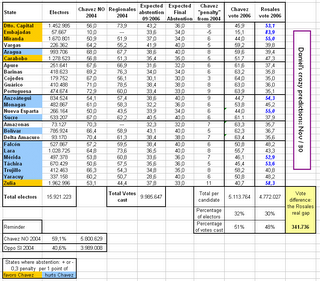
How come? Do not forget that the way my original sheet was set it favored deliberately Chavez by 1) assuming the contested results of the CNE as genuine (and indications are that they are not) and 2) by playing "normal" politics of government fatigue (even though the Venezuelan situation is all but normal). How could I thus reconcile what is my gut feeling, that Rosales might make it after all, and what my pro Chavez skewed numbers tell me? Read on.
Two predictions
This next graph is a reformatting of one published previously with the appropriate updates and arranged now by regions. Click here to see the old version, arranged by electoral weight. Click the graph below to open it in a different window to enlarge and follow better the discussion next. Reminder, the numbers in the first column are the rounded number of electors in each state and the number in the vertical cases on the right are the relative weight of each region. I chose this presentation as it makes it easier to discuss by region than by a mere laundry list of states.
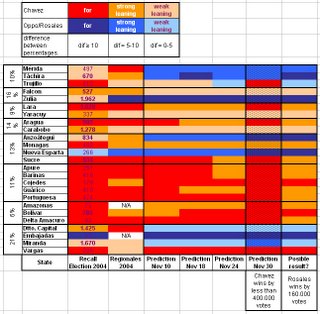
This table was done as I thought the political evolution of Venezuela was taking place. That is, I have been observing how the possible advantage of either candidate evolved in each state according to their activities, rally sizes, etc... However I did a mistake in that I went on gut feeling, forgetting that in some states Chavez had too much of an advantage. In those states where Chavez had already as much as 30 points advantage even a loss of 10% points would still leave that state in the red column, whereas I was already lowering them to orange. When I did an update of the table posted above I had to go back to reality and do the shaded column which is my "official" prediction, that is, Chavez ahead by 400 000 votes at most, a 51 to 48 result. This is the result that logic dictates, and interestingly the result that the serious polls indicated last week. Some pollsters and Daniel Duquenal agreed, though with very different methods. But in such close results scenarios, in a week all can change, from Rosales pulling an upset after all, to the chavista crowds decididng to vote en masse anyway.
I decided to do the reverse exercise, to see if Rosales had a change to pull it off anyway. At any rate it woudl indicate me where does Rosales need to get the lacking votes. That is, to use my final color code prediction on individual state trends and force these numbers in the excel sheet above. This is what appears in the right side column (not shown but available to whomever wants it). The results are clear if not dramatic. Now Rosales is winning by a narrow 160 000 votes. Is it possible? Yes, I think so. I will thus call this my “gut feeling prediction” which, when you look at it, is not too different from the “official” one of the shaded column, just some states “adjusted” according to what one can see going on, the poor Chavez track record there, the lousy local potentates, the size of different rallies, etc…
This is explained next as I do a blow by blow of each region of Venezuela
The regional predictions
Falcon Zulia
Zulia is the home state of Rosales and thus he gets the “favorite son” advantage. If to this you add that he has been a rather good governor, the advantage builds up. And then if you factor in the Zulia pride and the possibility that for the first time they are going to put one of them at Miraflores, the advantage starts ballooning. And if finally you realize that Zulia is the state financing all of Chavez eccentricities, and that people are starting to get tired of the money Chavez is giving away, well, you get a possible 20 points advantage for Rosales there. Zulia should go AT LEAST 60% Rosales and at most 40% Chavez. My informants, and I am willfully breaking the CNE rule of no poll this week, give me Zulia with 30 points, which I find hard to believe, but so I am told.
Falcon I am not so sure. The PDVSA fights at Punto Fijo were really bitter and protracted. The Tucacas region did not flourish and agrarian trouble has established there. The state has not progressed and the local governor seems overstaying his welcome. I still rate Falcon in Chavez camp but a surprise upset could come there because of Zulia. After all Falcon is also Maracaibo playground and the effect of Zulia enthusiasm could be enough to send Falcon to the blue states.
The Andes
Rosales was born in Merida and the Andes are the hinterland of Maracaibo, feeling far from Caracas from which they receive only tourists. Chavez did well in the past when he provided services to long abandoned communities. But that seems to have been forgotten. The border with Colombia and the unwillingness of the government to act strongly against crime and guerilla has brought a calamity over Tachira and to a lesser extent to Merida. The students riots and repression in Merida did not help. Tachira and Merida are sure bets for Rosales and even Trujillo might go for Rosales in spite of a previous very strong orientation for Chavez. Both have campaigned hard in Trujillo. In Tachira Rosales benefits from a particularly thuggish governor, Ronald Blanco, who seems to be universally despised in the area and of whom folks wonder how he managed reelection in 2004.
Centro Occidente
Lara Yaracuy are a puzzle for me and I live there. Both should go to Chavez. In Yaracuy putting former governor Lapi in jail has allowed the local failed governor to diminish the impact of Lapi. Normally if Lapi had been allowed to run around the state by now Chavez should be trailing by 10 points at least. But all is not well for Chavez. In the closing days of the campaign he felt compelled to have a short stop in Yaracuy!!! (which weighs little in Venezuela votes). This is due to the deep division within chavistas in Yaracuy as the governor Gimenez is universally disliked except by his PODEMOS supporters. Abstention could deliver a surprise victory to Rosales!
Lara should go for Chavez. Though the lousy governor, Reyes Reyes, will probably generate some abstention among chavistas that may or may not be compensated by the more dynamic mayor of Barquisimeto, Henri Falcon, the only chavista I could see myself voting for. Still, the risk there for Chavez is abstention, with the consequence of failing to capitalize on Lara to compensate for Zulia and Caracas. Rosales did a surprising strong show in a Barquisimeto rally and the buzz is that the taxi poll of Barquisimeto streets give Rosales more votes than expected.
The Centro
Aragua Carabobo should have spit evenly for Chavez and Rosales respectively. But in Carabobo the Salas machinery has collapsed and the very late support of Salas Feo might not be enough to save Carabobo. The governor, Acosta “eructo” Carles has managed to make his own political clientele and to even appear as slightly independent from Chavez. No one knows if the governor distancing will promote enough abstention within chavismo to compensate for the Salas collapse.
In Aragua we see the reverse phenomenon. Aragua, a MAS and then Chavez stronghold, has suddenly weakened. Perhaps Didalco Bolivar the pro-Chavez governor has overstayed his welcome (he was already governor before Chavez became president!)? Perhaps Aragua did not get from Chavez what it hoped to get? The fact is that Rosales had a great show in Maracay and if he will not win in Aragua he will rob Chavez of a lot of the votes he needs to compensate for his Zulia defeat.
Perhaps the final result of the election will be played there: all will depend on how many voters each one manages to preserve in these states! Any strong showing of Rosales in either state is a clue as to his possible victory.
Oriente
This is turning out to be the big surprise of the election. Six months ago pundits said that the strategy of any opposition candidates would be to secure Zulia, Centro and Caracas for a narrow win over Chavez. Oriente states were conceded, except Nueva Esparta, to Chavez. Well, it seems that Anzoategui will go strongly for Rosales and that the effect of Anzoategui could bring an upset in either Sucre or Monagas.
Underestimating Anzoategui was a mistake. This state never fully embraced Chavez. Tarek Saab was elected governor there because Chavez imposed him. Soon he run into trouble with chavistas, amen of his anti Semitic activities. Chavez visits to the state are marred by internecine warfare as the fortunes of Tarek plummet due to his very poor managerial skills and his talibanic positions on issues. It is possible that Rosales will carry Nueva Esparta and Anzoategui with enough votes to compensate for Sucre or Monagas where chavismo seems more established. Though Rosales could carry Monagas and I was told that Sucre might be more willing to vote against Chavez than what people suspect. The Sucre governor, Ramon Martinez, is another noted corrupt official who is there because he managed to gain Chavez support, not his people, at least if we base ourselves on some recent events such as the Guiria fishermen fiasco.
The Llanos
They remain the only arguable stronghold of Chavez, where he benefits of the “favorite son” complex. But Rosales was big in Barinas, in remote Calabozo, in San Fernando. The only “failure” came in San Carlos where Jhonny Yanez, one of the biggest thugs in chavista files, even managed to block the airport access to Rosales. All in all Chavez should carry the Llanos but by a much lesser margin than expected.
Why? All the land reform, all the corruption scandals such as the CAEZ indicate that Chavez has been trying to favor the area. However there has been too much nepotism in Barinas, too much violence in rural areas, not enough support for the peasants resettled on the expropriated lands. Agriculture is faltering in Venezuela, we import more and more food and the grain belt of Venezuela is not coming through. Surely this must mean that the quality of life is not improving in the Llanos and Chavez is losing ground.
The only surprise I expect in the Llanos is in Portuguesa where the governor has some civism left in her and where the democratic left tradition of past eras might come back to Acarigua and Guanare. The other states should still go for Chavez though perhaps with no more than a 10 points margin of victory! Though Guarico could have an interesting result as the local governor of the PPT has a big feud with the MVR. Manuitt is a thug accused of crimes committed by the police under his orders. How this will play is cryptic, Guarico being perhaps the state with the biggest “fear factor” of all.
Guayana
This is simpler. The two “native” states of Amazonas and Delta Amacuro are the ones supposed to have done great under Chavez when this one improved Natives rights. But in practice this has not happened and Caracas streets are littered with beggars from Delta Amacuro. These states are highly unpredictable today though they tended to vote for whomever was in charge in Caracas. Yet the surprisingly large turnout at Puerto Ayacucho for Rosales allows one to speculate wildly! But whoever wins there, those two are the lowest states vote wise.
Bolivar state is another matter. Today it seems to be the only state where Chavez can expect a big victory, by perhaps more than 20 pints. This did not used to be so.
Chavez has made Bolivar more than ever dependent on Caracas. He is hell bent to prove that state industries can do well and he is not afraid to invest/throw whatever money is needed to prove his point. Cost effectiveness is an unknown concept for Bolivar managers. Eventually this buys enough votes in spite of a rebellious past with Velazquez and the Causa R.
The assassination of the Indian miners in La Paragua in September was a national event that played a lot for Rosales. When he went to visit La Paragua everyone went out to receive him, the bells tolled. But Guayaneses were not impressed. See, they consider miners to be a plague, and even worse, to be foreigners from Brazil. Whether they are right, the thought among the Ciudad Bolivar and Puerto Ordaz populace was that the miners had it coming. As a result La Paragua was an early boost for Rosales, while it might have made him lose for good the rest of the state. If you add a big bridge for the imaginary of the folks, you can understand that even if the bridge is in fact incomplete, the state will go with Chavez as money will keep pouring down there.
And finally Caracas area
Let’s start with the mystery of Vargas, a state if any that suffers from the battered wife’s syndrome. It seems that the most disaster befall Vargas, the more Chavez gains! Unbelievable! From a particularly incompetent governor, to an incompetent recovery agency, and a fallen bridge, going through a belt of misery, nothing makes a dent, Chavez rides high in Vargas. I think it might even be the only state that Chavez has not visited recently! And yet were there to be only one state that is doing worse than 8 years ago, it would Vargas.
Caracas is a more complex problem but the answer comes simply form last weekend rallies. Let’s do a simple arithmetic. The greater Caracas and Miranda state are 3 million voters. If 25% do not vote we are left with 2.2 million voters. At least 600 00 showed for Rosales event strictly from the Caracas area. If one assumes that for every marcher there is one Rosales voter left behind at home or work, we have a conservative 1.2 million votes for Rosales. And hence 1 for Chavez. A 200 000 victory at the very least for Rosales. And if we consider that the Caracas contingent of the Chavez event was 200 000, then we have only 400 000 votes sure for Chavez in Caracas. The margin of Rosales victory could be much more than 200 000.
How come? Caracas has become unlivable: huge permanent traffic jams, garbage everywhere, ultra expensive housing even in miserable areas, poor health services in hospitals, etc, etc.. Combined with painful incompetence of the chavista mayors of the area and it is not surprising to see that Chavez is not doing good there. I still think that Chavez might not do too bad if he convinces popular sectors to go and vote. But no matter what, Rosales victory by 5 points at least in both Miranda and DC is unavoidable for Chavez.
Final word
Based on reason and “conventional” political wisdom Chavez should win, albeit by a meager 5%. That for him would be almost as bad as a loss as it would compromise seriously the implementation of his socialo-communist project. The country will remain ungovernable for years. His international image will be tarnished. He will not be able to sustain a 100% monochromatic national assembly.
There is reasonable chance that Rosales squeaks by with a bare 200 000 votes margin. Will Chavez accept? Will he try to cheat? Will he create commotion? Will he give the presidential sash to Rosales and sabotage from day one his administration as a formidable leader of the opposition, a place he was born for!?
And there is a not too crazy chance for Rosales to reach a 500 000 margin that would put Chavez against the wall and force him to accept what he cannot accept. With a 500 000 victory vote the army would not back Chavez in an adventure and will prefer to sit down with Rosales to negotiate a way to allow him to let them enjoy 8 years of discreet plundering. A small price to pay to avoid civil war, if you ask me. But for this to happen we need 1) strong chavista abstention in some areas, 2) a clear victory for Rosales in Carabobo, Anzoategui and Miranda.
The answer in the wee hours of December 4.
PS: I had to do some editing this morning. I should not be writing such long and complex post at night. I hope it is a little bit clearer to understand.
It is actually tougher than what I thought it would be. Contradictory polls played havoc with rationality, thus I had to stick to my trusted excel sheet which is reproduced below. First a reminder of how this one started. I took the CNE numbers of 2004, both Recall Election and Regional Elections later that year. I assumed that there was no cheating and that those were the true results (what I call the "Chavez advantage"). Then I factored in the local politics effect on the ability of Chavez to keep his voting strength. I do not know the local politics of all Venezuelan states, but I think I have a reasonable understanding of at least the 5 big ones and some of the smaller ones. Thus we get the chart below which gives a narrow victory for Chavez (click to enlarge). In states highlighted in yellow abstention favors Chavez, in blue states where abstention hurts Chavez. In bold blue numbers states where Rosales should win. For more details refer to this past link.
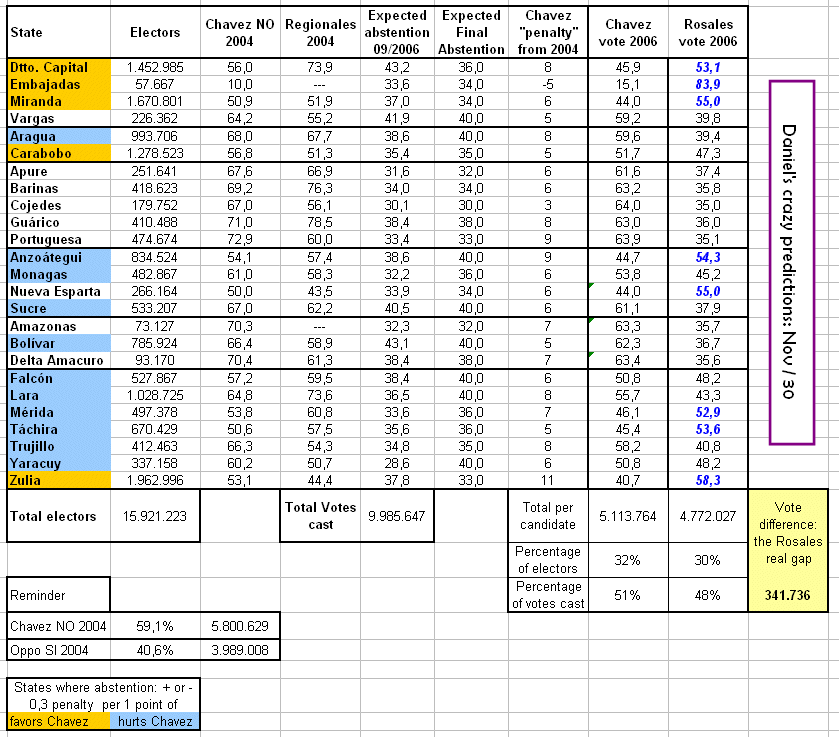
How come? Do not forget that the way my original sheet was set it favored deliberately Chavez by 1) assuming the contested results of the CNE as genuine (and indications are that they are not) and 2) by playing "normal" politics of government fatigue (even though the Venezuelan situation is all but normal). How could I thus reconcile what is my gut feeling, that Rosales might make it after all, and what my pro Chavez skewed numbers tell me? Read on.
Two predictions
This next graph is a reformatting of one published previously with the appropriate updates and arranged now by regions. Click here to see the old version, arranged by electoral weight. Click the graph below to open it in a different window to enlarge and follow better the discussion next. Reminder, the numbers in the first column are the rounded number of electors in each state and the number in the vertical cases on the right are the relative weight of each region. I chose this presentation as it makes it easier to discuss by region than by a mere laundry list of states.

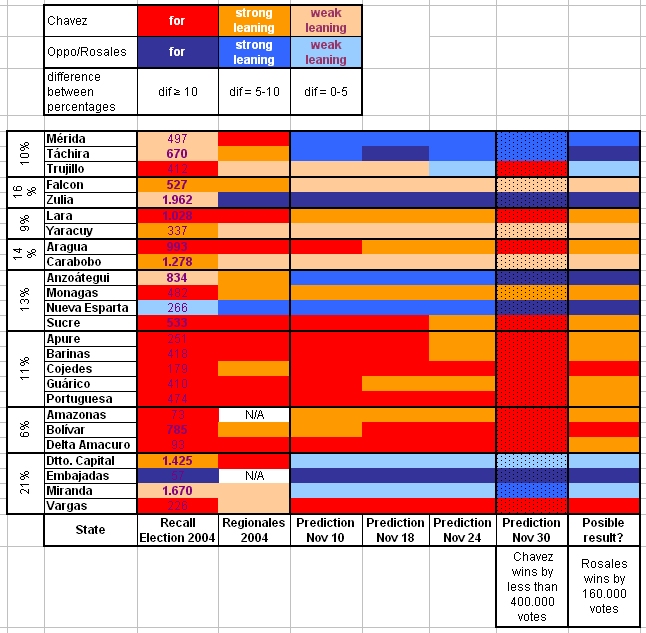
This table was done as I thought the political evolution of Venezuela was taking place. That is, I have been observing how the possible advantage of either candidate evolved in each state according to their activities, rally sizes, etc... However I did a mistake in that I went on gut feeling, forgetting that in some states Chavez had too much of an advantage. In those states where Chavez had already as much as 30 points advantage even a loss of 10% points would still leave that state in the red column, whereas I was already lowering them to orange. When I did an update of the table posted above I had to go back to reality and do the shaded column which is my "official" prediction, that is, Chavez ahead by 400 000 votes at most, a 51 to 48 result. This is the result that logic dictates, and interestingly the result that the serious polls indicated last week. Some pollsters and Daniel Duquenal agreed, though with very different methods. But in such close results scenarios, in a week all can change, from Rosales pulling an upset after all, to the chavista crowds decididng to vote en masse anyway.
I decided to do the reverse exercise, to see if Rosales had a change to pull it off anyway. At any rate it woudl indicate me where does Rosales need to get the lacking votes. That is, to use my final color code prediction on individual state trends and force these numbers in the excel sheet above. This is what appears in the right side column (not shown but available to whomever wants it). The results are clear if not dramatic. Now Rosales is winning by a narrow 160 000 votes. Is it possible? Yes, I think so. I will thus call this my “gut feeling prediction” which, when you look at it, is not too different from the “official” one of the shaded column, just some states “adjusted” according to what one can see going on, the poor Chavez track record there, the lousy local potentates, the size of different rallies, etc…
This is explained next as I do a blow by blow of each region of Venezuela
The regional predictions
Falcon Zulia
Zulia is the home state of Rosales and thus he gets the “favorite son” advantage. If to this you add that he has been a rather good governor, the advantage builds up. And then if you factor in the Zulia pride and the possibility that for the first time they are going to put one of them at Miraflores, the advantage starts ballooning. And if finally you realize that Zulia is the state financing all of Chavez eccentricities, and that people are starting to get tired of the money Chavez is giving away, well, you get a possible 20 points advantage for Rosales there. Zulia should go AT LEAST 60% Rosales and at most 40% Chavez. My informants, and I am willfully breaking the CNE rule of no poll this week, give me Zulia with 30 points, which I find hard to believe, but so I am told.
Falcon I am not so sure. The PDVSA fights at Punto Fijo were really bitter and protracted. The Tucacas region did not flourish and agrarian trouble has established there. The state has not progressed and the local governor seems overstaying his welcome. I still rate Falcon in Chavez camp but a surprise upset could come there because of Zulia. After all Falcon is also Maracaibo playground and the effect of Zulia enthusiasm could be enough to send Falcon to the blue states.
The Andes
Rosales was born in Merida and the Andes are the hinterland of Maracaibo, feeling far from Caracas from which they receive only tourists. Chavez did well in the past when he provided services to long abandoned communities. But that seems to have been forgotten. The border with Colombia and the unwillingness of the government to act strongly against crime and guerilla has brought a calamity over Tachira and to a lesser extent to Merida. The students riots and repression in Merida did not help. Tachira and Merida are sure bets for Rosales and even Trujillo might go for Rosales in spite of a previous very strong orientation for Chavez. Both have campaigned hard in Trujillo. In Tachira Rosales benefits from a particularly thuggish governor, Ronald Blanco, who seems to be universally despised in the area and of whom folks wonder how he managed reelection in 2004.
Centro Occidente
Lara Yaracuy are a puzzle for me and I live there. Both should go to Chavez. In Yaracuy putting former governor Lapi in jail has allowed the local failed governor to diminish the impact of Lapi. Normally if Lapi had been allowed to run around the state by now Chavez should be trailing by 10 points at least. But all is not well for Chavez. In the closing days of the campaign he felt compelled to have a short stop in Yaracuy!!! (which weighs little in Venezuela votes). This is due to the deep division within chavistas in Yaracuy as the governor Gimenez is universally disliked except by his PODEMOS supporters. Abstention could deliver a surprise victory to Rosales!
Lara should go for Chavez. Though the lousy governor, Reyes Reyes, will probably generate some abstention among chavistas that may or may not be compensated by the more dynamic mayor of Barquisimeto, Henri Falcon, the only chavista I could see myself voting for. Still, the risk there for Chavez is abstention, with the consequence of failing to capitalize on Lara to compensate for Zulia and Caracas. Rosales did a surprising strong show in a Barquisimeto rally and the buzz is that the taxi poll of Barquisimeto streets give Rosales more votes than expected.
The Centro
Aragua Carabobo should have spit evenly for Chavez and Rosales respectively. But in Carabobo the Salas machinery has collapsed and the very late support of Salas Feo might not be enough to save Carabobo. The governor, Acosta “eructo” Carles has managed to make his own political clientele and to even appear as slightly independent from Chavez. No one knows if the governor distancing will promote enough abstention within chavismo to compensate for the Salas collapse.
In Aragua we see the reverse phenomenon. Aragua, a MAS and then Chavez stronghold, has suddenly weakened. Perhaps Didalco Bolivar the pro-Chavez governor has overstayed his welcome (he was already governor before Chavez became president!)? Perhaps Aragua did not get from Chavez what it hoped to get? The fact is that Rosales had a great show in Maracay and if he will not win in Aragua he will rob Chavez of a lot of the votes he needs to compensate for his Zulia defeat.
Perhaps the final result of the election will be played there: all will depend on how many voters each one manages to preserve in these states! Any strong showing of Rosales in either state is a clue as to his possible victory.
Oriente
This is turning out to be the big surprise of the election. Six months ago pundits said that the strategy of any opposition candidates would be to secure Zulia, Centro and Caracas for a narrow win over Chavez. Oriente states were conceded, except Nueva Esparta, to Chavez. Well, it seems that Anzoategui will go strongly for Rosales and that the effect of Anzoategui could bring an upset in either Sucre or Monagas.
Underestimating Anzoategui was a mistake. This state never fully embraced Chavez. Tarek Saab was elected governor there because Chavez imposed him. Soon he run into trouble with chavistas, amen of his anti Semitic activities. Chavez visits to the state are marred by internecine warfare as the fortunes of Tarek plummet due to his very poor managerial skills and his talibanic positions on issues. It is possible that Rosales will carry Nueva Esparta and Anzoategui with enough votes to compensate for Sucre or Monagas where chavismo seems more established. Though Rosales could carry Monagas and I was told that Sucre might be more willing to vote against Chavez than what people suspect. The Sucre governor, Ramon Martinez, is another noted corrupt official who is there because he managed to gain Chavez support, not his people, at least if we base ourselves on some recent events such as the Guiria fishermen fiasco.
The Llanos
They remain the only arguable stronghold of Chavez, where he benefits of the “favorite son” complex. But Rosales was big in Barinas, in remote Calabozo, in San Fernando. The only “failure” came in San Carlos where Jhonny Yanez, one of the biggest thugs in chavista files, even managed to block the airport access to Rosales. All in all Chavez should carry the Llanos but by a much lesser margin than expected.
Why? All the land reform, all the corruption scandals such as the CAEZ indicate that Chavez has been trying to favor the area. However there has been too much nepotism in Barinas, too much violence in rural areas, not enough support for the peasants resettled on the expropriated lands. Agriculture is faltering in Venezuela, we import more and more food and the grain belt of Venezuela is not coming through. Surely this must mean that the quality of life is not improving in the Llanos and Chavez is losing ground.
The only surprise I expect in the Llanos is in Portuguesa where the governor has some civism left in her and where the democratic left tradition of past eras might come back to Acarigua and Guanare. The other states should still go for Chavez though perhaps with no more than a 10 points margin of victory! Though Guarico could have an interesting result as the local governor of the PPT has a big feud with the MVR. Manuitt is a thug accused of crimes committed by the police under his orders. How this will play is cryptic, Guarico being perhaps the state with the biggest “fear factor” of all.
Guayana
This is simpler. The two “native” states of Amazonas and Delta Amacuro are the ones supposed to have done great under Chavez when this one improved Natives rights. But in practice this has not happened and Caracas streets are littered with beggars from Delta Amacuro. These states are highly unpredictable today though they tended to vote for whomever was in charge in Caracas. Yet the surprisingly large turnout at Puerto Ayacucho for Rosales allows one to speculate wildly! But whoever wins there, those two are the lowest states vote wise.
Bolivar state is another matter. Today it seems to be the only state where Chavez can expect a big victory, by perhaps more than 20 pints. This did not used to be so.
Chavez has made Bolivar more than ever dependent on Caracas. He is hell bent to prove that state industries can do well and he is not afraid to invest/throw whatever money is needed to prove his point. Cost effectiveness is an unknown concept for Bolivar managers. Eventually this buys enough votes in spite of a rebellious past with Velazquez and the Causa R.
The assassination of the Indian miners in La Paragua in September was a national event that played a lot for Rosales. When he went to visit La Paragua everyone went out to receive him, the bells tolled. But Guayaneses were not impressed. See, they consider miners to be a plague, and even worse, to be foreigners from Brazil. Whether they are right, the thought among the Ciudad Bolivar and Puerto Ordaz populace was that the miners had it coming. As a result La Paragua was an early boost for Rosales, while it might have made him lose for good the rest of the state. If you add a big bridge for the imaginary of the folks, you can understand that even if the bridge is in fact incomplete, the state will go with Chavez as money will keep pouring down there.
And finally Caracas area
Let’s start with the mystery of Vargas, a state if any that suffers from the battered wife’s syndrome. It seems that the most disaster befall Vargas, the more Chavez gains! Unbelievable! From a particularly incompetent governor, to an incompetent recovery agency, and a fallen bridge, going through a belt of misery, nothing makes a dent, Chavez rides high in Vargas. I think it might even be the only state that Chavez has not visited recently! And yet were there to be only one state that is doing worse than 8 years ago, it would Vargas.
Caracas is a more complex problem but the answer comes simply form last weekend rallies. Let’s do a simple arithmetic. The greater Caracas and Miranda state are 3 million voters. If 25% do not vote we are left with 2.2 million voters. At least 600 00 showed for Rosales event strictly from the Caracas area. If one assumes that for every marcher there is one Rosales voter left behind at home or work, we have a conservative 1.2 million votes for Rosales. And hence 1 for Chavez. A 200 000 victory at the very least for Rosales. And if we consider that the Caracas contingent of the Chavez event was 200 000, then we have only 400 000 votes sure for Chavez in Caracas. The margin of Rosales victory could be much more than 200 000.
How come? Caracas has become unlivable: huge permanent traffic jams, garbage everywhere, ultra expensive housing even in miserable areas, poor health services in hospitals, etc, etc.. Combined with painful incompetence of the chavista mayors of the area and it is not surprising to see that Chavez is not doing good there. I still think that Chavez might not do too bad if he convinces popular sectors to go and vote. But no matter what, Rosales victory by 5 points at least in both Miranda and DC is unavoidable for Chavez.
Final word
Based on reason and “conventional” political wisdom Chavez should win, albeit by a meager 5%. That for him would be almost as bad as a loss as it would compromise seriously the implementation of his socialo-communist project. The country will remain ungovernable for years. His international image will be tarnished. He will not be able to sustain a 100% monochromatic national assembly.
There is reasonable chance that Rosales squeaks by with a bare 200 000 votes margin. Will Chavez accept? Will he try to cheat? Will he create commotion? Will he give the presidential sash to Rosales and sabotage from day one his administration as a formidable leader of the opposition, a place he was born for!?
And there is a not too crazy chance for Rosales to reach a 500 000 margin that would put Chavez against the wall and force him to accept what he cannot accept. With a 500 000 victory vote the army would not back Chavez in an adventure and will prefer to sit down with Rosales to negotiate a way to allow him to let them enjoy 8 years of discreet plundering. A small price to pay to avoid civil war, if you ask me. But for this to happen we need 1) strong chavista abstention in some areas, 2) a clear victory for Rosales in Carabobo, Anzoategui and Miranda.
The answer in the wee hours of December 4.
PS: I had to do some editing this morning. I should not be writing such long and complex post at night. I hope it is a little bit clearer to understand.
Tags:
Monday, June 09, 2008
The 2008 election gambles: part 5, hazardous predictions
And now for what the few patient readers who are still following after the previous 4 posts have been waiting for: the first round of predictions (1).
The predictions, round 1
First, let me state that my predictive stunning success for last December vote cannot possibly be replicated this time: local elections have so many parameters that it is impossible for a simple busy follower like me to master them all. I cannot for the life of me discuss in detail the inner politics of, e.g., Trujillo. Fortunately for me those states I know least of seem to be safely in the Chavez column.
This time I will not hazard an actual vote count as I did last year. For the referendum vote, we could assume general abstention trend, general voter support/defection patterns. But for a local election, no matter what the national issues might be, the local factor, the excitement generated or not by the local candidates will play a bigger role in how many people bother to go and vote in Tacusipon.
Right now we can only talk about a trend. Most candidates have yet to be chosen even within the PSUV. Its primary was shown to be a sham, and it is far from ensuring the support of the disgruntled base and the junior allies of chavismo such as the PPT. It is quite possible that by August someone, like Garcia Carneiro in Vargas, is so low in the polls that he might decide not to run and let another chavista try its luck: candidates can register early August, so that leaves us with 2 full month of sotto voce campaigning and polls until the final pro Chavez candidate is finally anointed (PSUV, PPT or else).
On the opposition side, the length of the "survey poll primaries" might ensure, comes August, a better candidate, or at least a clearly established one . But this has yet to happen. The more opposition delays in its agreements, the more time it gives chavismo to catch up from its very late start in deciding who would run in red. Thus we cannot make any serious prediction until September 30, when all candidates will be decided for good and one month of real campaign will have finally taken place.
But this should not stop us form having fun and we move on for the first round of reckless electoral predictions. This, of course, without forgetting that much more than who will pick the garbage we might be playing out the future of the country next November.
How the chart was designed
You might want to open the chart in a different window to follow better.
The chart lists the different Venezuelan states organized by regions. The names of the states are aligned on the left of the first column. For some states I have included some significant districts that tell us a lot on how things are moving. The names of these districts are aligned right in the same first column. I have included past results (rounded percentile votes cast at the date).

In red we have the states where chavismo won, and in blue the anti chavismo states. Orange are the states which started chavista and ended up independent or anti Chavez as their governors broke with Chavez. Green are the rare districts that could almost pretend to some independent status.
In the sixth column I am putting the prediction. This time no percentile prediction or vote count: a state is won or lost, period. In pink will be the states tending Chavez (sorry, Excel does not allow for a lighter red). Light blue of course means tendency toward the opposition. And in gray I indicate the states which right now can be considered too close to call.
Each column represents an election (I have skipped the 2005 ones which are totally meaningless, and the 2004 recall election which was such a special election that it is of no use to draw trends, though it would look a lot as the 2004 regional elections). In order: the 2000 local result, the 2004 local result, the 2006 presidential result and last December referendum.
The predictions on June 2008
Zulia. Let's start with the richest state of all in voters, and the easiest state to discuss, even if I placed it at the bottom of the chart. Zulia has had an historical tendency to drift away from whoever was in charge in Caracas. When Venezuela was AD, COPEI slowly crept in. When COPEI/AD ruled during Caldera 2, it shifted to Arias Cardenas in a pre-Chavez era mood. It is thus no surprise that the state with perhaps the strongest local character in Venezuela (music, cuisine, heat, all is different there than from the rest of Venezuela) would have felt very unconformable about Chavez using the oil pumped from under its feet to feed its ego trip.
The percentage of the state voting against chavismo clearly tends to go up. Chavez himself is liked enough, he won in 2006, but not impressively as elsewhere. If you look at the three towns I chose, this is confirmed. In 2000 Di Martino won Maracaibo easily in a pro Chavez fervor, though Rosales managed to carry the state, if barely (Venezuelans love to cross over their votes). But in 2004, even as the whole country went red, Di Martino barely made it; since Maracaibo has seen its anti Chavez number rise steadily. Popular San Francisco South of Maracaibo or Cabimas across the bridge also show a similar pattern even if less marked.
Chavismo has decided to run Di Martino anyway, as he cannot run again for Maracaibo again. I cannot see how Di Martino can win Zulia, though paradoxically he might be the best candidate chavismo could field in Zulia (the others such as Cabezas or Ortega never caught there in spite of their long tenure in parliament). I expect Zulia to be carried by the opposition, which in addition should get the top prize of Maracaibo and possibly a very large majority of the state districts. In short, chavismo risks to be shut out of Zulia: they might still get more than 40% of the votes but these will be evenly distributed thus creating a nice advantage for the Rosales led coalition, perhaps nearing a clean sweep.
The Llanos. The other easy to discuss region is the great plains of Venezuela, half way in the chart. They offer us the reverse observations of Zulia: they seem to be pretty proud of their Llanero president (Barinas is the home state) and we can expect a chavista clean sweep even if an occasional small district changes hands. Or can we?
The Llanos have tended to be AD. This one did the only real agrarian reform of Venezuela (the Chavez one is a joke). When AD collapsed, it was natural for its inhabitants to drift to chavismo, which was perceived by them as the left wing that AD had lost. Let's not forget that chavista did not appear as a spontaneous generation, out of nowhere: most of them were all their lives either AD or COPEI or MAS. Chavismo is also a macho party and that resonates well with the local habits of the Llanos which have never quite overcome the Doña Barbara civilization.
No problem here, even if there was a slight fall back in 2007, the trend is clear, the Llanos remain solidly in Chavez camp. But there are clouds on the horizon.
Barinas, which I put in pink as tending to Chavez, might have problems. Adam Chavez, the first brother's candidature ,seems to have been imposed over there. The Chavez brothers have become quite unpopular in Barinas as they have been perceived has reaching easy wealth fast, quite fast, quite suspiciously. In addition Barinas folk expect that being the home state of Chavez they should be much, much better off than what they are (paternalism has a way to come to bite their practionners). Scandals have been occurring enough in Barinas that we could have a surprise and Adam could well bite the dust if his campaign turns bad. He has a very wooden personality, very sectarian and I doubt that he will be campaigning very convincingly. The Llanos state to watch!
Just a warning note on Portuguesa. This one could be the safest bet as its results have been the most consistent. Yet, chavismo is at odds there with the PPT who thinks they have a stronger candidate. Right now it seems that chavismo will run two candidates. Yet the overall pro Chavez feeling there might be enough that chavismo may be able to afford a divided ticket and still win, in particular if the PSUV elected appointee flounders (oxymoron intended). This one, Castro Soteldo, is a rather lackluster military that has been imposed in the area and who barely got half of the votes in the PSUV primary. Thus Chavez might still win but not with the man he wants. Anyway, at this point I do not see the opposition being able to take advantage of that local situation and Portuguesa should remain red.
Guarico also offers a similar situation. Lara, the ineffable professional liar ex Information Minister somehow got dispatched there and only made 43% at the PSUV primary. Eight years ago he was running for Miranda state where he got unbelievably trounced by Mendoza. The current holder of the state house is not amused. Manuitt, barred from running again would like a relative to succeed him and counts discretely on the PPT to put pressure on the PSUV. That Manuitt is a possible criminal and mafia like governor does not stop him to pretend to rule the state after his departure. Could Guarico become an unexpected opportunity for the opposition?
No matter, I think at this point that chavismo is so far ahead in the Llanos that the opposition can expect at best to pick one state. And that if they put their act together because if chavistas settle their issues by September, it will be difficult to pick even Barinas.
The South (Guayana). These three states are today's "frontier" regions of sorts. Delta Amacuro and Amazonas are now ruled by strong chavista sycophants in the name of the native folks who still think that the pro native rights 1999 constitution really were meant for them. It did on paper but not quite on practice (see my Delta Amacuro posts). They have in fact become a group completely dependent of chavismo largesses, without the means to show any independence of will. In fact, the political battles are inside the chavista camp as the opposition groups are basically powerless there and of no interest for the natives.
Bolivar is another matter. The mining state, with huge public sector, and a growing one after the take over of SIDOR, was for a while a secure state for chavismo. But the incredibly bad administration of general Rangel (running again though barely getting the PSUV nod) has created lots of internal battles within chavismo. Trade unions, public servants, mining mafias and military are fighting it out for the control of the state and the opposition could well have better chances there than one would think of. After all, the trend is clearly down for chavismo and the question is how the negative slope will hold.
The Andes. Another easy area to discuss. The Andes went again all chavista in 2004, with better margins. There chavismo truly helped remote areas that had been neglected for a log time. In 2004 the agrarian policies and the FARC problems had not affected the area too much. Yet many people were surprised at the clean sweep of chavismo in 2004. But the fall was as fast as the rise! Trujillo, the poorest of the three, remained chavista in 2006 and 2007, but Tachira offered the best score to Rosales in 2006, and, again, the best NO score in 2007. The almost as dramatic drop in Merida is also influenced in part by the Tachira situation.
What happened? Well, the ambiguous security policies of Chavez have had a clear effect on the border. Letting the FARC hang around with all the crime that comes along, letting contraband of gasoline toward Colombia go through, has greatly perturbed the economic system of the area and its quality of life. Kidnappings, blackmails, "vacunas" are the norm of there and have brought it in a chronic depression now greatly accelerated as the recent Colombo-Venezuelan spat has decreased the border activity by 60%. Tachira and Merida are now two sure picks for the opposition. Besides the chavista candidates sent over there do not seem to carry much popular fervor with them and failed to make convincing shows at the PSUV primaries in Tachira.
Yet the opposition could still manage to blow it as too many candidates want these all but certain jobs. In particular many ghosts from the past have a hard time to understand that their time has gone. Merida is the most vulnerable on thsi respect, and I had to think about putting it blue instead of light blue.
Centro Occidente. Now we start getting into the more complex areas of the country and I will need to look at some town halls to find clues. Let's go by states.
Falcon is the simplest of the lot. It went surprisingly for chavismo in 2000, not even reaching the 50% mark. The governor, a relatively young military, did a good enough job and benefited from the 2003 strike crisis which dramatically polarized Punto Fijo, the main town there. Yet, as any rather uncouth soldier, his reelection brought out the true Montilla out: nepotism and arrogance became felt around and if Chavez was nicely reelected there in 2006, it was a stunning surprise to see that the NO barely missed that state in 2007 (in fact, it was a the only split state where one question was SI and the other NO). Now Falcon is undecided though chavismo should be able to recoup enough to sneak in. It will all depend on the candidate that the opposition manages to field as personality might be the main issue there: Montilla is running his wife!
Lara is a very interesting case. First, there was the stunning NO victory in 2007. That one was due strictly to the large NO votes of the two main districts, Barquisimeto and its suburb Cabudare. Yet Barquisimeto major Henry Falcon was riding rather high in the polls. What has happened there is that the fight between the ineffectual governor Reyes Reyes and Falcon has crated a deep rift within chavismo. In fact chavismo tried to block Falcon nomination but when he announced that he would run with or without Chavez blessing, Chavez had to relent and sure enough once allowed to run, Falcon won easily the PSUV primary last Sunday.
I do put Lara as too close to call because it is difficult to decide how much that chavismo division played: after all it was enough for that stunning NO last year. Reyes Reyes might secretly root for a Falcon defeat. Even Chavez might not cry much if Falcon loses as he is considered a chavista that places good management above unconditional loyalty to anyone, a rarity inside chavismo these days. It will all depend on who does the opposition fields for Barquisimeto district. This one carries about half of the state votes and thus a surprising opposition victory in Barquisimeto coupled with an embittered chavismo sector could give a surprise at state level. Still, at this point the opposition does not seem to be able to field a good candidate for the state house and I expect Falcon to have maybe a short but clear victory no matter what. However he could end up with a state legislature that will not be friendly to him, a possible split state. In fact, his relative good tenure at Barquisimeto might make many opposition electors vote for him for the job but against him at the state legislature, leaving the group hostile in general as hard core chavista would not mind voting agaisnt his proposals and budgets on occasion.
Yaracuy is a real enigma. The current governor, indicted and yet not placed on the Russian list, has been disowned by the PSUV but will apparently run again on his own. He will not win as his administration has been a disgrace: only the rabble rouser of the state might still back him up. In addition a rather discredited chavismo is fielding a local Taliban who scares everyone and who lost any previous electoral attempts he run at. He got the nomination because, in my opinion, no one with a real chance within chavismo wanted to waste it on what seems a sure defeat.
But is it a sure defeat for chavismo? I am not so sure. If there is one thing that Gimenez has succeeded is to get rid of his main rival, governor Lapi, who is now living in exile on trumped up judicial charges. This scandalous situation has not been effectively fought by his supporters and the Lapi movement, based as chavismo on a strong leader, is crumbling. The opposition is divided and no clear candidate is emerging to pick the pieces. If you look at the three main districts of Yaracuy, you can see by yourself that there is no trend. Yaritagua might seem to get closer to chavismo Independencia and San Felipe seem to become slowly more and more anti Chavez. All will be played on the country side vote: if the chavista candidate manages to inspire the peasantry, so to speak, he might win. If he fails to connect, the opposition might be strong enough in the cities to recover Yaracuy. We can also expect in Yaracuy a legislature of a different color than the governor, whichever side gains the much deteriorated mansion. One thing is certain: Giménez will end in jail for sure, probably before the election if necessary to improve Heredia's chances. In short I put right now a "too close to call" because simply we cannot get a sense for anything here yet even though I could probably put it already light blue.
Oriente. The tourist area of Venezuela suffers of spit personality at all levels. While in Monagas chavismo seems to dominate every day more, in the other three states nobody knows for sure what is going on.
In Monagas PDVSA rules. The country side is rather quiet because it is not very settled and thus agrarian problems are not as notorious there. The current governor, who apparently was not too bad, should have no problem to be reelected. Monagas, by the way, is another state which shifted easily from AD to Chavez. Still, the mayor of Maturin is not happy at not having been given the governor nod. Not enough to make Briceño stumble but forcing him to campaign more than he planned.
In Nueva Esparta, in spite of a consistent strong chavista vote, the opposition tends to dominate. Margarita has a much divided population between those who benefit from tourism and those who must clean their bathrooms. Yet, the agonizing free trade zone has made tourism less remunerative for the island as more cheap stakes visit than before. The government has failed to solve the water, electricity, transport, ferry problems and AD amazingly managed to retake the island in 2004. Today the governor should be reelected without any problem as even many chavista supporters realize that the lousy mass tourist schemes of the government are not only failing but are depriving them of those tourists who leave a good tip when they are happy with how clean their hotel room is. In addition the rumors of a terrible new Tourism law would play heavily against chavismo there.
Anzoategui, our next step, is more complex. The current governor, Tarek Saab, former human right defender turned local arrogant potentate has been bad news for he state. The tendency of chavismo to consolidate its hold of the state seems to have reverted even though like in Monagas PDVSA rules there. Anzoategui is a clear case of electoral problems due to incompetence and the only surprise here is that chavismo in lack of a good candidate decided to allow Tarek to run again (he did not even reach 50% on the PSUV primary!). The opposition should win there, even if barely. However as a PDVSA dependent state, a few largesses could go a long way to allow Tarek to retain his chair, even if barely. Still, the opposition should at least conquer the state legislature.
Of the lot, beach splendid Sucre is the most complex to scrutinize. Its governor, Ramon Martinez, cannot run again. And in addition he went all the way against Chavez and helped a lot in the defeat of the referendum. Even though the 74% Chavez vote in 2006 would have us think that the 2007 SI result would be a shoo in, it was a squeak in! Martinez is prepping a successor and will certainly campaign strongly for whoever is the nominee from the opposition side. Even though he is a dubious reputation, Martinez has impeccable left credentials and if the opposition can put its act together, Sucre could well fall. Thus the status of too close to call: very Chavez friendly but now too divided to be a sure bet. Besides the PSUV primaries did not show any rising chavista leader there, the PSUV campaign will need to promote its nominee, even if he is Cumana's mayor, before it can be competitive.
The industrial heartland. Carabobo and Aragua own the bulk of Venezuelan industry. As such they have been hard hit by the 2003 strike but they have failed to recover in spite of the growth boom. All the industries that survived the strike work at full speed but many never reopened and few new stuff was built. As a consequence real jobs in production have not grown much. Politics were rough there too as chavismo tried to promote its trade unions, force the burping general on Carabobo and eventually fought with Didalco Bolivar, the governor reelected with he highest result in 2000, a stunning 85%. Now Aragua gave a meager 53 SI, while Carabobo who for a while seemed to go Chavez went 53 for the NO in spite of a weak opposition organization who collapsed once the Salas lost office (personal movements always fail once their leaders are overthrown).
Prediction is not easy even if we look at the tend of the cities highlighted. In Aragua it is clear that Maracay and la Victoria are getting disenchanted with chavismo even if he still wins. If Didalco manages to tie up a nice coalition led by PODEMOS, Aragua will go away of chavismo which will be a major disaster as 4 years ago it was considered an impregnable bastion. Chavismo just picked Isea for the job. He comes from the finance ministry where he did not shine much. He has a shifty look which might not help him much on the trail. A weak candidate if you ask me. But Chavez needed a faithful in Maracay where too many military interests are at stake. Right now the long leftist tradition of Aragua gives the state to Chavez, but if the opposition accepts to rally solidly behind PODEMOS a surprise could be in the making. No matter what, for the time being I expect a close result for chavismo.
In Carabobo chavismo has made the mistake of dispatching Mario Silva of the most infamous La Hojilla VTV show. A divisive, hateful personality, he will polarize the state and will discourage many chavistas. With a good campaign Carabobo could come back for the opposition with a bang. The trends are clear, even in Puerto Cabello chavismo is weakening. It is amazing that chavismo has sent a candidate with no electoral experience and the most vulgar personality we can think of, a true insult to the Carabobo people. Then again La Hojilla had really high ratings there?
Caracas. All eyes are on Caracas. If it is already normal since Caracas metro area holds maybe more than a quarter of Venezuela's vote, it is also a dramatic battle for the prestige of Chavez. If the opposition manages the sweep of Caracas town halls, it would be considered by itself a major disaster for chavismo.
But let's start by the surrounding two states, heavenly influenced by whatever happens to Caracas.
Vargas is the long suffering state of the 1999 disaster. Amazingly, the more Chavez beats Vargas up, the more it seems to vote for the guy. Yet.... The current governor, the classical fat general, has been a disaster, often berated by Chavez himself. And the one that Chavez wanted to run, Garcia Carneiro has the personality of a rotten fish floating on La Guaira harbor. Clearly the opposition has a chance there. But of course no one knows how deep the codependency of the locals goes... I think that in the end Vargas should go Chavez but it is not a given.
Miranda on the other hand seems a sure pick. It has more than one candidate for the opposition that draws crowds whereas Diosdado Cabello has been a lousy governor, a much questioned one in addition. Yet chavismo decided to have him run again. The evolution of the different districts bode ill for Diosdado: the already bloated opposition margins in Baruta, Hatillo, Chacao, Salias seem to grow further, while bastions like Guaicaipuro and Guatire are far from being a sure thing next November. The Guatire loss in December 2007 was widely noted as Guatire was a district where the chavismo coalition could run in divided ranks and still win without any problem. Tough road for Diosdado: not only he is set to lose but he could lose by as much as 10 points. Then again he has only himself to blame as his tenure was much more concerned in pillaging and politics than actual community problem solving, counting too much on Chavez inaugurating public works to reflect good on Diosdado.
Now Caracas at large, the headache of chavismo. Prestige wise the loss of Caracas would be a major blow for Chavez, thus all the guns have been aligned. Barreto, an awful, truly awful mayor, has been tossed out. Bernal has been sent to political death by running for Vargas where he badly lost. Isturiz, a former Libertador mayor who did serve not too shabbily then had been dragged from a possible retirement to run for Caracas. But it might not be enough. Isturiz is black, that is not a problem as he was already elected once. But his blackness has become an issue as his long tenure at the education ministry has revealed a mean streak in him, a resentment that we did not know from him when he was a trade union activist, speaking for all workers. His best merit is that the could indeed motivate and unite the chavista base, but that might not be enough.
The two districts currently run by chavismo, Libertador and Sucre, are also the ones with the largest population and all the shanty towns. This solid base is not a solid as it used to be. 8 years of truly bad management by Rangel and Bernal have exacted a toll: the barrios now do not vote as massively as before, and not as massively for Chavez. In Sucre Ocariz of Primero Justicia almost won in 2004 in spite of the huge abstention movement. This time Ocariz might even win in Petare and other popular districts. A strong win by Ocariz could play against Isturiz for Caracas. Thus Isturiz chances depend heavily on how large a victory chavismo gets in Libertador.
But in Libertador things are not easy. This most chavista of districts, home of the choice fanatics such as Lina Ron or the president of the National Assembly Cilia Flores, has suffered too much under the painful physical degradation of Caracas. The 52 point loss of 2007 was perhaps in fact surprisingly low. There reaches a point where even the more driven supporter starts wishing that the garbage were to be picked up more regularly.
Chavismo dispatched Jorge Rodriguez to run for Libertador. If he certainly has name recognition and is totally identified with Chavez, he is also a divisive personality, with a mean streak and now perceived as a liar as of his fake impartial pretense when he was at the CNE. Truly the kind of candidate you would not leave your wallet alone with. I suppose that the gamble of chavismo there is the same as sending Silva to Carabobo: send a controversial candidate to motivate the chavista mean base. But chavismo has also a more moderate base that can be put off by people like Rodriguez or Silva while at the the same time these candidates do stimulate the opposition to vote. Rodriguez and Silva are not the kind of candidate that benefit from a long campaign, but they are perfect if you think that negative campaigning is the way to go: you will not find anyone viler than these two.
As a final note on Caracas I think that the truly bad administration of Barreto and Bernal will be the best visiting cards for the opposition and Isturiz for all the good memories he might generate in some quarters of Libertador will have hard time to overcome the negatives. If his campaign is not well run, we could see a clean opposition sweep of the area, the most dreaded result of all for chavismo. That explains why Leopoldo Lopez has been banned: he runs high in any poll of any district in Caracas. Even if chavismo manages to bar Lopez from running, the intention will be so clear that it could hurt chavismo by promoting abstention in its ranks.
Conclusion
Here I post a simplified chart that I will update in future posts. I also added at the bottom the state count election after election. Thus my prediction at this moment is 7 sure for the opposition, 1 very likely and 3 undecided. Thus even if everything goes well, I am not expecting more than a total of 11 states for the opposition, though those include the biggies. And please, if this exercice is fun, it should not distract us from the real aims of chavismo, to have president for life. Their attempts might look foolish recently but with oil at 130, all is possible. That is why the opposition should pick whatever it can with the clear idea that it is just a step on the way to save the country. Politicians might pretend not be aware of this but the opposition voters know it very well and they will punish at the polls if necessary.

--- --- --- --- --- ---
1) Previous posts on this subject:
Chavez motivations
Chavez strategy
Opposition options
What is at stake
Predictions June 2008 (this one).
-The end-
The predictions, round 1
First, let me state that my predictive stunning success for last December vote cannot possibly be replicated this time: local elections have so many parameters that it is impossible for a simple busy follower like me to master them all. I cannot for the life of me discuss in detail the inner politics of, e.g., Trujillo. Fortunately for me those states I know least of seem to be safely in the Chavez column.
This time I will not hazard an actual vote count as I did last year. For the referendum vote, we could assume general abstention trend, general voter support/defection patterns. But for a local election, no matter what the national issues might be, the local factor, the excitement generated or not by the local candidates will play a bigger role in how many people bother to go and vote in Tacusipon.
Right now we can only talk about a trend. Most candidates have yet to be chosen even within the PSUV. Its primary was shown to be a sham, and it is far from ensuring the support of the disgruntled base and the junior allies of chavismo such as the PPT. It is quite possible that by August someone, like Garcia Carneiro in Vargas, is so low in the polls that he might decide not to run and let another chavista try its luck: candidates can register early August, so that leaves us with 2 full month of sotto voce campaigning and polls until the final pro Chavez candidate is finally anointed (PSUV, PPT or else).
On the opposition side, the length of the "survey poll primaries" might ensure, comes August, a better candidate, or at least a clearly established one . But this has yet to happen. The more opposition delays in its agreements, the more time it gives chavismo to catch up from its very late start in deciding who would run in red. Thus we cannot make any serious prediction until September 30, when all candidates will be decided for good and one month of real campaign will have finally taken place.
But this should not stop us form having fun and we move on for the first round of reckless electoral predictions. This, of course, without forgetting that much more than who will pick the garbage we might be playing out the future of the country next November.
How the chart was designed
You might want to open the chart in a different window to follow better.
The chart lists the different Venezuelan states organized by regions. The names of the states are aligned on the left of the first column. For some states I have included some significant districts that tell us a lot on how things are moving. The names of these districts are aligned right in the same first column. I have included past results (rounded percentile votes cast at the date).

In red we have the states where chavismo won, and in blue the anti chavismo states. Orange are the states which started chavista and ended up independent or anti Chavez as their governors broke with Chavez. Green are the rare districts that could almost pretend to some independent status.
In the sixth column I am putting the prediction. This time no percentile prediction or vote count: a state is won or lost, period. In pink will be the states tending Chavez (sorry, Excel does not allow for a lighter red). Light blue of course means tendency toward the opposition. And in gray I indicate the states which right now can be considered too close to call.
Each column represents an election (I have skipped the 2005 ones which are totally meaningless, and the 2004 recall election which was such a special election that it is of no use to draw trends, though it would look a lot as the 2004 regional elections). In order: the 2000 local result, the 2004 local result, the 2006 presidential result and last December referendum.
The predictions on June 2008
Zulia. Let's start with the richest state of all in voters, and the easiest state to discuss, even if I placed it at the bottom of the chart. Zulia has had an historical tendency to drift away from whoever was in charge in Caracas. When Venezuela was AD, COPEI slowly crept in. When COPEI/AD ruled during Caldera 2, it shifted to Arias Cardenas in a pre-Chavez era mood. It is thus no surprise that the state with perhaps the strongest local character in Venezuela (music, cuisine, heat, all is different there than from the rest of Venezuela) would have felt very unconformable about Chavez using the oil pumped from under its feet to feed its ego trip.
The percentage of the state voting against chavismo clearly tends to go up. Chavez himself is liked enough, he won in 2006, but not impressively as elsewhere. If you look at the three towns I chose, this is confirmed. In 2000 Di Martino won Maracaibo easily in a pro Chavez fervor, though Rosales managed to carry the state, if barely (Venezuelans love to cross over their votes). But in 2004, even as the whole country went red, Di Martino barely made it; since Maracaibo has seen its anti Chavez number rise steadily. Popular San Francisco South of Maracaibo or Cabimas across the bridge also show a similar pattern even if less marked.
Chavismo has decided to run Di Martino anyway, as he cannot run again for Maracaibo again. I cannot see how Di Martino can win Zulia, though paradoxically he might be the best candidate chavismo could field in Zulia (the others such as Cabezas or Ortega never caught there in spite of their long tenure in parliament). I expect Zulia to be carried by the opposition, which in addition should get the top prize of Maracaibo and possibly a very large majority of the state districts. In short, chavismo risks to be shut out of Zulia: they might still get more than 40% of the votes but these will be evenly distributed thus creating a nice advantage for the Rosales led coalition, perhaps nearing a clean sweep.
The Llanos. The other easy to discuss region is the great plains of Venezuela, half way in the chart. They offer us the reverse observations of Zulia: they seem to be pretty proud of their Llanero president (Barinas is the home state) and we can expect a chavista clean sweep even if an occasional small district changes hands. Or can we?
The Llanos have tended to be AD. This one did the only real agrarian reform of Venezuela (the Chavez one is a joke). When AD collapsed, it was natural for its inhabitants to drift to chavismo, which was perceived by them as the left wing that AD had lost. Let's not forget that chavista did not appear as a spontaneous generation, out of nowhere: most of them were all their lives either AD or COPEI or MAS. Chavismo is also a macho party and that resonates well with the local habits of the Llanos which have never quite overcome the Doña Barbara civilization.
No problem here, even if there was a slight fall back in 2007, the trend is clear, the Llanos remain solidly in Chavez camp. But there are clouds on the horizon.
Barinas, which I put in pink as tending to Chavez, might have problems. Adam Chavez, the first brother's candidature ,seems to have been imposed over there. The Chavez brothers have become quite unpopular in Barinas as they have been perceived has reaching easy wealth fast, quite fast, quite suspiciously. In addition Barinas folk expect that being the home state of Chavez they should be much, much better off than what they are (paternalism has a way to come to bite their practionners). Scandals have been occurring enough in Barinas that we could have a surprise and Adam could well bite the dust if his campaign turns bad. He has a very wooden personality, very sectarian and I doubt that he will be campaigning very convincingly. The Llanos state to watch!
Just a warning note on Portuguesa. This one could be the safest bet as its results have been the most consistent. Yet, chavismo is at odds there with the PPT who thinks they have a stronger candidate. Right now it seems that chavismo will run two candidates. Yet the overall pro Chavez feeling there might be enough that chavismo may be able to afford a divided ticket and still win, in particular if the PSUV elected appointee flounders (oxymoron intended). This one, Castro Soteldo, is a rather lackluster military that has been imposed in the area and who barely got half of the votes in the PSUV primary. Thus Chavez might still win but not with the man he wants. Anyway, at this point I do not see the opposition being able to take advantage of that local situation and Portuguesa should remain red.
Guarico also offers a similar situation. Lara, the ineffable professional liar ex Information Minister somehow got dispatched there and only made 43% at the PSUV primary. Eight years ago he was running for Miranda state where he got unbelievably trounced by Mendoza. The current holder of the state house is not amused. Manuitt, barred from running again would like a relative to succeed him and counts discretely on the PPT to put pressure on the PSUV. That Manuitt is a possible criminal and mafia like governor does not stop him to pretend to rule the state after his departure. Could Guarico become an unexpected opportunity for the opposition?
No matter, I think at this point that chavismo is so far ahead in the Llanos that the opposition can expect at best to pick one state. And that if they put their act together because if chavistas settle their issues by September, it will be difficult to pick even Barinas.
The South (Guayana). These three states are today's "frontier" regions of sorts. Delta Amacuro and Amazonas are now ruled by strong chavista sycophants in the name of the native folks who still think that the pro native rights 1999 constitution really were meant for them. It did on paper but not quite on practice (see my Delta Amacuro posts). They have in fact become a group completely dependent of chavismo largesses, without the means to show any independence of will. In fact, the political battles are inside the chavista camp as the opposition groups are basically powerless there and of no interest for the natives.
Bolivar is another matter. The mining state, with huge public sector, and a growing one after the take over of SIDOR, was for a while a secure state for chavismo. But the incredibly bad administration of general Rangel (running again though barely getting the PSUV nod) has created lots of internal battles within chavismo. Trade unions, public servants, mining mafias and military are fighting it out for the control of the state and the opposition could well have better chances there than one would think of. After all, the trend is clearly down for chavismo and the question is how the negative slope will hold.
The Andes. Another easy area to discuss. The Andes went again all chavista in 2004, with better margins. There chavismo truly helped remote areas that had been neglected for a log time. In 2004 the agrarian policies and the FARC problems had not affected the area too much. Yet many people were surprised at the clean sweep of chavismo in 2004. But the fall was as fast as the rise! Trujillo, the poorest of the three, remained chavista in 2006 and 2007, but Tachira offered the best score to Rosales in 2006, and, again, the best NO score in 2007. The almost as dramatic drop in Merida is also influenced in part by the Tachira situation.
What happened? Well, the ambiguous security policies of Chavez have had a clear effect on the border. Letting the FARC hang around with all the crime that comes along, letting contraband of gasoline toward Colombia go through, has greatly perturbed the economic system of the area and its quality of life. Kidnappings, blackmails, "vacunas" are the norm of there and have brought it in a chronic depression now greatly accelerated as the recent Colombo-Venezuelan spat has decreased the border activity by 60%. Tachira and Merida are now two sure picks for the opposition. Besides the chavista candidates sent over there do not seem to carry much popular fervor with them and failed to make convincing shows at the PSUV primaries in Tachira.
Yet the opposition could still manage to blow it as too many candidates want these all but certain jobs. In particular many ghosts from the past have a hard time to understand that their time has gone. Merida is the most vulnerable on thsi respect, and I had to think about putting it blue instead of light blue.
Centro Occidente. Now we start getting into the more complex areas of the country and I will need to look at some town halls to find clues. Let's go by states.
Falcon is the simplest of the lot. It went surprisingly for chavismo in 2000, not even reaching the 50% mark. The governor, a relatively young military, did a good enough job and benefited from the 2003 strike crisis which dramatically polarized Punto Fijo, the main town there. Yet, as any rather uncouth soldier, his reelection brought out the true Montilla out: nepotism and arrogance became felt around and if Chavez was nicely reelected there in 2006, it was a stunning surprise to see that the NO barely missed that state in 2007 (in fact, it was a the only split state where one question was SI and the other NO). Now Falcon is undecided though chavismo should be able to recoup enough to sneak in. It will all depend on the candidate that the opposition manages to field as personality might be the main issue there: Montilla is running his wife!
Lara is a very interesting case. First, there was the stunning NO victory in 2007. That one was due strictly to the large NO votes of the two main districts, Barquisimeto and its suburb Cabudare. Yet Barquisimeto major Henry Falcon was riding rather high in the polls. What has happened there is that the fight between the ineffectual governor Reyes Reyes and Falcon has crated a deep rift within chavismo. In fact chavismo tried to block Falcon nomination but when he announced that he would run with or without Chavez blessing, Chavez had to relent and sure enough once allowed to run, Falcon won easily the PSUV primary last Sunday.
I do put Lara as too close to call because it is difficult to decide how much that chavismo division played: after all it was enough for that stunning NO last year. Reyes Reyes might secretly root for a Falcon defeat. Even Chavez might not cry much if Falcon loses as he is considered a chavista that places good management above unconditional loyalty to anyone, a rarity inside chavismo these days. It will all depend on who does the opposition fields for Barquisimeto district. This one carries about half of the state votes and thus a surprising opposition victory in Barquisimeto coupled with an embittered chavismo sector could give a surprise at state level. Still, at this point the opposition does not seem to be able to field a good candidate for the state house and I expect Falcon to have maybe a short but clear victory no matter what. However he could end up with a state legislature that will not be friendly to him, a possible split state. In fact, his relative good tenure at Barquisimeto might make many opposition electors vote for him for the job but against him at the state legislature, leaving the group hostile in general as hard core chavista would not mind voting agaisnt his proposals and budgets on occasion.
Yaracuy is a real enigma. The current governor, indicted and yet not placed on the Russian list, has been disowned by the PSUV but will apparently run again on his own. He will not win as his administration has been a disgrace: only the rabble rouser of the state might still back him up. In addition a rather discredited chavismo is fielding a local Taliban who scares everyone and who lost any previous electoral attempts he run at. He got the nomination because, in my opinion, no one with a real chance within chavismo wanted to waste it on what seems a sure defeat.
But is it a sure defeat for chavismo? I am not so sure. If there is one thing that Gimenez has succeeded is to get rid of his main rival, governor Lapi, who is now living in exile on trumped up judicial charges. This scandalous situation has not been effectively fought by his supporters and the Lapi movement, based as chavismo on a strong leader, is crumbling. The opposition is divided and no clear candidate is emerging to pick the pieces. If you look at the three main districts of Yaracuy, you can see by yourself that there is no trend. Yaritagua might seem to get closer to chavismo Independencia and San Felipe seem to become slowly more and more anti Chavez. All will be played on the country side vote: if the chavista candidate manages to inspire the peasantry, so to speak, he might win. If he fails to connect, the opposition might be strong enough in the cities to recover Yaracuy. We can also expect in Yaracuy a legislature of a different color than the governor, whichever side gains the much deteriorated mansion. One thing is certain: Giménez will end in jail for sure, probably before the election if necessary to improve Heredia's chances. In short I put right now a "too close to call" because simply we cannot get a sense for anything here yet even though I could probably put it already light blue.
Oriente. The tourist area of Venezuela suffers of spit personality at all levels. While in Monagas chavismo seems to dominate every day more, in the other three states nobody knows for sure what is going on.
In Monagas PDVSA rules. The country side is rather quiet because it is not very settled and thus agrarian problems are not as notorious there. The current governor, who apparently was not too bad, should have no problem to be reelected. Monagas, by the way, is another state which shifted easily from AD to Chavez. Still, the mayor of Maturin is not happy at not having been given the governor nod. Not enough to make Briceño stumble but forcing him to campaign more than he planned.
In Nueva Esparta, in spite of a consistent strong chavista vote, the opposition tends to dominate. Margarita has a much divided population between those who benefit from tourism and those who must clean their bathrooms. Yet, the agonizing free trade zone has made tourism less remunerative for the island as more cheap stakes visit than before. The government has failed to solve the water, electricity, transport, ferry problems and AD amazingly managed to retake the island in 2004. Today the governor should be reelected without any problem as even many chavista supporters realize that the lousy mass tourist schemes of the government are not only failing but are depriving them of those tourists who leave a good tip when they are happy with how clean their hotel room is. In addition the rumors of a terrible new Tourism law would play heavily against chavismo there.
Anzoategui, our next step, is more complex. The current governor, Tarek Saab, former human right defender turned local arrogant potentate has been bad news for he state. The tendency of chavismo to consolidate its hold of the state seems to have reverted even though like in Monagas PDVSA rules there. Anzoategui is a clear case of electoral problems due to incompetence and the only surprise here is that chavismo in lack of a good candidate decided to allow Tarek to run again (he did not even reach 50% on the PSUV primary!). The opposition should win there, even if barely. However as a PDVSA dependent state, a few largesses could go a long way to allow Tarek to retain his chair, even if barely. Still, the opposition should at least conquer the state legislature.
Of the lot, beach splendid Sucre is the most complex to scrutinize. Its governor, Ramon Martinez, cannot run again. And in addition he went all the way against Chavez and helped a lot in the defeat of the referendum. Even though the 74% Chavez vote in 2006 would have us think that the 2007 SI result would be a shoo in, it was a squeak in! Martinez is prepping a successor and will certainly campaign strongly for whoever is the nominee from the opposition side. Even though he is a dubious reputation, Martinez has impeccable left credentials and if the opposition can put its act together, Sucre could well fall. Thus the status of too close to call: very Chavez friendly but now too divided to be a sure bet. Besides the PSUV primaries did not show any rising chavista leader there, the PSUV campaign will need to promote its nominee, even if he is Cumana's mayor, before it can be competitive.
The industrial heartland. Carabobo and Aragua own the bulk of Venezuelan industry. As such they have been hard hit by the 2003 strike but they have failed to recover in spite of the growth boom. All the industries that survived the strike work at full speed but many never reopened and few new stuff was built. As a consequence real jobs in production have not grown much. Politics were rough there too as chavismo tried to promote its trade unions, force the burping general on Carabobo and eventually fought with Didalco Bolivar, the governor reelected with he highest result in 2000, a stunning 85%. Now Aragua gave a meager 53 SI, while Carabobo who for a while seemed to go Chavez went 53 for the NO in spite of a weak opposition organization who collapsed once the Salas lost office (personal movements always fail once their leaders are overthrown).
Prediction is not easy even if we look at the tend of the cities highlighted. In Aragua it is clear that Maracay and la Victoria are getting disenchanted with chavismo even if he still wins. If Didalco manages to tie up a nice coalition led by PODEMOS, Aragua will go away of chavismo which will be a major disaster as 4 years ago it was considered an impregnable bastion. Chavismo just picked Isea for the job. He comes from the finance ministry where he did not shine much. He has a shifty look which might not help him much on the trail. A weak candidate if you ask me. But Chavez needed a faithful in Maracay where too many military interests are at stake. Right now the long leftist tradition of Aragua gives the state to Chavez, but if the opposition accepts to rally solidly behind PODEMOS a surprise could be in the making. No matter what, for the time being I expect a close result for chavismo.
In Carabobo chavismo has made the mistake of dispatching Mario Silva of the most infamous La Hojilla VTV show. A divisive, hateful personality, he will polarize the state and will discourage many chavistas. With a good campaign Carabobo could come back for the opposition with a bang. The trends are clear, even in Puerto Cabello chavismo is weakening. It is amazing that chavismo has sent a candidate with no electoral experience and the most vulgar personality we can think of, a true insult to the Carabobo people. Then again La Hojilla had really high ratings there?
Caracas. All eyes are on Caracas. If it is already normal since Caracas metro area holds maybe more than a quarter of Venezuela's vote, it is also a dramatic battle for the prestige of Chavez. If the opposition manages the sweep of Caracas town halls, it would be considered by itself a major disaster for chavismo.
But let's start by the surrounding two states, heavenly influenced by whatever happens to Caracas.
Vargas is the long suffering state of the 1999 disaster. Amazingly, the more Chavez beats Vargas up, the more it seems to vote for the guy. Yet.... The current governor, the classical fat general, has been a disaster, often berated by Chavez himself. And the one that Chavez wanted to run, Garcia Carneiro has the personality of a rotten fish floating on La Guaira harbor. Clearly the opposition has a chance there. But of course no one knows how deep the codependency of the locals goes... I think that in the end Vargas should go Chavez but it is not a given.
Miranda on the other hand seems a sure pick. It has more than one candidate for the opposition that draws crowds whereas Diosdado Cabello has been a lousy governor, a much questioned one in addition. Yet chavismo decided to have him run again. The evolution of the different districts bode ill for Diosdado: the already bloated opposition margins in Baruta, Hatillo, Chacao, Salias seem to grow further, while bastions like Guaicaipuro and Guatire are far from being a sure thing next November. The Guatire loss in December 2007 was widely noted as Guatire was a district where the chavismo coalition could run in divided ranks and still win without any problem. Tough road for Diosdado: not only he is set to lose but he could lose by as much as 10 points. Then again he has only himself to blame as his tenure was much more concerned in pillaging and politics than actual community problem solving, counting too much on Chavez inaugurating public works to reflect good on Diosdado.
Now Caracas at large, the headache of chavismo. Prestige wise the loss of Caracas would be a major blow for Chavez, thus all the guns have been aligned. Barreto, an awful, truly awful mayor, has been tossed out. Bernal has been sent to political death by running for Vargas where he badly lost. Isturiz, a former Libertador mayor who did serve not too shabbily then had been dragged from a possible retirement to run for Caracas. But it might not be enough. Isturiz is black, that is not a problem as he was already elected once. But his blackness has become an issue as his long tenure at the education ministry has revealed a mean streak in him, a resentment that we did not know from him when he was a trade union activist, speaking for all workers. His best merit is that the could indeed motivate and unite the chavista base, but that might not be enough.
The two districts currently run by chavismo, Libertador and Sucre, are also the ones with the largest population and all the shanty towns. This solid base is not a solid as it used to be. 8 years of truly bad management by Rangel and Bernal have exacted a toll: the barrios now do not vote as massively as before, and not as massively for Chavez. In Sucre Ocariz of Primero Justicia almost won in 2004 in spite of the huge abstention movement. This time Ocariz might even win in Petare and other popular districts. A strong win by Ocariz could play against Isturiz for Caracas. Thus Isturiz chances depend heavily on how large a victory chavismo gets in Libertador.
But in Libertador things are not easy. This most chavista of districts, home of the choice fanatics such as Lina Ron or the president of the National Assembly Cilia Flores, has suffered too much under the painful physical degradation of Caracas. The 52 point loss of 2007 was perhaps in fact surprisingly low. There reaches a point where even the more driven supporter starts wishing that the garbage were to be picked up more regularly.
Chavismo dispatched Jorge Rodriguez to run for Libertador. If he certainly has name recognition and is totally identified with Chavez, he is also a divisive personality, with a mean streak and now perceived as a liar as of his fake impartial pretense when he was at the CNE. Truly the kind of candidate you would not leave your wallet alone with. I suppose that the gamble of chavismo there is the same as sending Silva to Carabobo: send a controversial candidate to motivate the chavista mean base. But chavismo has also a more moderate base that can be put off by people like Rodriguez or Silva while at the the same time these candidates do stimulate the opposition to vote. Rodriguez and Silva are not the kind of candidate that benefit from a long campaign, but they are perfect if you think that negative campaigning is the way to go: you will not find anyone viler than these two.
As a final note on Caracas I think that the truly bad administration of Barreto and Bernal will be the best visiting cards for the opposition and Isturiz for all the good memories he might generate in some quarters of Libertador will have hard time to overcome the negatives. If his campaign is not well run, we could see a clean opposition sweep of the area, the most dreaded result of all for chavismo. That explains why Leopoldo Lopez has been banned: he runs high in any poll of any district in Caracas. Even if chavismo manages to bar Lopez from running, the intention will be so clear that it could hurt chavismo by promoting abstention in its ranks.
Conclusion
Here I post a simplified chart that I will update in future posts. I also added at the bottom the state count election after election. Thus my prediction at this moment is 7 sure for the opposition, 1 very likely and 3 undecided. Thus even if everything goes well, I am not expecting more than a total of 11 states for the opposition, though those include the biggies. And please, if this exercice is fun, it should not distract us from the real aims of chavismo, to have president for life. Their attempts might look foolish recently but with oil at 130, all is possible. That is why the opposition should pick whatever it can with the clear idea that it is just a step on the way to save the country. Politicians might pretend not be aware of this but the opposition voters know it very well and they will punish at the polls if necessary.

--- --- --- --- --- ---
1) Previous posts on this subject:
Chavez motivations
Chavez strategy
Opposition options
What is at stake
Predictions June 2008 (this one).
-The end-
Monday, March 01, 2010
Electoral update: blackmail everywhere? Poltical prisoners, PPT, the Carabobo Salas...
Some people may have wondered how come I have been rather silent since last year on the matter of the September election. Very simple: the ground keeps shifting all the time and it is too early to really predict much, even though some of my colleagues try to do so with maps and all.
However there seems to be a recurring theme in both sides: blackmail to get good positions on the electoral list, and I find it rather shocking and irresponsible in the opposition, while it is rather meaningless inside chavismo but equally nasty.
If you expect Political Correctness skip this section.
However there seems to be a recurring theme in both sides: blackmail to get good positions on the electoral list, and I find it rather shocking and irresponsible in the opposition, while it is rather meaningless inside chavismo but equally nasty.
Political prisoners
If you expect Political Correctness skip this section.
Friday, March 02, 2018
Something shifted somewhere under someone's feet
Three things happened today that tells us something is brewing inside chavismo.
My important/favorite is defense minister Padrino announcing that he is against armed colectivos. You know, those colectivos which are nothing else but paramilitary thugs wearing red shirts and working for the regime. Chavismo version of storm troopers.
The reason was certainly the damaging video out of this weekend maneuvers that went viral and that I tweeted below (I am more active on Twitter than on Blog, the more so that it is easier now to make micro posts in Twitter)
My important/favorite is defense minister Padrino announcing that he is against armed colectivos. You know, those colectivos which are nothing else but paramilitary thugs wearing red shirts and working for the regime. Chavismo version of storm troopers.
The reason was certainly the damaging video out of this weekend maneuvers that went viral and that I tweeted below (I am more active on Twitter than on Blog, the more so that it is easier now to make micro posts in Twitter)
A paramilitary group this week end in Caracas. It does not matter wether you underatand Spanish: the theatrics of violence, hate, intimidation and abuse are crystal clear.— daniel duquenal (@danielduquenal) February 26, 2018
Venezuela as the novel totalitarian state. https://t.co/XTLzRJqEsl
Saturday, May 05, 2018
May betrayals
This week there are only two news worthy commenting on Venezuela. The campaign itself is not worth a comment, though the first bit is more than campaign related.
Andres Oppenheimer is a long established and respect journalist/Op-Ed writer at the Miami Herald. When he speaks about Latin America his batting average is, well, let's say 90%. I am not measuring details here, but the general flow of politics in Latin America. One of his rare misses is chavismo in its earlier days. He was not fooled but he was among those who expected that the usages of power and administration would tame Chavez enough to avoid an utter mess and eventually have him leave power by reasonable means. He has made more than amends since that, become one of the first true coherent critics of Chavez. But today, at least on Venezuela, he hit a home run. Do read that piece which is going to explain better what is going in Venezuela right now than, well, at least 90% of the other ones you may come across.
Don't be fooled: Henri Falcon is the No. 1 traitor to the cause of democracy in Venezuela. See this: https://t.co/j7PdJ063ij @miamiherald pic.twitter.com/vkoo6YbzNQ— Andres Oppenheimer (@oppenheimera) May 4, 2018
Andres Oppenheimer is a long established and respect journalist/Op-Ed writer at the Miami Herald. When he speaks about Latin America his batting average is, well, let's say 90%. I am not measuring details here, but the general flow of politics in Latin America. One of his rare misses is chavismo in its earlier days. He was not fooled but he was among those who expected that the usages of power and administration would tame Chavez enough to avoid an utter mess and eventually have him leave power by reasonable means. He has made more than amends since that, become one of the first true coherent critics of Chavez. But today, at least on Venezuela, he hit a home run. Do read that piece which is going to explain better what is going in Venezuela right now than, well, at least 90% of the other ones you may come across.
Friday, December 19, 2008
The 2008 Venezuelan results: 7 - Conclusions
It is rather late to give the conclusions of the November 23 electoral joust. But a new election sneaked in and well, you know, I had to cover two elections at once. Thus this post can be considered the last of the 2008 series but also the preamble of the 2009 series. And to illustrate this duality I will like to look at the Lara state results.
Lara is a very interesting state because it is supposed to be a chavista bastion and yet as the table on the right, click to enlarge, shows it has a high electoral instability, meaning that chavismo can never be sure how it will perform there. And at a referendum time this is quite a handicap as the 2007 "surprise" illustrates when Chavez lost the referendum in Lara. It is also interesting to observe that the percentage of votes obtained in Lara bears little relationship with the actual amount of votes gained there. The top vote getting was for Chavez in 2006, but Henry Falcon gets 7% more share with almost 70 000 votes less. And yet chavismo should not be happy with that result at all: at least 100 000 of these votes are cross votes from the opposition!!!
If you look at the 2008 details you will see that there were almost 120 000 more votes cast for governor than for the state legislature. I know it is more difficult and maybe less interesting to vote for legislators, but that is quite a difference, is it not? And when you look at who lost the most votes you can see by yourself that the PSUV lost 50.000 but its allies more than 100.000! However the opposition in spite of its division loses much less. In fact, Primero Justicia gets more vote in the legislature list than for the governor they supported!
There is only one explanation for the numbers that you see in that table on the right: the new governor of Lara, Henry Falcon, is a free agent of chavismo, well, almost, and a significant chunk of chavismo will not follow Chavez every time. From 2006 to 2007 chavismo lost 120.000. But it did not recover them to elect Falcon: at least 100.000 of his electors came from the opposition. Chavismo must be worried sick about Lara this time around: not only Lara could contribute even more to a NO result next February, but a solid NO victory could even force the hand of Falcon to become in turn a dissident. All that is at stake for Chavez in 2009 is illustrated in Lara!
And this is perhaps the most important result of 2008: Chavez might have reached his last historical plateau. If we believe chavismo account of 53% of the popular vote it is way below the 66% of Chavez two years ago, the more damaging that the regional election campaign became a plebiscite on Chavez due to his grotesque intervention in the election. Indeed chavismo did win more votes than the opposition on November 23 but as we have seen there are many factors that diminish greatly whatever positive might reside in that 53. For example, key states were lost. For example, dissidence might not have been as strong as expected but the way in which chavismo dealt with it will come back to haunt them. For example rural vote might have gone for Chavez, but all indicate that a significant fraction of it was a "dependency" vote. Maybe individually these things are not that big, but taken together they are very ominous for the next referendum.
But the opposition should not gloat as much as some of its spokespeople do. It still lack in vote even though it has been growing steadily since 2006. And even if it wins next February, its difficulty at unifying its electorate weakens its future perspectives. The arrogance of a a few local leaders was enough to cause the loss of at least 10% of the districts that should have gone to the opposition. The opposition has thus three urgent tasks that it must conduct almost simultaneously:
- get ready for the amendment referendum.
- find a way to effect better unity for the municipal council elections later in 2009.
- offer a real program that can carry the opposition to a National Assembly victory in 2010.
The work starts today, Xmas or not.
-The end-
Lara is a very interesting state because it is supposed to be a chavista bastion and yet as the table on the
 right, click to enlarge, shows it has a high electoral instability, meaning that chavismo can never be sure how it will perform there. And at a referendum time this is quite a handicap as the 2007 "surprise" illustrates when Chavez lost the referendum in Lara. It is also interesting to observe that the percentage of votes obtained in Lara bears little relationship with the actual amount of votes gained there. The top vote getting was for Chavez in 2006, but Henry Falcon gets 7% more share with almost 70 000 votes less. And yet chavismo should not be happy with that result at all: at least 100 000 of these votes are cross votes from the opposition!!!
If you look at the 2008 details you will see that there were almost 120 000 more votes cast for governor than for the state legislature. I know it is more difficult and maybe less interesting to vote for legislators, but that is quite a difference, is it not? And when you look at who lost the most votes you can see by yourself that the PSUV lost 50.000 but its allies more than 100.000! However the opposition in spite of its division loses much less. In fact, Primero Justicia gets more vote in the legislature list than for the governor they supported!
There is only one explanation for the numbers that you see in that table on the right: the new governor of Lara, Henry Falcon, is a free agent of chavismo, well, almost, and a significant chunk of chavismo will not follow Chavez every time. From 2006 to 2007 chavismo lost 120.000. But it did not recover them to elect Falcon: at least 100.000 of his electors came from the opposition. Chavismo must be worried sick about Lara this time around: not only Lara could contribute even more to a NO result next February, but a solid NO victory could even force the hand of Falcon to become in turn a dissident. All that is at stake for Chavez in 2009 is illustrated in Lara!
And this is perhaps the most important result of 2008: Chavez might have reached his last historical plateau. If we believe chavismo account of 53% of the popular vote it is way below the 66% of Chavez two years ago, the more damaging that the regional election campaign became a plebiscite on Chavez due to his grotesque intervention in the election. Indeed chavismo did win more votes than the opposition on November 23 but as we have seen there are many factors that diminish greatly whatever positive might reside in that 53. For example, key states were lost. For example, dissidence might not have been as strong as expected but the way in which chavismo dealt with it will come back to haunt them. For example rural vote might have gone for Chavez, but all indicate that a significant fraction of it was a "dependency" vote. Maybe individually these things are not that big, but taken together they are very ominous for the next referendum.
But the opposition should not gloat as much as some of its spokespeople do. It still lack in vote even though it has been growing steadily since 2006. And even if it wins next February, its difficulty at unifying its electorate weakens its future perspectives. The arrogance of a a few local leaders was enough to cause the loss of at least 10% of the districts that should have gone to the opposition. The opposition has thus three urgent tasks that it must conduct almost simultaneously:
- get ready for the amendment referendum.
- find a way to effect better unity for the municipal council elections later in 2009.
- offer a real program that can carry the opposition to a National Assembly victory in 2010.
The work starts today, Xmas or not.
-The end-
Monday, July 21, 2014
Can Venezuelan "ruling" party PSUV avoid division?
 |
| Red tide coming? |
I suppose that one week ago writing about the opposition MUD trying not to fall in the sinkhole was going to bring karma to hit me with writing a post about the PSUV fate. Indeed one week without writing brought me today in front of the PSUV holding internal "elections" for its political congress starting in a very few days (July 26) (1).
I am not going to go into the diatribe of obvious low electoral participation (the PSUV has only itself to blame for reporting unrealistic high membership numbers, far higher than its actual average voting record). I am not going to go into all the electoral propaganda to make the country believe these elections are meaningful (Globovision looked today like a more behaved state TV propaganda). No, the true meaning of these elections is what it is trying to hide outside of the electoral contest.
Subscribe to:
Posts (Atom)